
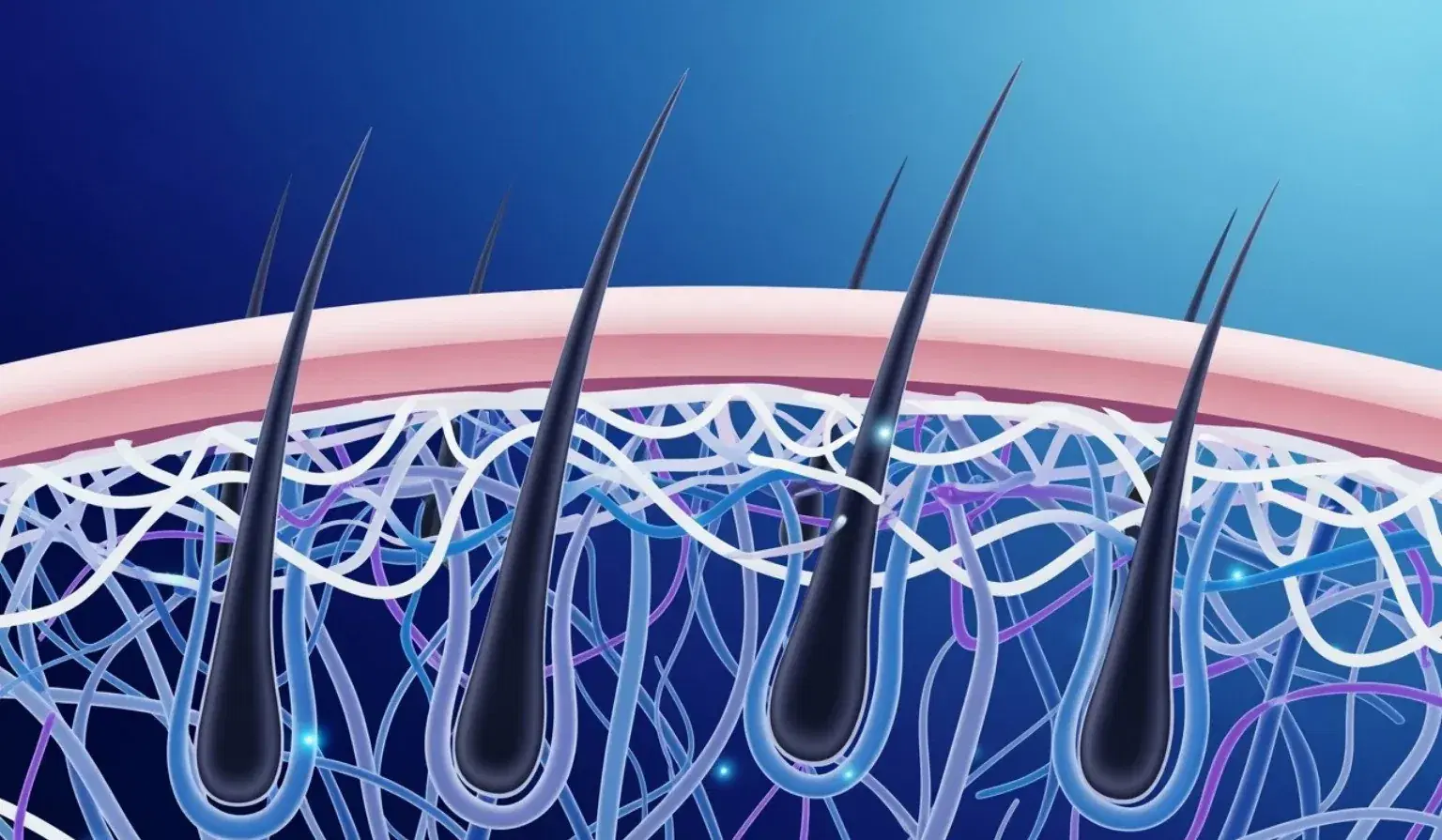
What Are Lab-Grown Hair Follicles?
Lab-grown hair follicles are experimental follicle-like structures created from cultured cells using regenerative medicine, stem-cell biology, tissue engineering, or organoid technology. Researchers aim to reproduce the complex epithelial and mesenchymal interactions that naturally create a functioning hair follicle.
A follicle is much more than a tube that produces a hair shaft. It contains specialized cells, signaling networks, stem-cell niches, supporting tissue, glands, and structures that regulate repeated growth cycles.
The ultimate goal is to create new functional follicles outside the scalp and implant them into areas where usable follicles no longer exist.
Can Lab-Grown Hair Follicles Really Treat Hair Loss?
Lab-grown follicles could eventually become a genuine hair loss treatment, but they remain experimental and are not currently an established human therapy. Researchers have demonstrated increasingly sophisticated follicle regeneration in laboratory and animal models, yet routine human treatment still requires further development.
A clinically useful follicle must survive implantation, connect with surrounding tissue, produce visible hair, and continue normal growth cycles for years.
Scientists must also reproduce these results safely and consistently across thousands of follicles. Until human studies establish those capabilities, laboratory follicle regeneration remains promising research rather than an alternative to existing treatment.
Have Scientists Already Grown Hair Follicles in a Laboratory?
Scientists have successfully created hair-bearing follicle structures in laboratory models, including organoids developed from pluripotent stem cells and bioengineered follicle systems. Human stem-cell-derived skin organoids can form pigmented hair follicles alongside skin layers, sebaceous glands, and sensory structures.
More recent work has improved researchers ability to reproduce important aspects of follicle development, maturation, and growth cycles. A 2026 experimental model regenerated functional follicles using several interacting adult follicular cell populations.
These achievements prove that follicle formation can be engineered experimentally. They do not yet prove that thousands of clinically reliable human scalp follicles can be manufactured.
Can Lab-Grown Hair Follicles Produce Real Hair?
Experimental lab-grown follicles can produce hair shafts, but producing hair experimentally is different from creating a reliable human hair restoration treatment. Researchers have generated follicle structures capable of hair production in organoid systems and transplantation models.
A useful clinical follicle must do considerably more than produce one visible shaft. It needs to establish itself in adult scalp tissue and repeatedly enter growth, regression, resting, and renewal phases.
The regenerated hair must also maintain appropriate thickness, direction, pigmentation, and texture. Long-term survival and repeated cycling in humans remain essential unanswered clinical questions.
What Is a Hair Follicle Organoid?
A hair follicle organoid is a three-dimensional laboratory model containing cells arranged to reproduce important structural and biological features of natural hair follicles. Unlike simple cell cultures, organoids allow different cell populations to communicate within an organized tissue-like environment.
Modern hair organoids can reproduce parts of follicle formation, growth signaling, pigmentation, and interactions between epidermal and dermal cells. They have become valuable tools for studying hair biology and testing experimental treatments.
Some organoids also produce visible hair-like shafts. However, a research organoid does not automatically function as a transplantable replacement follicle suitable for human scalp restoration.
How Are Stem Cells Used to Grow Hair Follicles?
Stem cells help researchers recreate the epithelial and mesenchymal cell populations that communicate during natural hair follicle development. Pluripotent stem cells can develop into several skin-related cell types, allowing complex hair-bearing skin organoids to form under controlled laboratory conditions.
Another strategy starts with adult cells collected from existing follicles. Researchers can isolate specialized epithelial cells, dermal papilla cells, and supportive populations before expanding or reorganizing them into follicle-forming structures.
The challenge involves preserving their hair-inductive properties during laboratory expansion. Cells can lose important biological behavior after repeated culture, making reliable large-scale follicle production difficult.
Could Lab-Grown Follicles Solve the Donor Hair Problem?
Lab-grown follicles could theoretically reduce the donor limitation that currently restricts conventional hair transplantation. Standard transplantation redistributes existing follicles from permanent donor areas, meaning every patient has a finite supply.
Regenerative treatment aims to generate additional follicular units rather than simply move the original ones. If researchers can expand a small cell sample into thousands of functional follicles, advanced hair loss could become easier to address.
This possibility represents one of the strongest reasons for developing follicle regeneration. However, researchers still need reliable human follicle manufacturing before donor limitation can genuinely become less important in clinical treatment.
Could Lab-Grown Hair Follicles Treat Male Pattern Baldness?
Lab-grown follicles could potentially treat male pattern baldness by adding newly generated follicles to areas where androgen-sensitive follicles have miniaturized or disappeared. The concept could be especially valuable for people who lack sufficient donor reserves for traditional transplantation.
New follicles would still need biological characteristics that support long-term growth after implantation. Researchers would therefore need to understand how regenerated follicles respond to androgen signaling within a scalp affected by androgenetic alopecia.
Current regenerative programs are investigating follicle formation for conditions including androgenetic hair loss, but clinical effectiveness in humans has not yet been established.
Could Lab-Grown Hair Follicles Treat Female Pattern Hair Loss?
Lab-grown follicles could eventually offer an option for female pattern hair loss if regenerated follicles can survive and maintain stable growth within areas of diffuse thinning. This approach could be particularly useful when traditional donor harvesting provides limited opportunities.
Female pattern loss often involves widespread miniaturization rather than one completely bald region. A regenerative technique would therefore need precise placement without unnecessarily damaging existing follicles.
Researchers are also exploring cell-based approaches intended to improve the follicular environment alongside new follicle formation. These concepts remain experimental, and controlled human evidence will be necessary before they can become routine treatment.
Could Lab-Grown Follicles Help With Scarring Alopecia?
Lab-grown follicles could theoretically help selected forms of permanent hair loss, but scarring alopecia presents challenges beyond simply replacing missing follicles. Scarred scalp tissue can have altered blood supply, fibrosis, inflammation, and damaged follicular support structures.
A new follicle would need a suitable environment that allows integration and continued growth. Active inflammatory scarring disease could also threaten newly implanted follicles just as it damaged the original ones.
For this reason, follicle regeneration alone may not solve every scarring condition. Research into organoids remains important because permanent follicle destruction represents one major reason scientists want to create entirely new follicles.
Is Lab-Grown Hair the Same as Hair Cloning?
Lab-grown hair and hair cloning describe overlapping ideas, but the scientific strategies can differ substantially. Traditional hair cloning usually suggests multiplying follicle-producing cells so that a limited donor sample can generate much more hair.
Modern regenerative research includes broader approaches such as organoids, induced pluripotent stem cells, bioengineered follicle germs, three-dimensional tissue culture, and bioprinting.
Some methods attempt to reconstruct an entire follicle, while others try to restore hair-inducing capacity to cultured cells. The public term hair cloning therefore simplifies several distinct technologies that scientists are developing through different biological and engineering approaches.
Would Lab-Grown Follicles Need to Be Transplanted Into the Scalp?
Most regenerative follicle concepts would require newly created follicular structures or follicle-forming cells to be introduced into the scalp. Producing a follicle in a laboratory does not automatically position it at the correct depth, angle, and direction in human skin.
Successful implantation would need the regenerated structure to connect with surrounding tissue and establish a functional biological niche. Blood supply and communication with nearby cells would also influence survival.
Some experimental delivery systems are exploring engineered scaffolds and microneedle technologies, but these remain research methods. A future clinical procedure could therefore resemble transplantation while using manufactured rather than harvested follicles.
Can Lab-Grown Follicles Produce Natural Hair Cycles?
Experimental bioengineered follicles have demonstrated hair-cycle behavior in preclinical models, which represents an important step toward genuine follicle regeneration. A 2026 study reported regenerated follicles with growth-phase entry, structural maturation, and hair-cycle functions in experimental systems.
Repeated cycling matters because a follicle that produces one hair and then stops would offer limited clinical value. Natural follicles continuously alternate between growth, regression, rest, and renewed growth.
Researchers still need to establish whether manufactured human follicles can maintain reliable cycles for years after scalp implantation. Long-term human behavior remains more important than short experimental hair production.
Could Scientists Control Hair Direction, Thickness, and Texture?
Scientists may eventually influence hair direction, thickness, and other characteristics, but reliable control remains an important engineering challenge. Natural hair appearance depends on follicle geometry, implantation angle, dermal papilla behavior, genetics, and surrounding tissue.
A regenerated follicle placed at the wrong angle could produce healthy hair that still looks cosmetically unnatural. Thickness and texture must also match neighboring hairs, especially around the frontal hairline.
Pigmentation adds another layer of complexity because hair color depends on interactions involving melanocytes and follicular cycling. Creating follicles is therefore only one part of recreating natural-looking scalp hair.
What Are the Main Challenges With Lab-Grown Hair Follicles?
The biggest challenges involve creating mature follicles consistently, producing them at scale, integrating them into adult scalp tissue, and proving long-term safety and cycling.
Important barriers include:
Maintaining hair-inductive cell behavior during expansion
Reproducing complete follicle architecture
Establishing reliable blood supply after implantation
Supporting nerve and tissue integration
Controlling hair direction and depth
Maintaining repeated hair cycles
Producing thousands of uniform follicles
Preventing abnormal cell growth
Demonstrating long-term human safety
Recent reviews continue to identify vascular integration, neural integration, maturation, and hair-cycle control as major barriers separating laboratory success from routine clinical regeneration.
Are Lab-Grown Hair Follicles Safe?
The safety of lab-grown follicles cannot yet be considered established for routine human hair restoration because large-scale clinical evidence does not exist. Researchers must evaluate both the cells used to create follicles and the behavior of the final regenerated tissue.
A future therapy would need to demonstrate genetic stability, predictable differentiation, controlled growth, sterile manufacturing, and reliable tissue integration. Long-term surveillance would also need to confirm that implanted cells do not behave abnormally.
Animal and laboratory results can identify important risks but cannot replace human safety studies. Safety evaluation therefore represents a necessary stage before regenerative follicles could become a commercial treatment.
Could Lab-Grown Follicles Cause Tumors?
Tumor risk is an important consideration when regenerative follicle technology uses pluripotent stem cells because these cells can form many tissue types and require tightly controlled differentiation. Researchers must ensure that undifferentiated cells do not remain in the final implant.
Adult follicle-derived cell strategies may involve different risks, but they still require careful assessment for genetic changes and uncontrolled growth during cell expansion.
Manufacturing standards would need to confirm cell identity and stability before implantation. The possibility of abnormal growth does not mean regenerative hair treatment will necessarily cause tumors, but proving acceptable long-term safety remains essential.
Would the Immune System Reject Lab-Grown Hair Follicles?
Immune rejection may be reduced when regenerated follicles come from the patient’s own cells, but immune compatibility still requires careful study. Autologous cells generally offer a biological advantage because the immune system recognizes their genetic background.
However, laboratory manipulation can change cell behavior, and engineered tissue contains multiple interacting cell populations. A treatment derived from donor cells would introduce additional compatibility challenges.
Researchers must also understand local inflammation in the scalp because immune activity can affect follicle survival even without classic transplant rejection. Creating personalized follicles may therefore simplify compatibility but does not eliminate every immunological concern.
How Difficult Would It Be to Produce Thousands of Follicles?
Producing thousands of clinically consistent follicles is substantially harder than generating a small number of successful structures in an experimental setting. Hair restoration requires scale because moderate or advanced baldness can involve thousands of missing follicular units.
Each manufactured follicle would need reliable structure, viability, orientation, hair-producing capacity, and long-term cycling. Production would also need to meet strict standards for sterility and reproducibility.
Laboratory protocols that work manually on small samples may become impractical at clinical scale. Automation, tissue engineering, standardized cell expansion, and quality-control systems will therefore play major roles in making regenerative follicle treatment practical.
When Could Lab-Grown Hair Follicles Become Available?
No reliable date can currently be given for routine lab-grown hair follicle treatment because the technology has not yet completed the human clinical validation required for standard use. Current research includes advanced organoid systems, preclinical follicle regeneration, human-cell development, and preparation for future clinical research.
The remaining steps include reliable human follicle production, transplantation studies, safety assessment, controlled clinical trials, manufacturing development, and regulatory review.
Progress during 2025 and 2026 has strengthened the scientific foundation, but laboratory success should not be confused with an available treatment. The field is moving forward, yet major translational questions remain unresolved.