
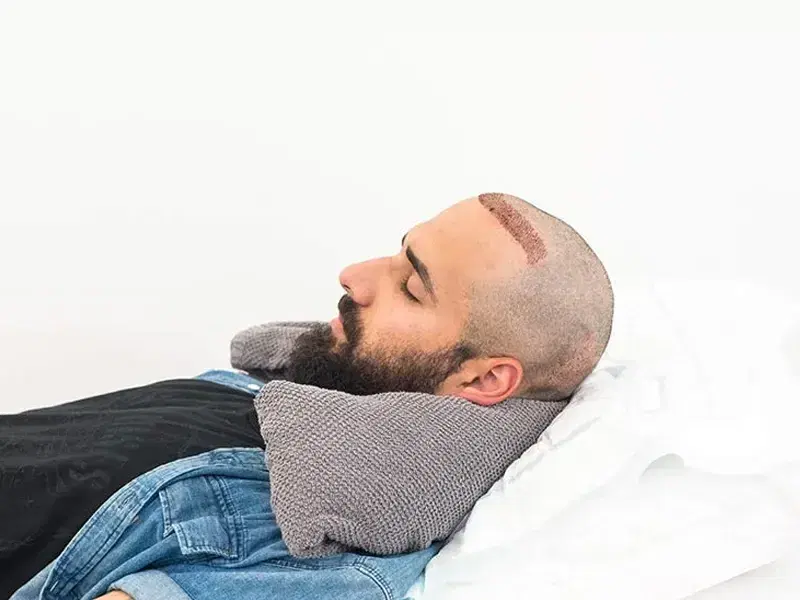
Can You Accidentally Dislodge Hair Grafts While Sleeping?
Newly transplanted hair grafts can become dislodged during sleep if the recipient area experiences significant rubbing, pulling or direct impact before the follicles have securely settled into the scalp. The greatest concern involves the initial postoperative period, particularly the first 48 hours, when the surrounding tissues have only begun forming the connections that stabilize each graft.
However, ordinary movements during sleep do not automatically cause graft loss. Turning the shoulders, adjusting a pillow or briefly moving the head does not necessarily create enough force to remove a follicle.
The important distinction is between movement and direct mechanical trauma. A pillowcase that catches on a fresh scab or prolonged pressure against the recipient area presents a greater concern than simply changing position during the night.
Creating a comfortable sleeping arrangement reduces these risks without requiring patients to remain completely motionless until morning.
Why Are Newly Transplanted Grafts Vulnerable at Night?
During hair transplantation, individual follicular units are inserted into small openings created in the recipient area. Immediately after placement, the grafts rely on their position within these openings and the early wound-healing process for stability.
The surrounding tissues gradually develop stronger connections around the implanted follicles. Until this process progresses, substantial friction or pulling can interfere with their attachment.
Sleeping creates a particular challenge because people naturally move without being fully aware of their surroundings. Someone accustomed to sleeping face down may unconsciously turn toward the pillow, bringing the newly transplanted hairline into contact with the bedding.
The recipient area can also remain numb or less sensitive following the procedure, making it harder to notice pressure immediately.
These circumstances explain why nighttime precautions focus on preventing direct contact rather than eliminating every movement. A stable sleeping position and suitable support help protect the scalp while allowing the body to rest.
When Do Hair Grafts Become Secure in the Scalp?
Hair grafts become progressively more resistant to displacement as the recipient sites heal and the surrounding tissue secures the transplanted follicles.
During the first two days, forceful pulling presents a particularly significant risk because the grafts have not yet developed strong tissue attachment. Their stability improves over the following days, although crusts attached to the healing sites can remain vulnerable to accidental removal.
Research examining graft anchoring has shown that follicles become considerably more resistant to mechanical displacement during the first week, with strong anchoring demonstrated around the ninth postoperative day.
This finding does not mean patients should begin rubbing or scratching their scalp once a particular date arrives. Surface healing, remaining crusts and scalp sensitivity still require attention.
For a practical understanding of the first 10 days after hair transplantation, it helps to recognize that graft stabilization and complete scalp recovery are related but separate processes.
Which Sleeping Positions Best Protect Newly Transplanted Grafts?
The most suitable sleeping arrangement keeps the recipient area away from direct pressure while supporting a comfortable, stable position throughout the night.
Sleeping on your back: This position generally makes it easier to protect a newly transplanted frontal hairline because the face and forehead remain away from the pillow. The head should rest comfortably without placing pressure on grafts located farther back on the scalp.
Keeping the upper body slightly elevated: A supportive wedge or carefully arranged pillows can help maintain a gentle incline during the first nights. This positioning may also reduce postoperative swelling around the forehead.
Avoiding stomach sleeping: Lying face down increases the possibility of rubbing the frontal hairline or temples against bedding, particularly when the head turns sideways during sleep.
Limiting pressure on transplanted crown areas: When grafts have been placed on the crown, the sleeping arrangement must keep that region from pressing directly against the pillow. Support should remain beneath unaffected areas without compressing the recipient sites.
How Can You Prevent Pillow Friction and Accidental Contact?
A carefully prepared sleeping environment can reduce unexpected contact with newly transplanted grafts and make the first postoperative nights more manageable.
Use a stable pillow arrangement: A wedge pillow or supportive cushions can help maintain the upper body in a comfortable position. Avoid unstable stacks of soft pillows that allow the head to slide sideways during sleep.
Consider a U-shaped neck pillow: A travel-style pillow can support the neck and limit excessive head movement, particularly when the transplant involves the frontal hairline. Position it so that no part presses against recipient sites.
Keep bedding clean and smooth: Fresh pillowcases and soft, uncomplicated fabrics reduce unnecessary irritation. Avoid decorative textures, loose threads and rough materials that could catch against healing crusts.
Remove potential sources of accidental contact: Keep blankets away from the transplanted hairline and consider preventing pets from sleeping near the head during the earliest recovery period.
What Happens If You Roll Onto Your Side or Stomach?
Waking up in an unintended sleeping position can be unsettling, especially when the procedure took place only a day or two earlier. However, discovering that you turned onto your side does not establish that any grafts were displaced.
The actual concern depends on whether the transplanted region experienced direct pressure, significant rubbing or an impact against the pillow.
If you wake in an uncomfortable position, gently return to the recommended arrangement without touching or inspecting individual follicles. Avoid pulling at hairs to check whether they remain secure.
When there is no new bleeding, significant pain or visible injury, the change in position alone does not provide evidence of graft loss.
A recurring tendency to roll over may indicate that the pillow arrangement needs improvement. Supporting the shoulders and upper body more consistently can make it easier to remain comfortable without excessive movement.
Can a Pillow Pull Out Hair Grafts?
A pillow can contribute to graft displacement during the early healing period if its fabric catches on a fresh scab or creates enough friction to disturb a recipient site. The possibility is greatest when the transplanted area rests directly against the material.
Ordinary contact with bedding does not always produce this outcome. The amount of force matters, and a light accidental brush differs considerably from dragging the scalp across a pillowcase.
Dried blood or crusts may occasionally adhere to fabric, making sudden movements more concerning. Pulling the head away forcefully could place tension on the healing area.
A clean, smooth pillowcase helps reduce friction, but it cannot compensate for a sleeping position that puts sustained pressure on transplanted follicles.
The most effective protection comes from arranging the head and upper body so that the recipient area remains clear of the bedding rather than relying solely on the material used.
Does Sleeping Elevated Help After Hair Transplant Surgery?
Sleeping with the upper body slightly elevated is commonly recommended during early hair transplant recovery because it can help manage swelling and make it easier to maintain a controlled position.
Postoperative swelling may develop around the forehead and occasionally move toward the upper face during the first days. Elevation can support more comfortable fluid drainage and reduce the amount of time spent lying completely flat.
A gentle incline of approximately 30 to 45 degrees is often used during the initial period, although the position should remain comfortable enough to maintain through the night.
Stacking several unstable pillows beneath the head alone may bend the neck excessively or allow the body to slide downward. A wedge supporting the upper back and shoulders usually provides a more stable arrangement.
Patients should avoid creating such an upright position that sleep becomes difficult. Comfortable rest and effective graft protection should work together rather than compete with one another.
Do FUE and FUT Require Different Sleeping Precautions?
FUE and FUT create different wounds in the donor area, which can influence comfort during sleep. However, both techniques require careful protection of the transplanted recipient sites during the initial healing period.
FUE involves extracting individual follicular units, leaving numerous small wounds across the donor region. When the back of the head rests against a pillow, these areas may feel tender or sensitive.
FUT removes a strip of hair-bearing scalp and closes the incision, creating a linear wound that may produce additional tightness along the back of the head.
Regardless of the extraction technique, patients must avoid pressure on the newly implanted grafts. Supporting the head without placing excessive weight on healing donor tissue can improve comfort.
The main sleeping precautions therefore remain similar, while the arrangement of pillows may need to accommodate the location of the treated regions.
How Long Should You Use a Neck Pillow After a Hair Transplant?
A neck pillow can be particularly helpful during the first several nights because it limits broad sideways movements and reduces the need to reposition the head repeatedly.
Many patients use this support during the first week, when newly implanted grafts are more vulnerable to friction. Continuing to use it for approximately 7 to 10 days may be practical when the scalp remains sensitive or the usual sleeping position would create direct contact with recipient sites.
The pillow itself does not make the grafts heal faster. Its purpose is to provide a more controlled sleeping environment while natural tissue attachment develops.
A neck pillow should also fit comfortably. Models that push the head forward, compress the donor region or create neck discomfort may be less useful than a well-supported wedge arrangement.
Patients can gradually stop using additional support after the early restrictions have ended and the scalp can remain free from direct pressure during ordinary sleep.
Is Blood or a Hair on the Pillow a Sign of Graft Loss?
Finding a small amount of dried blood on bedding after a hair transplant does not necessarily indicate that a follicle has been dislodged. Minor postoperative fluid leakage or bleeding from the donor area can occur during the earliest stages of recovery.
Similarly, discovering a hair shaft on the pillow does not prove that an entire graft has been removed. A hair shaft and a transplanted follicular unit are not the same structure.
A genuinely displaced graft may include tissue attached to one or more hairs, and fresh bleeding from the recipient site can raise concern about possible displacement. However, patients cannot reliably determine whether a viable follicle has been lost simply by examining a small fragment.
Avoid pulling additional hairs or manipulating crusts to investigate.
If the recipient area develops fresh bleeding after significant contact, or visible tissue appears to have detached, seek postoperative assessment rather than attempting to identify the material yourself.
What Should You Do If You Suspect a Graft Was Dislodged?
Suspected graft displacement requires a calm response focused on protecting the area from further injury and obtaining appropriate assessment.
Avoid touching the affected area: Do not pull surrounding hairs, scrape away crusts or press the scalp to check whether the graft remains attached. Further manipulation can irritate nearby healing sites.
Assess visible symptoms without disturbing the scalp: Look for fresh bleeding, unusual tenderness or an obvious change in the recipient area. A photograph taken under good lighting can help document what happened without repeated physical inspection.
Do not attempt to reinsert a detached graft: A follicular unit that has come out should not be pushed back into the scalp at home because improper handling may damage tissue or introduce contamination.
Contact the surgical team promptly: Explain when the incident occurred, whether the scalp rubbed against bedding and whether bleeding or visible tissue loss followed. Persistent bleeding, substantial pain or significant trauma requires urgent medical assessment.
Can Scratching Your Head While Asleep Damage Grafts?
Itching commonly develops during hair transplant recovery as the scalp repairs the small surgical openings and crusts begin forming around the implanted follicles. Although the sensation is usually temporary, scratching during sleep can create unwanted mechanical stress.
A fingernail may catch against a scab or disturb delicate tissue, particularly during the first several days when the grafts remain vulnerable.
Patients who notice itching should avoid attempting to remove crusts before bedtime. Gentle cleansing, once permitted, and the use of approved postoperative products can help maintain scalp comfort.
Keeping fingernails short may reduce the severity of accidental scratching, although it cannot eliminate the possibility entirely.
If itching becomes intense enough to repeatedly interrupt sleep, medical guidance can help identify appropriate ways to relieve it without damaging healing skin.
The objective is to manage discomfort while allowing crusts to separate naturally instead of treating them as something that must be removed immediately.
What Should You Avoid Before Bed During Early Recovery?
Bedtime routines can influence how comfortably patients sleep and how effectively newly implanted follicles remain protected. Clothing, medications and the surrounding environment all deserve attention during the first days.
Tight garments that must be pulled over the head can rub against the recipient area when changing before bed. Button-up shirts and loose clothing offer a simpler alternative that reduces direct contact.
Patients should also avoid applying ordinary oils, creams or styling products to healing grafts unless those products are included in the postoperative care instructions.
Alcohol and unapproved sleep medication are unsuitable ways to manage anxiety about nighttime movement. Excessive sedation may reduce awareness of uncomfortable positions and interfere with postoperative medication safety.
A comfortable room temperature and a consistent evening routine can make sleeping easier without adding unnecessary products or medications.
How Does the Scalp Change During the First 10 Nights?
The first 10 nights after hair transplantation involve gradual changes in scalp sensitivity, graft stability and visible healing.
During the first two nights, newly implanted grafts are especially sensitive to direct pressure and mechanical pulling. Redness, mild tenderness and small amounts of postoperative fluid may also be present.
Between the third and fifth nights, crust formation becomes more apparent while the surrounding tissues continue healing. Swelling may begin improving, although discomfort can persist around the donor area.
By the end of the first week, many patients notice that sleeping becomes easier and the scalp feels less sensitive. However, attached crusts still require gentle handling, and rubbing them against bedding remains undesirable.
Around days eight to ten, graft anchoring has usually progressed substantially, making accidental displacement increasingly unlikely under ordinary circumstances.
The broader recovery continues beyond this stage, but the need for highly restrictive sleeping precautions gradually diminishes as healing progresses.
When Can You Return to Your Normal Sleeping Position?
Returning to normal sleeping habits generally becomes easier once the first 7 to 10 days have passed and the transplanted follicles are more securely anchored. However, remaining crusts, tenderness or direct pressure on treated areas may justify continuing a protective arrangement somewhat longer.
Patients who normally sleep on their backs often find the transition straightforward because their preferred position already minimizes contact with the frontal hairline.
Side sleepers may need more time if grafts were placed around the temples, while stomach sleepers should avoid positions that press the forehead directly into bedding until the initial healing restrictions have ended.
The location of the recipient area is especially relevant when deciding whether a familiar pillow arrangement is suitable.
For additional practical guidance, the article on how to sleep after a hair transplant explains supportive positioning, pillow selection and the gradual return to ordinary sleeping habits.
Does One Bad Night Affect the Final Hair Transplant Result?
A single uncomfortable night does not automatically compromise a hair transplant. Temporary changes in sleeping position, interrupted rest or a brief accidental touch should not be interpreted as evidence that multiple grafts have been lost.
The meaningful concern involves actual injury to newly implanted follicles rather than the amount of movement experienced during sleep.
If a graft is physically dislodged before it has secured itself, that individual follicular unit may be lost. However, an isolated incident does not necessarily affect the larger number of grafts that remain undisturbed.
Patients should also distinguish early mechanical graft loss from the temporary shedding that commonly develops in the following weeks. Hair shafts can fall out while the follicles remain beneath the skin and continue toward a new growth cycle.
The best approach is to maintain sensible nighttime precautions, obtain adequate rest and seek assessment when bleeding or visible injury suggests a genuine problem.
Final Thoughts on Protecting Hair Grafts While Sleeping
Accidentally dislodging hair grafts while sleeping is possible during the earliest stage of recovery, particularly when the recipient area experiences strong friction, pressure or direct impact. The first several days require the greatest care because the transplanted follicles are still becoming securely attached to the surrounding tissue.
Sleeping in a supported position, keeping the recipient area away from bedding and using comfortable pillows can reduce the likelihood of accidental contact. As graft stability improves during the first 7 to 10 days, ordinary sleeping habits generally become easier to resume.
Protecting newly transplanted hair does not require remaining motionless throughout the night. A stable sleeping environment, appropriate aftercare and a clear understanding of normal healing changes allow patients to rest without unnecessary concern while the scalp continues recovering.