
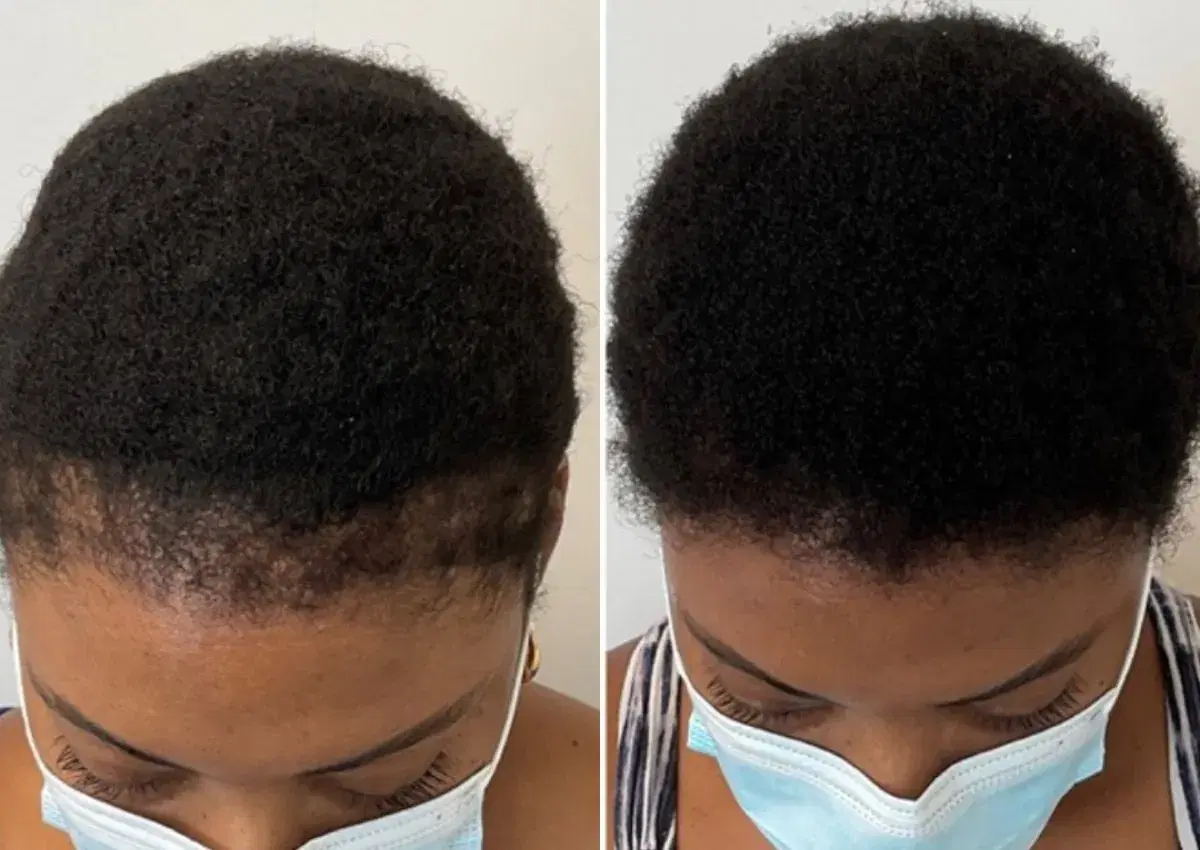
What Is Long Hair FUE for Afro-Textured Hair?
Long Hair FUE is a variation of Follicular Unit Extraction in which individual follicular units are removed while their existing hair shafts remain long. The extracted grafts are then transferred into thinning or bald areas without requiring conventional shaving of the entire scalp.
For Afro-textured hair, the procedure must account for both the visible curl pattern and the shape of the follicle beneath the skin.
The main attraction is the ability to preserve much of the existing hairstyle during treatment. However, retaining long hair does not change the biological principles of transplantation or create additional donor follicles.
It changes the surgical approach rather than the source of hair growth.
Can Afro-Textured Hair Be Transplanted Without Shaving?
Afro-textured hair can be transplanted without a complete head shave when the donor follicles can be harvested safely and the required graft number is manageable.
Tightly curled or coiled strands do not automatically prevent transplantation. The difficulty arises when the follicle curves beneath the scalp, making it harder to release intact through a small extraction opening.
Preserving the hair at full length adds another layer of complexity because the surrounding strands can obstruct visibility.
Some procedures retain every hair shaft, while others use small, concealed trimmed sections to make extraction more practical.
The distinction matters because a no-shave appearance does not necessarily mean that no hair has been cut.
How Is Long Hair FUE Different From Conventional FUE?
Conventional FUE commonly involves trimming the donor hair to improve visibility during graft extraction. Shorter hair allows the surgical field to remain relatively clear as individual follicular units are isolated.
Long Hair FUE preserves the hair shafts attached to the harvested grafts. These strands provide immediate visual information about their natural direction, length and curl.
However, longer hair can become tangled, restrict access to the scalp and make graft handling more time-consuming.
The underlying transplantation principle remains unchanged: follicles are removed from a donor region and transferred to a recipient area.
Long Hair FUE does not automatically provide better graft survival or greater density. Its primary distinction is the preservation of existing hair length during surgery.
Is Long Hair FUE the Same as an Unshaven Hair Transplant?
The terms Long Hair FUE and unshaven hair transplant are sometimes used interchangeably, but they can describe different preparation methods.
In true Long Hair FUE, the harvested follicular units retain their long hair shafts throughout extraction and placement.
An unshaven procedure may instead preserve the surrounding hairstyle while trimming individual donor sections or shortening selected hairs before harvesting.
Partial-shave FUE follows another approach, using concealed trimmed areas beneath longer hair.
These differences affect visibility, operating time and the number of grafts that can be processed efficiently.
Why Are Afro-Textured Hair Follicles More Challenging to Extract?
Many tightly curled hair follicles follow a curved or angled path beneath the skin. This means the direction of the visible hair shaft may not accurately reveal the position of the deeper follicular structures.
During FUE, a small punch separates the follicular unit from the surrounding tissue.
If the instrument advances along a path that does not accommodate the hidden curve, it may cut part of the follicle. This injury is known as follicular transection.
Research involving tightly curled Afro-textured hair has documented the limitations of conventional rotary extraction techniques and explored alternative punch designs.
The challenge is anatomical rather than a reflection of hair quality. Appropriate extraction methods must respond to the individual follicle's shape.
What Are the Main Technical Challenges of Long Hair FUE?
Combining tightly curled follicles with long, untrimmed hair creates several technical demands during harvesting and implantation.
Curved follicular paths: The root may bend beneath the scalp, increasing the risk of transection when the extraction instrument does not follow its anatomy.
Restricted visibility: Long curls and densely packed strands can obscure follicular openings and make precise instrument positioning more difficult.
More demanding graft handling: Long hair shafts can tangle during extraction, inspection and implantation, requiring additional care to avoid pulling or crushing the grafts.
Longer operating time: Separating hair, harvesting individual units and controlling their orientation can slow the procedure, making extensive sessions less practical.
Does the Visible Curl Pattern Reveal the Shape of the Hair Follicle?
The appearance of the hair above the scalp provides useful information about texture, but it cannot fully describe the shape of the follicle beneath the skin.
Two people with similarly tight coils may have different follicular angles, depths and degrees of curvature.
Even within the same scalp, individual follicular units can follow slightly different paths.
This matters because FUE extraction depends on separating the complete follicle without damaging structures hidden below the surface.
A visible hair strand that initially appears to emerge at one angle may belong to a follicle that curves more sharply at a deeper level.
For this reason, curl classification alone cannot determine which extraction instrument or technique will be most effective.
How Are Curved Follicles Extracted Without Damaging Them?
Extracting curved follicles requires an approach that respects the three-dimensional shape of the follicular unit.
The instrument must release the follicle from surrounding tissue while limiting unnecessary contact with deeper curved structures.
Different punch designs, controlled insertion depths and modified movements may help reduce transection in tightly curled hair.
Research has investigated curved, non-rotary extraction instruments as an alternative to conventional approaches for selected Afro-textured follicles.
After extraction, the grafts must be inspected and protected from dehydration, crushing and excessive manipulation.
The central objective is preserving complete, viable follicular units rather than simply removing them quickly.
Does Keeping the Hair Long Affect Graft Survival?
Preserving a long hair shaft does not inherently make the transplanted follicle stronger or more likely to survive.
Graft survival depends on maintaining the integrity of the follicular structures during extraction, storage and implantation.
The long shaft can provide useful visual guidance, particularly when establishing the direction of a curl.
However, working through untrimmed hair may increase handling demands and operating time. Poor visibility or excessive manipulation could compromise graft quality if those challenges are not adequately addressed.
There is also limited direct evidence comparing the outcomes of true Long Hair FUE specifically in tightly coiled Afro-textured hair against conventional preparation methods.
The technique should therefore be valued for its practical and aesthetic advantages, without assuming superior biological performance.
Can Long Hair FUE Preserve the Existing Hairstyle?
One of the clearest advantages of Long Hair FUE is the possibility of avoiding a dramatic change in hairstyle immediately before surgery.
Existing curls, coils, locs or longer sections of natural hair may provide coverage over some donor extraction sites, although particular hairstyles can create practical access challenges.
Preserving length can be especially important when the hair has taken considerable time to grow or when shaving would substantially alter a familiar appearance.
However, the scalp still undergoes a surgical procedure.
Redness, small crusts, temporary swelling and localized shedding may remain visible, particularly near the frontal hairline.
Keeping hair long can make early changes less noticeable, but it does not guarantee that the procedure will be completely concealed.
Who Is a Suitable Candidate for Long Hair FUE?
Suitability depends on follicular anatomy, available donor hair, the cause of hair loss and the amount of restoration required.
Stable donor hair: The back and sides of the scalp should contain enough healthy follicles to support harvesting without creating excessive donor thinning.
A defined treatment area: Smaller hairline defects or localized thinning may be more manageable than extensive hair loss requiring a large graft session.
A controlled hair-loss condition: Active infection or inflammatory scarring disease should be investigated and managed before elective transplantation.
Realistic expectations about shaving: Preserving every hair shaft may not always be practical, particularly when tightly curved follicles require greater access and visibility.
Can Long Hair FUE Restore a Receding Hairline?
Long Hair FUE may be considered for a receding hairline when the hair-loss pattern is sufficiently stable and adequate donor follicles are available.
The frontal hairline requires careful planning because small differences in angle, spacing and curl direction can strongly affect the final appearance.
Afro-textured hairlines should not automatically be designed as perfectly straight or unusually dense borders.
Natural hairlines often contain subtle irregularities and gradual transitions that prevent an artificial edge.
Long Hair FUE allows the existing hairstyle to remain largely intact during treatment, but the eventual result still depends on viable grafts establishing growth.
The goal should be balanced framing of the face rather than maximum follicular density along a single line.
Can It Treat Hair Loss Around the Edges From Traction Alopecia?
Traction alopecia occurs when prolonged pulling places excessive tension on hair follicles, commonly affecting the temples and frontal edges.
Tight braids, extensions and other high-tension hairstyles may contribute to this condition.
Early traction-related thinning can sometimes improve when the pulling stops and the follicles remain healthy.
Long-standing traction alopecia may cause permanent follicular loss, creating defined areas that could be considered for transplantation once the condition is stable.
However, surgery should not proceed while damaging tension continues.
Transplanted follicles can also be affected by repeated pulling, making future hairstyle choices an important part of preserving the result.
Long Hair FUE offers a potential restoration technique, not a solution to ongoing traction.
Is Long Hair FUE Suitable for Central Centrifugal Cicatricial Alopecia?
Central centrifugal cicatricial alopecia, or CCCA, is a scarring hair-loss condition that frequently begins around the crown and progresses outward.
It is particularly relevant when evaluating hair loss in people of African descent, although it cannot be diagnosed from ethnicity or hair texture alone.
Active CCCA can permanently destroy follicles through inflammation.
Transplantation into an actively inflamed scalp may place new grafts at risk and fail to control continued hair loss.
Selected individuals with long-standing, clinically inactive disease may be considered for surgical restoration after thorough assessment.
However, preserving existing follicles and controlling inflammation take priority over transplant technique.
A no-shave procedure does not eliminate the risks associated with scarring alopecia.
How Is Donor Hair Density Evaluated?
Donor assessment determines how many follicular units can be removed while preserving sufficient natural coverage across the back and sides of the scalp.
The evaluation considers follicular density, hair shaft thickness, the number of hairs within each unit and possible miniaturization.
Curl pattern also influences the visual appearance of density.
Coiled hair can cover a relatively large area because curved strands overlap, but this does not mean the donor region contains unlimited grafts.
Previous transplantation, scarring and ongoing hair loss can further reduce the available supply.
The objective is to preserve enough donor hair for a balanced appearance after harvesting and potential future treatment needs.
How Many Grafts Can Be Transplanted Without Shaving?
Long Hair FUE does not have a universal graft limit that applies to every Afro-textured scalp.
The practical number depends on donor availability, follicular curvature, existing hair length and the amount of time needed to harvest intact grafts.
Small, localized treatment areas may be more suitable for a fully long-hair approach than extensive thinning across the front and crown.
Larger procedures may require multiple sessions or a modified shaving strategy to improve surgical access.
A high graft count should not become the main objective when extraction is technically demanding.
Protecting donor density and avoiding unnecessary follicular damage are more important than completing the largest possible session.
How Is a Natural Afro-Textured Hairline Designed?
A natural-looking hairline must reflect facial proportions, existing hair distribution and the way tightly curled hair frames the forehead.
Straight, unusually sharp borders may look artificial when they do not match the surrounding growth pattern.
The leading edge generally benefits from carefully controlled spacing and a gradual transition into denser hair behind it.
The angle at which follicles leave the scalp also matters because newly growing curls will occupy space in several directions.
A design that appears balanced with straight hair may behave differently once tightly coiled strands mature.
Planning should therefore consider the finished hairstyle rather than only the placement of individual grafts.
How Are Curl Direction and Density Managed During Implantation?
Successful implantation requires attention to the angle, direction and spacing of each follicular unit.
Afro-textured hair may curl soon after emerging from the scalp, so the orientation of neighboring grafts affects how the strands interact.
Incorrectly directed grafts can create sections that stand apart from surrounding hair or become difficult to style naturally.
Long hair shafts can provide immediate visual guidance during placement, allowing the developing arrangement to be inspected.
However, the visible temporary result does not prove that the implanted follicles will survive.
Density must also remain compatible with blood supply and the available donor reserve.
Well-planned curl distribution can create convincing coverage without unnecessarily crowding the recipient area.
Can Long Hair FUE Work With 4A, 4B and 4C Hair?
Long Hair FUE may be technically possible across 4A, 4B and 4C hair patterns, but these classifications do not establish surgical suitability by themselves.
They describe visible texture and curl characteristics rather than the complete anatomy of follicles beneath the scalp.
A tightly coiled 4C strand may be associated with substantial follicular curvature, but individual variation remains important.
Likewise, a person with 4A hair may still have follicles that require careful extraction.
The assessment should focus on donor density, scalp health, follicular structure and the extent of hair loss.
Hair texture informs the technique; it should not be used as a substitute for evaluating the actual scalp.
Can DHI Be Combined With Long Hair FUE?
DHI, commonly described as Direct Hair Implantation, refers to the use of an implanter device during the placement stage of hair transplantation.
It does not replace the need to harvest follicular units.
Long Hair FUE can therefore be combined with an implanter-based placement approach when the grafts and recipient area are suitable for that method.
However, long, tightly curled hair may require additional care during graft loading to avoid tangling, bending or damaging the follicles.
Using an implanter does not automatically guarantee better density, graft survival or faster healing.
The important distinction is between how grafts are extracted and how they are inserted into the recipient scalp.
What Happens During the Long Hair FUE Procedure?
The process begins with an assessment of the hair-loss pattern, donor area, follicular characteristics and intended restoration.
The treatment area and hairline are mapped before local anesthesia is administered.
During extraction, existing hair is carefully separated so selected follicular units can be isolated while their shafts remain long.
The harvested grafts are inspected and preserved before implantation.
Recipient sites are prepared according to the planned growth direction, with attention to the way curls will emerge and blend with surrounding hair.
The procedure may take longer than conventional shaved FUE because visibility and graft handling require additional attention.
Afterwards, small wounds remain in the donor and recipient areas, beginning the normal postoperative healing process.
What Is Recovery Like When the Hair Is Not Shaved?
Early recovery follows the same biological principles as other FUE procedures.
Small crusts develop around the transplanted follicles, and the donor area may show pinpoint wounds, redness or tenderness.
Existing hair can conceal some of these changes, but it can also make cleaning the scalp more demanding.
Washing must protect the newly implanted grafts while allowing the scalp to remain clean.
Tight braids, extensions, vigorous combing and hairstyles that pull on healing tissues should be avoided during early recovery.
The recipient area should not be subjected to unnecessary friction or pressure.
Although the hairstyle may look less visibly altered, the grafts still require the same attention and protection as those placed during conventional FUE.
What Are the Risks and Warning Signs?
Long Hair FUE carries the usual risks of hair transplantation, together with technical challenges associated with curved follicles and untrimmed strands.
Follicular transection: Deeply curved follicles can be injured during harvesting if the extraction path does not accommodate their shape, potentially reducing the number of usable grafts.
Donor area thinning: Removing too many units or concentrating extraction in a limited area may produce visible, lasting gaps in the donor region.
Temporary shedding and uneven growth: Shock loss can affect existing hair, while transplanted follicles may begin growing at different times, creating an irregular appearance during recovery.
Postoperative complications: Increasing pain, spreading redness, pus, fever or worsening swelling may indicate infection or another problem requiring prompt medical assessment.
Will Transplanted Afro-Textured Hair Shed After Surgery?
Transplanted hair shafts commonly shed during the first several weeks after surgery, even when the follicles have been successfully placed.
This process is a normal part of the postoperative hair growth cycle and does not necessarily indicate graft failure.
Long Hair FUE may create an immediately fuller appearance because the transplanted shafts are already visible.
However, that initial effect is temporary for many grafts.
After shedding, the follicles enter a period during which little new growth may be visible.
As new strands emerge, they generally retain characteristics associated with their original donor follicles, including their natural curl pattern.
The final appearance develops gradually rather than remaining identical to the immediate postoperative result.
When Do Long Hair FUE Results Become Visible?
The first several weeks are primarily concerned with scalp healing and temporary shedding rather than permanent visible growth.
New transplanted hairs commonly begin emerging around three to four months after surgery, although the timeline is not identical for every follicle.
During the following months, the strands become longer and gradually contribute more coverage.
By approximately nine to twelve months, substantial growth may be visible, while further maturation can continue toward twelve to eighteen months.
Afro-textured hair may appear different during early regrowth because short strands have not yet developed their mature curl arrangement.
The final assessment should consider hairline balance, curl integration and donor appearance rather than density alone.
How Does Long Hair FUE Compare in Cost With Shaved FUE?
Long Hair FUE often involves a higher treatment cost than conventional shaved FUE because preserving long shafts can require more operating time and detailed graft handling.
Tightly curled follicles may add further technical demands during extraction.
However, cost should not be evaluated solely through the number of grafts or the promise of avoiding shaving.
A less expensive procedure that damages a substantial proportion of harvested follicles may compromise the limited donor supply.
Likewise, the most expensive method is not automatically the most suitable.
A meaningful comparison considers the planned restoration, expected graft yield, donor preservation, the shaving approach and the possibility that extensive treatment may require more than one session.
What Can Long Hair FUE Achieve in the Long Term?
Long Hair FUE can offer a way to restore selected areas of hair loss while preserving much of the existing hairstyle during surgery.
For Afro-textured hair, its potential benefits include reduced disruption to the visible hairstyle and useful guidance when arranging long, naturally curled strands.
However, the technique also combines two demanding tasks: harvesting follicles that may curve sharply beneath the skin and working without the visibility provided by conventional shaving.
The long-term outcome depends on viable graft extraction, appropriate donor management, controlled implantation and the stability of the underlying hair-loss condition.
Transplanted follicles can provide lasting growth, but the procedure does not stop future loss of non-transplanted hair or reverse active scarring disease.
The most balanced approach gives priority to follicle preservation and natural hair distribution. Keeping the hair long is valuable when it can be achieved without compromising those essential surgical objectives.