
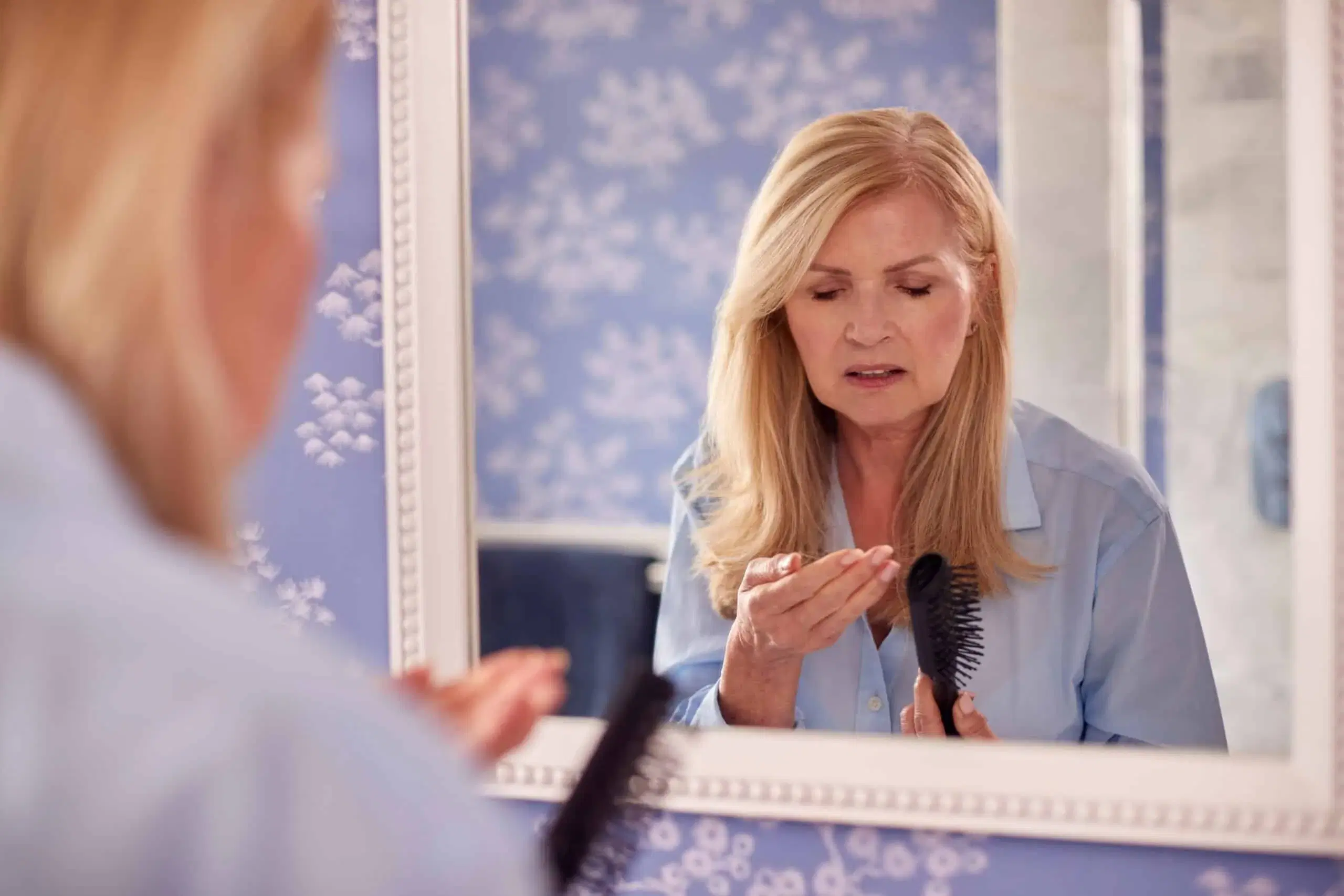
Menopause can contribute to hair thinning in women, but it is rarely the only possible explanation for increased shedding or reduced density. As estrogen and progesterone levels decline, the balance of signals affecting the hair follicle changes, and genetically susceptible women may notice female pattern hair loss becoming more visible. At the same time, stress, iron deficiency, thyroid disease, illness, weight changes and medications can produce similar symptoms. The most useful approach is therefore to identify the pattern of hair loss rather than assuming every change during menopause is hormonal.
Can Menopause Cause Hair Loss?
Menopause can contribute to hair thinning, especially in women who are already genetically predisposed to female pattern hair loss. The change is usually gradual rather than a sudden loss of large amounts of hair.
Falling estrogen levels may alter the balance of signals affecting the hair-growth cycle, while the relative influence of androgens can become more noticeable in susceptible follicles. This does not mean menopause directly destroys hair follicles.
Many women also experience unrelated conditions during the same period, including iron deficiency, thyroid disorders, major stress or illness. These can either cause additional shedding or make pre-existing thinning easier to see.
Why Does Hair Become Thinner During Menopause?
Hair can become thinner during menopause because follicle growth cycles change and some hairs gradually become smaller in diameter. This process is particularly relevant in female pattern hair loss.
Estrogen is involved in several tissues that influence hair growth, and reduced estrogen exposure may shorten or alter the active growth phase in some women. At the same time, genetically sensitive follicles can become more affected by androgen-related signalling.
Age also matters independently of menopause. Individual hairs may become finer, growth may slow and the total number of actively growing follicles can decline.
The result is often less volume rather than complete baldness.
What Types of Hair Loss Are Common During Menopause?
Several different forms of hair loss can appear during the menopausal years. Some are directly related to follicular aging or genetic pattern loss, while others simply become more common at the same age.
Female pattern hair loss is one of the most important causes and usually produces progressive thinning across the central or upper scalp. Telogen effluvium can cause more sudden diffuse shedding after illness, stress, nutritional changes or major weight loss.
Alopecia areata can develop at any age, while inflammatory and scarring alopecias may also appear in midlife or later.
Correct diagnosis matters because these conditions require very different treatment strategies.
What Causes Hair Loss Around Menopause?
Hair loss around menopause can result from hormonal changes, genetic susceptibility or completely separate medical factors.
Common causes include:
Female pattern hair loss
Age-related reduction in hair density
Menopausal hormonal changes
Telogen effluvium after stress or illness
Iron deficiency
Thyroid dysfunction
Significant calorie or protein restriction
Major weight loss
Certain medications
Chronic scalp inflammation
Alopecia areata
Scarring alopecias
Repeated traction from tight hairstyles
Chemical and heat-related hair breakage
More than one cause can occur at the same time. For example, telogen effluvium may temporarily expose female pattern thinning that had already been developing slowly.
What Does Menopausal Hair Loss Look Like?
Menopause-associated thinning often appears as reduced density through the central scalp rather than completely bald patches. The part may look wider, the crown can become more visible under overhead light and a ponytail may gradually feel smaller.
The frontal hairline is often relatively preserved in female pattern hair loss, although the hairs immediately behind it may become finer.
Some women first notice that styling takes more effort because the hair no longer creates the same volume. Others notice more scalp visibility when the hair is wet.
A gradual change in hair calibre is more suggestive of pattern hair loss than a sudden increase in full-length hairs falling out.
Is Menopausal Hair Loss Usually Diffuse?
Hair thinning during menopause is often diffuse across the top of the scalp, but the pattern is not always completely uniform. Female pattern hair loss commonly affects the central part and crown more than the sides and back.
Telogen effluvium, by contrast, tends to produce widespread shedding across the entire scalp.
This distinction is important. A woman who notices hundreds of additional full-length hairs shedding over several weeks may have a different process from someone whose part has slowly widened over several years.
Both conditions can coexist. Increased shedding can temporarily make long-standing pattern thinning look dramatically worse.
Does Menopause Cause a Receding Hairline?
Menopause does not usually cause the classic male-pattern receding hairline by itself, although some women may notice greater thinning around the temples or frontal scalp.
A clearly receding frontal hairline deserves closer assessment because several conditions can affect this area. Female pattern hair loss may sometimes involve the front, but traction alopecia and frontal fibrosing alopecia can also produce recession.
Frontal fibrosing alopecia is particularly important because it can cause permanent scarring hair loss and is seen frequently in postmenopausal women. Its exact cause is not simply menopause.
Loss of eyebrows, scalp redness, perifollicular scale or a smooth receding band should prompt medical assessment.
Can Menopause Trigger Female Pattern Hair Loss?
Menopause can make female pattern hair loss more noticeable, particularly in women who already have genetic susceptibility. The condition usually develops gradually as affected follicles produce progressively finer hairs.
Changes in the estrogen-androgen balance may contribute to this transition, but hormone levels do not need to be abnormal for female pattern hair loss to occur.
Many women have normal laboratory hormone results yet still develop significant thinning because follicular sensitivity matters.
The process may have started years before menopause without being obvious. Once overall hair calibre and density decline further, the central part and crown become easier to see.
Can Menopause Cause Sudden Hair Shedding?
Menopause itself is not the typical explanation for sudden dramatic shedding. Rapid diffuse hair loss is more suggestive of telogen effluvium or another trigger affecting the hair cycle.
Telogen effluvium often begins two to four months after a major physical or emotional stressor. Possible triggers include surgery, significant illness, rapid weight loss, severe calorie restriction, iron deficiency or medication changes.
Because these events are common during midlife, women may incorrectly attribute the shedding directly to menopause.
Telogen effluvium is often temporary when the underlying trigger resolves, although recovery can take months. It can also reveal previously subtle female pattern hair loss.
How Do Estrogen and Androgens Affect Hair?
Estrogen and androgen signalling both influence hair follicles, but their effects depend on the location and genetic characteristics of the follicle. Estrogen appears to support several aspects of the hair-growth cycle, while androgens can miniaturize susceptible scalp follicles.
After menopause, estrogen levels fall substantially. Androgens also change with age, but the relative balance between these hormones becomes different.
In genetically susceptible women, this shift may make androgen-sensitive scalp follicles more vulnerable to miniaturization.
The biology is more complex than simply having too much testosterone. Many women with female pattern hair loss have androgen levels within normal ranges.
Can Iron Deficiency Worsen Hair Loss During Menopause?
Iron deficiency can contribute to diffuse shedding and may worsen the appearance of already thin hair. It should be considered especially when there is a history of heavy bleeding before menopause, restricted diet, gastrointestinal symptoms or unexplained fatigue.
Low iron stores do not automatically explain every case of female hair loss, and there is no single ferritin target that guarantees regrowth.
Testing is most useful when the clinical history makes deficiency plausible.
Iron supplementation should also not be started blindly. Too much iron can be harmful, and treatment should match confirmed deficiency.
When iron deficiency is corrected, hair recovery remains slow because follicles need time to re-enter and progress through the growth phase.
Can Thyroid Problems Mimic Menopausal Hair Loss?
Thyroid disorders can cause diffuse thinning and can easily be mistaken for menopause-related hair changes. Both underactive and overactive thyroid function can affect normal hair cycling.
Other symptoms may include changes in energy, weight, temperature tolerance, heart rate, bowel habits or skin texture, although some people have few obvious symptoms.
A thyroid test is therefore often reasonable when diffuse shedding is unexplained or when additional symptoms are present.
Treating a thyroid disorder does not produce immediate hair recovery. Even after hormone levels normalize, new growth takes time.
Thyroid disease can also coexist with female pattern hair loss, so correcting one problem may not fully restore density.
Does Hair Texture Change After Menopause?
Hair texture can change after menopause even when there is no major follicular hair loss. Individual strands may become finer, drier, rougher or more fragile as aging affects both scalp and hair-shaft characteristics.
Sebum production may also decline, which can make the lengths feel less lubricated and more prone to breakage.
Gray hair often has a different texture as well, sometimes feeling coarser or more resistant to styling.
These changes can make overall density appear lower because the hair behaves differently.
Breakage should still be distinguished from follicular thinning. Short snapped strands, split ends and fraying suggest shaft damage, while widening scalp visibility suggests a follicular process.
Is Menopausal Hair Loss Reversible?
Some menopausal hair loss can improve, but the likelihood depends on the underlying cause. Telogen effluvium related to a temporary trigger often improves once the trigger resolves, while female pattern hair loss usually requires ongoing management.
Miniaturized follicles are not necessarily permanently lost. When treatment begins before advanced miniaturization, some may produce thicker hairs.
Scarring alopecias are different because destroyed follicles cannot regrow once replaced by scar tissue.
The goal is therefore not always complete restoration. In many women, stabilizing progression, thickening existing hairs and preserving long-term density represent meaningful treatment success.
Earlier assessment generally provides more options than waiting until thinning becomes advanced.
Can Minoxidil Help Hair Loss After Menopause?
Minoxidil can help many women with female pattern hair loss by supporting the growth phase and increasing hair calibre in some miniaturized follicles. It is one of the most established treatments for this pattern of thinning.
Improvement is gradual and varies between individuals. Some women achieve visible thickening, while others mainly slow further progression.
Temporary increased shedding can occur after treatment begins because hairs are shifting between growth-cycle phases.
Continued use is usually needed to maintain the benefit. Stopping treatment generally allows the hair to move back toward the pattern it would have followed without therapy.
Scalp sensitivity and medical history should be considered when choosing a formulation.
Can Hormone Replacement Therapy Stop Hair Loss?
Hormone replacement therapy is not considered a reliable standalone treatment for female hair loss. Some women may notice changes in hair quality after starting menopausal hormone therapy, but the evidence is not strong enough to recommend HRT primarily for restoring scalp hair.
Hormone therapy should be prescribed for appropriate menopausal indications after considering the individual's symptoms, medical history and potential risks.
Starting HRT solely because hair has become thinner is generally not an appropriate substitute for diagnosing the cause of hair loss.
A woman using HRT can still develop female pattern hair loss, telogen effluvium, thyroid disease or iron deficiency.
Hair treatment should therefore be selected according to the actual diagnosis.
Are Anti-Androgen Treatments Used After Menopause?
Anti-androgen approaches can be considered in selected women with female pattern hair loss, particularly when androgen-related follicular miniaturization is suspected. Treatment choice depends on age, medical history and other medications.
Spironolactone is one option sometimes used under medical supervision. Finasteride or dutasteride may also be considered in selected postmenopausal women in specialist practice, although use and regulatory approval vary by country and indication.
These treatments are not appropriate for every type of thinning.
Blood pressure, kidney function, medication interactions and other health considerations may influence the decision. A clinician should determine whether an anti-androgen strategy is suitable rather than using it as a general menopause treatment.
How Long Does Hair Recovery Take?
Hair recovery usually takes several months because follicles respond slowly even after the underlying trigger is corrected. Noticeable changes rarely occur within a few weeks.
After telogen effluvium, shedding may gradually decrease first, while density returns later as new hairs gain length. Improvement can continue over six to twelve months or longer.
Pattern hair loss treatments also require patience. Early success may mean stabilization rather than obvious regrowth.
Standardized photographs taken under similar lighting are more useful than daily mirror inspection.
Because hair cycles are slow, frequent treatment changes can make it difficult to know whether a therapy is working. Consistent monitoring over an appropriate period gives a clearer picture.
How Can Women Protect Thinning Hair During Menopause?
Women can protect thinning hair by addressing the cause while reducing avoidable stress on already finer strands.
Useful measures include:
Seek a clear diagnosis before trying multiple supplements
Monitor the part and crown with standardized photographs
Maintain adequate protein intake
Investigate iron deficiency when clinically appropriate
Check thyroid function when symptoms or history suggest it
Avoid chronically tight hairstyles
Reduce unnecessary bleaching and repeated chemical processing
Limit excessive heat styling
Use conditioner to reduce friction and breakage
Treat persistent dandruff or scalp inflammation
Discuss evidence-based hair-loss treatment when thinning progresses
Avoid megadose vitamins without documented need
Review medications if shedding began after a treatment change
Reassess if hair loss becomes rapidly progressive
Gentle hair care cannot stop genetic miniaturization by itself, but it can prevent extra breakage that makes thinning look worse.
When Should Hair Loss Be Medically Assessed?
Hair loss should be medically assessed when thinning is progressive, unusually rapid or accompanied by scalp symptoms. A dermatologist can distinguish female pattern hair loss from telogen effluvium, alopecia areata, thyroid-related thinning and inflammatory or scarring disorders.
Warning signs include:
Sudden heavy shedding
Clearly defined bald patches
Rapid frontal hairline recession
Loss of eyebrows
Scalp burning or pain
Persistent redness
Thick scale or crusting
Pustules
Smooth shiny areas with fewer visible follicular openings
New facial hair with acne or irregular hormonal symptoms
Hair loss associated with unexplained fatigue or weight change
Menopause can influence hair, but it should not be used as a blanket explanation for every new change. Identifying the actual pattern and cause gives women the best chance of preserving density and choosing treatment that matches the problem.