
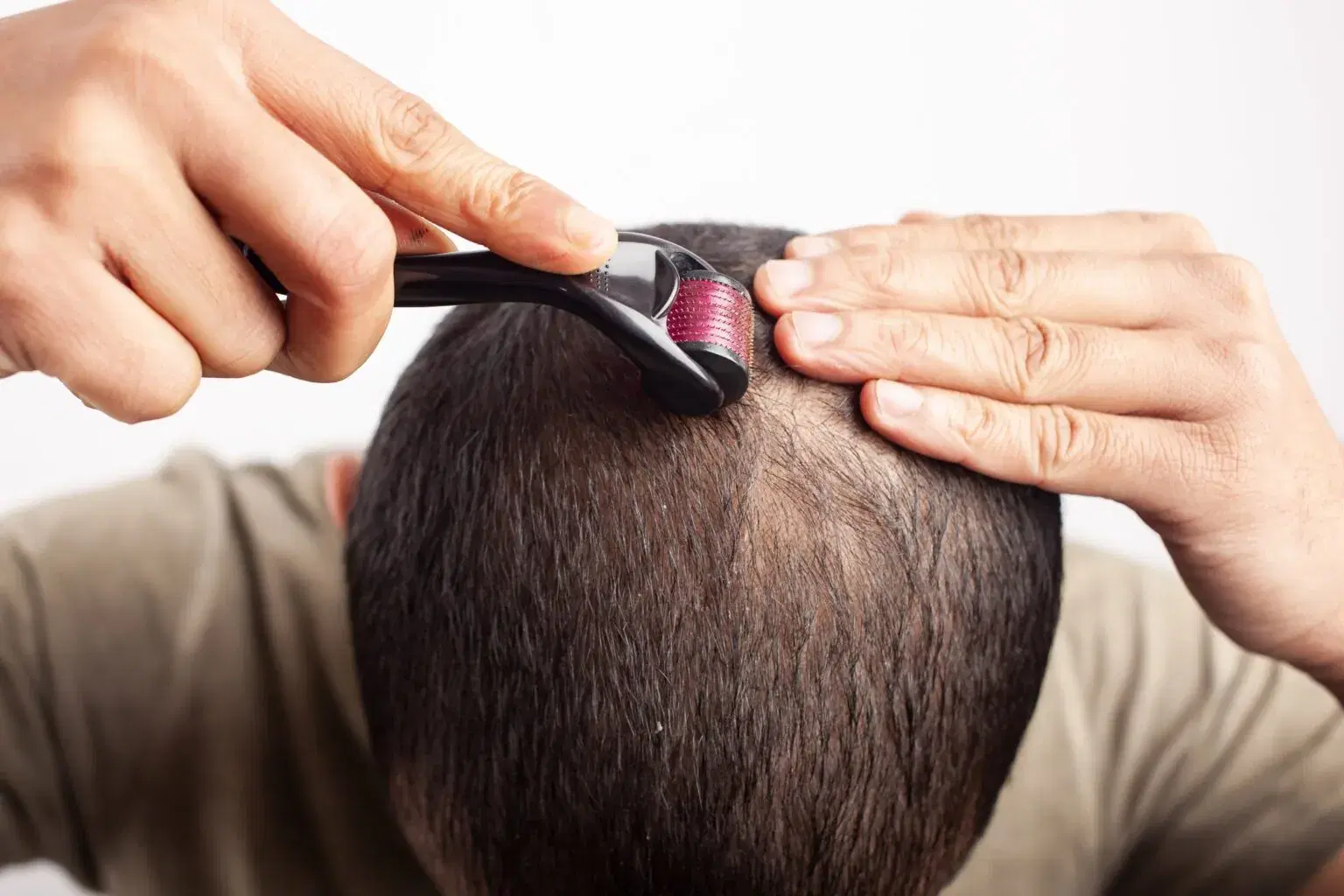
What Is Microneedling for Hair Loss?
Microneedling for hair loss is a scalp treatment that creates controlled microscopic injuries to stimulate repair processes around existing hair follicles. The procedure uses fine needles that enter the scalp at a planned depth without permanently damaging healthy tissue.
These microchannels trigger a healing response involving blood flow, cellular signaling, and tissue remodeling around treated areas. Microneedling does not create new follicles where none remain, so it cannot restore completely scarred or permanently bald skin.
Its main role involves supporting weakened but still functioning follicles, particularly when thinning comes from progressive follicular miniaturization rather than permanent follicle destruction.
How Does Microneedling Help Hair Growth?
Microneedling may support hair growth by activating wound-healing signals around follicles and creating conditions that encourage weakened follicles to remain more active. Controlled injury stimulates several repair pathways involved in skin remodeling and follicular activity.
The treatment may also improve how certain topical products reach the superficial scalp, although this requires careful timing because freshly treated skin absorbs substances more readily.
Microneedling works through stimulation rather than transplantation, so results depend on whether viable follicles remain in the thinning area. Follicles that have already disappeared cannot be recreated simply by repeatedly needling the scalp.
Is Microneedling Effective for Androgenetic Hair Loss?
Microneedling can support treatment for androgenetic hair loss, especially when miniaturized follicles remain active and the procedure accompanies an established hair-loss strategy. Pattern hair loss gradually produces thinner and shorter hairs as genetically sensitive follicles shrink over repeated growth cycles.
Microneedling aims to stimulate these existing follicles rather than change the underlying genetic sensitivity. This makes it more useful as a supportive treatment than as a complete replacement for other proven approaches.
Early and moderate thinning generally provides a better biological target than long-standing smooth baldness because weakened follicles still need to exist before stimulation can influence their activity.
Can Microneedling Regrow Hair on a Receding Hairline?
Microneedling may improve a receding hairline when miniaturized follicles still remain along the frontal edge, but it cannot reliably recreate a hairline where follicles have disappeared completely. Hairline recession often progresses gradually, leaving thinner hairs before an area becomes fully bare.
Treating these weakened follicles early may support thicker growth when microneedling forms part of a broader treatment plan. However, the frontal hairline can respond differently from the crown because follicular loss may become advanced sooner in certain areas.
A smooth, long-standing bald temple usually offers less potential than a thinning region that still contains fine visible hairs.
Can Microneedling Improve Crown Thinning?
Microneedling can support improvement in crown thinning when the area still contains miniaturized hairs rather than complete follicular loss. The crown often develops progressive density reduction before becoming fully bald, creating a period when weakened follicles may still respond.
Because the crown covers a broad surface, treatment must distribute stimulation evenly rather than repeatedly concentrating on one small point. Consistency matters more than aggressive needling because excessive trauma can increase irritation without improving follicular response.
Visible density also depends on existing hair thickness and coverage. Even modest shaft thickening can make the crown appear fuller when enough active follicles remain.
Does Microneedling Work for Diffuse Hair Thinning?
Microneedling may help selected cases of diffuse thinning when follicular miniaturization contributes to the reduced density, but it does not correct every cause of widespread shedding. Diffuse thinning can arise from pattern hair loss, telogen effluvium, nutritional problems, medications, illness, or other factors.
The underlying cause therefore determines whether scalp stimulation makes sense. If temporary shedding follows a major trigger, treating that trigger usually matters more than repeatedly needling the scalp.
Microneedling becomes more relevant when diffuse thinning includes persistent weakened follicles rather than a temporary shift in the hair cycle that would improve naturally over time.
Can Microneedling Be Combined With Minoxidil?
Microneedling can be combined with topical minoxidil because the two treatments act through different mechanisms and may complement each other in selected cases. Minoxidil supports follicular activity, while microneedling creates a controlled repair response within the scalp.
However, freshly needled skin can absorb topical products more readily and may react more strongly to alcohol, propylene glycol, or other formulation ingredients. Applying minoxidil immediately after aggressive microneedling can therefore increase irritation or systemic absorption.
Spacing should follow an appropriate treatment plan rather than assuming faster application creates stronger results. More exposure does not automatically produce better hair growth.
Is Microneedling Better Than Minoxidil Alone?
Microneedling combined with minoxidil may provide stronger improvement than topical minoxidil alone for some people with pattern hair loss, particularly when viable miniaturized follicles remain. The combination targets follicular activity from two different directions rather than relying on one mechanism.
This does not mean microneedling replaces minoxidil for every person. Some patients respond well to topical treatment alone, while others cannot tolerate minoxidil or require different long-term strategies.
The additional benefit also depends on consistent treatment and appropriate scalp recovery. Excessively frequent needling can create inflammation that works against the goal of maintaining a healthy environment for growing hair.
What Needle Depth Is Used for Hair Loss?
Needle depth for scalp microneedling varies according to the treatment goal, device, scalp thickness, treatment frequency, and whether the procedure occurs professionally or at home. Deeper treatment produces more tissue injury and therefore requires longer recovery than superficial cosmetic needling.
Several factors influence depth selection:
Scalp thickness
Treatment area
Device type
Hair density
Planned treatment frequency
Skin sensitivity
Previous scalp procedures
Degree of intended stimulation
Using the deepest available setting does not automatically produce better hair growth. Excessive penetration can increase bleeding, pain, prolonged inflammation, infection risk, and unnecessary tissue injury without improving results.
How Often Should Scalp Microneedling Be Done?
Scalp microneedling should be spaced far enough apart to allow the treated tissue to recover before another significant session creates additional controlled injury. Frequency depends largely on needle depth because superficial treatment generally heals faster than deeper professional procedures.
Aggressive needling several times each week can keep the scalp chronically irritated rather than supporting an organized healing response. The treatment should stimulate recovery, not continuously interrupt it.
Consistency over months matters more than excessive frequency. A sensible schedule balances enough stimulation to support the treatment goal with enough recovery time to maintain healthy skin and reduce cumulative irritation.
How Long Does Microneedling Take to Show Hair Growth?
Microneedling usually requires several months before visible hair improvement becomes meaningful because follicles follow slow biological growth cycles. Early changes may involve reduced miniaturization or thicker emerging strands rather than immediate increases in overall density.
Hair grows gradually, and individual follicles do not enter active growth at exactly the same time. For this reason, photographs taken only a few weeks apart rarely provide a useful assessment.
Progress becomes easier to judge when images use the same lighting, angle, hairstyle, and hair length. Meaningful evaluation should focus on longer-term changes rather than expecting rapid growth after several sessions.
How Many Microneedling Sessions Are Needed for Hair Loss?
Microneedling for hair loss usually requires multiple sessions because one treatment cannot produce enough long-term follicular change to meaningfully alter progressive thinning. Hair follicles respond gradually, and the treatment depends on repeated controlled stimulation followed by adequate healing.
A treatment course often extends across several months before the response becomes clear. Continuing indefinitely without assessing progress, however, does not guarantee additional improvement.
The decision to continue should consider visible density, hair shaft quality, tolerance, scalp condition, and whether the underlying hair-loss process remains active. Treatment should have a measurable purpose rather than becoming an automatic permanent routine.
What Happens During a Scalp Microneedling Session?
A scalp microneedling session typically begins with cleansing and sectioning the hair before a sterile needling device passes systematically across the planned treatment area. The goal is to create evenly distributed microchannels without unnecessarily traumatizing untreated skin.
Professional procedures may use adjustable devices that control needle depth and speed across different scalp regions. Mild pinpoint bleeding can occur with deeper treatment, although heavy bleeding is not the objective.
After needling, the scalp may appear red and feel warm or sensitive. Post-treatment care should minimize irritation while the small channels close and the skin begins its repair response.
Is Microneedling for Hair Loss Painful?
Microneedling for hair loss can cause discomfort because multiple fine needles repeatedly penetrate the scalp, especially when treatment uses greater depth. People commonly describe the sensation as scratching, pressure, stinging, or a series of sharp pinpricks.
Sensitivity differs across scalp regions, with some areas feeling more uncomfortable than others. Professional treatment may use measures that improve comfort when deeper stimulation is planned.
Pain should remain temporary and decrease once the session ends. Persistent severe pain, increasing tenderness, or throbbing accompanied by swelling and redness may suggest excessive irritation or infection rather than expected post-treatment sensitivity.
What Is Recovery Like After Scalp Microneedling?
Recovery after scalp microneedling usually involves temporary redness, tenderness, mild swelling, and sensitivity that gradually settle as the microscopic channels close. Deeper sessions generally create more noticeable inflammation than superficial needling.
The scalp may also feel dry or tight for a short period. During early healing, harsh products, aggressive scratching, heavy sweating, and unnecessary chemical exposure can increase irritation.
Normal recovery should show consistent improvement rather than worsening symptoms. Increasing redness, pus, marked swelling, fever, or persistent severe pain may indicate infection or another complication and deserves medical evaluation rather than repeated home treatment.
What Are the Side Effects of Microneedling for Hair Loss?
Common microneedling side effects include temporary redness, tenderness, pinpoint bleeding, dryness, itching, and short-term scalp sensitivity. These reactions usually reflect controlled skin injury and improve as the scalp heals.
More significant problems can develop when people use excessive pressure, inappropriate depth, unclean devices, or treatments that are too frequent. Infection, prolonged inflammation, pigmentation changes, and scarring remain possible risks.
Needling through active acne-like scalp lesions, dermatitis, or infection can also worsen the underlying problem. Proper hygiene and controlled technique matter because creating microchannels temporarily reduces part of the skin barrier.
Can Microneedling Make Hair Loss Worse?
Microneedling can temporarily increase apparent shedding or worsen scalp problems when treatment becomes too aggressive, inflames unhealthy skin, or repeatedly traumatizes fragile hairs. Passing a device through existing hair can also mechanically catch and break some strands.
Appropriate microneedling should not intentionally destroy healthy follicles. However, deeper and more frequent treatment does not automatically create stronger stimulation and can produce unnecessary inflammation.
People sometimes interpret normal short-term shedding as treatment failure, especially when they also use minoxidil. Persistent worsening, increasing scalp symptoms, or clearly declining density should prompt reassessment rather than simply increasing microneedling intensity.
Who Should Avoid Scalp Microneedling?
Scalp microneedling should generally be avoided over active infections, open wounds, severe inflammatory scalp disease, or areas with impaired healing until the underlying condition has resolved. Creating controlled wounds in unhealthy skin can worsen inflammation and increase infection risk.
People with conditions or medications that significantly affect bleeding, immunity, or wound healing also need appropriate medical assessment before treatment. A history of abnormal scarring deserves similar consideration.
Microneedling should not become the first response to unexplained hair loss. Sudden bald patches, scarring, severe itching, significant scaling, or rapid shedding can indicate conditions that require diagnosis before cosmetic scalp stimulation begins.
Can Microneedling Be Used After a Hair Transplant?
Microneedling may be considered after a hair transplant once the scalp has fully healed and the newly implanted grafts are no longer vulnerable to mechanical disruption. It should not be performed during the early postoperative period when grafts, crusts, and healing tissue still require protection.
Later treatment may support scalp quality or ongoing management of native hair when an appropriate hair-loss plan includes microneedling. It does not replace transplanted grafts or guarantee greater graft survival.
Timing matters because premature needling can unnecessarily traumatize healing recipient areas. Post-transplant microneedling should therefore begin only after adequate recovery rather than following a fixed early schedule.
What Results Can You Realistically Expect From Microneedling?
Realistic microneedling results include gradual improvement in hair thickness or visible density when viable follicles remain and the underlying hair-loss condition can respond to stimulation. The treatment works best as part of a consistent strategy rather than as a one-session cure.
It cannot recreate follicles in smooth, permanently bald areas, and it cannot stop every form of progressive hair loss on its own. Some people achieve noticeable thickening, while others experience only modest changes.
The strongest expectations focus on supporting existing follicles, improving the appearance of thinning areas, and complementing other appropriate treatments without promising complete restoration of original density.