
What Does a Bad Beard Transplant Look Like?
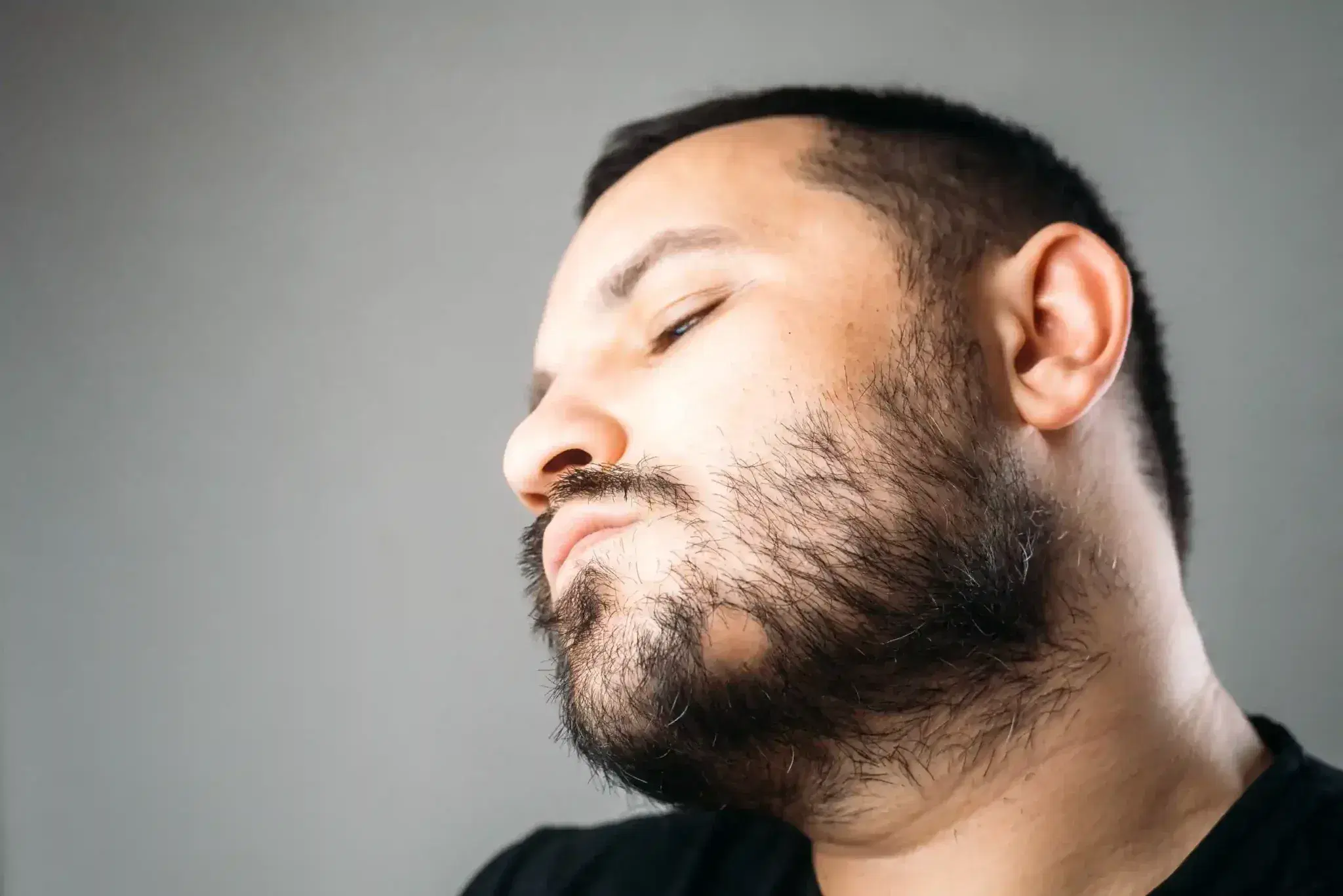
A bad beard transplant usually looks unnatural because the graft direction, beard outline, density, or distribution does not match the way facial hair normally grows.
Common warning signs include:
Grafts standing too upright from the skin
Hair growing sideways in the wrong direction
An overly sharp cheek line
A beard border that looks drawn on
Large multi-hair grafts placed at the outer edge
Obvious gaps between transplanted areas
Excessively dense sections next to sparse sections
Visible scarring or pitting
Donor-area thinning
Poor connection between the beard, sideburns, and moustache
A natural beard should show gradual transitions rather than perfectly uniform density everywhere.
Why Do Some Beard Transplants Look Unnatural?
Beard transplants often look unnatural when facial-hair anatomy is treated like scalp transplantation. Beard hairs grow at much flatter angles, and their direction changes dramatically across the cheeks, jaw, chin, moustache, and sideburn areas.
A technically successful graft can still produce a poor visual result if it grows in the wrong direction. Design also matters because a perfectly straight cheek line rarely looks natural on a real beard.
Natural facial hair contains irregular spacing, subtle asymmetry, and different density levels. Ignoring those details can produce a transplanted beard that looks artificial even when most grafts survive.
Can a Beard Transplant Look Bad During the First Months?
A beard transplant can look uneven, sparse, or slightly awkward during the first months without representing a poor final result. Early redness, crusting, shedding, and temporary differences in growth can distort the appearance.
Transplanted hairs commonly shed after the procedure before new growth begins from the follicles beneath the skin. Early regrowth can also appear thin, wiry, or inconsistent.
Judging the final design too soon may therefore create unnecessary concern. Directional problems can sometimes be noticed earlier, but density and texture usually need more time.
A clearer assessment often becomes possible once growth has matured and the transplanted hairs have gained length.
Why Is Graft Angle So Important in Beard Transplantation?
Graft angle is one of the most important technical details because beard hair normally exits the skin at a relatively shallow angle rather than standing vertically.
The correct angle also changes across the face. Hair near the sideburn may travel downward, cheek hair can move diagonally, and chin hair often follows a different pattern entirely.
When grafts are implanted too upright, the beard may look bristly even after the hairs grow longer. Styling can hide the problem to some degree, but the underlying direction remains visible.
A natural result depends on reproducing local facial-hair flow rather than using one implantation angle for every region.
What Happens When Beard Grafts Point in the Wrong Direction?
Wrong-direction grafts can create crossing hairs, visible turbulence, and sections that refuse to lie naturally with the surrounding beard. This problem becomes more noticeable as the transplanted hair grows longer.
A few isolated grafts may be manageable through trimming or styling. Larger directional errors are more difficult because every new growth cycle reproduces the same orientation.
Revision may involve selectively removing problematic follicles and redistributing new grafts around the area. In some cases, camouflage with carefully angled additional grafts can reduce the visual contrast.
The appropriate approach depends on how many follicles are misplaced and how close they sit to natural beard hair.
Can an Unnatural Beard Line Be Corrected?
An unnatural beard line can often be improved, but correction depends on whether the problem comes from shape, excessive density, badly angled grafts, or a combination of several issues.
Overly straight cheek borders are a common concern because natural facial hair rarely forms a ruler-like edge. A softer transition can sometimes be created by removing selected follicles and adding irregular single-hair grafts around the border.
Repair work should focus on breaking up obvious geometry rather than simply adding more density.
The existing beard, facial proportions, and natural sideburn connection all need to guide the new outline so the revised result looks integrated rather than redrawn.
Why Does Poor Density Make a Beard Transplant Look Patchy?
Poor density creates a patchy result when the transplanted grafts are spread too widely across an area that requires stronger visual coverage. The problem becomes especially noticeable on the cheeks.
A limited donor supply may force conservative coverage, but poor distribution can also leave unnecessary gaps even when enough grafts were available.
The visual result depends on hair caliber, curl, contrast with skin, graft survival, and how many hairs each follicular unit contains. Coarser or curlier hairs often create more visual coverage than very fine straight hairs.
Repair planning should therefore consider coverage, not simply the number written in the original surgical report.
Can Too Much Density Make a Beard Transplant Look Fake?
Excessive density can make a beard transplant look artificial when too many grafts are packed into areas that naturally show softer or more irregular growth.
This problem often appears along the upper cheek line or around transitional zones. A beard that starts with abrupt, uniform density can look more like a painted border than natural facial hair.
Very dense implantation can also make incorrect angles more obvious because many hairs reinforce the same directional mistake.
Natural-looking beard restoration depends on controlled variation. Stronger density usually belongs in central beard areas, while borders and transition zones benefit from more delicate spacing and single-hair grafts.
What Causes a Pluggy Beard Transplant Appearance?
A pluggy appearance usually develops when large follicular units are placed too close to the visible beard border or when grafts cluster in obvious groups.
Several technical issues can contribute:
Multi-hair grafts placed along the cheek line
Poor separation of single-hair and multi-hair grafts
Uneven spacing between implantation sites
Repeated groups placed in straight rows
Excessive density at the outer edge
Incorrect angulation
Visible scarring around implanted follicles
Limited transition between transplanted and natural hair
Repair often involves reducing the most obvious graft groups and rebuilding the border with finer single-hair follicles.
Can Scalp Hair Look Different After Being Transplanted Into the Beard?
Scalp hair can remain somewhat different from native beard hair after transplantation because its original diameter, curl pattern, growth speed, and texture come from the donor follicle.
A follicle moved from the scalp does not automatically transform into a true beard follicle. The transplanted hair can adapt somewhat to the new environment, but its basic characteristics remain strongly influenced by donor biology.
For some people, the match looks convincing. For others, transplanted strands may grow faster, softer, straighter, or longer than surrounding beard hairs.
Regular trimming can reduce this contrast, although major texture mismatch may remain noticeable when the beard is grown long.
Can a Beard Transplant Damage the Donor Area?
A beard transplant can create visible donor-area thinning when too many follicles are removed from a limited region or when extraction is concentrated unevenly.
The back and sides of the scalp contain a finite donor supply. Removing grafts does not cause replacement follicles to appear in the same extraction sites.
Small extraction points usually become difficult to notice when harvesting is distributed properly. Overharvesting, however, can create moth-eaten density or visibly thin patches.
This matters even more for someone who may later want a scalp hair transplant, because grafts already used for the beard reduce the remaining donor reserve available for future restoration.
Does Scarring Make a Beard Transplant Look Worse?
Scarring can make a beard transplant look less natural when recipient sites heal with visible pitting, raised tissue, texture changes, or color differences around the implanted follicles.
Small surface irregularities may become harder to notice once the beard reaches moderate length, but severe textural changes can remain visible after shaving.
Scarring can result from several factors, including overly large recipient sites, excessive trauma, infection, poor healing, or repeated procedures in the same area.
Revision planning needs to consider skin quality before adding more grafts. Simply increasing density over damaged tissue does not always solve the underlying cosmetic problem.
Can Uneven Growth Improve Without Another Procedure?
Uneven beard growth can improve naturally when different grafts enter active growth at different times, particularly during the early and middle stages of recovery.
One cheek may initially appear fuller than the other even when the final graft distribution was relatively balanced. Transplanted hairs also mature gradually, gaining thickness over time.
Persistent asymmetry is different. If one area remains clearly sparse after the result has matured, lower graft survival or uneven placement may have contributed.
Before planning repair, it is important to distinguish delayed maturation from a stable long-term deficiency. Additional transplantation performed too early can add unnecessary density to areas that were still developing.
When Is a Beard Transplant Considered Failed?
A beard transplant may be considered unsuccessful when the mature result shows poor graft survival, unnatural direction, problematic design, visible scarring, severe donor damage, or persistent density defects.
Low growth alone does not describe every failed transplant. A beard with excellent graft survival can still look poor if the cheek line sits too high or the hairs grow vertically.
Similarly, a technically neat design can disappoint if too few follicles survive to create meaningful coverage.
The result should therefore be assessed as a combination of growth, direction, design, donor preservation, skin quality, and how naturally the transplanted hair integrates with existing facial hair.
Can Bad Beard Transplant Grafts Be Removed?
Problematic beard grafts can sometimes be removed individually when their direction, position, or density creates an obvious unnatural appearance.
Small punch extraction may allow selected follicles to be taken out from the recipient area. The challenge is minimizing additional scarring while removing enough of the follicle to prevent regrowth.
Trying to remove hundreds of grafts at once can create new texture problems, so complex repair may require several stages.
Some cases benefit from combining selective removal with new transplantation. Removing the worst grafts first can create space for better-directed follicles and reduce the need to camouflage every mistake with additional density.
Can Laser Hair Removal Correct a Bad Beard Transplant?
Laser hair removal can reduce unwanted transplanted hairs in selected cases, especially when the problem involves excessive density or grafts positioned outside the desired beard border.
Its usefulness depends heavily on hair color, skin tone, follicle depth, and the location of the unwanted grafts. Laser treatment also lacks the precision of removing one specific follicular unit when several neighbouring hairs should remain.
Multiple sessions may be necessary, and partial reduction can create temporary irregularity.
Laser therefore works better for broader unwanted areas than highly detailed directional correction. A repair plan should consider whether selective extraction, laser reduction, camouflage, or a combination produces the cleanest result.
Can a Second Beard Transplant Fix Poor Density?
A second beard transplant can improve poor density when the first procedure left stable gaps and the donor area still contains enough suitable follicles.
The second operation should not simply repeat the original approach. It needs to explain why the first result remained thin and whether low graft survival, inadequate graft count, poor distribution, or progressive loss of native facial hair contributed.
Additional grafts can then strengthen specific zones without making already dense regions unnaturally heavy.
Donor availability becomes especially important during revision because the first procedure has already consumed part of the supply. Long-term planning should therefore remain conservative.
How Is a Bad Beard Transplant Repair Planned?
Repair begins by identifying whether the main problem involves design, density, direction, scarring, donor damage, or several of these issues at the same time.
Some cases need removal before any new grafts are added. Others look better when carefully angled follicles are placed between existing hairs to soften an unnatural pattern.
The face should be divided into separate aesthetic zones rather than treated as one continuous beard surface. Cheeks, sideburns, jaw, chin, moustache, and connecting areas each require different directional planning.
A successful repair aims to make the old transplant less visible, not simply to increase the number of transplanted hairs.
What Should Be Checked Before Choosing Beard Transplant Revision?
Revision planning should begin with an honest assessment of what can realistically be improved and how much donor hair remains available.
Important points to review include:
Original graft count
Remaining donor density
Beard graft direction
Cheek-line shape
Existing scar tissue
Areas with poor survival
Native beard density
Texture mismatch
Previous repair attempts
Need for graft removal
Potential role of laser reduction
Amount of additional coverage required
Photographs taken with short and longer beard lengths can also reveal problems that one viewing distance may hide. Repair should target the specific defects rather than starting another full transplant automatically.
How Can the Risk of a Bad Beard Transplant Be Reduced?
The risk of a poor beard transplant falls when the planning respects natural facial-hair anatomy, uses conservative donor management, and treats angle and direction as seriously as graft survival.
A convincing beard should not look identical across every square centimetre. Borders need softness, central zones can carry stronger density, and transitions toward the sideburns and moustache should change gradually.
Single-hair grafts are particularly important around visible edges, while larger follicular units usually belong deeper within the beard.
The strongest result comes from creating believable facial-hair architecture rather than simply implanting as many grafts as possible.