

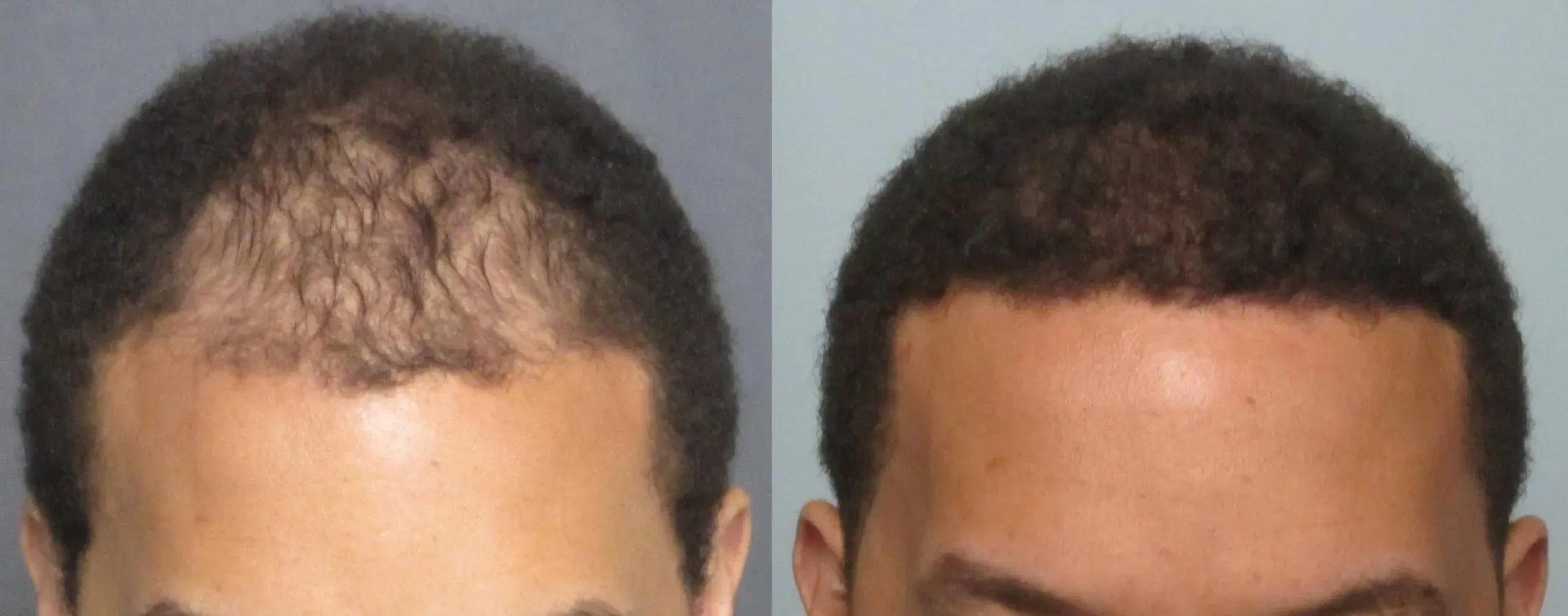
What Makes Very Straight Hair Different in Hair Transplantation?
Very straight hair follows a relatively consistent direction from the scalp and has little natural curl to create additional volume. This characteristic influences how transplanted strands overlap, cover the skin and blend with neighboring hair.
Curly or wavy strands often occupy more visual space because their shape creates overlapping layers. Straight strands tend to lie in a more uniform pattern, making differences in density easier to notice.
However, straight hair is not necessarily thin hair. Some men have very straight, coarse strands that provide substantial coverage, while others have fine strands that reveal more scalp.
The distinction influences the entire transplant plan, particularly the hairline and frontal density.
Can Men With Very Straight Hair Get a Natural Hair Transplant?
Men with very straight hair can achieve natural-looking hair transplant results when the placement of the follicles respects their existing growth pattern.
The procedure transfers healthy follicular units from the donor region, usually the back and sides of the scalp, into areas affected by hair loss.
The transplanted hair retains characteristics associated with its original follicles, including its natural texture.
What determines the appearance is not simply whether the grafts survive. Their angle, spacing, direction and distribution must blend with the surrounding hair.
Straight hair can produce a convincing result, but errors in placement may remain more visible because the strands do not curl over neighboring areas to conceal irregularities.
Is Straight Hair More Difficult to Make Look Dense?
Straight hair can make scalp coverage more challenging when the strands are fine or the contrast between hair and skin is pronounced.
Curly hair creates a three-dimensional appearance that can conceal spaces between follicles. Very straight hair usually provides less of this natural overlap, particularly when worn short.
As a result, an area containing a reasonable number of grafts may still appear thin under strong overhead lighting.
However, visual density depends on several characteristics rather than texture alone.
Coarse straight hair can create substantial coverage, especially when the strands emerge at suitable angles and lie across neighboring scalp.
The objective is to distribute available grafts where they make the greatest visible difference.
Does Hair Thickness Matter More Than Hair Texture?
Hair shaft diameter plays a major role in the appearance of transplant density.
A thick strand occupies more visible space than a very fine strand, even when both grow from healthy follicles. This means two men receiving the same number of grafts may achieve noticeably different coverage.
Hair texture influences the way strands overlap, but thickness determines how much each individual shaft contributes to the overall appearance.
Very fine straight hair may require particularly thoughtful graft distribution because placing additional follicles does not automatically reproduce the fullness of naturally coarse hair.
Hair thickness should therefore be measured during donor assessment rather than estimated from whether the hair looks straight, wavy or curly.
How Does Hair and Scalp Color Contrast Affect Coverage?
The difference between hair color and scalp color influences how easily thinning becomes visible.
Dark, very straight hair against a light scalp can create strong contrast, making gaps between strands more noticeable.
When hair and skin tones are closer, the scalp may attract less attention even when follicular density is similar.
Lighting also changes the appearance considerably. Overhead illumination can expose areas that look adequately covered in softer daylight.
Color contrast does not determine graft survival or the biological success of transplantation.
It does, however, influence the density strategy and the cosmetic expectations associated with the procedure, especially when restoring the frontal scalp.
Which Factors Most Influence Straight Hair Transplant Results?
The final appearance depends on how the available follicles are used rather than the total graft count alone.
Hair shaft thickness: Coarse strands contribute more visible coverage, while very fine straight strands may leave the scalp easier to see between grafts.
Donor hair availability: The number and quality of stable follicles in the donor region determine how much hair can be redistributed without creating excessive thinning.
Implantation angle and direction: Straight strands reveal incorrect growth angles more readily, making natural orientation essential for a result that is easy to style.
Hairline and density distribution: A soft frontal transition, appropriate use of single-hair grafts and greater density behind the leading edge help prevent an artificial appearance.
Is FUE Suitable for Men With Very Straight Hair?
Follicular Unit Extraction, or FUE, is a suitable transplantation technique for many men with straight hair.
The procedure removes individual follicular units from the donor scalp using small surgical punches before placing them into thinning regions.
Straight follicles often follow a more predictable path beneath the skin than tightly curved follicles, which can make extraction technically more straightforward.
However, follicular damage remains possible if the instrument does not follow the actual direction of the hair root.
FUE also leaves small extraction scars and permanently reduces the follicular supply at the harvested sites.
Appropriate donor management remains essential regardless of hair texture.
How Does FUT Compare for Straight Hair?
Follicular Unit Transplantation, or FUT, removes a narrow strip of hair-bearing scalp, which is then divided into individual grafts.
Unlike FUE, which produces numerous small extraction marks, FUT generally leaves a linear scar across the donor region.
Both techniques can transplant very straight hair successfully because the recipient follicles follow the same fundamental biological process after placement.
The distinction mainly concerns how the grafts are obtained and how the donor area heals.
For men who prefer very short haircuts, scar visibility deserves particular attention. FUT scars may become noticeable when the surrounding hair is cut close, while FUE can create scattered pale dots.
Neither method automatically produces a more natural hairline.
Can DHI Improve Straight Hair Transplant Results?
Direct Hair Implantation, commonly known as DHI, uses an implanter instrument to assist with placing follicular units into the recipient scalp.
It does not create new hair or eliminate the need to harvest donor follicles.
The technique may offer controlled graft placement in appropriate situations, but the instrument itself does not guarantee correct hair angles or greater density.
Very straight hair requires careful orientation whether the grafts are placed with an implanter or through previously created recipient sites.
The final result depends on the design of the hairline, protection of the grafts and accurate placement.
The name of the implantation method is therefore less important than how well those principles are followed.
How Is Donor Hair Density Evaluated?
Donor assessment examines the number of follicular units, the number of hairs within each unit and the thickness of individual strands.
The presence of miniaturized hairs is also important because a donor area affected by progressive thinning may not provide reliable long-term coverage.
Magnified scalp examination can help identify differences in density and caliber across the back and sides of the head.
Hair length matters as well. A donor region that appears full with longer straight hair may reveal substantial spacing when closely shaved.
Harvesting should never compromise the donor area's ability to maintain balanced coverage.
Are Straight Hair Follicles Easier to Extract?
Straight hair follicles often have a less curved path beneath the skin, which may make their direction easier to anticipate during graft extraction.
This can be an advantage compared with follicles that bend sharply below the surface.
However, visible straightness does not establish the exact depth or angle of every follicular unit.
Differences in scalp anatomy, hair thickness and the direction of growth still require careful assessment.
An extraction instrument can damage a follicle if it cuts through the structures responsible for future hair production.
The aim is therefore to obtain intact grafts while preserving surrounding donor hair, not to assume that straight hair makes the procedure free from technical challenges.
How Many Grafts Are Needed for a Straight Hair Transplant?
There is no universal graft number for men with very straight hair.
The required amount depends on the size of the thinning region, donor availability, hair thickness and the desired level of visual coverage.
Restoring a limited recession at the temples is different from treating extensive thinning across the frontal scalp and crown.
Fine straight hair may provide less coverage per strand than coarser hair, but this does not justify extracting as many grafts as possible.
The donor supply is finite, and excessive harvesting can create permanent thinning at the back of the head.
A balanced plan distributes available grafts according to aesthetic priorities while reserving follicles for possible future hair loss.
What Are the Most Important Hairline Design Considerations?
Very straight hair makes the first few rows of the hairline particularly important because individual strands and their direction remain easy to distinguish.
A natural frontal border: Small, controlled irregularities prevent the hairline from resembling a perfectly straight or artificially drawn edge.
Single-hair follicular units: Fine single-hair grafts at the front create a softer transition, while units containing several hairs provide density farther behind.
A suitable position: The hairline should complement the forehead, temples, facial proportions and the possibility of further hair loss with age.
Gradual density changes: Avoiding a sudden wall of densely packed grafts allows the transplanted hair to blend more convincingly with neighboring strands.
Why Are Single-Hair Grafts Important for Straight Hair?
Natural follicular units may contain one, two, three or more hair shafts.
When several thick hairs emerge together directly along the frontal border, they can create a noticeably clustered appearance.
This effect is especially apparent with very straight hair because the individual shafts remain visually distinct.
Single-hair grafts allow a more delicate transition between the forehead and the denser scalp.
Farther behind the hairline, follicular units containing several hairs can contribute greater fullness without making the leading edge appear unnatural.
A natural front edge relies on carefully selected follicles rather than uniformly dense placement.
How Should Hair Angle and Direction Be Planned?
The angle at which hair emerges from the scalp strongly influences how straight strands behave.
At the frontal hairline, hair generally follows a relatively shallow angle rather than projecting vertically.
The temples and lateral scalp have different directions, while the crown follows a rotating growth pattern.
If grafts are implanted too upright, straight hair may stand away from the head and become difficult to style.
Incorrect direction can also create crossed strands or visible gaps.
Recipient sites should therefore follow the neighboring growth patterns and the intended hairstyle.
For straight hair, appropriate direction is not merely an aesthetic detail. It directly affects how individual strands overlap to provide coverage.
Why Can a Straight Hair Transplant Look Unnatural?
A straight hair transplant can appear artificial when the follicles are arranged in rigid rows, placed at inconsistent angles or concentrated into an excessively sharp frontal border.
A hairline that is too low may also look disproportionate to the face and consume donor follicles that could be useful later.
Straight strands tend to display their individual direction clearly, so an incorrectly positioned graft may stand apart from the surrounding hair.
Using thick multi-hair units at the very front can make the edge look heavy.
Natural results require slight variation in spacing, a soft transition and consistent regional growth direction.
The goal is not geometric perfection but a hairline that behaves like naturally growing hair.
How Are the Temples and Hairline Corners Restored?
Temple restoration requires particular attention because hairs in these areas often emerge close to the scalp and follow a distinct lateral direction.
Very straight hair makes these angles easy to see, especially when the hairstyle exposes the sides of the forehead.
Grafts placed too vertically may protrude rather than lie naturally against the skin.
The frontal corners also need to maintain an appropriate relationship with the central hairline and the sides of the face.
Reconstructing an excessively low or rounded temple shape can produce an unnatural appearance.
Fine grafts, appropriate spacing and careful orientation are especially important when working in these visible transition zones.
Can Straight Hair Transplants Restore a Receding Hairline?
Hair transplantation can improve a receding hairline when sufficient stable donor follicles are available and the underlying hair-loss pattern has been evaluated.
For many men, restoring the frontal corners or strengthening the central forelock can make a substantial difference without covering every thinning region.
Very straight hair may reveal sparse areas more clearly, so frontal graft distribution deserves careful planning.
However, creating the lowest possible hairline is not necessarily beneficial.
An overly aggressive design uses additional grafts and may become difficult to maintain aesthetically if natural hair continues thinning behind it.
A balanced frontal restoration should frame the face while remaining appropriate for future changes.
Is Crown Restoration More Challenging With Straight Hair?
Crown restoration can be demanding because hair in this region follows a circular or spiral growth pattern.
Grafts must reproduce the natural whorl rather than point in a single uniform direction.
Very straight strands may expose gaps between neighboring hairs when their angles do not overlap effectively.
The crown also covers a relatively large surface area, making dense restoration potentially expensive in terms of donor follicles.
When the donor reserve is limited, stronger coverage at the hairline may provide greater overall visual improvement than attempting maximum density across the crown.
The desired distribution should reflect the entire scalp rather than treating every thinning region with the same graft concentration.
Can Very Fine Straight Hair Be Transplanted?
Very fine straight hair can be transplanted when the donor follicles are healthy and sufficiently stable.
However, each strand contributes less visual coverage than a thick hair shaft, which may limit the apparent fullness achieved with a particular number of grafts.
Fine hair can offer an advantage at the leading edge because delicate strands create a naturally soft hairline.
The difficulty lies in building convincing density farther behind that edge.
A careful plan may concentrate suitable multi-hair units in the frontal region while maintaining a gradual transition.
Fine texture alone does not make transplantation unsuccessful, but it should influence expectations about coverage.
Will Transplanted Hair Keep Its Straight Texture?
Transplanted follicles generally retain characteristics associated with their donor location, including their tendency to produce straight hair.
The procedure changes where the follicles grow rather than fundamentally altering their genetic characteristics.
During early regrowth, some transplanted strands may initially appear finer, shorter or slightly different in texture as the growth cycle resumes.
These changes can settle as the hair matures.
However, transplantation does not guarantee that every strand will grow identically to the original hair surrounding the recipient area.
Donor and recipient hair may differ in diameter or natural growth direction, making thoughtful graft selection important for a consistent overall appearance.
What Happens During the Hair Transplant Procedure?
The procedure begins with assessment of the donor area, the existing hair-loss pattern and the planned recipient regions.
The hairline is marked before local anesthesia is administered.
In FUE, individual follicular units are extracted from suitable donor areas and prepared for transplantation. In FUT, grafts are obtained from a surgically removed donor strip.
The follicles are protected while outside the scalp and organized according to their characteristics.
Recipient sites are then prepared with attention to angle, direction and density.
For men with very straight hair, the placement stage is especially important because future strands should follow the natural flow of nearby hair.
After transplantation, small wounds begin healing in both the donor and recipient areas.
What Are the Risks of Hair Transplantation With Straight Hair?
Hair transplantation carries surgical and aesthetic risks that should be considered alongside the expected improvement.
Unnatural growth direction: Incorrect implantation angles may make straight strands protrude, cross neighboring hairs or become difficult to style.
Insufficient visual density: Fine hair, strong scalp contrast or inadequate graft distribution may leave more visible scalp than expected.
Donor area depletion: Excessive harvesting can permanently reduce density and make extraction scars more noticeable, particularly with short hairstyles.
Postoperative complications: Temporary swelling, shock loss and discomfort can occur, while increasing pain, spreading redness, pus or fever may indicate a complication requiring medical assessment.
What Is Recovery Like After a Straight Hair Transplant?
Recovery follows the same basic biological stages as transplantation performed on other hair textures.
During the first several days, the recipient and donor areas may develop redness, mild swelling and small crusts.
Surface healing commonly progresses substantially within one to two weeks.
Straight hair does not independently determine how quickly the surgical wounds close.
However, existing straight strands may make individual transplanted hairs or small changes in direction more noticeable during the early period.
Gentle washing and protection from rubbing, scratching and unnecessary pressure help safeguard the newly placed grafts.
The appearance during initial healing should not be confused with the final density or direction of mature hair growth.
When Will the Transplanted Hair Start Growing?
Transplanted hair shafts commonly shed during the first several weeks after surgery. This temporary shedding does not necessarily mean that the transplanted follicles have failed.
New growth often begins becoming visible around three to four months after the procedure.
During the following months, the strands increase in length and gradually contribute greater scalp coverage.
More substantial improvement commonly develops between six and twelve months, while additional maturation may continue beyond the first year.
With very straight hair, early short regrowth can appear uneven because the strands have not yet reached enough length to overlap naturally.
The final appearance should be assessed after sufficient growth and maturation rather than during the first months.
Can Natural Hair Continue Thinning After Surgery?
Hair transplantation does not eliminate the underlying biological process responsible for common male pattern hair loss.
Transplanted follicles from suitable donor regions often retain greater resistance to androgen-related miniaturization, but native hairs surrounding them may continue thinning.
This can create new gaps behind a restored hairline or reduce density in previously untreated regions.
The possibility of progression is especially important for younger men whose eventual hair-loss pattern may not yet be established.
Evidence-based medical treatments may help manage ongoing loss in suitable individuals, but they do not guarantee permanent stabilization.
Long-term planning should therefore preserve donor follicles and avoid creating a restored hairline that could become isolated as neighboring hair changes.
What Makes a Straight Hair Transplant Look Natural Long Term?
A natural straight hair transplant is not defined simply by the number of grafts implanted or the amount of new hair visible after surgery.
The strongest results combine an appropriate hairline position, carefully selected follicular units and accurate growth direction with sufficient density in the areas that matter most.
Hair thickness and scalp contrast influence the amount of coverage that can realistically be achieved, while donor management determines whether additional treatment remains possible later.
Very straight hair requires particular precision because each strand contributes to the visible arrangement rather than being concealed by curls.
A well-planned restoration respects those characteristics instead of attempting to overcome them through excessive graft numbers.
The long-term objective is hair that follows the natural contours of the scalp, blends with existing strands and remains visually balanced as the surrounding hair changes with age.