

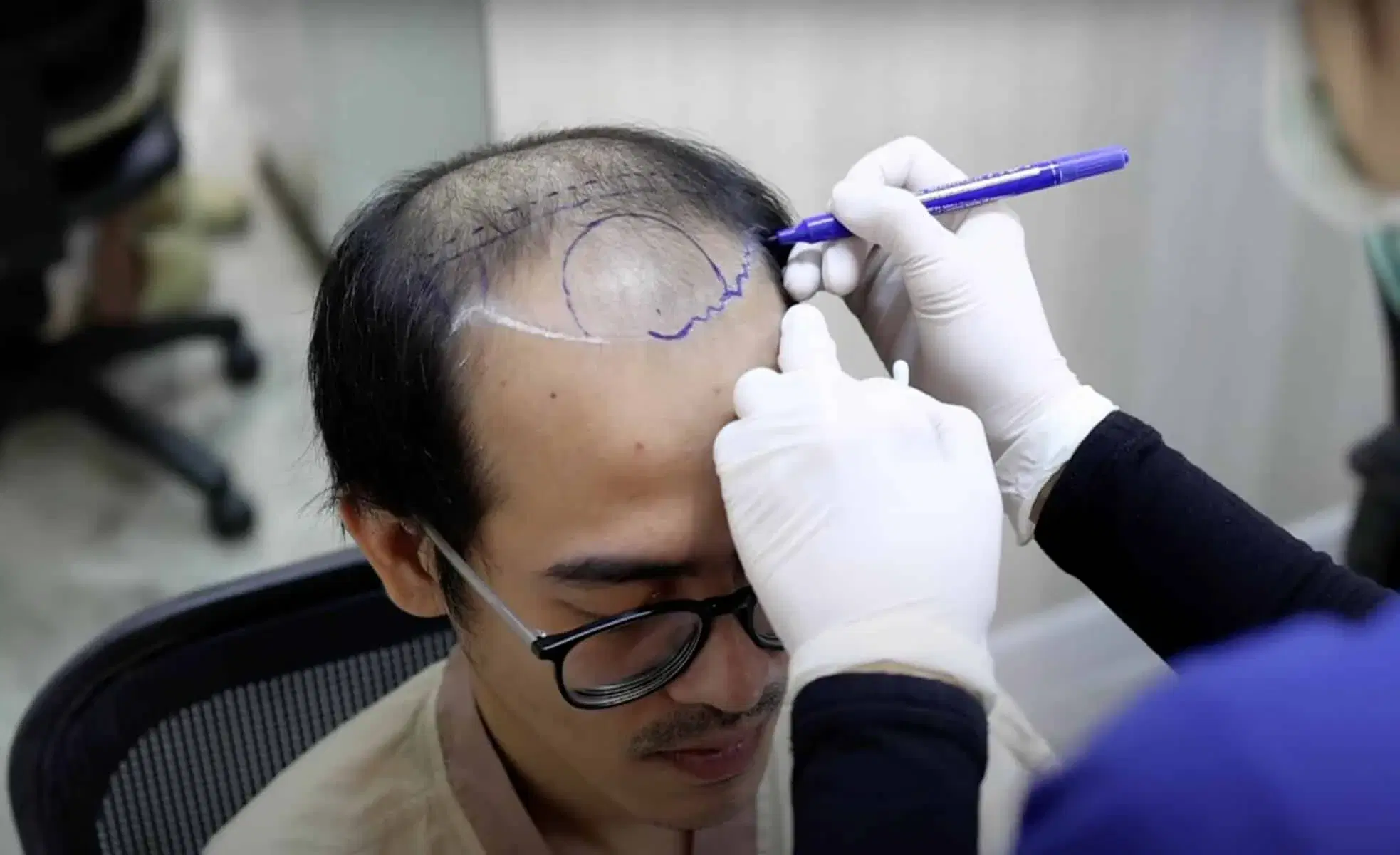
A hair transplant can work very well for thick Asian hair, but successful planning requires more than simply placing a large number of grafts. Thick hair shafts can provide strong visual coverage, while straight dark hair may also create greater contrast against the scalp and make poor graft placement easier to notice. Many Asian patients also have different combinations of follicular density, hair calibre and growth direction, so ethnicity alone cannot determine the surgical plan. The best results come from evaluating the individual donor area, follicle characteristics, future hair-loss pattern and desired hairline before deciding how many grafts to transplant.
Is Thick Asian Hair Good for a Hair Transplant?
Thick Asian hair can be very favourable for transplantation because larger hair-shaft diameter often creates strong visual coverage. Each transplanted hair can block more scalp visibility than a very fine hair.
That advantage does not automatically mean fewer grafts are always required. Density depends on the number of follicular units, hairs per graft, scalp contrast, hair direction and the size of the thinning area.
Straight dark hair can also make individual transplanted hairs more visible. If grafts are placed too regularly or at incorrect angles, an artificial appearance may be easier to notice.
The quality of the donor area therefore matters more than ethnicity alone.
What Makes Asian Hair Different in Hair Transplant Surgery?
Asian hair often combines relatively large shaft diameter with straight growth, dark pigmentation and a distinctive relationship between follicular density and visual coverage. These characteristics can affect both extraction and implantation.
Important features may include:
Thick terminal hair shafts
Straight or mildly wavy texture
Strong contrast between dark hair and light scalp
Lower follicular density in some individuals
Relatively large follicular units
Acute hair-exit angles around the temples
Deep follicular positioning in some donor areas
A hairline shape that may differ from typical Western designs
High visibility of incorrect graft direction
Strong cosmetic coverage from individual hairs
These are general tendencies rather than rules. Asian hair varies considerably between individuals and populations.
Does Thick Hair Create Better Transplant Density?
Thick hair usually creates better visual density because every strand covers more scalp surface. This can make a transplant look fuller even when the actual number of follicular units is moderate.
Hair calibre is therefore one of the most important characteristics affecting cosmetic coverage.
However, thick straight strands do not overlap in the same way as curly or wavy hair. A patient with very straight hair may still need careful graft distribution to prevent visible gaps.
Scalp colour also influences the result. Dark hair against a lighter scalp produces stronger contrast, meaning small differences in density may remain visible under direct light.
Good planning balances actual density with optical coverage.
Do Asian Patients Need More or Fewer Grafts?
Asian patients do not automatically need more or fewer grafts because graft requirements depend on the individual pattern of hair loss. Thick hair may reduce the number needed for visual coverage, but lower donor density can limit how many are safely available.
A small frontal recession may require far fewer grafts than diffuse thinning extending through the midscalp.
Hairline position also changes the calculation. Lowering a hairline even one centimetre can significantly increase the surface area that requires coverage.
The number of hairs within each graft matters as well. A donor containing many two-hair and three-hair follicular units can provide greater coverage than one dominated by single-hair grafts.
Is Asian Donor Hair Usually Dense?
Asian donor areas can provide excellent transplant material, but follicular density may be lower on average than in some other populations. Thick shaft diameter can partly compensate for this because each hair creates more coverage.
Density should therefore be measured rather than guessed from how thick the hair looks.
A donor area can appear very full because the shafts are coarse even when the number of follicular units per square centimetre is moderate. Removing too many grafts from that donor may leave visible thinning.
This becomes particularly important with FUE, where individual follicular units are extracted across a broad area.
Conservative donor management is essential for anyone who may need another transplant later.
Why Is Hair-to-Scalp Contrast Important?
Hair-to-scalp contrast strongly influences how dense a transplant appears. Dark hair against a lighter scalp creates a clear visual boundary, so spaces between hairs can become more noticeable.
This can be particularly relevant for patients with black, straight hair.
Thick shaft diameter helps compensate because wider hairs cover more scalp. Styling direction and hair length can improve coverage further.
The challenge is that poor placement also becomes easier to detect. Rows, excessive symmetry or grafts standing too upright may be highly visible.
A natural transplant therefore depends on using the correct angle, irregular distribution and gradual transition from the frontal edge into denser areas behind it.
How Should an Asian Hairline Be Designed?
An Asian hairline should be designed around the patient's facial proportions, age, existing hair pattern and future hair-loss risk rather than copied from a standard template. Natural hairlines are not perfectly straight or symmetrical.
The front should usually contain predominantly single-hair follicular units. Larger grafts are better placed behind the transition zone where they add density without creating a coarse edge.
Direction is especially important with thick straight hair. A graft placed too upright can look conspicuous because the shaft remains visually dominant.
Temple design also requires caution. Temporal hairs normally grow at very flat angles, and incorrect placement can make reconstructed temples look artificial even when density is good.
Is FUE Suitable for Thick Asian Hair?
FUE is suitable for many patients with thick Asian hair when the donor follicles can be extracted safely. The method removes follicular units individually using small punches rather than removing a strip of scalp.
Hair thickness itself is not the main extraction challenge. Follicle depth, direction beneath the skin and the relationship between the visible shaft and follicular structure matter more.
A surgeon must follow follicle orientation carefully to reduce transection.
Punch size also needs to balance graft safety with donor scarring. Using a very small punch is not automatically better if it increases follicle damage.
FUE technique should therefore be adapted to individual follicular anatomy rather than chosen solely because the hair is Asian.
Is DHI Better for Asian Hair?
DHI is not proven to be universally better than FUE for Asian hair. The main difference usually concerns how extracted grafts are implanted, often through an implanter pen.
The follicles still need to be harvested safely before implantation.
Implanter devices can help control depth, angle and handling in suitable cases, but the quality of the result depends heavily on planning and surgical technique.
Traditional recipient-site creation followed by graft placement can also produce natural results.
Thick straight hair makes direction particularly important regardless of implantation tool.
Patients should therefore compare hairline design, donor management, graft handling and the surgeon's experience rather than assuming that DHI automatically produces greater density or survival.
Does Thick Hair Increase the Risk of Follicle Damage During Extraction?
Thick hair shafts do not necessarily mean follicles are easier to extract. The visible hair may be robust while the follicular unit beneath the skin remains vulnerable to transection.
The extraction path must follow the direction of the follicle below the scalp.
If the punch is aligned only with the visible shaft, the deeper portion of the follicle can still be cut when its direction changes beneath the skin.
Magnification, appropriate punch selection and controlled extraction technique are therefore important.
A thick graft can also contain more surrounding tissue, making careful handling necessary after removal.
The goal is to obtain intact follicular units without removing unnecessary donor tissue.
How Should Grafts Be Distributed in Thick Asian Hair?
Grafts should be distributed according to visual importance rather than placed at identical density across every part of the scalp. The frontal third usually deserves the strongest cosmetic priority.
A sensible distribution strategy may include:
Single-hair grafts along the frontal transition
Larger follicular units behind the hairline
Greater density in visually important frontal regions
Lower density in areas where existing hair provides coverage
Careful matching of natural hair direction
Strategic use of thick multi-hair grafts for midscalp volume
Conservative crown coverage when donor supply is limited
Avoiding perfectly regular spacing
Preserving sufficient donor grafts for future progression
Considering hair calibre when calculating optical density
Thick hair can provide powerful coverage when graft placement works with its natural characteristics.
Can Thick Asian Hair Look Pluggy After Transplantation?
Thick Asian hair can look pluggy when large grafts are placed too close to the frontal edge or when implantation follows obvious rows. Coarse straight strands make structural errors more visible.
Modern follicular-unit transplantation is specifically designed to avoid the old plug appearance.
The frontal few millimetres require particular attention. Single-hair units, irregular spacing and gradual density create a softer transition.
Multi-hair grafts can then increase volume behind this zone.
Angle matters just as much as graft size. Thick hairs emerging too vertically from the hairline may look unnatural even if single-hair grafts were used.
Natural results therefore depend on both graft selection and three-dimensional placement.
Is Crown Hair Transplantation Different for Asian Hair?
Crown transplantation requires careful planning with thick Asian hair because the natural whorl spreads hairs in several directions. Grafts cannot simply be inserted in parallel rows.
Thick shafts may provide strong optical coverage, but the crown is a large curved surface and can consume many grafts.
For younger patients with ongoing androgenetic alopecia, aggressively filling the crown may use donor hair that could later be needed for the frontal or midscalp areas.
The whorl centre should also be positioned and reconstructed according to the patient's original growth pattern.
A moderate number of strategically angled thick hairs can sometimes create more visual coverage than very high density placed without respect for crown geometry.
Can Asian Women Have a Hair Transplant?
Asian women can undergo hair transplantation when they have a suitable pattern of stable hair loss and sufficient donor density. Not every form of female thinning is appropriate for surgery.
Female pattern hair loss can sometimes affect the donor region diffusely, which reduces the number of stable grafts available.
Women may also seek transplantation for naturally high hairlines, temporal recession or scarring.
The cause of thinning should be established before surgery. Telogen effluvium, iron deficiency, thyroid disease and inflammatory hair disorders require different management.
Hairline lowering in women also needs careful design because frontal density, temple shape and natural direction strongly influence the final appearance.
How Does Future Hair Loss Affect Planning?
Future hair loss is one of the most important considerations because transplanted follicles and native hairs can behave differently over time. Donor grafts may remain relatively resistant while untreated native follicles continue miniaturizing.
This can create gaps behind a transplanted hairline if surgery is planned only around today's appearance.
Younger patients require particularly conservative design.
Lowering the hairline aggressively consumes more donor hair and increases the area that must remain dense for decades.
Thick hair can disguise moderate thinning temporarily, which makes long-term planning even more important.
The transplant should fit the likely future pattern rather than creating a result that only looks appropriate during the first few years.
How Should the Donor Area Be Managed?
The donor area should be managed conservatively because thick-looking Asian hair does not always mean exceptionally high follicular density. Safe extraction depends on how many grafts can be removed without leaving visible thinning.
Several points matter during donor planning:
Measure follicular density instead of judging appearance alone
Assess hair calibre and hairs per follicular unit
Map the safest permanent donor zone
Avoid aggressive harvesting near donor boundaries
Distribute FUE extractions evenly
Preserve grafts for possible future procedures
Consider existing donor miniaturization
Avoid concentrating too many punch sites in one region
Evaluate scalp visibility with short hair
Consider hairstyle preferences before choosing FUE or FUT
Reassess donor capacity before any second procedure
A strong donor strategy is more important than maximizing the first-session graft count.
How Long Does Thick Asian Hair Take to Grow After Transplantation?
Thick Asian hair follows the same basic biological recovery timeline as other transplanted scalp hair. Hair calibre does not eliminate the normal shedding and regrowth phases.
Many transplanted shafts shed within the first several weeks. New growth then begins gradually over the following months.
Early hairs can appear thin or uneven before gaining diameter.
Visible density often improves substantially between six and twelve months, while maturation can continue beyond one year. Crown areas may take longer to look complete.
Thick shafts can create noticeable cosmetic improvement once they mature, but patients should not expect immediate dense growth.
The final result depends on successful graft growth, calibre, length and styling.
Can Minoxidil or Finasteride Be Used After a Hair Transplant?
Minoxidil or finasteride may be considered after transplantation when ongoing androgenetic alopecia threatens native hair, but neither medication is required simply to keep correctly transplanted grafts alive.
Their main role is usually preservation of existing susceptible hair.
Finasteride reduces DHT and can slow male pattern hair loss in appropriate men. Minoxidil can support hair growth and may improve density in some patients.
Timing after surgery should follow medical advice because freshly transplanted skin needs an appropriate healing period before topical products are resumed.
These medications have different contraindications and potential adverse effects.
Treatment should therefore be based on the patient's diagnosis and medical history.
What Can Reduce the Chance of an Unnatural Result?
Natural results depend on matching graft choice, angle, density and hairline shape to the patient's existing hair rather than simply maximizing graft numbers.
The most important factors are conservative hairline placement, appropriate use of single-hair grafts and careful direction.
Straight thick hair leaves less room for imprecise angles because individual shafts remain highly visible.
Overly symmetrical designs can also look artificial.
The surgeon must consider future thinning so that transplanted areas continue to blend with surrounding hair over time.
Good transplantation aims to reproduce how natural hair grows rather than creating the highest possible number of hairs per square centimetre.
Who Is a Good Candidate for a Hair Transplant With Thick Asian Hair?
A good candidate has a stable donor area, a transplantable pattern of hair loss and realistic expectations about density and future progression. Thick shaft diameter can be a strong cosmetic advantage, but donor capacity still determines what can safely be achieved.
Ideal candidates generally have established androgenetic alopecia or another stable indication rather than active unexplained shedding.
The scalp should also be free from uncontrolled inflammatory or scarring disease.
Age alone does not determine eligibility, but younger patients need especially cautious planning because their eventual pattern may not yet be clear.
For thick Asian hair, successful transplantation comes from using the natural calibre and coverage advantage intelligently while protecting the donor area and reproducing the correct hair direction.