

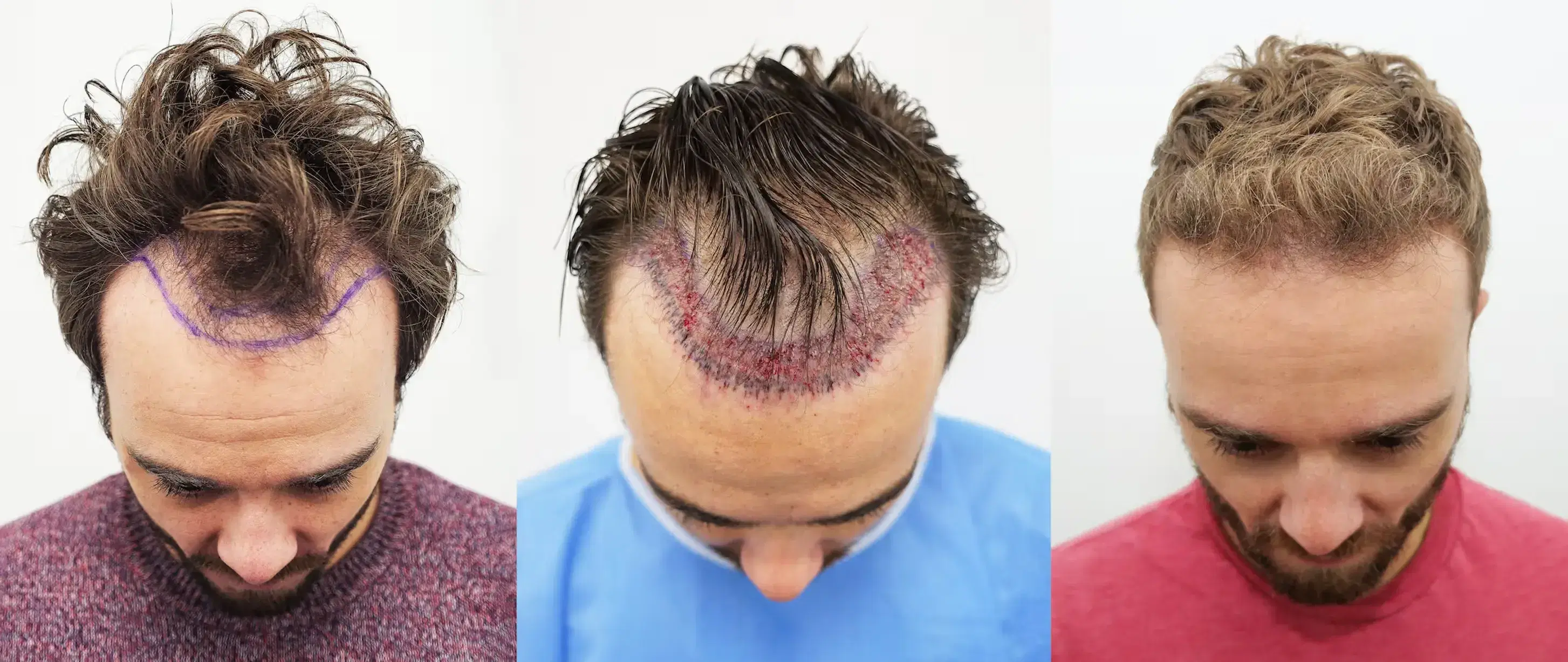
How Many Hair Transplants Can One Person Have?
Some people undergo one hair transplant and never need another. Others have two, three or occasionally more procedures as their hair loss progresses or their restoration goals change.
There is no fixed surgical limit that applies to everyone.
The number of possible operations depends on how many healthy follicles remain in the donor region, how they were harvested during earlier sessions and how much additional coverage is required.
Someone who received a modest frontal transplant may retain enough donor hair for further work years later. Another person who underwent extensive harvesting during the first operation may have very limited options.
The number of surgeries is therefore less informative than the cumulative number of grafts removed and the condition of the remaining donor scalp.
Is There a Maximum Number of Hair Transplant Surgeries?
Hair transplantation does not have a universal maximum of two or three procedures. The scalp can undergo additional surgery when sufficient stable donor hair remains and the recipient area can support further implantation.
However, surgical feasibility is different from whether another procedure is worthwhile.
A technically possible transplant may provide only a small cosmetic improvement while creating noticeable donor thinning.
Repeated surgery also introduces additional scar tissue and reduces flexibility for future treatment.
The practical limit is reached when another operation would require sacrificing too much remaining donor coverage or would offer too little benefit to justify the additional intervention.
Why Is Donor Hair a Limited Lifetime Resource?
A hair transplant redistributes existing follicles. It does not generate a new supply.
Most scalp grafts come from the back and sides of the head, where hair commonly shows greater resistance to androgen-related thinning.
Every harvested follicular unit leaves its original location and is transferred to another area.
This creates a permanent exchange: greater coverage in the recipient area comes at the cost of fewer follicles in the donor region.
Imagine spending most of the available donor supply to create a particularly dense hairline at age twenty-eight. If extensive crown loss develops fifteen years later, the remaining grafts may be insufficient to restore it.
This is why donor hair must be managed across decades rather than a single operation.
How Many Grafts Can Be Taken From the Scalp Over a Lifetime?
Published surgical guidance has described a possible lifetime harvesting range of approximately 4,000 to 6,500 scalp grafts across multiple procedures.
That range is an estimate from relatively limited evidence, not a universal allowance or a target every patient should reach.
A person with thick hair, high follicular-unit density and a large stable donor region may have more usable hair than someone with fine strands and a smaller donor area.
Previous extraction, scalp elasticity and follicular miniaturization further change the calculation.
A graft count should therefore emerge from measured donor characteristics.
Is a Second Hair Transplant Usually Possible?
A second hair transplant is a realistic option when the first procedure has healed, additional hair restoration would provide a meaningful improvement and adequate donor follicles remain.
Many second operations address areas that were deliberately left untreated during the first session.
Others strengthen a hairline that has become isolated as native hair behind it continues thinning.
A second transplant does not necessarily mean that the original grafts failed.
However, repeating surgery without reassessing the donor region can produce a different problem: greater fullness on top of the head accompanied by permanent thinning at the back.
Both areas must be considered together.
What Are the Main Reasons People Need Another Hair Transplant?
A repeat procedure may be considered for several distinct reasons, each requiring a different approach to graft allocation.
Progressive natural hair loss: Native hair may continue thinning around successfully transplanted follicles, creating new gaps behind the restored hairline or across the crown.
Additional density: The first operation may have provided adequate coverage but deliberately left room for a carefully planned second session.
Untreated areas: A previous procedure may have focused on the frontal scalp, leaving the mid-scalp or crown for later restoration.
Correction of an earlier result: An unnatural hairline, poor graft direction or uneven coverage may require selective revision rather than a large new transplant.
Can Someone Have a Third or Fourth Hair Transplant?
A third or fourth transplant can be possible, but each additional procedure operates within a smaller remaining donor reserve.
The earlier surgeries matter more than their number alone.
Three conservative sessions may have removed fewer grafts than one excessively aggressive operation. Conversely, several closely spaced extractions from the same donor region can produce significant depletion even when individual sessions appeared modest.
The recipient scalp also deserves reassessment because previous implantation may have changed local tissue characteristics.
Before proceeding, the expected visual improvement should be compared with the follicles still available for harvesting.
The ability to perform another operation should never be mistaken for an obligation to use every remaining graft.
Is It Better to Have Several Smaller Sessions or One Large Procedure?
Dividing hair restoration into stages can preserve flexibility when future hair loss is uncertain.
For example, restoring the frontal scalp first allows its final density and the progression of native hair loss to become clearer before committing additional grafts to the crown.
However, smaller procedures are not automatically safer simply because fewer grafts are harvested each time.
Repeated anesthesia, wound healing and donor extraction still accumulate.
A large procedure may be reasonable when donor capacity is well established and the planned recipient area is appropriate.
The better approach balances total graft demand, tissue recovery and future donor preservation rather than assuming that either one large session or several small sessions is always preferable.
Do Extracted Donor Follicles Ever Grow Back?
A follicular unit that has been completely removed during FUE does not normally regenerate at its original donor location.
The same underlying limitation applies to follicles removed through FUT strip harvesting.
After surgery, surrounding hairs can grow longer and conceal the extraction sites, giving the impression that the donor region has fully recovered.
This visual improvement does not mean the harvested follicles have returned.
Temporary postoperative shedding of unharvested hairs is different because those follicles may resume normal growth.
When calculating the remaining donor supply, the follicles previously extracted must be treated as permanently used.
What Is the Safe Donor Zone, and Can It Change With Age?
The safe donor zone refers to scalp regions expected to retain relatively stable hair despite the progression of androgenetic alopecia.
It commonly includes selected areas across the back and sides of the head.
However, its boundaries are not identical in every person or permanently fixed throughout life.
Some individuals develop retrograde alopecia, with thinning that advances upward from the nape or affects the areas around the ears.
Others show diffuse miniaturization within regions initially considered suitable for harvesting.
Taking grafts from these unstable areas can result in transplanted hairs that eventually thin at their new location.
A previous donor map should therefore not be treated as permanently valid.
How Are Remaining Donor Grafts Measured After Previous Surgery?
The first step is to examine what remains rather than rely exclusively on the graft count recorded during the earlier operation.
Trichoscopy or digital magnification can help assess follicular-unit density, individual hair thickness and signs of miniaturization.
The assessment should cover multiple locations across the back and sides of the scalp.
It also needs to identify where earlier FUE extractions were concentrated or whether an FUT scar limits future harvesting.
Hair length can conceal reduced density, so an apparently full donor area may still contain fewer usable follicles than expected.
A reliable estimate considers both the number of remaining units and the coverage that must be preserved around them.
Which Findings Matter Before Approving Another Procedure?
A repeat transplant requires a fresh assessment of the donor and recipient areas because their condition may have changed substantially since the previous operation.
Remaining follicular density: Measurements must establish how many stable units remain without reducing the donor region to an unacceptably sparse appearance.
Signs of miniaturization: Progressive thinning within the donor area can indicate that some apparently available follicles may not provide durable transplanted growth.
Previous extraction and scarring: Concentrated FUE harvesting, linear FUT scars and altered scalp elasticity can restrict where additional grafts can be obtained.
Current and future recipient needs: The size of untreated areas, ongoing hair loss and likely progression determine whether using the remaining grafts now is justified.
Why Do Graft Counts Not Tell the Whole Story?
A follicular unit can contain one hair or several hairs, so two procedures involving the same number of grafts may transfer very different numbers of individual strands.
Hair shaft thickness also affects coverage. A relatively coarse hair can conceal more scalp than a fine strand.
Curl pattern and hair-to-skin color contrast further influence apparent density.
This means that two people with the same remaining graft count may have very different restoration possibilities.
It also explains why maximizing extraction numbers does not automatically produce a better result.
The relevant goal is useful visual coverage from healthy follicles, achieved without creating a visible shortage in the donor region.
Can FUE Be Repeated in the Same Donor Area?
Repeat FUE is possible when the region still contains sufficient stable follicles and previous harvesting has not created excessive depletion.
The main concern is cumulative extraction density.
A donor area that tolerated its first procedure well may become patchy if another session removes too many units from the same narrow band.
Small scars and pale extraction marks can also become more noticeable as surrounding hair density falls.
Another FUE session should be planned around the remaining follicular pattern, not simply the fact that the area healed after the first operation.
Can FUT Be Performed More Than Once?
Repeated FUT can be considered when the scalp retains enough elasticity and a suitable strip of stable donor hair remains.
Unlike FUE, FUT removes a section of hair-bearing skin and closes the resulting wound.
A subsequent strip procedure may sometimes incorporate the previous linear scar, although the feasibility depends on its location, width and the surrounding tissue.
Repeated removal can increase tension during closure, making scalp laxity an important consideration.
A wide existing scar may also complicate planning.
FUT does not create an unlimited alternative supply of follicles. It harvests from the same finite scalp resource, even though the pattern of tissue removal differs from FUE.
Is It Possible to Combine FUE and FUT Over Several Surgeries?
Some patients undergo FUT during one stage of restoration and FUE during another.
The techniques can complement one another because strip harvesting removes a continuous section of scalp while FUE collects selected follicular units individually.
For someone with an existing FUT scar, later FUE may provide access to suitable remaining follicles without requiring another strip excision.
In other situations, FUT may still be considered after previous FUE if adequate scalp elasticity and donor density remain.
Combining methods can improve how the available resource is used, but it does not increase the total number of naturally occurring scalp follicles.
Both the scar burden and the cumulative reduction in donor density must be assessed.
How Long Should You Wait Between Hair Transplants?
The timing of another procedure should allow enough healing and hair growth to assess the previous result accurately.
Transplanted hair often begins growing visibly after approximately three to four months, while density continues developing through the following year.
Some results, particularly in the crown, may continue maturing for twelve to eighteen months.
Planning density correction before this process is sufficiently advanced risks treating an area that has not yet reached its final appearance.
The donor region also needs time to recover from temporary shedding and early healing changes.
There is no universal minimum waiting period appropriate for every repeat procedure, but the decision should be based on meaningful recovery and reassessment rather than a predetermined calendar date.
Can a Second Transplant Add Density Between Existing Grafts?
A second procedure can increase density within a previously transplanted area when enough space and healthy tissue remain for additional follicular units.
However, inserting grafts between established hairs requires care.
The recipient sites must respect the direction of existing follicles and avoid unnecessary injury to their growth structures.
Excessive crowding can increase tissue trauma without delivering a proportional improvement in visible fullness.
The potential benefit also depends on hair caliber and the coverage already present.
If the existing transplant is reasonably dense but the strands are very fine, the improvement from additional grafts may be less dramatic than the graft number suggests.
Why Is a Receding Hairline Different From Crown Hair Loss?
A relatively small number of grafts placed strategically along the frontal scalp can have a substantial effect because the hairline frames the face.
The crown creates a different demand.
Its surface is often larger, and the natural spiral growth pattern can leave the scalp visible even when transplanted follicles are growing successfully.
For someone with a limited donor reserve, restoring a wide crown to high density may consume grafts that would be more valuable in the frontal region.
This is why surgical priorities matter as much as total graft availability.
A balanced result may involve stronger frontal coverage and more conservative density farther back, rather than treating every thinning area equally.
How Does Age Influence the Number of Future Surgeries?
Age does not directly determine how many hair transplants a person can undergo, but it changes the uncertainty surrounding future hair loss.
A man considering surgery at twenty-five may not yet know how far his androgenetic alopecia will progress.
A low hairline created at that age can consume follicles that might later be needed to address extensive mid-scalp or crown thinning.
In an older person with a well-established pattern, future graft requirements may be easier to estimate.
However, older age does not guarantee stable hair loss or an adequate donor reserve.
The important relationship is between age, progression and the remaining supply of reliable follicles.
Can Finasteride or Minoxidil Reduce the Need for Repeat Surgery?
Medical treatment can sometimes reduce future surgical demand by helping preserve native hair that remains susceptible to androgenetic alopecia.
Finasteride reduces the formation of dihydrotestosterone and can slow follicular miniaturization in suitable men.
Minoxidil may also support hair growth and improve the appearance of thinning areas.
Neither treatment creates a new supply of donor follicles or restores grafts already removed during surgery.
Their main value is preserving or improving hair that might otherwise contribute to new gaps around a transplant.
Both treatments require an appropriate assessment of benefits, adverse effects and ongoing use.
Managing hair loss medically can be particularly valuable when the donor reserve has already been reduced by previous procedures.
What Happens When the Donor Area Has Been Overharvested?
Overharvesting occurs when too many follicular units are removed relative to the original density and the amount of hair needed to maintain natural donor coverage.
The result can be permanent patchiness, visible scalp or a distinctive irregular appearance across the back of the head.
These changes may become particularly apparent with short haircuts.
Because extracted follicles do not regenerate, simply allowing more recovery time cannot replace genuinely missing donor units.
Longer hair or scalp micropigmentation may reduce the visual contrast.
Further transplantation into the depleted region is possible in selected circumstances but consumes additional follicles and may provide limited improvement.
Preventing overharvesting is considerably easier than correcting its consequences.
Can Beard or Body Hair Expand the Donor Supply?
Beard and body hair can provide additional follicles when the scalp donor reserve is limited.
Beard hair often has a coarser diameter and may contribute useful coverage in selected regions, particularly when blended with scalp hair.
Body hair presents different challenges because its growth cycle, length and texture may differ substantially from scalp hair.
Its behavior after transplantation is also less predictable.
These alternative donor sources are not suitable substitutes for carefully selected scalp follicles in every location, especially along a delicate frontal hairline.
Their use should be considered a supplementary strategy rather than an unlimited extension of the original donor supply.
What Are the Warning Signs That Another Transplant Is a Bad Idea?
Several findings suggest that further surgery could create more problems than it solves, particularly when the available donor follicles are already limited.
Visible donor depletion: Patchy thinning, extensive extraction marks or very low remaining density may indicate that additional harvesting would produce an unacceptable appearance.
Unstable donor hair: Significant miniaturization or progressive thinning at the back and sides can make the remaining follicles unsuitable for durable transplantation.
Active scalp disease: Uncontrolled inflammatory or scarring alopecia may threaten both existing follicles and newly transplanted grafts.
Disproportionate graft demand: When the desired coverage requires more follicles than can be safely harvested, another operation may compromise the donor area without meeting the intended result.
Can Hair Be Transplanted Into Scar Tissue After Earlier Surgery?
Selected scars can receive transplanted hair, including certain linear donor scars or areas affected by previous surgical damage.
However, scar tissue differs from ordinary scalp.
Its blood supply, thickness and elasticity may be altered, making follicular survival less predictable.
A broad scar may require conservative graft placement rather than an attempt to achieve dense coverage immediately.
It is also necessary to distinguish a stable surgical scar from active scarring alopecia, which can continue destroying follicles.
Scar transplantation should therefore be considered a specialized corrective procedure.
The presence of an old scar does not automatically prevent further hair restoration, but it changes how the available follicles should be used.
What Options Exist When Another Hair Transplant Is Not Possible?
When donor follicles are insufficient, further surgery may offer little benefit or create unacceptable thinning elsewhere.
Scalp micropigmentation can reduce the visual contrast between hair and skin, although it does not produce actual hair growth.
Hair systems offer another non-surgical way to cover extensive loss without consuming remaining follicles.
Strategic haircuts and styling can also improve the appearance of existing density.
For people with ongoing androgenetic alopecia, appropriate medical treatment may help maintain native hair that has not yet been lost.
These options have different maintenance requirements and limitations, but they can provide meaningful cosmetic improvement without adding further surgical damage.
How Should a Lifetime Hair Restoration Plan Be Designed?
The strongest long-term plan begins by separating what a person wants to restore today from what they may need to preserve for the future.
It accounts for the current hair-loss pattern, likely progression, hair shaft characteristics and the amount of stable donor hair that can be harvested safely.
A conservative frontal design may remain natural for decades, while an aggressively low hairline can consume grafts that later become difficult to replace.
Staging surgery can preserve flexibility, but dividing treatment into multiple procedures does not make donor follicles renewable.
The most important calculation is not how many times the scalp can be operated on. It is how much useful coverage can be achieved over a lifetime without exhausting the remaining donor resource.
One carefully planned transplant may meet that goal. For another person, two or three procedures may produce a better long-term balance.
The appropriate endpoint is reached when the existing result is sustainable and additional surgery would offer less value than preserving the hair that remains.