
What Is Scalp Inflammation?
Scalp inflammation describes an inflammatory response affecting the skin of the scalp and sometimes the follicles beneath it, rather than one specific medical condition.
The scalp may become inflamed because of dermatitis, psoriasis, infection, allergic reactions, folliculitis, or less common disorders that directly attack or damage hair follicles. Each condition can produce a different combination of itching, scaling, tenderness, pustules, redness, or hair loss.
That distinction matters because treatment that works well for ordinary dandruff may be inappropriate for a fungal infection or inflammatory scarring alopecia. Identifying the pattern usually matters more than simply trying to reduce redness.
What Does an Inflamed Scalp Feel Like?
An inflamed scalp can feel itchy, sore, tight, tender, warm, or unusually sensitive, and some people notice burning even when the visible skin changes appear relatively mild.
Common symptoms include:
Persistent itching
Burning or stinging
Red or discoloured patches
White, yellow or silvery scale
Tenderness when touching the hair
Greasy flaking
Small bumps or pustules
Crusting
Bleeding after scratching
Increased shedding
Broken hairs
Localised areas of thinning
The combination provides more information than one symptom alone. An oily, flaky scalp suggests a different problem from a painful area containing pustules or a smooth region where follicle openings appear to disappear.
What Causes Scalp Inflammation?
Scalp inflammation can develop from inflammatory skin conditions, infection, irritation, allergy, follicular disorders, or repeated physical and chemical stress.
Common causes include:
Seborrheic dermatitis
Scalp psoriasis
Contact dermatitis
Bacterial folliculitis
Fungal scalp infection
Atopic eczema
Reactions to hair dye
Fragrances or preservatives in hair products
Heavy product buildup
Excessive scratching
Tight hairstyles that irritate follicles
Certain scarring alopecias
Autoimmune or inflammatory skin disease
Several causes can resemble one another during the early stages. A flaky scalp should therefore not automatically be labelled dandruff when pain, patchy hair loss, pustules, or progressive thinning accompany the scale.
Can Scalp Inflammation Cause Hair Loss?
Scalp inflammation can cause temporary hair loss when itching, scratching, scale, infection, or inflammatory activity disrupts the normal environment around growing hair.
The type of hair loss depends on the underlying condition. Psoriasis can lead to temporary shedding when severe scale and scratching loosen hairs, while fungal infection can cause patches containing broken or missing hair.
Inflammation can also make existing pattern hair loss look more obvious by reducing density temporarily.
Most importantly, inflammatory shedding does not automatically mean follicles have died. Many hairs can return once the scalp condition improves, provided inflammation has not permanently scarred the follicle.
Can Scalp Inflammation Permanently Damage Hair Follicles?
Severe or persistent inflammation can permanently damage follicles when an inflammatory disease destroys the follicular structure and replaces it with scar tissue.
This process is known as scarring or cicatricial alopecia. Unlike temporary shedding, the affected follicle can no longer produce a normal hair once it has been destroyed.
A smooth or shiny area with disappearing follicular openings can raise more concern than ordinary dandruff-related shedding. Burning, pain, tenderness, perifollicular scale, and progressive localised thinning may also appear in certain scarring conditions.
Early assessment matters because treatment generally aims to stop additional follicle destruction rather than recreate follicles that have already been lost.
Is Dandruff a Form of Scalp Inflammation?
Dandruff represents a mild form within the seborrheic dermatitis spectrum and typically causes flaking with little or no obvious redness.
The flakes may be white or slightly oily, and itching can range from almost absent to troublesome. Symptoms often fluctuate rather than remaining equally severe every day.
Dandruff itself usually does not destroy hair follicles. Aggressive scratching, repeated picking, or significant overlapping dermatitis can still make hair shed more noticeably.
Someone with severe redness, thick plaques, pain, pustules, crusting, or clear patches of hair loss should not assume that ordinary dandruff explains everything simply because flakes are present.
How Does Seborrheic Dermatitis Affect the Scalp?
Seborrheic dermatitis commonly causes recurrent scalp inflammation with itching, redness and greasy or flaky scale in areas where sebaceous glands are active.
Symptoms often move through better and worse periods. Some people experience only mild dandruff, while others develop obvious inflammatory patches extending around the hairline, eyebrows, ears, or facial folds.
The condition can make the scalp uncomfortable and increase apparent shedding, particularly when scratching becomes frequent.
It does not normally produce permanent baldness by itself. When substantial hair loss appears alongside suspected seborrheic dermatitis, it is useful to consider whether another hair-loss process is occurring at the same time.
What Does Scalp Psoriasis Look Like?
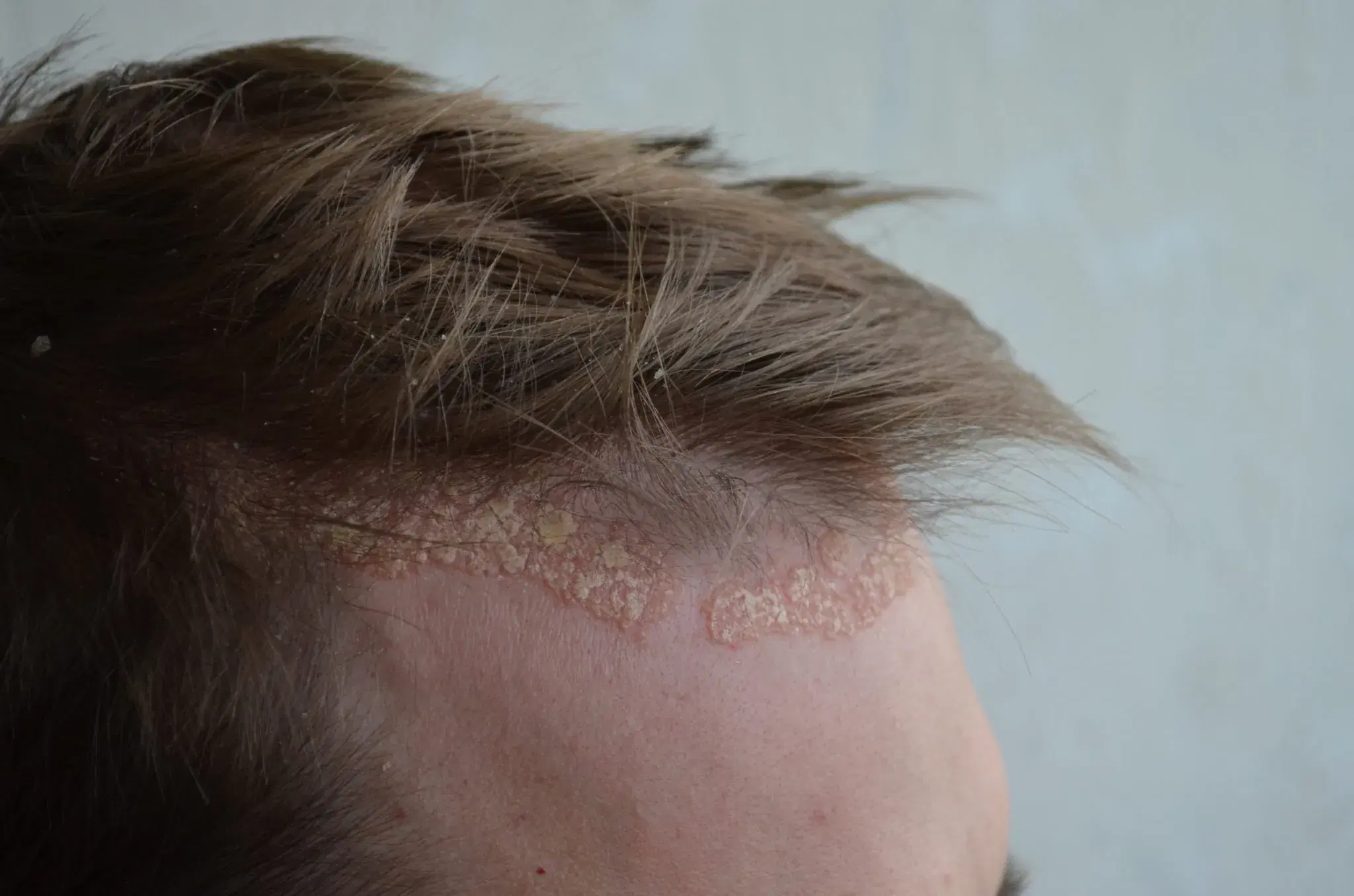
Scalp psoriasis commonly produces well-defined inflammatory plaques covered by thicker scale, which may look white or silvery and can extend beyond the hairline.
The scalp may become intensely itchy, dry, sore, or burning. Forcefully scratching or pulling off adherent scale can cause bleeding and may remove hairs along with the scale.
Temporary hair loss can therefore accompany a severe flare without indicating permanent follicle destruction.
Psoriasis can resemble severe dandruff, particularly when the plaques are relatively thin. The distinction becomes more apparent when thick scale, sharply defined patches, similar skin changes elsewhere, or recurrent inflammatory flares occur.
Can Folliculitis Cause an Inflamed Scalp?
Folliculitis can cause scalp inflammation when individual hair follicles become irritated or infected, producing small tender bumps, pustules, crusting, or localised soreness.
The scalp may feel painful when brushing or pressing against a pillow, which differs from the mainly itchy presentation of ordinary dandruff.
Mild folliculitis can settle without permanent hair loss, while persistent or severe follicular inflammation needs closer attention because some forms can scar.
Repeatedly squeezing scalp pustules can worsen irritation and introduce additional infection.
When bumps recur in the same areas, leave scars, or accompany progressive thinning, identifying the exact type of follicular inflammation becomes more important than treating every episode as a simple spot.
Can a Fungal Infection Cause Scalp Inflammation?
Fungal infection of the scalp can cause scale, broken hairs and patches of hair loss, with some inflammatory cases becoming painful, swollen and pustular.
Tinea capitis is particularly important because the fungus involves hair shafts and follicles rather than merely sitting on the scalp surface. Some cases show black dots where hairs have broken close to the skin.
A severe inflammatory reaction can produce a boggy, tender swelling known as a kerion.
Unlike routine dandruff, scalp ringworm generally requires systemic antifungal treatment because topical shampoo alone cannot reliably eliminate infection deep within affected hair follicles.
Can Hair Products Cause Scalp Inflammation?
Hair products can cause scalp inflammation when an ingredient irritates the skin or triggers allergic contact dermatitis.
Hair dye, fragrances, preservatives, styling products, shampoos, adhesives and certain botanical ingredients can all become triggers in susceptible individuals.
The reaction may cause burning, itching, redness, swelling, flaking, or small blisters. Symptoms can extend beyond the scalp to the hairline, ears, forehead, eyelids, or neck depending on where the product touched the skin.
A product labelled natural is not automatically non-irritating.
When symptoms repeatedly appear after the same colour treatment or product, stopping the suspected exposure becomes more useful than continuously adding anti-dandruff products.
Can an Oily Scalp Still Be Inflamed?
An oily scalp can be inflamed because excess surface oil and inflammation are not opposites, particularly in seborrheic dermatitis.
Some people respond to greasy roots by shampooing aggressively several times a day, which can add irritation without addressing the underlying condition. Others avoid washing because they fear increased shedding, allowing scale and buildup to become more noticeable.
The correct cleansing frequency depends on scalp characteristics and the cause of inflammation.
Oiliness alone does not reveal whether the scalp is healthy. A greasy scalp that also burns, itches, flakes heavily, or develops sores deserves attention even when the hair itself does not feel dry.
Can Stress Make Scalp Inflammation Worse?
Stress can aggravate several inflammatory scalp disorders in susceptible people, although it does not explain every flare and should not replace a proper diagnosis.
Someone may notice psoriasis, seborrheic dermatitis, itching, or scratching becoming more troublesome during periods of poor sleep and emotional strain.
Stress can also coincide with telogen effluvium, creating two overlapping problems: an inflamed scalp and increased diffuse shedding from a delayed hair-cycle response.
That combination can make the situation appear more severe than either problem alone.
Treating scalp inflammation still matters even when stress clearly contributed, because waiting for life to become calmer may leave a treatable skin condition active.
How Can You Tell Scalp Inflammation From a Dry Scalp?
A dry scalp mainly reflects reduced moisture or barrier disruption, while inflammatory scalp disease more often produces persistent itching, redness, scale, tenderness, plaques, or other visible skin changes.
The distinction is not always obvious because an inflamed scalp can also feel dry.
Simple dryness may improve after changing harsh shampoos, reducing very hot water, or using gentler products. Persistent greasy flakes suggest a different process, while thick silvery scale can point toward psoriasis.
Pustules, crusts, pain, marked redness, or patchy hair loss are even less typical of uncomplicated dryness.
Repeatedly applying oils without identifying the cause can sometimes worsen buildup or certain scalp conditions.
Can Scalp Inflammation Cause Burning Without Visible Redness?
Scalp inflammation can produce burning or tenderness before dramatic redness becomes visible, particularly because hair can make subtle skin changes difficult to see.
Skin tone also influences how inflammation appears. Redness may look pink or bright red on some skin tones but appear darker, violaceous, greyish, or less visually obvious on others.
Persistent burning therefore deserves attention even when the scalp seems normal in a mirror.
Tenderness concentrated around follicles, progressive thinning, significant itching, or scale around individual hairs can provide additional clues.
A painful or burning scalp accompanied by hair loss should not automatically be dismissed simply because visible inflammation seems limited.
How Should an Inflamed Scalp Be Washed?
An inflamed scalp should generally be cleansed gently enough to remove sweat, oil and scale without repeatedly scratching or stripping the skin.
Very hot water, aggressive fingernail scratching, rough scalp brushes and harsh repeated cleansing can intensify irritation. Using the fingertips with controlled pressure usually creates less trauma.
The most suitable shampoo depends on the diagnosis.
An anti-dandruff shampoo may help seborrheic dermatitis, while psoriasis, fungal infection and contact dermatitis can require completely different approaches.
Someone who notices burning immediately after shampooing should also consider whether a product ingredient is irritating the scalp rather than assuming that the discomfort proves the shampoo is working.
Should You Remove Scales From an Inflamed Scalp?
Scalp scale should be managed gently because forcefully scraping or picking it can cause bleeding, increase inflammation and pull out hairs that are trapped within adherent scale.
Thick plaques can feel satisfying to remove, but aggressive mechanical removal often makes the scalp more irritated afterward.
When scale needs softening, treatment should match the underlying condition rather than relying on fingernails or sharp tools.
Repeated picking can also make it harder to determine what the original disease looks like because scratching creates additional wounds and crusts.
If scale is unusually thick, painful, persistent, or associated with hair loss, diagnosis becomes more important than simply removing the visible flakes.
What Treatments Are Used for Scalp Inflammation?
Treatment for scalp inflammation depends on the cause because antifungal, anti-inflammatory and antimicrobial therapies target very different processes.
Seborrheic dermatitis may respond to medicated shampoos and anti-inflammatory scalp treatments. Psoriasis can require topical medication, scale-softening approaches, light-based treatment, or systemic therapy when disease is extensive.
Folliculitis treatment depends on whether infection or another inflammatory disorder is responsible.
Scalp fungal infection generally requires an oral antifungal medicine rather than shampoo alone.
Contact dermatitis improves by identifying and avoiding the trigger while controlling inflammation. Scarring alopecia may require stronger anti-inflammatory treatment aimed at protecting follicles that remain active.
When Can Scalp Inflammation Become a Hair-Loss Emergency?
Scalp inflammation deserves prompt assessment when symptoms suggest infection, rapidly progressive follicle damage, or another process capable of producing permanent hair loss.
More concerning changes include:
Rapidly expanding bald areas
Severe scalp pain or burning
Pus or draining lesions
A soft, swollen inflammatory mass
Fever with worsening scalp symptoms
Smooth or shiny areas losing follicle openings
Progressive scarring
Significant swelling after hair dye
Facial or eye swelling
Difficulty breathing after a product exposure
Extensive crusting with hair loss
Rapid thinning accompanied by marked tenderness
Breathing difficulty or severe allergic swelling requires emergency care, while progressive inflammatory hair loss deserves timely dermatologic assessment.
Will Hair Grow Back After Scalp Inflammation?
Hair can grow back after many inflammatory scalp conditions when the follicles remain intact and the underlying inflammation is brought under control.
Temporary loss from psoriasis, scratching, mild dermatitis, or some infections may improve gradually after the scalp recovers. Regrowth still takes time because follicles must restart active growth and new strands need enough length to become visible.
Scarring alopecia follows a different course.
Once inflammation permanently destroys a follicle and scar tissue replaces it, that follicle cannot produce normal hair again. The priority then becomes stopping inflammation before additional follicles are lost, which makes early recognition particularly important.
When Should Scalp Inflammation Be Medically Evaluated?
Scalp inflammation should be medically evaluated when it persists despite basic care, repeatedly returns, causes significant discomfort, or begins to affect hair density.
Pain, pustules, thick scale, bleeding, sores, patchy hair loss, or progressive recession deserve particular attention. The same applies when inflammation spreads beyond the scalp or begins soon after hair dye or another chemical exposure.
Diagnosis may involve direct scalp examination and, in selected cases, fungal testing, cultures, dermoscopy, allergy investigation or a small skin biopsy.
The purpose is not simply to give the inflammation a name, but to identify whether hair follicles face any risk of lasting damage.
What Is the Most Important Thing to Know About Scalp Inflammation?
The most important point is that scalp inflammation ranges from common, manageable dandruff to less common conditions that can permanently damage hair follicles, so the pattern and severity matter more than the word inflammation itself.
Itching and flaking alone often reflect a treatable surface condition, while persistent pain, pustules, thick plaques, patchy loss, or disappearance of follicle openings deserve closer attention.
Hair loss from inflammation is frequently temporary when follicles remain intact.
When a condition causes scarring, however, early treatment becomes much more important because controlling active inflammation can protect remaining follicles even though already destroyed follicles cannot simply regenerate.