
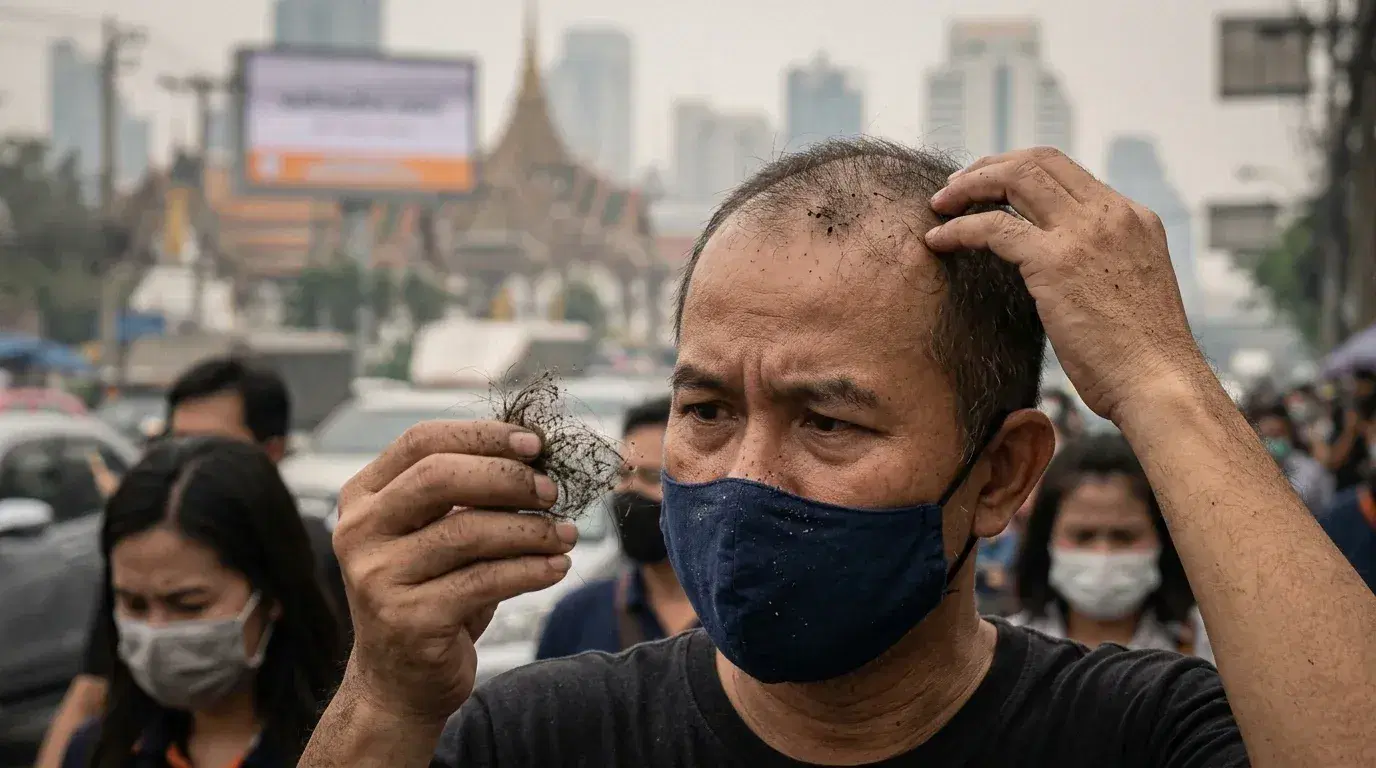
Bangkok air pollution may contribute to scalp irritation and hair health problems through exposure to fine particles, traffic emissions and other environmental pollutants. Although research suggests a possible relationship between long-term particulate matter exposure and certain forms of hair loss, pollution has not been established as a direct cause of every episode of thinning or shedding.
Why Is Air Pollution a Concern for Hair Health in Bangkok?
Bangkok experiences a combination of heavy road traffic, urban emissions and seasonal changes in air circulation that can increase pollution levels. Residents who commute through busy streets, work outdoors or spend long periods near major roads may encounter airborne particles as part of their daily routine.
The scalp is continuously exposed to the surrounding environment, particularly when hair is short or thinning. Airborne particles can settle on the hair and skin, where they mix with sweat, natural oils and styling products. This accumulation may increase discomfort in people who already experience itching, sensitivity or inflammatory scalp conditions.
However, visible dust on the hair does not mean that follicles have been permanently damaged. Understanding the difference between surface buildup, scalp inflammation and actual hair loss is essential when evaluating the potential effects of Bangkok's air pollution.
What Is PM2.5 and Why Does It Matter?
PM2.5 refers to airborne particles with a diameter of 2.5 micrometers or smaller. These particles can originate from vehicle exhaust, industrial activity, combustion and chemical reactions occurring in the atmosphere. Their small size makes them particularly important from a public health perspective because inhaled particles can reach deep into the respiratory system.
For scalp health, researchers are interested in how pollutants interact with the skin barrier and hair follicles. Laboratory investigations have shown that particulate matter can stimulate inflammatory responses and oxidative stress in cells involved in hair growth.
These findings provide a possible biological explanation for pollution-related hair concerns, but laboratory exposure does not reproduce every aspect of daily life in Bangkok. The concentration, duration and composition of real-world exposure can vary considerably.
When Is Bangkok's Air Pollution at Its Worst?
Bangkok generally experiences higher PM2.5 concentrations during the cooler, drier months, particularly from December through February. During this period, weaker winds and atmospheric conditions that restrict vertical air movement can allow pollutants to accumulate closer to the ground.
Traffic and other urban emissions occur throughout the year, but seasonal weather determines how effectively those pollutants disperse. Smoke from agricultural burning outside the city can also contribute to pollution episodes when regional winds transport particles toward Bangkok.
The rainy season often brings lower average particulate concentrations because rainfall and changing atmospheric conditions help remove or disperse some pollutants. Nevertheless, lower seasonal averages do not guarantee clean air every day, especially near busy roads or construction activity.
For residents concerned about exposure, checking current air quality provides more useful information than relying exclusively on the month or the appearance of the sky.
Can Bangkok Air Pollution Actually Cause Hair Loss?
Research increasingly suggests that prolonged exposure to particulate matter may influence hair follicle health, but the relationship requires careful interpretation. Laboratory studies have found that pollutants can affect follicular cells, while population-level research has identified associations between long-term particulate exposure and certain diagnosed hair loss conditions.
One large observational study found that higher particulate matter exposure was associated with an increased likelihood of androgenetic alopecia. However, observational findings cannot establish that air pollution directly caused the condition, and results from one population cannot automatically be applied to Bangkok residents.
Hereditary hair loss is strongly influenced by genetic susceptibility and hormonal responses within the follicles. Environmental factors may contribute additional stress, but current evidence does not justify treating Bangkok smog as an independent explanation for male or female pattern baldness.
The appropriate conclusion is that air pollution represents a potential contributing factor worth studying, not a confirmed cause of permanent hair loss in every exposed individual.
How Air Pollution May Affect Hair Follicles and the Scalp
The possible effects of pollution involve several biological processes rather than one straightforward pathway. Researchers have focused particularly on oxidative stress, inflammatory signaling and disruption of the skin's protective barrier.
Oxidative Stress and Hair Follicle Function
Oxidative stress develops when reactive molecules accumulate beyond the capacity of normal protective systems to manage them. Hair follicles are metabolically active structures, making their cells potentially vulnerable to substantial changes in their surrounding environment.
Experimental research has shown that particulate matter can increase oxidative stress and inflammatory activity in follicular cells. These effects may interfere with normal cellular function, although the degree to which everyday urban exposure produces clinically meaningful hair loss remains uncertain.
Importantly, laboratory findings should not be translated into claims that a particular shampoo or antioxidant supplement can prevent pollution-related baldness.
Scalp Barrier Disruption and Inflammation
The scalp contains a protective skin barrier that helps retain moisture and limit exposure to external irritants. Pollution may affect this barrier and contribute to inflammatory responses, particularly when the skin is already sensitive.
People experiencing dermatitis or recurring scalp irritation may notice greater discomfort during periods of environmental exposure. However, itching and redness can also result from sweat, hair products, dandruff or other conditions unrelated to particulate matter.
Identifying the actual source of inflammation is more useful than assuming that every scalp reaction comes from polluted air.
Pollution-Related Hair Damage vs True Hair Loss
Hair can look thinner after repeated environmental exposure without a measurable reduction in functioning follicles. Sweat, scalp oil and airborne residue may cause strands to clump together, reducing volume and making the underlying skin more visible.
The hair shaft can also experience physical and chemical weathering over time. Environmental exposure, repeated washing, sunlight and heat styling may contribute to roughness or breakage, although pollution is only one possible factor among several.
True follicular hair loss produces a different pattern. A gradually widening part, recession around the temples or progressive crown thinning may indicate androgenetic alopecia, while sudden widespread shedding can develop after illness, nutritional disturbances or substantial physiological stress.
Recognizing these differences prevents unnecessary attempts to treat hereditary hair loss with cleansing products alone.
Does Bangkok's Heat and Humidity Make Pollution Worse for the Scalp?
Bangkok's hot and humid conditions create a distinctive environment for scalp care. Perspiration can mix with sebum, particulate residue and styling products, making the roots feel coated after a day outdoors or a lengthy commute.
When hair becomes greasy and clumps together, thinning areas may appear more prominent. This cosmetic change does not necessarily indicate increased shedding, but it can make existing density problems more noticeable.
Humidity also influences hair texture, particularly in people with naturally wavy, curly or chemically treated strands. Frizz and repeated restyling may encourage excessive brushing or heat exposure, adding mechanical stress that is separate from pollution itself.
These overlapping factors explain why changes in hair appearance during Bangkok's hot season should not automatically be interpreted as evidence of pollution-induced follicular damage.
Can Short-Term Exposure Trigger Sudden Hair Shedding?
A few days of heavy haze are not known to cause immediate, widespread hair loss in otherwise healthy individuals. Hair follicles operate through growth cycles that unfold over weeks, months and years, making sudden visible thinning difficult to attribute to a single pollution episode.
Significant scalp irritation may develop more quickly, particularly in people who react to environmental contaminants or already have sensitive skin. However, an itchy scalp and an actual disturbance in the follicular growth cycle are not interchangeable conditions.
When shedding begins abruptly, the preceding months deserve attention. Recent fever, major weight changes, emotional stress, medication changes and nutritional deficiencies may provide more established explanations for temporary telogen effluvium.
Pollution exposure can still form part of the broader history, but timing alone cannot confirm that it caused the shedding.
How to Protect Your Scalp During High-Pollution Days in Bangkok
Reducing exposure is a more practical strategy than relying on products that claim to neutralize environmental toxins. Checking the daily air quality index can help residents decide when outdoor exercise, long walks or other optional activities are better postponed.
During heavily polluted periods, reducing time beside congested roads and choosing less exposed routes may limit unnecessary contact with traffic emissions. A well-fitting particulate respirator can reduce inhalation exposure, although it should not be mistaken for a treatment that directly prevents scalp-related hair loss.
People who exercise outdoors may benefit from moving their workouts indoors when pollution reaches unhealthy levels. Those who must work outside can focus on reasonable exposure reduction, consistent hygiene and protection against other environmental stresses, including strong sunlight.
The objective is to reduce avoidable exposure while maintaining a practical routine, not to eliminate every outdoor activity throughout the dry season.
How Often Should You Wash Your Hair in Polluted Conditions?
Regular cleansing helps remove sweat, natural oil, styling residue and some particles deposited on the scalp. For someone spending considerable time outdoors in Bangkok, washing after a particularly sweaty or dusty day may improve comfort and prevent the roots from feeling excessively coated.
However, washing more frequently does not automatically provide greater protection against follicular hair loss. Aggressive cleansing can leave sensitive skin dry or irritated, while vigorous scrubbing may damage already fragile strands.
A suitable shampoo should clean effectively without creating persistent tightness, itching or burning. People with oily scalps may tolerate regular washing, whereas those with dry or chemically treated hair may need a gentler routine and additional conditioning.
For further guidance, the article on sulfate-free shampoo and gentle scalp cleansing explains how cleansing formulations differ and why the condition of the scalp matters more than the amount of foam produced.
Building a Practical Anti-Pollution Hair Care Routine
A useful hair care routine should address the problems pollution exposure can aggravate without making unsupported promises about hair regrowth. Cleansing, conditioning and reducing unnecessary irritation provide a reasonable foundation for people living in a busy urban environment.
After outdoor exposure, gently washing the scalp can remove accumulated residue. Conditioner should primarily protect the hair lengths from tangling and friction, while products applied directly to the scalp should be chosen according to sensitivity and oiliness.
Heavy oils, strongly fragranced tonics and multiple styling products may leave additional buildup without offering established protection against particulate matter. Similarly, aggressive scalp exfoliation can make an already sensitive skin barrier more uncomfortable.
Consistency matters more than the number of products used. A simple routine that keeps the scalp clean and comfortable is often preferable to frequently changing treatments in response to every period of poor air quality.
Can Indoor Air Quality Help Protect Hair and Scalp Health?
Indoor environments can reduce exposure to outdoor pollution when windows and ventilation are managed appropriately. During severe haze episodes, keeping windows closed and using a properly sized air purifier with an effective particle filter may help lower indoor particulate levels.
However, indoor air is not necessarily clean simply because it is air-conditioned. Outdoor pollutants can enter through ventilation systems, open doors and poorly sealed windows, while cooking and other indoor activities can generate additional particles.
Regular maintenance of air-conditioning filters and appropriate ventilation practices help support indoor air quality. These measures are valuable for general health, although direct evidence that household air purification prevents hair loss remains insufficient.
For people who spend most of their day in offices or apartments, maintaining cleaner indoor air may be a realistic way to reduce overall exposure without relying on specialized cosmetic products.
When Does Scalp Irritation Need Medical Attention?
Persistent itching, redness, flaking or tenderness should not automatically be blamed on Bangkok's air pollution. Seborrheic dermatitis, contact allergies, psoriasis and folliculitis can produce similar symptoms, sometimes becoming more uncomfortable when sweat and environmental residue accumulate.
Small painful bumps or pustules around individual hairs may indicate folliculitis rather than simple pollution buildup. Repeated scratching can worsen irritation, while deeper inflammatory conditions may threaten follicular health if they remain untreated.
The guide to scalp folliculitis and hair loss provides additional information about symptoms that help distinguish ordinary scalp discomfort from follicular inflammation.
A dermatologist should assess persistent shedding, expanding bald patches, scalp pain, crusting or visible changes in density. Identifying an underlying condition allows treatment to address the problem directly rather than assuming that cleaner air or a different shampoo will resolve it.
Can Hair Grow Back After Pollution-Related Scalp Problems?
The possibility of regrowth depends on what caused the thinning. Hair that appears sparse because of oil buildup or reduced volume may look fuller after appropriate cleansing, without any change in the number of active follicles.
Temporary shedding associated with a reversible physiological disturbance can improve when the underlying trigger resolves. However, hair follicles need time to progress through their growth cycle, so visible regrowth may take several months.
Progressive hereditary thinning usually requires a different approach because affected follicles gradually become smaller and produce finer strands. Reducing pollution exposure may support general health, but it has not been shown to reverse androgenetic alopecia.
The most useful first step is establishing whether the concern involves cosmetic flatness, hair shaft damage, temporary shedding or ongoing follicular miniaturization. Each condition has different implications for recovery.
Frequently Asked Questions
The following questions address common concerns about PM2.5 exposure, scalp cleansing and the possibility of permanent hair thinning.
Can Bangkok's PM2.5 pollution cause permanent hair loss?
Research suggests an association between long-term particulate matter exposure and certain hair loss conditions, but direct causation has not been established for individuals living in Bangkok. Permanent thinning should be assessed for established causes such as androgenetic alopecia and inflammatory scalp disorders rather than attributed to pollution alone.
Should you wash your hair every day during Bangkok's pollution season?
Daily washing can be appropriate when heavy sweating, oil and environmental residue make the scalp uncomfortable, provided the shampoo is gentle and the hair tolerates frequent cleansing. People with dry or sensitive scalps may prefer a different schedule, since excessive washing does not provide proven protection against pollution-related follicular damage.
Will hair grow back if you move away from polluted air?
Improved environmental conditions may reduce certain irritants, but moving away from pollution does not guarantee hair regrowth. Recovery depends on whether the follicles remain healthy and whether the underlying cause involves temporary shedding, progressive hereditary thinning or another scalp condition.