
What Is the Difference Between Hairline Lowering Surgery and a Hair Transplant?
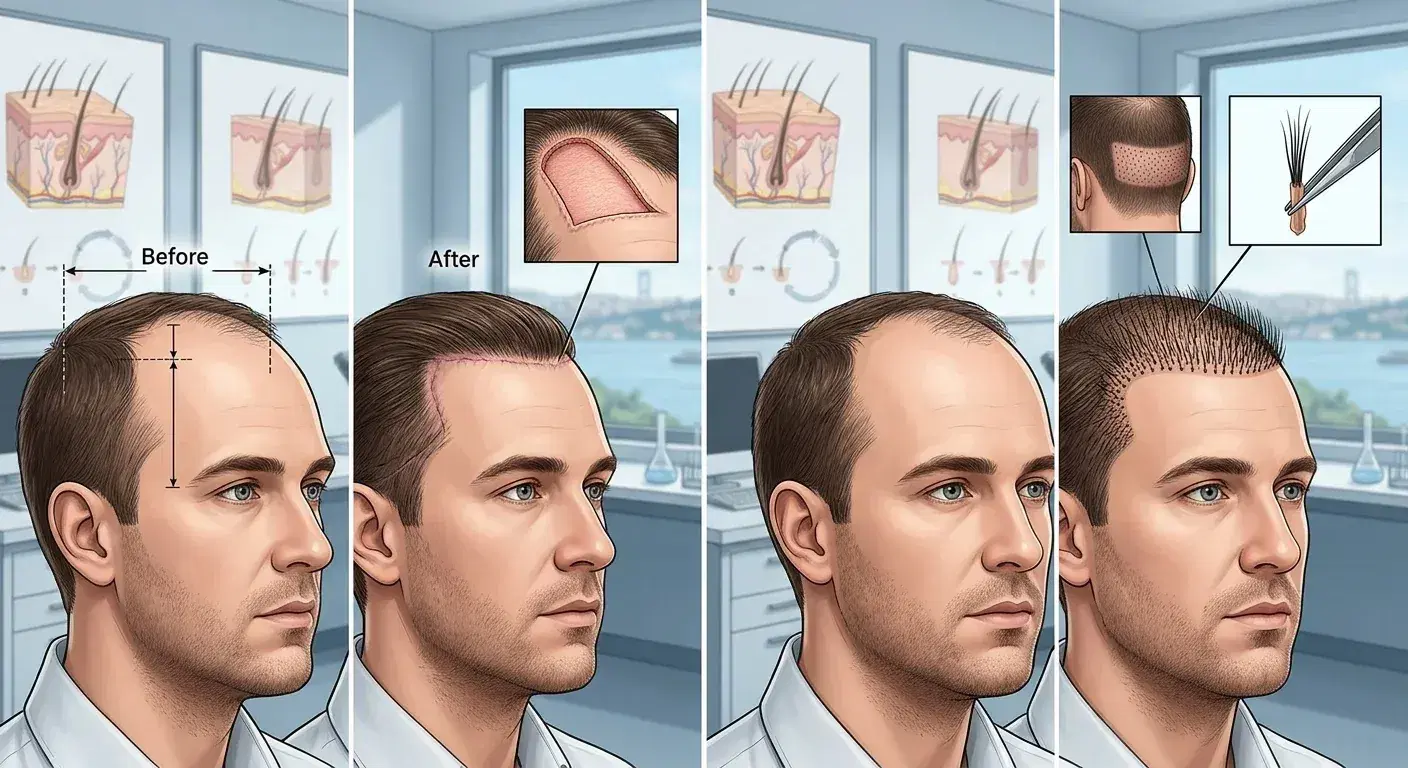
The main difference between hairline lowering surgery and a hair transplant is how each procedure changes the position of the hairline. Hairline lowering, also called forehead reduction or scalp advancement, physically moves the existing frontal hairline closer to the eyebrows. Hair transplantation instead adds follicles in front of the current hairline, gradually creating new coverage in an area that previously had little or no hair.
This distinction affects more than the surgical technique. Scalp advancement preserves the density of the existing frontal hair as it moves forward, whereas transplantation relies on individual grafts to establish density in a new location. The procedures also differ in their incision patterns, recovery processes and suitability for people experiencing progressive hair loss.
Choosing between them requires understanding whether the main concern is forehead height, insufficient hair density or an irregular hairline shape. These problems may look similar in photographs, but they do not always benefit from the same approach.
How Does Hairline Lowering Surgery Work?
Hairline lowering surgery reduces forehead height by removing a measured section of skin near the upper forehead and advancing the hair-bearing scalp forward. The surgeon makes an incision along the existing hairline, releases enough scalp tissue to allow movement and secures the advanced scalp in its new position.
The procedure relies heavily on scalp laxity, which describes how easily the scalp can move without excessive tension. Someone with a naturally flexible scalp may be able to achieve a greater reduction than a person whose scalp tissue is relatively tight. Advancing the hairline too aggressively can place additional stress on the incision and interfere with comfortable healing.
One advantage is that the existing hair density moves forward with the scalp. The change in forehead height becomes visible immediately after surgery, although swelling and the healing incision affect the early appearance. Unlike transplantation, the procedure does not require waiting for thousands of newly implanted follicles to begin producing hair.
How Does a Hair Transplant Lower the Hairline?
Hair transplantation lowers the visible hairline by placing healthy follicles into selected areas of the forehead immediately below the existing hairline. These follicles are generally collected from the back or sides of the scalp, where suitable donor hair is available.
Modern procedures commonly use follicular unit extraction, or FUE, to collect individual follicular units. The grafts are then implanted according to a design that considers the forehead, temples, natural growth direction and desired density. The leading edge usually requires fine single-hair grafts, while suitable multi-hair units can create additional coverage farther behind the frontal border.
Unlike scalp advancement, this approach allows the hairline to be reshaped in different regions without moving the entire scalp. However, transplanted follicles need time to establish themselves and begin growing, so the final change develops gradually over several months.
Which Procedure Is Better for a Naturally High Forehead?
A naturally high forehead does not always indicate hair loss. Some people have maintained the same elevated hairline since adolescence, with strong density and little evidence of progressive recession. In these circumstances, forehead reduction may be worth considering because the objective is to reposition healthy existing hair rather than replace missing follicles.
Hairline lowering surgery can provide a relatively direct reduction in forehead height when scalp mobility is sufficient. A reduction of approximately one to two centimeters may be achievable in selected patients, although the safe amount of movement is determined by tissue flexibility and the tension created during closure.
Hair transplantation offers another option when a person wants a smaller adjustment, a different hairline shape or additional coverage around the temples. It does not require the same degree of scalp mobility, but a substantial reduction may consume a large number of donor follicles.
The most suitable approach therefore begins with identifying the specific change needed to improve facial balance, rather than selecting the procedure that promises the lowest possible hairline.
Is Hair Transplantation Better for a Receding Hairline?
A receding hairline presents a different challenge from a forehead that has always been naturally high. When hair loss gradually affects the frontal corners or central hairline, the position and density of the remaining follicles may continue changing over time.
Hair transplantation is often more suitable for reconstructing selected areas of recession because individual grafts can be placed precisely where coverage has been lost. This allows restoration of the frontal corners, adjustment of an uneven outline and improvement of density without advancing the entire scalp.
Hairline lowering surgery is generally less suitable when the existing frontal hairline is actively receding. Moving an unstable hairline forward does not stop further thinning, and future hair loss can make the surgical incision more visible.
Progressive hair loss also requires careful planning before transplantation. Existing native hair may continue thinning after surgery, so the reconstructed hairline should remain compatible with the available donor supply and likely future changes.
Why Does Scalp Laxity Matter in Forehead Reduction?
Scalp laxity is one of the most important anatomical considerations in hairline lowering surgery because it determines how far the hair-bearing scalp can move forward. The surgeon must advance the tissue while maintaining adequate circulation and avoiding unnecessary tension along the incision.
Scalp flexibility varies naturally between individuals. Previous surgery, scar tissue and differences in connective tissue structure can reduce mobility, limiting the amount of safe advancement.
Hair transplantation does not require the scalp to move in the same way. Instead, it depends on the availability of suitable donor follicles and the ability of the recipient skin to support their growth. Someone with limited scalp laxity may therefore be unable to achieve the desired change through forehead reduction but still have the option of follicular transplantation.
These anatomical differences explain why forehead measurements alone cannot determine which operation is appropriate.
Which Procedure Creates a More Natural Hairline?
Both procedures can produce natural-looking results, but they preserve or recreate the hairline in different ways. Hairline lowering surgery moves the existing frontal border, meaning the original follicular density, hair texture and growth direction remain largely intact.
Hair transplantation builds a new border from individual grafts, offering greater flexibility when the natural hairline is uneven, recessed or poorly defined. However, this flexibility introduces a design challenge because the transplanted hairs must reproduce the irregularities and directional changes found in natural growth.
An overly straight frontal border or thick multi-hair grafts placed at the leading edge can create an artificial appearance. Similarly, lowering an existing hairline too far can produce facial proportions that look less balanced, even when the surgical scar heals well.
The principles of natural-looking hairline design after transplantation help explain why height, density, graft selection and the relationship with the temples should be considered together.
Hairline Lowering Surgery vs Hair Transplant Scars
Scarring is an important difference between the two procedures because each leaves a distinct surgical pattern. Hairline lowering creates a continuous incision along or near the frontal hairline, while hair transplantation produces small recipient sites and scars in the donor region.
Scarring After Hairline Lowering Surgery
The incision from forehead reduction is usually positioned to follow the natural hairline. As healing progresses, surrounding hair may help conceal the scar, although its final visibility depends on tissue healing, incision tension and the contrast between the scar and surrounding skin.
Some patients develop a fine, relatively inconspicuous line, while others may experience a wider scar or localized hair loss around the incision. Wearing the hair pulled tightly backward can make the scar more noticeable.
Scarring After Hair Transplantation
FUE hair transplantation avoids creating a continuous incision across the frontal hairline. However, individual follicle extraction leaves small scars in the donor area, while the recipient skin also undergoes healing after graft placement.
These marks are often difficult to notice when surrounding hair provides adequate coverage, but extensive harvesting can make the donor area appear thin or uneven. Neither procedure should therefore be described as completely scar-free.
Recovery Time: Hairline Lowering Surgery vs Hair Transplant
Recovery after hairline lowering surgery involves healing a larger incision and allowing the advanced scalp tissue to settle into its new position. Temporary swelling, tightness, tenderness and altered scalp sensation can develop during the early postoperative period.
The incision requires protection from excessive tension, and physical activities that place stress on the healing tissue may need to be restricted. Although the new hairline position is visible immediately, the scar can continue maturing for several months.
Hair transplant recovery follows a different pattern. Small crusts develop around the implanted follicles, while temporary redness and swelling may occur during the first week. These superficial signs generally improve as the recipient and donor areas heal.
Many patients return to non-strenuous daily activities within several days after transplantation, but graft protection remains important during early recovery. The disappearance of crusts does not mean that the final cosmetic result is already visible.
How Long Does It Take to See Final Results?
Hairline lowering surgery produces an immediate change in forehead height because the original hair-bearing scalp has already been moved. However, swelling, incision redness and temporary changes in scalp sensation can affect how the area looks and feels during recovery.
The scar gradually matures, and the hairline's final appearance should be assessed only after sufficient healing. Some patients may also experience temporary shedding near the incision before the surrounding hair regains its usual appearance.
Hair transplantation requires considerably more patience. Many implanted hair shafts shed during the first several weeks, followed by a resting period before new growth becomes noticeable around the third or fourth month.
Density typically improves between six and twelve months, while further maturation can continue beyond the first year. Although the visible change takes longer, transplantation offers the advantage of positioning follicles individually to refine the hairline's shape and temporal contours.
Comparing the Risks of Both Procedures
Both hairline lowering surgery and hair transplantation involve surgical risks, including infection, bleeding, swelling and unsatisfactory cosmetic results. However, the nature of the complications differs because one procedure advances scalp tissue while the other relocates follicles.
Forehead reduction carries risks related to the frontal incision and tissue movement. These include visible scarring, altered scalp sensation, wound-healing problems and temporary or persistent hair loss around the surgical border. Excessive tension can also increase the difficulty of healing.
Hair transplantation presents different concerns, including poor graft growth, donor-area thinning and unnatural hair direction. A low hairline created without considering future hair loss may become difficult to maintain as native follicles continue to miniaturize.
Neither procedure guarantees a particular cosmetic result. Careful assessment of tissue health, hair density and long-term stability remains essential before making a permanent change to the frontal hairline.
Hairline Lowering for Women and Men
Women with naturally high, stable hairlines and sufficient scalp mobility are often considered potential candidates for surgical forehead reduction. Some want to reduce forehead height without changing the density or texture of their existing hair, making scalp advancement a relevant option.
However, women experiencing diffuse thinning or an unstable frontal hairline require a different assessment. When the donor region and pattern of hair loss are suitable, female hair transplantation may help restore selected areas without creating a continuous forehead incision.
Men more commonly experience progressive androgenetic alopecia, particularly around the frontal corners and crown. This can make permanent scalp advancement less suitable because the existing hairline may continue receding after surgery.
Nevertheless, sex alone does not determine eligibility. A naturally high, stable hairline and healthy scalp may present different possibilities from a hairline affected by active thinning, regardless of the individual's gender.
Can Hairline Lowering Surgery and Hair Transplantation Be Combined?
Hairline lowering surgery and transplantation can complement each other when a patient needs both a reduction in forehead height and refinement of the frontal contour. Moving the existing scalp forward can address the central forehead, while strategically placed grafts can improve areas that scalp advancement does not fully correct.
The temples are a common example because advancing the central hairline may not adequately fill deep frontotemporal recessions. Additional grafts can help create a smoother transition between the frontal border and side hair.
In some cases, procedures can be planned as separate stages to allow the incision to heal and the final hairline position to become established before further graft placement. This also provides an opportunity to assess whether the initial operation has achieved sufficient improvement.
Combining procedures does not automatically produce better results. It introduces additional surgical considerations and should serve a clearly defined anatomical objective.
How to Choose Between Hairline Lowering and Hair Transplantation
The decision should begin with an assessment of the existing hairline rather than an assumption that one procedure is generally superior. A stable, dense frontal hairline with an unusually high position presents different possibilities from a hairline affected by thinning, temple recession or irregular density.
Scalp laxity, donor hair availability and tolerance for a visible incision are important practical considerations. Someone primarily concerned about a long forehead may favor a procedure that advances existing hair, while someone who wants to rebuild temporal corners may benefit more from the precision of follicular transplantation.
Long-term planning matters equally. Lowering the hairline too aggressively can create proportions that become less natural with age, while using excessive donor follicles may limit future restoration options.
The strongest approach prioritizes a believable hairline that complements the face and remains sustainable rather than simply achieving the greatest possible reduction.