
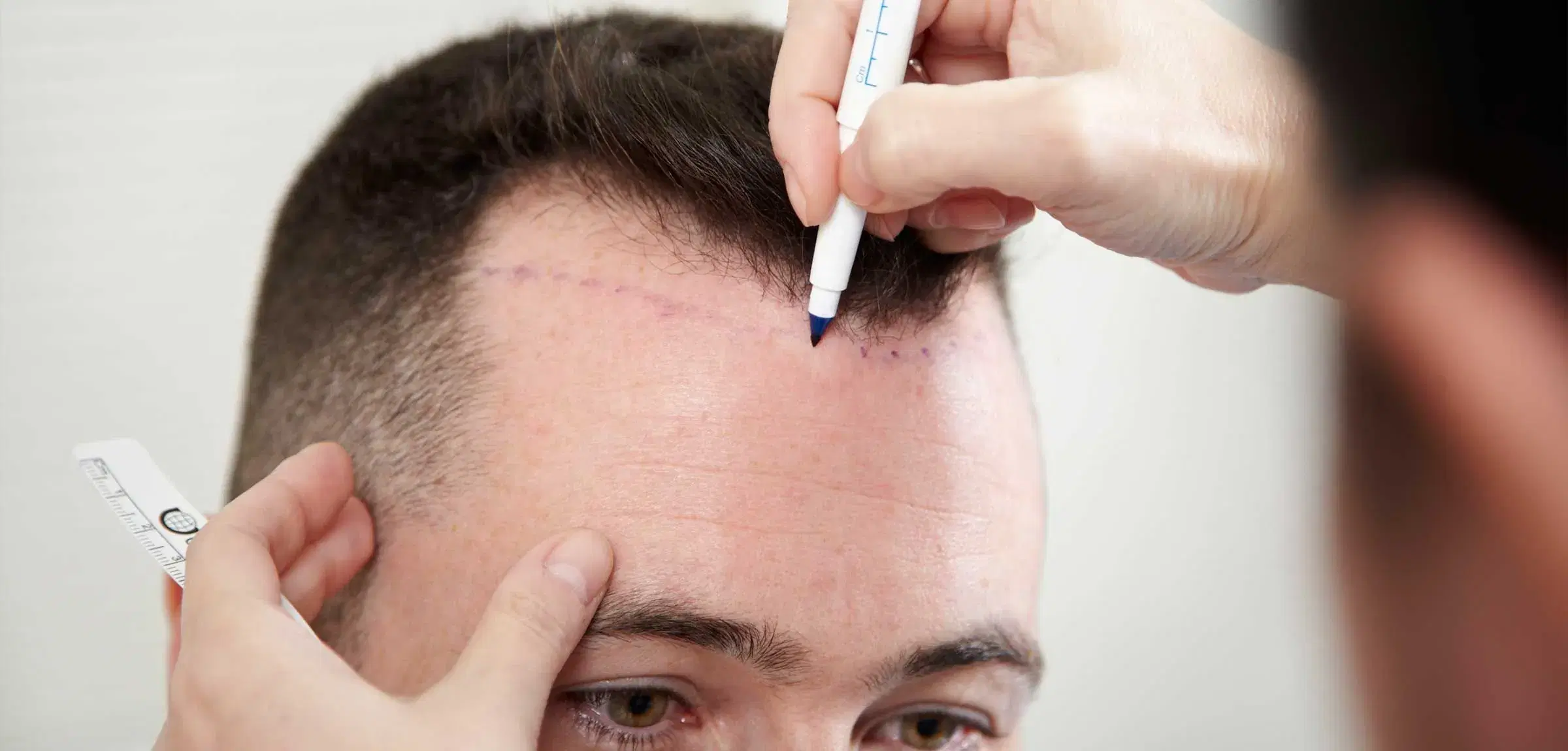
How Natural Can a Transplanted Front Hairline Look?
A well-designed transplanted front hairline can closely resemble natural hair growth and may be difficult to identify as transplanted hair after full maturation.
Naturalness depends on reproducing features that occur in an untreated hairline rather than simply creating maximum density. Normal hairlines contain subtle irregularity, changing density, varied follicular directions, and gradual transitions between forehead and denser scalp. Modern follicular-unit transplantation allows individual graft selection for these different zones. Recent evidence also identifies thoughtful hairline design as a major contributor to natural, long-lasting outcomes. A technically successful transplant can still look artificial when the design ignores these visual characteristics.
What Makes a Hair Transplant Hairline Look Natural?
A natural hairline combines appropriate height, irregular edges, single-hair follicular units, realistic temporal recession, correct angulation, and gradually increasing density.
Each feature supports the others. A perfectly shaped outline can still look transplanted if thick multi-hair grafts are placed along its front edge. Conversely, excellent graft selection cannot rescue a hairline positioned unrealistically low on the forehead. Natural restoration therefore requires both anatomical design and careful follicular placement. Contemporary complication reviews identify abrupt borders, incorrect graft angles, excessive anterior density, and inappropriate graft selection as recognizable causes of artificial results.
How High Should a Natural Front Hairline Be?
A natural front hairline should be positioned according to facial proportions, age, forehead anatomy, donor supply, and expected future hair loss rather than one fixed measurement.
Historical design principles often use facial landmarks to establish an initial reference point, but the final position must reflect the individual face. A very low hairline can consume thousands of additional grafts and become increasingly unnatural as surrounding native hair recedes. Conservative positioning usually ages more convincingly and preserves donor resources. Published complication literature specifically identifies excessively low frontal placement as a cause of artificial appearance, particularly in people with progressive advanced hair loss.
Why Should a Natural Hairline Be Slightly Irregular?
A natural hairline should contain controlled irregularity because untreated frontal hair does not grow along a perfectly straight, symmetrical border.
Small forward and backward variations soften the visual transition between bare forehead skin and denser hair. Larger contour changes can also prevent the front edge from resembling a drawn line. Natural asymmetry is equally relevant because the two sides of the face and hairline are rarely identical. A 2025 anatomical analysis highlighted natural left-to-right differences in hair direction and challenged the assumption that perfect symmetry produces the most realistic result. Carefully planned imperfection therefore improves authenticity.
Why Are Single-Hair Grafts Used in the Front Hairline?
Single-hair follicular units are preferred along the leading edge because natural frontal borders contain finer, isolated hairs before density increases farther backward.
Placing grafts containing several thick hairs directly in the first row can create a plug-like or tufted appearance. Multi-hair follicular units remain useful behind the transition zone, where they provide greater visual volume. Published transplantation descriptions commonly recommend single-hair grafts at the front, followed by two-hair and larger follicular groups farther behind. Recent complication evidence also shows that multi-hair grafts at the leading edge can create an unnatural frontal appearance requiring corrective transplantation.
How Does Hair Direction Affect Hairline Naturalness?
Hair direction strongly affects naturalness because transplanted shafts must emerge in patterns that match the surrounding frontal and temporal hair.
Incorrect direction remains visible even when every transplanted follicle survives. Frontal hairs generally leave the scalp at shallow angles and gradually change orientation across the hairline. Temporal hairs follow different directional patterns from central frontal hairs. Recent research also demonstrates naturally occurring asymmetry between sides, meaning mirrored placement can sometimes look less realistic. Correct slit or implantation orientation is therefore essential for styling, light reflection, density perception, and integration with existing hair.
Why Is the Hair Growth Angle Important?
A low and anatomically appropriate emergence angle helps transplanted frontal hairs lie naturally against the scalp instead of projecting upward in a conspicuous pattern.
Angle and direction are related but separate considerations. Direction determines where the hair points across the scalp, while angulation determines how steeply it exits the skin. Excessively upright grafts can create a coarse brush-like appearance, especially along the frontal border. Current complication evidence identifies inaccurate graft angulation as a major source of unnatural hair-transplant results. Once follicles establish their orientation, correcting severe angle errors can require additional transplantation or removal of poorly positioned grafts.
How Should Density Change Behind the Hairline?
Natural hairline density should increase gradually from a softer transition zone into denser frontal scalp rather than reaching maximum density immediately at the first row.
This progression helps conceal the exact beginning of transplanted hair. Single-hair units can create the softer anterior transition, while larger follicular groups provide increasing visual mass farther behind. Current evidence describing unnatural FUE outcomes notes that abrupt density patterns and excessive anterior concentration can disrupt normal visual flow. Modern hairline correction research also uses progressive density patterns to improve facial integration. The objective is therefore a believable transition, not identical graft density across every frontal centimeter.
What Features Should Be Included in a Natural Hairline Design?
A natural front hairline should reproduce several connected anatomical features instead of concentrating only on its central height.
An age-appropriate central hairline position
Subtle macro-irregularity in the overall contour
Fine micro-irregularity along the leading edge
Natural left-to-right asymmetry
Correct frontotemporal recession
Single-hair grafts along the anterior border
Progressive density behind the first rows
Direction that follows surrounding native hair
Low, realistic graft angulation
A design compatible with future hair loss
Together, these details make the transplanted border appear less constructed and more biologically plausible.
How Important Are the Temples and Frontotemporal Angles?
The temples and frontotemporal angles are crucial because they connect the central hairline with the side hair and strongly influence how naturally the face is framed.
Adult male hairlines normally retain some temporal recession rather than forming a continuous rounded juvenile curve. Blunting these angles can create an artificial helmet-like outline. Historical and contemporary design literature therefore treats frontotemporal anatomy as a separate component rather than simply extending the central hairline sideways. Temporal restoration also requires particularly careful direction and fine graft selection because temple hairs usually emerge at very acute angles and have delicate visual characteristics.
Should a Hairline Be Perfectly Symmetrical?
Perfect symmetry is usually unnecessary for a natural hairline because normal facial anatomy and hair-growth direction contain measurable differences between the left and right sides.
Artificially mirroring every contour can remove the small variations that make natural hair growth believable. A 2025 study specifically examined directional asymmetry and concluded that these differences should be considered during male hairline design. Controlled asymmetry does not mean creating visibly uneven sides. The objective is maintaining overall balance while allowing subtle differences in curvature, recession, direction, and irregularity. Naturalness therefore depends on harmonious proportions rather than mathematical duplication.
Does Face Shape Affect Front Hairline Design?
Face shape affects hairline design because forehead height, facial width, temporal recession, and hairline contour influence how the upper third of the face is perceived.
An anatomical study of 200 adults identified several naturally occurring frontal hairline patterns, including round, M-shaped, rectangular, bell-shaped, and triangular forms. This variation shows why one standardized template cannot suit every patient. A hairline should complement forehead dimensions and existing facial landmarks rather than being copied from another person. Recent research on hairline transplantation also demonstrates that proportional design can change perceived facial balance. Personalized geometry therefore contributes directly to a natural result.
How Does Age Affect the Most Natural Hairline Position?
Age affects natural hairline design because a mature pattern should remain believable as surrounding native hair continues changing over future decades.
A very low juvenile hairline may look attractive immediately but become increasingly difficult to support if androgenetic alopecia progresses. It also consumes more donor follicles because advancing the line increases the recipient surface. Published revision literature identifies failure to consider progressive hair loss as an important cause of unfavorable long-term results. A slightly more conservative design can still frame the face effectively while preserving the temporal recession expected in an adult hairline. Long-term naturalness therefore matters more than creating the lowest possible border.
Does Hair Thickness Affect How Natural the Hairline Looks?
Hair thickness affects hairline naturalness because coarse donor hairs create stronger visual contrast at the forehead edge than fine hairs.
Thicker shafts can provide excellent density behind the hairline, but they require careful distribution in the transition zone. Fine single-hair grafts are particularly valuable at the leading edge because they soften the contrast between bare skin and transplanted coverage. Hair color and scalp contrast can also influence how easily individual grafts are seen. Research evaluating transplanted hairlines has long emphasized hair texture as an important aesthetic variable. The best design therefore considers follicular composition as well as the geometric shape of the line.
Does FUE or DHI Create a More Natural Front Hairline?
Neither FUE nor DHI automatically creates a more natural hairline because naturalness depends primarily on design, graft selection, direction, angle, density, and donor characteristics.
FUE describes follicular-unit extraction from the donor scalp. DHI commonly describes placement using an implanter device after follicles have already been harvested. Either approach can produce convincing frontal restoration when individual follicular units are positioned appropriately. Likewise, either can produce an artificial result when the hairline is too straight, grafts are too thick, or angles are incorrect. Modern reviews emphasize thoughtful planning and follicular-unit techniques rather than identifying one implantation label as inherently more natural.
Can an Unnatural Hair Transplant Hairline Be Corrected?
An unnatural transplanted hairline can often be improved by adding finer grafts, increasing irregularity, correcting weak zones, or removing conspicuous misplaced follicles.
The correction depends on why the original result looks artificial. A straight border can be softened by adding irregular single-hair units in front. Multi-hair plugs may require removal or redistribution when they dominate the leading edge. Poor temporal design may need reconstruction of the frontotemporal transition. Current complication literature specifically illustrates correction of plug-like frontal grafts by adding single-hair follicular units. Revision planning must still protect the remaining donor supply because corrective procedures consume additional follicles.
When Does a Transplanted Hairline Look Fully Natural?
A transplanted hairline is best judged around 12 months after surgery because early growth, shaft thickness, density, and styling characteristics continue changing for many months.
New hairs typically emerge gradually rather than simultaneously. Early growth can appear thin or uneven, making an otherwise appropriate hairline seem less convincing during the first months. As transplanted shafts mature, additional length and caliber improve the transition between frontal grafts and surrounding hair. Final assessment should consider the hairline from multiple angles and under different lighting rather than only from the front. Long-term naturalness also depends on whether native hair behind the transplant remains adequately preserved.