

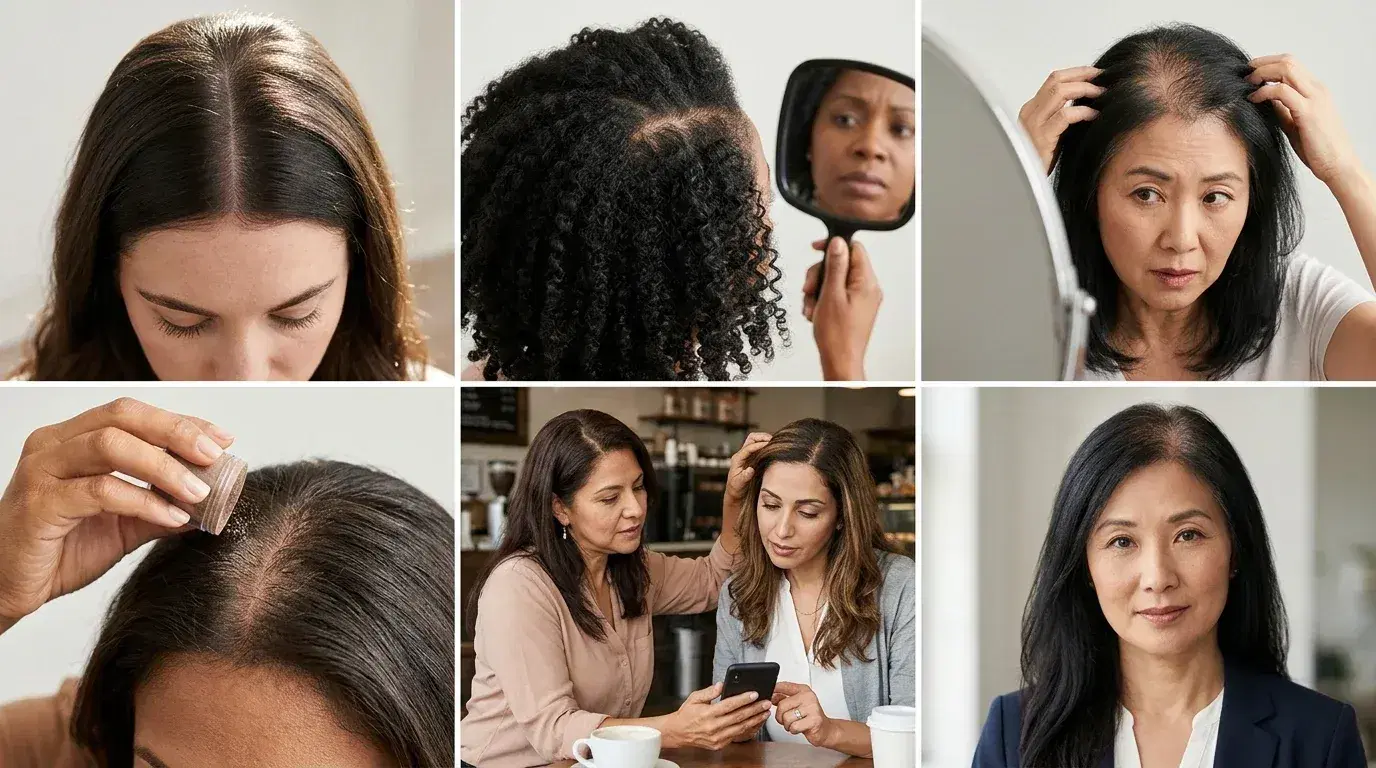
What Does a Widening Hair Part Mean?
A widening hair part occurs when fewer or finer strands provide coverage along the line where the hair is separated. Many women first notice the change while styling their hair, looking at photographs or standing beneath bright bathroom lighting. The scalp may gradually become more visible even though the frontal hairline remains almost unchanged.
An increasingly wide center part is particularly associated with female pattern hair loss, also called female androgenetic alopecia. However, a wider part does not automatically establish that diagnosis. Hair length, styling habits, temporary shedding and changes in the condition of the scalp can all influence how much skin becomes visible.
The most important distinction is whether the change has developed gradually over several years or appeared relatively quickly. That history provides valuable clues about the underlying process and the treatments most likely to help.
Why Female Pattern Hair Loss Makes the Part Line Wider
Female pattern hair loss develops when genetically susceptible follicles gradually produce thinner, shorter strands. This process, known as follicular miniaturization, reduces the amount of coverage provided by individual hairs even before a substantial number of follicles stop producing visible strands.
Unlike the typical pattern of male baldness, thinning in women often concentrates across the central and upper scalp while preserving much of the frontal hairline. As miniaturization progresses, the center part can become increasingly pronounced, sometimes producing a wider area of visible scalp toward the crown.
Hormonal influences contribute to the condition, but many affected women have normal circulating androgen levels. Family history may increase susceptibility, although the condition can occur without an obvious history of significant hair loss among close relatives.
Female pattern thinning often becomes noticeable around midlife, but younger women can experience it as well. Because the process usually develops gradually, early changes may be mistaken for naturally fine hair or a temporary reduction in volume.
A broader explanation of female and male pattern hair loss describes how follicular miniaturization affects hair density over time.
Other Causes of a Widening Part Line in Women
Although female pattern hair loss is a common explanation, not every widening part results from hereditary follicular changes. Several medical and mechanical factors can reduce hair density or make the scalp appear more exposed.
Temporary Hair Shedding and Nutritional Problems
Telogen effluvium occurs when a greater proportion of hairs enter the resting phase of the growth cycle, often following significant physiological stress. High fever, major illness, childbirth, substantial weight loss and certain medications can trigger increased shedding several months later.
Unlike gradual female pattern thinning, telogen effluvium commonly produces a noticeable increase in hairs collected during washing or brushing. The reduction in volume may affect the entire scalp, although it can make an existing center part look wider.
Iron deficiency, thyroid disorders and inadequate protein intake can also contribute to thinning in some women. These possibilities deserve evaluation when the history suggests a medical cause rather than assuming that supplements will automatically restore density.
Hormonal and Scalp Conditions
Polycystic ovary syndrome may contribute to androgen-related hair thinning, particularly when accompanied by irregular menstrual cycles, persistent acne or increased facial hair growth. Changes around menopause can also coincide with more noticeable pattern hair loss, although menopause itself does not explain every case.
Certain inflammatory scalp disorders require particular attention because they can permanently damage follicles. Central centrifugal cicatricial alopecia, for example, often begins around the crown and can resemble ordinary central thinning during its early stages.
Tight hairstyles can create additional problems, especially when repeated tension damages the hairline or other areas under persistent pulling. These conditions require different approaches, making an accurate diagnosis more important than selecting a treatment based solely on appearance.
How to Tell Whether Your Hair Part Is Actually Widening
A change in hairstyle can make a normal part appear wider, particularly when strands become oily, wet or separated into narrow sections. Before concluding that hair loss has progressed, examine whether the change remains visible under comparable conditions.
Photographs can provide a useful reference when taken with the same parting position, lighting and camera distance. A view from directly above the head is especially helpful because it shows the relationship between the central part and surrounding density.
Pay attention to changes beyond the width of the part itself. A smaller ponytail, reduced volume over the crown and an increasing number of fine, short hairs may support the possibility of progressive thinning.
However, checking the scalp every day can make ordinary variations seem more significant than they are. Comparing photographs taken several months apart provides a more meaningful indication of progression than repeatedly examining the hair under different lighting conditions.
How Dermatologists Diagnose a Widening Part Line
Diagnosing female hair thinning begins with the pattern and timing of the changes. A dermatologist will consider whether thinning developed gradually, whether excessive shedding occurred suddenly and whether symptoms such as scalp pain, itching or redness are present.
A close examination of the scalp may reveal differences in hair shaft diameter, suggesting that some follicles are becoming miniaturized. Trichoscopy, which uses magnification to examine the hair and skin, can help distinguish female pattern hair loss from other causes.
Blood tests may be appropriate when symptoms or medical history suggest anemia, thyroid disease or another contributing condition. However, an extensive hormone or vitamin panel is not automatically necessary for every woman with a wider hair part.
When inflammation or scarring is suspected, a scalp biopsy may help establish the diagnosis. This becomes particularly important when the affected skin looks unusually smooth or when hair loss progresses alongside burning, tenderness or persistent scaling.
Can a Widening Part Line Grow Back?
The possibility of regrowth depends on whether the affected follicles remain capable of producing hair. In female pattern hair loss, miniaturized follicles may respond to treatment by producing thicker strands, especially when thinning has not progressed extensively.
Temporary shedding can improve when the underlying trigger resolves. However, new hair needs time to grow, meaning a reduction in shedding may occur well before the scalp looks noticeably fuller.
Scarring alopecia presents a different situation because inflammation can permanently destroy follicles and replace them with scar tissue. Treatment may help preserve the remaining hair, but follicles that have been completely destroyed cannot simply be reactivated.
Early assessment improves the opportunity to protect existing density. Waiting until the center part becomes markedly wider can make restoration more difficult, particularly when the cause involves progressive follicular damage.
Minoxidil for a Widening Part Line
Topical minoxidil is one of the best-supported treatments for female pattern hair loss. It can help prolong the active growth phase and improve hair density in some women, although its primary benefit may involve slowing further thinning rather than restoring the original thickness completely.
Products formulated for women commonly include 2% solution or 5% foam, with application schedules determined by the specific product. Minoxidil should be applied to the scalp rather than concentrated on the hair shafts, and regular use is important for maintaining its benefits.
Some women experience temporary increased shedding during the first several weeks. This can be unsettling, but it may occur as follicles transition through their growth cycle. Visible improvement generally requires several months, with six to twelve months providing a more useful period for evaluating results.
Scalp irritation and unwanted facial hair growth are possible adverse effects. Minoxidil should also be avoided during pregnancy, while planning pregnancy and during breastfeeding.
The guide to minoxidil for hair loss provides further information about its formulations, expected timeline and limitations.
Prescription Treatments and Additional Hair Restoration Options
When topical treatment provides insufficient improvement, prescription medication may offer another approach for selected women with female pattern hair loss. Spironolactone is sometimes used to reduce androgen-related effects on susceptible follicles, particularly when hormonal features accompany thinning.
However, spironolactone can affect blood pressure and potassium balance, and it is unsuitable during pregnancy because of potential fetal risks. Medication history, kidney health and reproductive considerations are therefore important before treatment begins.
Low-dose oral minoxidil is another option sometimes prescribed for hair loss, although this use is off-label. Because it acts throughout the body, adverse effects can include fluid retention, unwanted body hair growth and cardiovascular symptoms, making appropriate medical assessment essential.
Other interventions, including platelet-rich plasma and low-level light therapy, have shown potential in some studies. Their results are less consistently established than those of topical minoxidil, and they should not be presented as guaranteed solutions for a widening part.
Can a Hair Transplant Restore Density Along the Part Line?
Hair transplantation may help selected women with stable, localized thinning and sufficient healthy donor hair. The procedure transfers follicles from the back or sides of the scalp into areas where additional coverage is desired.
However, women with widespread thinning require careful assessment because the donor region may also be affected by follicular miniaturization. Extracting follicles from an unstable donor area can compromise both the appearance of the remaining hair and the durability of the transplant.
Transplantation also does not prevent native hair from continuing to thin. A wider part may improve after graft placement while untreated neighboring follicles remain vulnerable to progression, which is why long-term management matters.
For many women, preserving existing hair with medical treatment provides a more appropriate starting point than immediately pursuing surgery. The suitability of transplantation should be established through a detailed evaluation of the hair loss pattern and donor supply.
Hairstyles and Daily Care for a Widening Hair Part
Styling adjustments cannot reverse follicular miniaturization, but they can improve the appearance of thinning hair without exposing it to unnecessary damage. A slightly off-center or softer part may reduce the contrast between the scalp and surrounding strands, while layered cuts can create a fuller appearance.
Lightweight volumizing products can help fine hair maintain movement without weighing the roots down. Scalp-colored powders and hair fibers may also temporarily conceal visible areas, provided they do not cause irritation.
Gentle hair care is particularly important when the strands are already fine or fragile. Excessive heat styling, repeated bleaching and forceful brushing can increase breakage, making reduced volume more noticeable even when the follicles remain active.
Tight ponytails, braids and extensions should not create persistent pulling or discomfort. Reducing mechanical stress helps protect existing hair, although changing styling habits alone will not stop hereditary pattern thinning.
How to Monitor Progress and Know When to Seek Treatment
Monitoring should focus on meaningful changes over time rather than the number of hairs lost during one shower. The width of the part, density around the crown and thickness of the ponytail can provide practical indicators when assessed consistently.
Photographs taken approximately every two to three months can help document progression or improvement. Using the same lighting, hairstyle and camera position makes comparisons more reliable and reduces the temptation to interpret ordinary variations as treatment failure.
Early dermatological evaluation is particularly important when thinning progresses rapidly, appears in distinct patches or involves scalp tenderness, burning, redness or scaling. These symptoms can indicate inflammatory conditions that require more urgent treatment than ordinary cosmetic thinning.
Women who notice gradual widening without other symptoms can still benefit from timely assessment. Female pattern hair loss is often progressive, and beginning suitable treatment while follicles remain active may help preserve more of the existing density.