
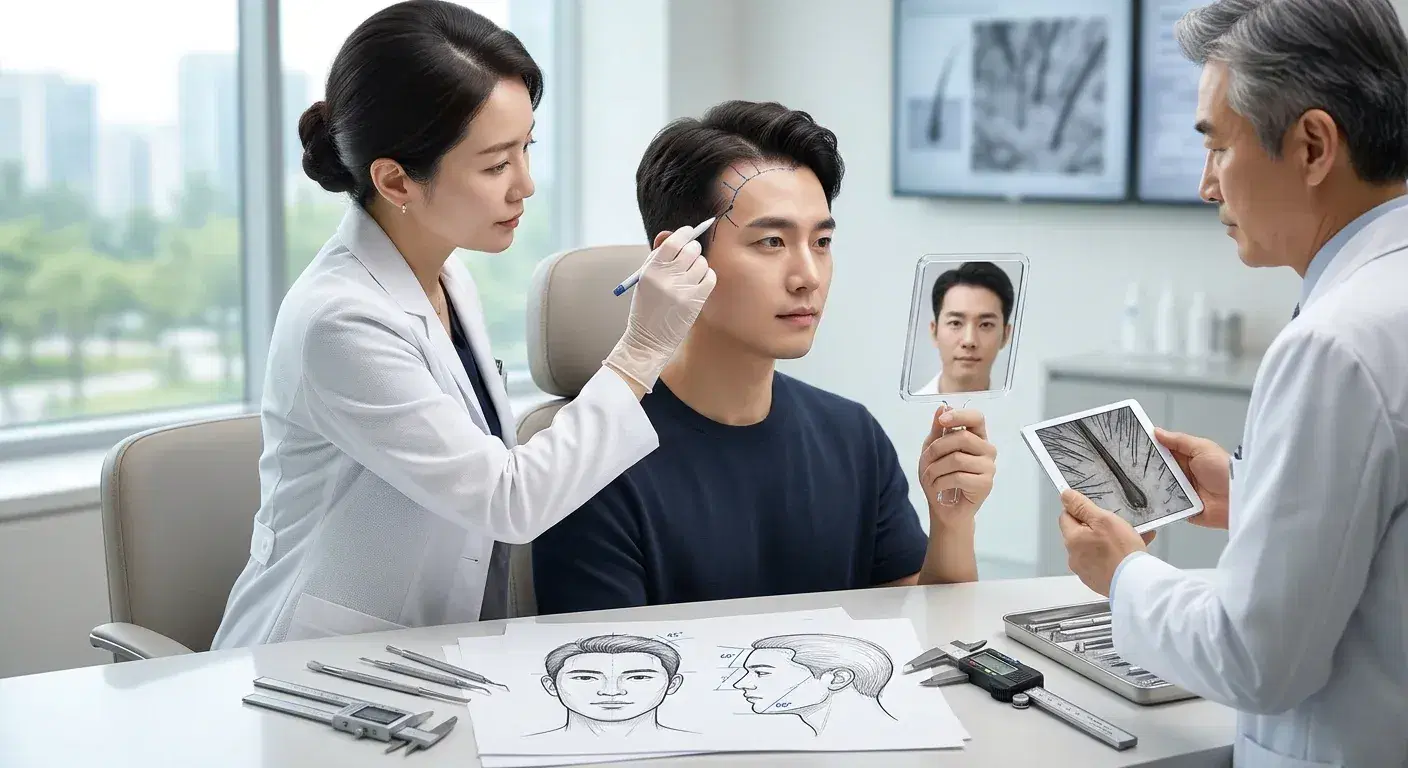
Hairline design for Asian men requires careful consideration of facial proportions, natural hair growth direction, follicular density and individual hair characteristics. A successful hair transplant should create a balanced, age-appropriate hairline that complements the face while preserving sufficient donor hair for long-term restoration.
What Makes Hairline Design for Asian Men Different?
Hairline design plays a central role in hair transplantation because the frontal hairline determines how naturally the restored hair frames the face. For Asian men, achieving a harmonious appearance requires understanding both individual facial anatomy and the hair characteristics that can influence graft placement, density and overall coverage.
Many men of East Asian ancestry have relatively straight hair with a thicker average shaft diameter, although substantial variation exists across individuals and populations. These characteristics can influence the appearance of a transplanted hairline because thicker, straighter strands may make irregular placement or unnatural growth angles more noticeable. At the same time, greater hair shaft thickness can contribute to visual fullness even when follicular density is relatively modest.
Asian men do not share one universal hairline shape. A personalized design must consider existing hair distribution, forehead dimensions, age and the patient's preferred appearance rather than relying on a fixed ethnic template.
Understanding Natural Asian Male Hairline Shapes
Natural hairlines among Asian men vary considerably in shape, height and the degree of recession around the temples. Research examining men from several Asian populations has identified multiple frontal hairline patterns, including rounded, rectangular, M-shaped and wave-shaped contours.
A rounded hairline creates a softer transition between the forehead and frontal scalp, while a rectangular outline may produce a more angular appearance. An M-shaped hairline contains greater recession around the frontal corners, and a wave-shaped contour introduces subtle changes in height across the frontal border.
These shapes are not necessarily signs of hair loss. Some men naturally develop higher temporal corners or an angular hairline without experiencing progressive follicular miniaturization.
Hair transplant planning should therefore begin by distinguishing the individual's natural facial characteristics from changes caused by androgenetic alopecia. Recreating a previous hairline can be appropriate when its original shape remains compatible with current facial proportions, but copying another person's outline rarely produces an equally convincing result.
How to Determine the Ideal Hairline Position
The position of the frontal hairline influences forehead height, facial balance and the overall appearance of the upper face. Even relatively small changes in hairline placement can alter how the eyebrows, temples and forehead relate to one another.
Forehead Height and Facial Proportions
Hairline planning involves examining the relationship between the upper, middle and lower regions of the face. The distance between the eyebrows and the frontal hairline provides a useful reference, but no single measurement produces the ideal result for every Asian man.
A lower hairline can reduce the appearance of a tall forehead, although excessively lowering the frontal border may create an unnatural appearance. It also increases the surface area requiring transplanted follicles, potentially consuming donor hair that may be needed later.
The design should complement the patient's existing facial structure rather than force the forehead into predetermined proportions.
Age-Appropriate Hairline Design
Age matters because hairline shape and facial appearance change throughout adulthood. A low, rounded hairline may look appropriate in a young man with naturally dense hair, but recreating the same outline during later adulthood may not provide the most balanced appearance.
A mature male hairline often contains some degree of frontotemporal recession. Preserving this characteristic can create a more natural result while reducing the number of grafts needed for reconstruction.
Long-term planning becomes particularly important for younger patients because hereditary hair loss may continue progressing behind the transplanted area.
Why a Natural Hairline Should Not Be Perfectly Straight
A completely straight hairline can create an artificial appearance, particularly when the individual hair shafts are thick and grow in relatively uniform directions. Natural hairlines contain small variations in position, density and orientation that become visible when examined closely.
Hair transplant design addresses these variations through controlled irregularity. The frontal border should include subtle changes in its outline rather than forming a sharply defined row of follicles.
This does not mean creating obvious gaps or an uneven hairline. The purpose is to reproduce the gradual transition found in natural growth, where individual hairs emerge at slightly different positions before density increases farther behind the leading edge.
For additional details, this guide to natural-looking frontal hairline transplantation explains how hairline shape, graft selection and controlled irregularity contribute to a convincing result.
Why Single-Hair Grafts Matter for Asian Hairlines
A follicular unit may contain one or several hairs, and the distribution of these units directly affects the appearance of a transplanted hairline. Single-hair grafts are especially valuable along the frontal edge because they create a softer boundary between the forehead and the denser scalp.
This becomes particularly important when the donor hair is relatively coarse or straight. Placing multi-hair grafts at the very front can produce thick clusters that appear noticeably different from naturally emerging hair.
Behind the leading edge, carefully selected two-hair and other suitable follicular units can contribute greater density and improve coverage. The gradual increase in hair concentration helps the reconstructed region blend naturally with the existing scalp.
Appropriate graft distribution therefore matters more than attempting to place the greatest possible number of hairs along the first row.
Hair Growth Direction and Implantation Angles
Correct follicular direction is one of the most technically important aspects of Asian male hairline design. When naturally straight hair grows at an unsuitable angle, the resulting strands may project outward or resist normal styling, making the transplanted area appear less natural.
Along the frontal hairline, hair commonly emerges at relatively low angles and follows a forward direction. However, orientation changes across the center, frontal corners and temples, requiring recipient sites to follow the existing growth pattern rather than one uniform direction.
Natural hair growth also contains asymmetry. Differences between the left and right sides may be present even in men without hair loss, making perfectly mirrored implantation angles unnecessary.
A successful design balances these variations while ensuring that transplanted strands can be combed naturally and blend with surrounding hair across different hairstyles.
Temple Restoration and Frontal Hairline Balance
The temples influence how the frontal hairline connects with the side hair and how the face appears from different angles. Reconstructing this relationship requires more than extending the central hairline toward the sides.
Some Asian men naturally have relatively full temporal corners, while others maintain a more angular transition between the frontal scalp and temples. Both patterns can look natural when they complement the individual's forehead and facial proportions.
Temple hair also tends to emerge at very shallow angles, often lying close to the skin surface. Using unsuitable grafts or incorrect implantation directions can create hair that stands away from the scalp, making the reconstruction noticeable when viewed from the side.
Overly aggressive temple restoration can create another long-term problem if surrounding native hair continues receding. A balanced design should preserve a natural transition without committing unnecessary donor follicles to areas that may become increasingly difficult to maintain.
Hair Thickness, Density and Scalp Contrast
The appearance of hair density depends on more than the number of transplanted follicles. Hair shaft thickness, curl, color and contrast with the underlying scalp all influence how much coverage a particular graft count can produce.
Some East Asian hair populations have relatively thick average hair shafts but lower average follicular density than certain other populations. These characteristics can partially balance one another because thicker strands provide greater individual coverage.
Dark, straight hair can also create visible contrast against lighter scalp skin, making gaps between follicles more noticeable under strong lighting. For this reason, strategic density distribution becomes particularly important around the frontal hairline.
Rather than pursuing maximum density throughout the entire recipient area, an effective plan concentrates appropriate coverage where it contributes most to facial framing and the appearance of natural fullness.
Donor Hair Selection for Asian Men
The donor area, usually located along the back and sides of the scalp, supplies the healthy follicles used during transplantation. Its characteristics influence both the number of available grafts and how naturally those grafts will blend with the recipient region.
Donor evaluation considers follicular-unit density, hair shaft diameter, growth direction and the presence of miniaturization. Fine single-hair units may be particularly useful for creating a soft frontal border, while thicker grafts can provide coverage behind it.
The donor supply is limited because transplanted follicles do not regenerate in their original locations. Extracting too many grafts can create visible thinning or an uneven appearance across the back of the scalp.
Preserving donor resources is especially important when progressive hair loss may require additional treatment in the future.
FUE vs DHI for Asian Hairline Transplantation
FUE and DHI are commonly considered when planning hairline restoration, although they describe different stages or methods of the transplantation process.
FUE involves extracting individual follicular units from the donor region using specialized instruments. The collected grafts are then implanted into prepared recipient sites according to the planned hairline design.
DHI uses a specialized implanter pen to insert follicular units into the scalp. This method allows the operator to control graft placement during implantation, although it does not eliminate the importance of precise follicular handling and surgical planning.
Both approaches can produce natural-looking hairlines when appropriate grafts are positioned at suitable angles and densities. Neither technique automatically guarantees superior results for Asian hair, since the final appearance depends more directly on the quality of the design and the execution of graft placement.
How Many Grafts Are Needed for Asian Hairline Restoration?
Graft requirements depend on the degree of recession, the desired hairline position, existing frontal density and the characteristics of the donor hair. A limited procedure addressing the temporal corners generally requires fewer follicles than a complete reconstruction of the frontal hairline.
A lower or more rounded design may require additional grafts because it increases the area that must be covered. Meanwhile, relatively thick hair shafts can provide substantial visual coverage, potentially influencing the amount of density required for a balanced appearance.
Graft planning should also distinguish the frontal transition zone from the denser region behind it. The leading edge benefits from carefully selected single-hair units, whereas the supporting area can accommodate grafts that provide greater visual fullness.
An individualized estimate is more useful than selecting a fixed number based solely on ethnicity or the desired hairline shape.
Planning for Future Male Pattern Hair Loss
Androgenetic alopecia can continue progressing after a successful hair transplant, making long-term planning essential for maintaining a natural appearance. The transplanted follicles may remain productive while surrounding native hair gradually becomes thinner.
This can become particularly noticeable when an aggressively lowered hairline remains dense but the mid-scalp or temples continue receding. The result may appear increasingly disconnected from the surrounding hair, even when the transplanted grafts themselves survive.
A conservative design helps preserve the relationship between the frontal border, temples and existing coverage. Maintaining adequate donor reserves also leaves more options available if additional hair restoration becomes necessary.
Understanding hair transplant surgery for male pattern baldness provides further context for the relationship between hairline restoration, progressive thinning and long-term graft planning.
Common Mistakes in Asian Male Hairline Design
One frequent mistake involves choosing a hairline based entirely on photographs of another person. Even when two men share similar hair color or texture, their forehead dimensions, temple anatomy and natural growth patterns may differ substantially.
Another problem involves creating a frontal border that is excessively straight or densely packed with thick multi-hair grafts. This can produce an abrupt transition that becomes particularly noticeable when straight hair is brushed upward or away from the forehead.
Incorrect implantation angles can also compromise the appearance of an otherwise well-positioned hairline. Strands that grow against the surrounding hair direction may require constant styling and can remain conspicuous despite successful follicular growth.
Finally, an overly low hairline may consume unnecessary donor resources and become difficult to integrate with future hair loss. A convincing result requires visual balance and long-term stability rather than immediate coverage alone.
Hairline Recovery and Final Results After Transplantation
Hairline transplantation involves an initial healing period followed by several months of gradual hair growth. During the first week, small crusts, temporary redness and mild swelling can appear around the implanted follicles as the scalp repairs the surgical openings.
Many transplanted hair shafts begin shedding during the following weeks. This temporary shedding is a common response to transplantation and does not automatically indicate that the underlying follicles have failed.
New hair commonly begins emerging around the third or fourth month, although early growth may appear fine or uneven. Coverage generally becomes more noticeable between six and twelve months, with further maturation continuing for up to eighteen months.
The final hairline should be evaluated after sufficient growth has developed, ideally from frontal, side and angled views under consistent lighting. Naturalness depends not only on density but also on whether the reconstructed outline blends convincingly with the forehead, temples and existing hair.
Frequently Asked Questions About Hairline Design for Asian Men
The following questions address common concerns about natural hairline shapes, graft density and long-term transplant results.
What is the most natural hairline shape for Asian men? A natural hairline may be rounded, rectangular, M-shaped or subtly wave-shaped, depending on individual facial anatomy and existing hair characteristics. The most suitable design complements forehead proportions, age and temple structure while preserving natural irregularities rather than following a standardized ethnic template.
Do Asian men need more grafts for a natural hairline? Graft requirements depend on the treatment area, donor density, follicular-unit composition and hair shaft characteristics rather than ethnicity alone. Relatively thick hair may provide greater visual coverage per strand, while lower follicular density or strong contrast between dark hair and scalp skin can influence how grafts should be distributed.
Can a transplanted Asian male hairline look completely natural? Hair transplantation can create a highly natural appearance when the design incorporates appropriate height, single-hair grafts, realistic growth directions and gradual density transitions. However, the final result depends on graft survival, available donor resources and the relationship between transplanted hair and surrounding native hair as it changes over time.
Final Thoughts on Hairline Design for Asian Men
Hairline design for Asian men requires an individualized approach that accounts for forehead proportions, natural hairline shape, hair thickness, follicular density and growth direction. Although certain hair characteristics occur more frequently in particular Asian populations, no single design can represent the facial anatomy or aesthetic preferences of every individual.
Creating a natural result involves careful placement of single-hair grafts, subtle irregularity along the frontal border and appropriate density behind the leading edge. Temple balance and long-term donor preservation are equally important because a hairline should remain convincing as the surrounding hair changes with age.
A successful Asian male hairline transplant therefore combines anatomical planning with precise follicular placement, producing an appearance that complements the face without drawing unnecessary attention to the restored area.