
Can Hair Transplant Surgery Treat Male Pattern Baldness?
Hair transplant surgery can restore visible hair coverage in selected men with male pattern baldness by moving follicles from a relatively stable donor area into thinning or bald regions.
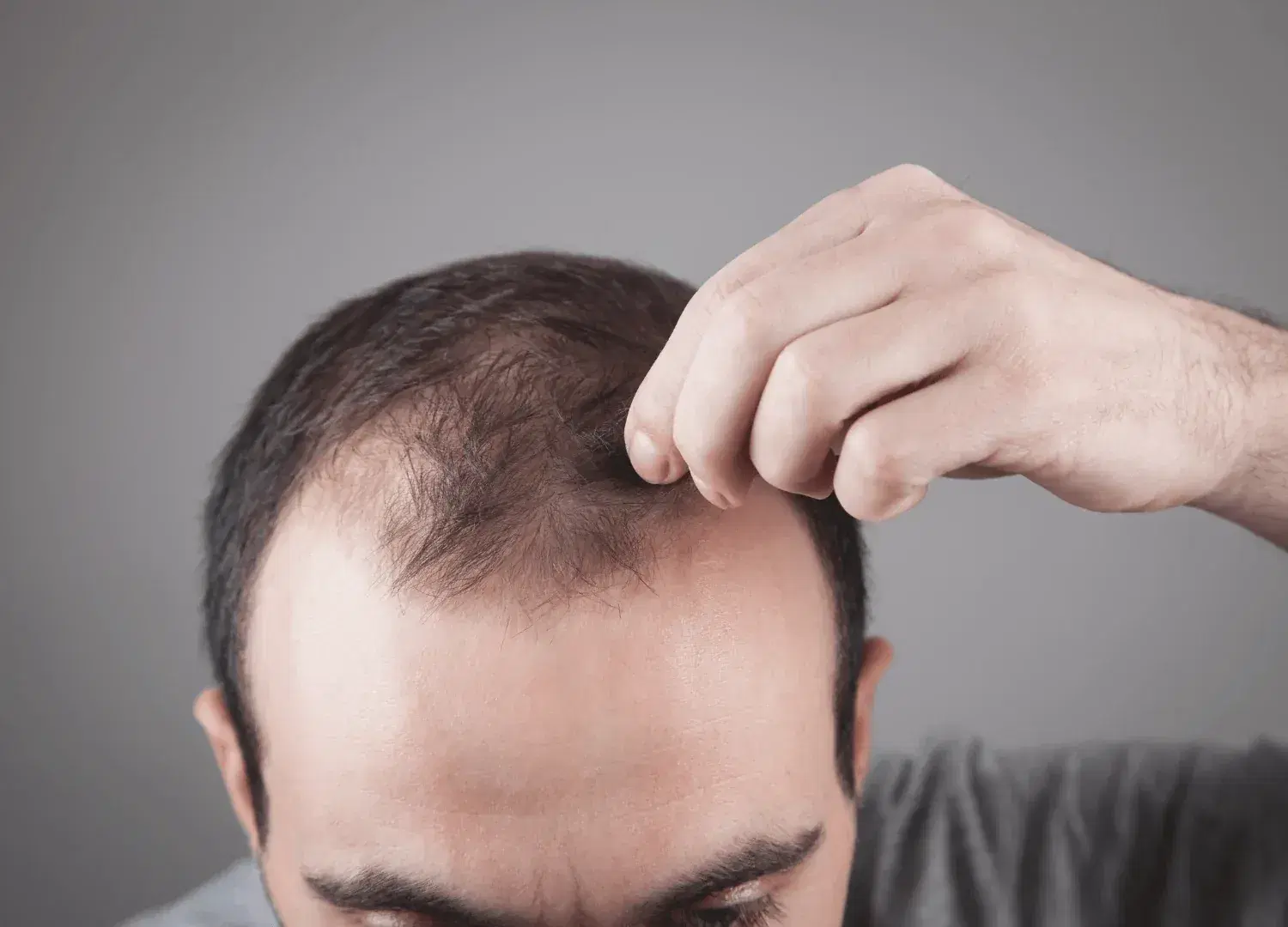
Male pattern baldness, medically called androgenetic alopecia, is a progressive form of hair loss in which genetically susceptible follicles gradually become smaller. Hair shafts become finer and shorter until some follicles produce little visible hair.
A transplant approaches the problem differently from medication. It does not reverse the genetic process throughout the scalp. Instead, it relocates follicles that are generally more resistant to androgen-related miniaturization, most commonly from the back and sides of the head.
Modern hair transplantation is primarily used for androgenetic alopecia and is based on the principle of donor dominance. Transplanted follicles tend to retain important characteristics of the donor area after they are moved.
This makes surgery particularly useful where visible hair has already been lost and medication alone is unlikely to recreate adequate coverage.
How Does Male Pattern Baldness Affect Hair Transplant Planning?
Male pattern baldness affects transplant planning because the condition usually continues progressing after surgery.
The typical pattern may begin with recession around the temples, thinning through the frontal or mid-scalp region, crown loss, or a combination of these changes. In some men, the affected areas eventually connect and produce extensive baldness across the top of the scalp.
A transplant performed today must therefore still make sense if more native hair disappears in the future.
This is one of the most important differences between short-term cosmetic planning and long-term hair restoration. A very low, dense hairline can look attractive immediately but consume a large number of follicles. If the patient later develops extensive loss behind it, the remaining donor supply may not be sufficient to create balanced coverage.
This concern is particularly relevant in younger men whose eventual pattern is difficult to predict. Current hair-restoration guidance continues to emphasize caution when operating on very young patients with evolving androgenetic alopecia.
The goal should therefore be an age-appropriate design that can remain credible as the patient gets older.
Who Is a Good Candidate for Hair Transplant Surgery?
A good candidate generally has a confirmed diagnosis of pattern hair loss, a sufficiently stable donor area, realistic expectations and enough donor follicles to address the areas that matter most.
Visible baldness alone is not sufficient. A surgeon needs to assess whether hair at the back and sides of the scalp is dense and stable enough to serve as a reliable donor source.
Diffuse miniaturization within the expected donor zone can substantially reduce candidacy. Removing hair from an unstable donor region may leave the donor area thin and provide grafts that do not behave as expected over time.
Age also needs context. There is no universal age at which surgery suddenly becomes appropriate. A man in his twenties with limited recession and rapidly changing hair loss presents a different planning problem from a man with a well-established pattern that has changed slowly over several years.
Overall health, previous surgery, scalp disease and expectations should also be considered.
The central question is not simply whether hair can technically be transplanted. It is whether surgery can create a result that remains visually reasonable without exhausting the donor area.
Why Is the Donor Area So Important?
The donor area is the limiting resource in male hair transplant surgery because transplantation redistributes existing follicles rather than creating new ones.
Most donor grafts are taken from regions around the back and sides of the scalp where follicles tend to be more resistant to the androgen-driven miniaturization responsible for male pattern baldness.
However, the donor zone is finite.
A patient with extensive baldness may have a very large area requiring coverage but only enough donor hair to restore part of it at useful density. Hair diameter, follicular density, the number of hairs within each follicular unit and previous procedures can all affect the apparent amount of donor coverage available.
This creates a simple but critical principle: recipient demand can exceed donor supply.
A responsible surgical plan therefore asks not how many grafts can physically be removed, but how many can be harvested while preserving an acceptable donor appearance and enough reserve for possible future needs.
How Do FUE and FUT Treat Male Pattern Baldness?
FUE and FUT are the two principal methods used to obtain donor follicular units for transplantation, rather than two fundamentally different ways of treating androgenetic alopecia.
With Follicular Unit Excision, or FUE, individual follicular units are removed through small circular punch incisions. The extractions are distributed across the donor region.
With Follicular Unit Transplantation, commonly called FUT or linear strip excision, a strip of donor scalp is surgically removed. Individual follicular units are then dissected from that tissue under magnification, and the donor incision is closed.
Both methods can provide high-quality grafts and both remain contemporary approaches to hair transplantation. A 2025 review of modern hair transplantation describes FUE and linear strip excision as state-of-the-art donor harvesting techniques.
The most visible difference is the donor scar. FUT creates a linear scar, while FUE produces numerous small extraction scars distributed through the donor area.
Neither method is universally superior. Hairstyle preference, donor characteristics, previous procedures and long-term graft requirements can influence which approach fits a particular patient.
Is DHI Different From FUE?
DHI usually describes how grafts are implanted, while FUE describes how they are removed from the donor area.
This distinction matters because the two terms are often marketed as if they were complete alternatives.
A patient can undergo FUE extraction followed by implantation with an implanter device commonly associated with DHI. The extraction and implantation stages are separate parts of the operation.
Likewise, terms such as Sapphire FUE generally describe instruments or recipient-site techniques rather than a new biological method capable of producing additional follicles.
Modern devices can change surgical workflow, but they cannot overcome limited donor supply, progressive hair loss or unfavorable hair characteristics.
Patients should therefore understand exactly what happens during extraction, recipient-site planning and implantation rather than selecting surgery solely from a branded technique name.
How Is the Hairline Designed for Male Pattern Baldness?
A transplant hairline should be designed for the patient's facial proportions, available donor supply and expected future pattern rather than recreating the lowest hairline the patient remembers.
Hairline design has an unusually strong effect on both appearance and long-term graft consumption. Lowering a hairline by even a relatively modest amount increases the surface area that must be covered.
Natural hairlines are also not perfectly straight or uniformly dense. The transition zone usually contains finer single-hair follicular units, with greater density developing farther behind.
A mature design should remain appropriate if temple recession or mid-scalp loss continues later.
This is particularly important when treating young men. Designing an aggressive juvenile hairline while leaving little donor reserve can produce an increasingly unnatural relationship between the transplanted front and future bald scalp.
Good planning therefore combines aesthetics with conservation.
Can a Hair Transplant Restore Full Original Density?
A hair transplant usually cannot restore the original biological density that existed before male pattern baldness developed.
The donor supply is too limited to replace every follicle lost across a large recipient area.
Instead, hair transplantation aims to create the visual impression of fuller coverage. Hairline design, graft angle, hair caliber, curl, color contrast and strategic distribution can make a lower number of transplanted hairs appear substantially denser.
This explains why two men receiving the same graft number can have different-looking outcomes.
Thicker or wavier hair generally provides greater visual coverage than fine, straight hair. Low contrast between hair and scalp can also make thinning less obvious.
The practical goal is therefore cosmetic density, not a one-for-one reconstruction of every original follicle.
Should the Frontal Area or Crown Be Treated First?
The frontal hairline and frontal scalp are often prioritized when donor supply is limited because they usually contribute more strongly to facial framing and everyday appearance.
The crown creates a different challenge. Its spiral growth pattern and broad surface area can consume large numbers of grafts while still appearing relatively thin under direct light.
In early or moderate baldness, treating both regions may be realistic. In advanced patterns, attempting high density everywhere can exhaust donor supply.
A patient may therefore need to choose between moderate coverage over a wider area and stronger coverage concentrated at the front.
This decision should be made before surgery rather than after donor follicles have already been used.
A conservative crown strategy can also preserve grafts for future mid-scalp progression.
Does a Hair Transplant Stop Male Pattern Baldness?
No, a hair transplant does not stop androgenetic alopecia from continuing in the patient's existing non-transplanted hair.
The transplanted follicles and native follicles can therefore follow different courses after surgery.
Donor follicles may continue producing hair, while susceptible native follicles nearby gradually become thinner. Over time, this can create new areas of reduced density behind or between previously transplanted regions.
This is why surgical and medical treatment are often complementary rather than competing approaches. Hair-restoration guidance notes that medical treatment may help preserve miniaturizing native hairs while surgery redistributes follicles into areas where visible hair has already been lost.
Planning only for the bald area visible today can therefore produce problems several years later.
Do Finasteride and Minoxidil Still Matter After a Hair Transplant?
Medical treatment can remain important after transplantation because it addresses ongoing native hair loss rather than the physical placement of donor grafts.
Finasteride is a 5-alpha-reductase inhibitor approved in the United States for male pattern hair loss in men. Current prescribing information states that continued use is recommended to sustain benefit and that its effect reverses after treatment is discontinued.
Minoxidil is another established treatment used to support hair growth in androgenetic alopecia.
Neither medication replaces transplantation when an area is already significantly bald, and transplantation does not automatically remove the reason for using medical therapy.
The decision to use medication should be individualized because each treatment has contraindications, potential adverse effects and practical considerations.
A patient should therefore discuss the medical and surgical components of long-term management separately rather than assuming surgery makes further hair-loss treatment unnecessary.
What Happens During Hair Transplant Surgery?
Hair transplant surgery generally includes donor assessment, hairline planning, local anesthesia, follicular harvesting, recipient-site preparation and graft placement.
The exact workflow depends on whether FUE or FUT is used and how the clinic organizes implantation.
With FUE, individual follicular units are removed using small punches. With FUT, a donor strip is removed and divided into individual grafts.
The surgeon then plans recipient distribution according to hairline position, existing hair and the number of available grafts. Angle and direction are especially important in the frontal region because transplanted hairs need to blend with natural growth patterns.
Grafts are subsequently inserted into recipient sites using forceps, implanters or related instruments.
The procedure may take several hours, particularly when thousands of grafts are involved. It should be treated as surgery, not simply as a salon-style cosmetic treatment. Current professional guidance specifically considers harvesting and recipient-site creation surgical acts requiring appropriate medical training and responsibility.
What Should Be Checked Before Choosing Surgery?
Before undergoing a transplant for male pattern baldness, the patient should understand the diagnosis, donor capacity and long-term strategy rather than focusing only on a quoted graft number.
Useful points to clarify include:
Whether the diagnosis is confirmed androgenetic alopecia
Whether miniaturization extends into the intended donor region
Who designs the hairline and performs the surgical stages
Why the proposed number of grafts is appropriate
Whether FUE, FUT or another harvesting strategy is being recommended and why
Which areas will receive priority if donor supply is limited
How future native hair loss is expected to affect the result
Whether medical treatment is relevant before or after surgery
What type of donor scarring should be expected
How much donor reserve is likely to remain after the procedure
A consultation that cannot answer these questions clearly may provide a graft package without providing a genuine long-term restoration plan.
What Is Recovery Like After a Male Hair Transplant?
Early recovery involves healing of thousands of small recipient sites and, depending on the harvesting method, either FUE extraction wounds or an FUT donor incision.
Crusting and redness can develop in the recipient area during the first stage of healing. The transplanted hair shafts commonly shed afterward, which does not necessarily mean the transplanted follicles have been lost.
New growth develops gradually rather than immediately.
Professional hair-restoration guidance describes transplanted graft growth as occurring over several months and potentially continuing to mature for around a year.
This makes early before-and-after comparisons misleading. A result at three months cannot reasonably be judged in the same way as a mature result.
The donor region also needs time to heal. FUT requires healing of a linear incision, while FUE involves many small extraction wounds.
What Are the Main Risks of Hair Transplant Surgery?
Hair transplantation has surgical and cosmetic risks even when performed for common male pattern baldness.
Possible problems include infection, bleeding, swelling, folliculitis, temporary numbness, postoperative discomfort, scarring and temporary shock loss of nearby hair.
FUE can produce visible donor thinning if too many follicular units are removed. FUT can result in a wider or more noticeable linear scar than expected.
Recipient-side problems can include unnatural hair direction, poor hairline design, inadequate density or disappointing graft growth.
The most difficult problems may be planning errors rather than short-term complications. An excessively low hairline or overharvested donor area can be difficult to correct because the supply of usable follicles is finite.
This is why surgical judgment matters as much as the extraction device.
Are Hair Transplant Results Permanent?
Transplanted follicles from an appropriately selected stable donor region can provide long-lasting growth, but the overall appearance of a transplant is not frozen permanently in time.
The principle of donor dominance means transplanted hair generally retains important characteristics of its original donor region.
The surrounding native hair can still continue miniaturizing.
A man who has a strong frontal transplant at age 30 may therefore develop thinning behind it during his forties if the underlying androgenetic alopecia progresses.
The transplanted hair may remain while the overall pattern changes.
This distinction is important when the procedure is marketed simply as permanent hair restoration. The grafts can be long-lasting, but maintaining a natural overall pattern still depends on how intelligently future hair loss was anticipated.
Will One Hair Transplant Be Enough?
One hair transplant can be sufficient for some men, but others may require additional procedures because of extensive baldness, a desire for greater density or continued native hair loss.
A second operation does not automatically mean the first transplant failed.
A large restoration can be intentionally divided into stages. The frontal region may be treated first, followed later by the mid-scalp or crown.
Progressive androgenetic alopecia can also create a new reason for surgery several years after an initially successful result.
However, every procedure consumes additional donor follicles. Follow-up surgery must therefore remain within the same lifetime donor strategy rather than being viewed as an unlimited option.
Is Hair Transplant Surgery Worth It for Male Pattern Baldness?
Hair transplant surgery can provide substantial cosmetic improvement for appropriately selected men when donor supply, future progression and expectations are considered before surgery.
Its greatest strength is the ability to place hair into areas where visible coverage has already been permanently lost. Medical therapies can help preserve or strengthen susceptible existing follicles, but surgery can physically redistribute stable follicles into bald regions.
Its greatest limitation is the same mechanism that makes it possible: there is only a finite amount of donor hair.
Successful treatment therefore requires more than achieving the highest graft number in one session. The hairline needs to remain appropriate with age, the donor area needs to remain visually acceptable, and future loss must be anticipated.
For male pattern baldness, the best surgical plan is not necessarily the one that creates the maximum immediate density. It is the one that uses a limited donor supply carefully enough to produce a natural result that can still make sense as androgenetic alopecia continues over the patient's lifetime.