
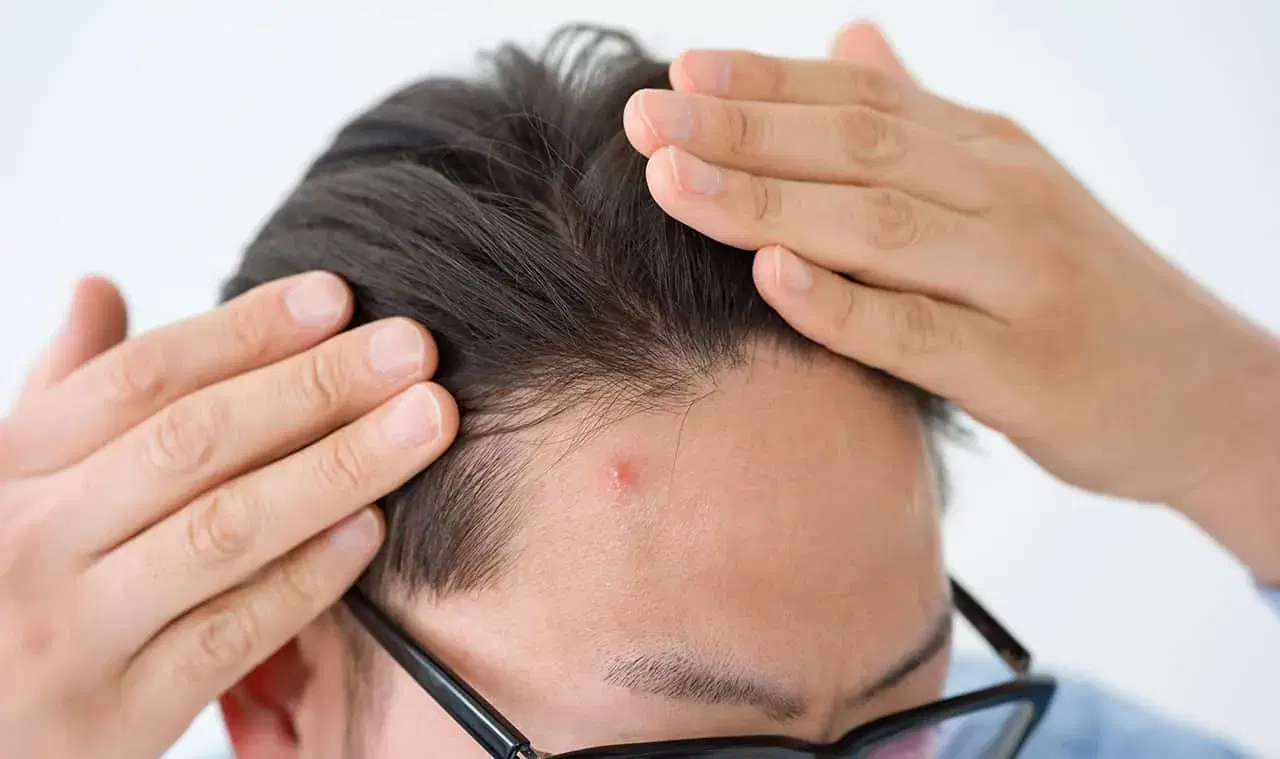
What Is Scalp Acne?
Scalp acne describes pimple-like lesions that develop on the skin beneath the hair, often appearing as small red bumps, whiteheads or inflamed pustules. These lesions can occur near the hairline, behind the ears or across the crown and back of the scalp.
The term is commonly used for several different conditions, including true acne and inflammation centered around individual hair follicles.
Unlike facial acne, scalp breakouts can be difficult to see because the hair conceals the affected skin. Itching or tenderness may therefore become noticeable before the bumps themselves.
Identifying the type of eruption matters because similar-looking lesions do not necessarily respond to the same treatment.
Can Scalp Acne Damage Hair Follicles?
Scalp acne can damage hair follicles when inflammation becomes sufficiently deep, persistent or destructive to affect the structures responsible for hair production.
Most mild pimples remain superficial and resolve without permanently changing the follicle. Even when a few hairs shed around an inflamed spot, the underlying growth structures may remain healthy.
More serious inflammatory disorders behave differently. Deep lesions, repeated infections or conditions that produce scarring can destroy follicles and leave areas where new hair can no longer grow.
The appearance of a pimple alone cannot establish whether permanent damage has occurred.
The greater concern arises when scalp bumps repeatedly affect the same area and appear alongside increasing hair loss, pain or visible changes in the skin.
How Does Scalp Inflammation Affect Hair Growth?
Each hair follicle produces hair through a growth cycle influenced by its local tissue environment.
Inflammation can interfere with that environment by causing swelling, irritation and changes around the follicular opening. Some affected hairs may shed prematurely, while others break because scratching or crust formation places mechanical stress on the strands.
When the follicle remains intact, hair production can resume after the scalp recovers.
Deep inflammation creates a different risk. If the regenerative portion of the follicle is destroyed and replaced by scar tissue, the affected area loses its normal capacity to produce hair.
This explains why temporary shedding and permanent follicular damage require different approaches.
Are Scalp Acne and Scalp Folliculitis the Same?
Scalp acne and folliculitis can look similar, but the terms do not describe exactly the same condition.
Acne commonly involves blockage and inflammation within the pilosebaceous unit, which includes the hair follicle and its associated oil gland. Comedones, such as blackheads and whiteheads, may be present.
Folliculitis describes inflammation centered around a hair follicle and may result from infection, irritation or a chronic inflammatory disease.
The lesions often appear as relatively uniform bumps or pustules surrounding individual hairs.
Because treatment depends on the underlying process, a scalp covered in pimple-like bumps should not automatically be managed as ordinary facial acne.
What Causes Pimple-Like Bumps on the Scalp?
Scalp breakouts may develop when oil, dead skin cells and other material contribute to blockage around follicular openings.
Inflammation can then produce red bumps, pustules or tender lesions.
Bacteria and yeasts can also participate in certain follicular eruptions, while friction and repeated mechanical irritation may worsen existing inflammation.
Close shaving, tight headwear and products that leave substantial residue can contribute to discomfort in susceptible skin.
However, persistent scalp bumps are not necessarily caused by poor hygiene or excessive oil production.
Some represent chronic inflammatory diseases, and others are associated with fungal infection or a reaction to hair-care products.
Can Bacteria or Yeast Trigger Scalp Breakouts?
Microorganisms can contribute to scalp lesions, although their presence does not mean every breakout is an active infection.
Staphylococcus aureus can cause bacterial folliculitis, producing inflamed pustules and sometimes more extensive infection.
Malassezia, a yeast that normally lives on human skin, may contribute to certain itchy follicular eruptions. This condition differs from a typical bacterial infection and may require a different treatment approach.
The scalp also contains microorganisms that participate in ordinary skin function.
Consequently, eliminating bacteria indiscriminately is not an appropriate goal. Treatment should address the specific condition rather than repeatedly using antimicrobial products without a clear indication.
What Are the Early Symptoms of Scalp Acne?
Early scalp acne or folliculitis often appears as small bumps that become noticeable when washing, brushing or touching the hair.
Some lesions develop a white or yellow center, while others remain red and slightly raised.
Itching can become particularly uncomfortable along the hairline, where sweat and friction may aggravate the skin. Tenderness or a mild burning sensation may also occur.
When a pustule opens, fluid can dry into a small crust around nearby strands.
Hair density may remain completely normal at this stage.
However, lesions that repeatedly return to the same location, become increasingly painful or appear alongside thinning deserve closer attention.
Which Signs Suggest Hair Follicle Damage?
Certain changes are more concerning than isolated superficial pimples because they may indicate ongoing inflammation or loss of functioning follicles.
Patchy hair loss: Noticeable gaps developing where painful pustules or crusted lesions repeatedly appear may suggest more extensive follicular involvement.
Smooth areas without visible hair openings: Shiny or scar-like skin can indicate that follicles have been replaced by scar tissue.
Clusters of hairs emerging together: Unusual hair tufting, especially when surrounded by crusts and inflammation, may occur in certain scarring scalp disorders.
Persistent deep lesions: Painful nodules, repeated discharge or expanding inflamed patches require assessment because deeper disease carries a greater risk of lasting damage.
Can Scratching or Popping Scalp Pimples Cause Hair Loss?
Scratching can worsen scalp inflammation by damaging the skin and disturbing the protective barrier around affected follicles.
When crusts attach to hair shafts, repeatedly removing them may pull or break nearby strands. Popping inflamed lesions can also create small wounds and introduce additional microorganisms.
A few broken hairs do not necessarily indicate permanent follicular injury.
However, repeated picking can prolong inflammation and increase the likelihood of infection or scarring, particularly when lesions are already deep.
Avoiding mechanical damage is an important part of protecting inflamed follicles.
When Can Scalp Acne Lead to Permanent Hair Loss?
Permanent hair loss becomes possible when inflammation destroys the structures that allow a follicle to regenerate and produce new strands.
Ordinary superficial acne rarely reaches this level of damage.
The greater risk comes from deep inflammatory lesions, severe infections and specific scalp disorders that progressively replace follicles with scar tissue.
For example, recurrent abscesses or chronic pustular inflammation can eventually leave smooth areas where follicular openings are no longer visible.
The process may develop gradually, with small patches merging into larger regions of hair loss.
Because scarred follicles cannot reliably regenerate through ordinary hair-growth treatments, early recognition of destructive inflammation is essential.
What Is the Difference Between Scarring and Non-Scarring Hair Loss?
Non-scarring hair loss occurs when follicles remain capable of producing hair despite shedding, temporary growth disruption or changes in hair thickness.
Once the underlying problem improves, the follicles may return to normal activity, although visible density takes time to recover.
Scarring alopecia involves permanent damage to the follicular structures responsible for continued growth.
The damaged areas may become smoother, paler or more fibrotic, with fewer visible follicular openings.
Distinguishing between these patterns is particularly important when scalp pimples accompany expanding bald patches.
Can Folliculitis Decalvans Resemble Ordinary Scalp Acne?
Folliculitis decalvans is a chronic inflammatory scalp disease that can initially resemble recurring acne or bacterial folliculitis.
It often produces pustules, crusts and discomfort, particularly around areas where hair density begins to decline.
As the condition progresses, follicles may become permanently damaged, leaving irregular patches of scarring hair loss.
A characteristic finding is hair tufting, where several hair shafts appear to emerge through a shared opening.
The condition has been associated with an abnormal inflammatory response involving Staphylococcus aureus, although its precise cause remains incompletely understood.
Because flare-ups may return after periods of improvement, treatment focuses on controlling disease activity and preserving surviving follicles.
How Does Dissecting Cellulitis Damage Hair Follicles?
Dissecting cellulitis is a more severe inflammatory scalp condition associated with deep nodules, painful swellings and abscesses.
Unlike ordinary superficial pimples, lesions can develop beneath the skin and sometimes form interconnected areas that release fluid.
Hair loss may initially occur around the active inflammation, but repeated or prolonged tissue damage can eventually produce permanent scarring.
The condition commonly affects the crown or back of the scalp, although the distribution is not identical in every person.
Effective treatment generally requires prescription medication aimed at controlling substantial inflammation.
Attempting to squeeze or drain deep scalp nodules at home can increase tissue injury and should be avoided.
Can Acne Keloidalis Nuchae Cause Bald Patches?
Acne keloidalis nuchae is a chronic inflammatory condition that typically affects the hairline at the back of the neck and the lower occipital scalp.
It may begin with small, itchy bumps that resemble acne or ingrown hairs.
Repeated inflammation can lead to firm raised lesions, fibrotic plaques and permanent loss of hair within affected areas.
Close shaving, friction from collars and certain grooming practices may aggravate the condition.
Despite its name, the disorder does not always represent conventional acne or ordinary keloid formation.
Early control of inflammation is important because established fibrotic tissue is much harder to reverse than the initial bumps.
Which Scalp Conditions Are Mistaken for Acne?
Several scalp disorders produce bumps, redness or crusting but require treatments that differ from those used for ordinary acne.
Tinea capitis: A fungal infection that can cause scaling, broken hairs and patchy hair loss; severe inflammatory cases may produce a swollen lesion known as a kerion.
Seborrheic dermatitis: An inflammatory condition associated with greasy scales, itching and redness rather than typical acne lesions.
Acne necrotica: A follicular inflammatory condition in which lesions may develop dark crusts and leave small permanent scars.
Contact dermatitis: Irritation or allergy triggered by hair products can produce redness, itching and inflamed bumps, sometimes accompanied by scratching-related hair breakage.
Do Hair Oils, Sweat and Styling Products Make Scalp Acne Worse?
Some scalp eruptions become more troublesome when heavy oils, waxes and styling products accumulate around follicular openings.
Sweat, moisture and friction may further aggravate irritated skin, particularly beneath tight hats or helmets.
However, these factors do not cause every form of scalp folliculitis, and naturally oily hair does not automatically indicate an infection.
Products containing fragrances or other irritating ingredients may also trigger contact dermatitis, which can resemble an acne breakout.
Reviewing products introduced shortly before symptoms developed may help identify a contributing factor.
Simplifying the routine is often more useful than repeatedly adding stronger cleansers to an already inflamed scalp.
Can Scalp Pimples Develop After a Hair Transplant?
Small pimple-like bumps can appear in the donor or recipient area after hair transplantation.
Some develop when newly growing hairs become trapped beneath the skin or when healing follicles react to local irritation.
Other lesions may reflect bacterial folliculitis or inflammation associated with the surgical process.
A few superficial bumps do not automatically mean that transplanted follicles have been destroyed.
However, painful swelling, spreading redness, significant discharge or persistent lesions require assessment because deeper infection can threaten healing tissues.
Newly transplanted areas should not be treated with aggressive acne products or manipulated without appropriate postoperative guidance.
How Are Scalp Acne and Related Hair Loss Diagnosed?
Diagnosis begins with examining the appearance, distribution and persistence of the scalp lesions.
The presence of comedones may support acne, while pustules centered around individual hairs can suggest folliculitis.
A dermatologist may use trichoscopy, a magnified examination of the scalp, to assess follicular openings, hair shaft changes, inflammation and possible signs of scarring.
Hair-loss patterns also provide valuable information.
Broken hairs, diffuse shedding and smooth bald patches do not necessarily share the same underlying cause.
Previous medication use, grooming habits, scalp treatments and recurring symptoms help complete the assessment.
The aim is to identify the actual disorder before choosing a treatment.
When Are a Scalp Culture or Biopsy Necessary?
Mild scalp eruptions may be diagnosed through clinical examination without extensive testing.
When pustules repeatedly return, become severe or fail to respond to appropriate treatment, a bacterial culture may help identify an organism and guide medication selection.
If fungal infection is suspected, hair samples or skin scrapings may be tested.
A scalp biopsy becomes more relevant when progressive hair loss, persistent inflammation or absent follicular openings raise concern for scarring alopecia.
Microscopic examination can help distinguish inflammatory disorders that otherwise look similar.
Testing is especially important when the diagnosis remains uncertain and continued inflammation could threaten permanent follicular survival.
How Is Mild Scalp Acne Treated?
Mild scalp acne or superficial folliculitis may improve when irritating factors are reduced and the skin is cleaned gently.
A suitable shampoo can remove accumulated oil and styling residue without requiring vigorous scrubbing.
Warm compresses may ease tenderness around a small, uncomplicated lesion, provided the skin is not irritated further.
Selected cases of acne may benefit from topical treatments containing ingredients such as benzoyl peroxide or salicylic acid, although these products can cause dryness, irritation or hair discoloration.
They are not appropriate for every scalp eruption.
Pustules should not be squeezed, and treatments that cause burning or worsening inflammation should be discontinued and reassessed.
When Are Prescription Treatments Needed?
Prescription medication may be necessary when lesions are widespread, painful, recurrent or associated with significant hair loss.
Bacterial folliculitis may require topical antibiotics or, in more extensive cases, oral treatment.
Yeast-related follicular eruptions may respond to antifungal medication, while scalp ringworm generally requires prescription antifungal treatment taken by mouth.
Chronic scarring disorders may need anti-inflammatory medication, antibiotics or other targeted therapies to reduce ongoing follicular damage.
The treatment choice should reflect the diagnosis rather than the appearance of pimples alone.
Repeated antibiotic courses without identifying the cause can promote antimicrobial resistance and delay recognition of an inflammatory condition that requires a different approach.
Can Medicated Shampoos Help Prevent Scalp Breakouts?
Medicated shampoos can help manage selected conditions that contribute to recurring scalp inflammation.
Antifungal formulations may be useful when yeast-related disease or seborrheic dermatitis plays a role.
Other products are designed to reduce oil accumulation, remove scales or limit certain microorganisms.
However, shampoo alone cannot reliably treat every deep follicular infection or prevent the progression of a scarring inflammatory disorder.
Excessive washing and frequent changes between strong medicated products can also damage the skin barrier.
A consistent cleansing routine should control buildup without creating additional irritation.
When scalp bumps continue returning despite appropriate care, identifying the underlying condition is more important than using increasingly aggressive shampoos.
How Long Does Scalp Acne Take to Heal?
Small, uncomplicated scalp pimples may settle within several days, while mild superficial folliculitis can take approximately one to two weeks to clear.
The recovery period becomes longer when lesions are deep, frequently scratched or associated with an ongoing infection.
Chronic inflammatory disorders behave differently and may involve recurring flare-ups over months or years.
The disappearance of visible bumps also does not mean that surrounding hair density will immediately return.
Hair growth progresses more slowly than surface wound healing, so noticeable regrowth may require several months.
When symptoms repeatedly return to the same location, the pattern deserves further investigation rather than indefinite self-treatment.
Will Hair Grow Back After Scalp Acne?
Hair can regrow after scalp acne when the affected follicles remain structurally intact.
Temporary shedding caused by superficial inflammation may improve once the scalp settles and normal growth resumes.
New strands need time to reach a visible length, so the recovery of hair density can lag behind the disappearance of the pimples.
Scarring creates a different outcome.
When severe inflammation destroys a follicle and replaces it with fibrous tissue, that location can no longer produce hair naturally.
This is why the condition of the scalp matters more than the number of hairs shed during a breakout.
Early treatment aims to stop inflammation before permanent follicular damage develops.
Can Hair Growth Products Restore Damaged Follicles?
Hair growth products may help certain forms of thinning when living follicles remain capable of producing hair.
Minoxidil, for example, has established uses in specific non-scarring hair-loss conditions, but it does not treat a bacterial scalp infection or eliminate chronic follicular inflammation.
Applying irritating solutions to an actively inflamed scalp may worsen discomfort.
Likewise, cosmetic serums and strengthening shampoos cannot recreate follicles destroyed by scar tissue.
When hair loss occurs alongside scalp pimples, controlling the underlying skin condition should take priority.
Once inflammation is stable, any remaining thinning can be evaluated to determine whether a separate hair-growth treatment has a useful role.
Which Scalp Acne Symptoms Require Prompt Medical Attention?
Scalp bumps become more concerning when they suggest spreading infection, deep inflammation or progressive damage to the follicles.
Rapidly worsening pain or swelling: Expanding redness, marked tenderness, fever or spreading warmth may indicate a significant infection requiring urgent assessment.
Deep lumps or persistent drainage: Painful nodules, abscesses and repeatedly draining lesions can signal a destructive inflammatory condition.
New or expanding bald patches: Hair loss accompanied by crusting, shiny skin or missing follicular openings raises concern for scarring alopecia.
Recurring lesions that resist treatment: Repeated outbreaks in the same region, especially when hair density continues declining, require diagnostic evaluation rather than prolonged self-treatment.
How Can You Prevent Scalp Acne and Protect Hair Follicles?
Protecting hair follicles begins with reducing unnecessary irritation while treating the actual cause of recurring scalp inflammation.
Gentle shampooing helps remove sweat and product residue without damaging the scalp barrier. Avoiding frequent scratching, aggressive shaving and friction from tight headwear can further reduce mechanical irritation.
Hair-care products should be selected for scalp tolerance rather than their ability to create the strongest cleansing sensation.
Persistent pustules, deep nodules or unexplained hair loss require attention because chronic inflammatory disease cannot always be prevented through hygiene changes alone.
The most important distinction is between a superficial breakout that heals without scarring and an inflammatory process that threatens the follicle itself.
Recognizing that difference early makes it possible to address scalp discomfort while protecting the hair-producing structures that remain healthy.