DHI Hair Transplant in Turkey: What Is It?
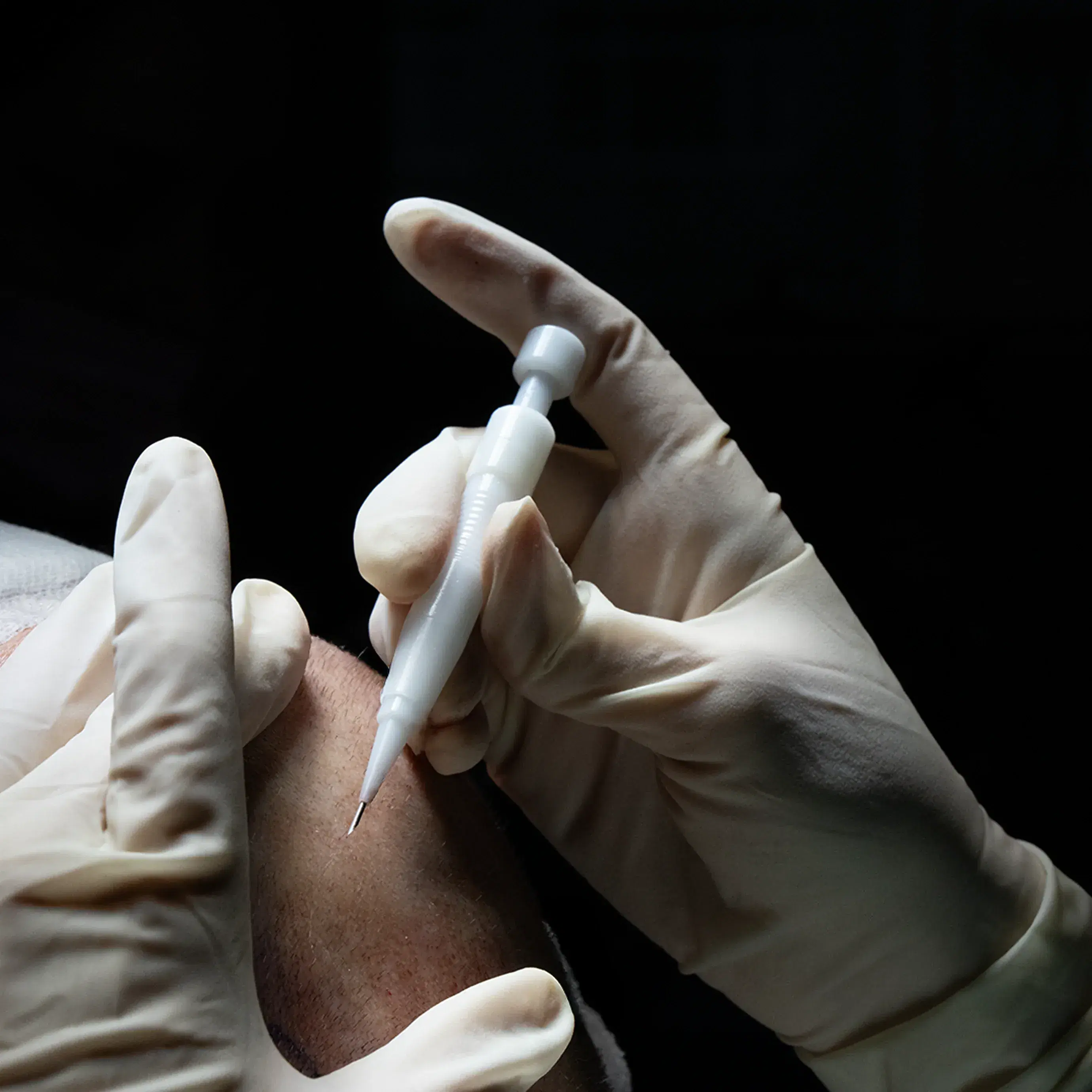
A DHI hair transplant in Turkey is a hair restoration procedure using direct follicle implantation with a specialized implanter pen.
In Turkey, DHI procedures typically combine donor assessment, hairline design, follicle extraction, implantation, and structured aftercare. Istanbul is a major destination for patients seeking DHI hair transplant Turkey treatments and international medical travel. The method allows controlled placement of each graft according to the planned angle, direction, and depth. Turkey attracts international patients because DHI treatments are widely available within organized medical tourism programs.
How Does DHI Hair Transplant Work?
DHI transplantation works by loading harvested follicular units into an implanter and placing them into the recipient scalp with controlled direction, angle and depth.
The Choi hair transplanter was originally described in the medical literature in 1992. Since then, different implanter designs and implantation workflows have been developed. A modern review of graft-placement techniques describes both sharp implanters, which can create an opening and insert the follicular unit during the same movement, and implanters used with recipient sites that have already been created.
This means the word direct does not always describe one identical procedure at every clinic.
Who is a Good Candidate For DHI Hair Transplant?
A good candidate for DHI hair transplant is someone with stable or manageable hair loss, enough healthy donor hair, realistic expectations, and no medical issue that would make the procedure unsafe. Suitability cannot be determined by photos alone, although photos may help with early screening.
You may be a suitable candidate if:
Your hair loss pattern is clear enough to plan around.
Your donor area has adequate density and hair quality.
You understand that transplanted hair takes time to grow.
You are prepared to follow aftercare instructions carefully.
You are seeking improvement rather than impossible perfection.
Why Do People Choose DHI Hair Transplant in Turkey?
People often explore DHI Hair Transplant in Turkey because the country is a well-known destination for hair restoration and medical travel. Many clinics are used to supporting international patients with consultation, treatment planning, local transfers, accommodation guidance, translation support, and post-procedure instructions.
Another reason is accessibility. Patients who may find the procedure difficult to arrange or afford in their home country sometimes compare hair transplant turkey options to find a suitable balance of experience, service, and overall value. Still, price should never be the only deciding factor. A low-cost offer is not a benefit if the assessment is rushed, the donor area is overharvested, or aftercare is unclear.
The best decision comes from comparing medical standards, communication, patient evaluation, graft planning, and realistic expectations. A reputable provider should explain whether DHI is right for you rather than pushing one method for every case.
DHI Hair Transplant vs FUE: What Is the Difference?
"DHI vs FUE" is easily one of the most debated topics among patients. It’s important to understand that both methods can deliver incredibly natural results if they are done right, but they aren't exactly the same.
With FUE, the surgeon first creates incisions (channels) in the bald areas and then goes back to insert the individual follicles. DHI skips that middle step. Because the implanter pen creates the channel and places the hair at the exact same time, it’s a much more direct process.
Generally speaking, doctors prefer DHI for detail-oriented work. If you need a dense front hairline, temple filling, beard or eyebrow restoration, or simply want to add thickness in small areas, DHI is fantastic. On the flip side, if you have a larger area of baldness and need a massive number of grafts, traditional FUE might be the more practical route. Sometimes, a clinic will even combine both methods in one session.
What Are The Main Benefits of DHI Hair Transplant?
The main benefits of DHI hair transplant are precision, controlled placement, and the potential for natural-looking density when the procedure is planned properly. Because grafts are placed one by one, the team can pay close attention to the angle and direction of growth, especially around visible areas such as the hairline.
Common benefits include:
Natural-looking hairline design: Careful placement can help the transplanted hair blend with existing hair.
Controlled graft depth: The implanter tool may reduce unnecessary handling during placement.
Useful for smaller or detailed areas: DHI can be especially helpful for hairlines, temples, crowns, and density refinement.
No need for large linear incisions: Like many modern follicular methods, DHI uses small extraction points rather than a long donor-area scar.
Potentially faster visual recovery in some cases: Smaller implantation points may look less dramatic than larger incisions, although healing varies.
What Happens Before DHI Hair Transplant?
Long before you sit in the surgical chair, you'll go through a strict evaluation phase. Usually, you’ll send in photos of your head from every angle so the clinic can estimate how many grafts you need and confirm if DHI is the right call.
Once you arrive, a proper consultation dives deep into your medical history, any meds you take, allergies, and even your smoking habits. The doctor might also recommend medical treatments to help protect the hair you still have.
Then comes arguably the most critical part: designing the hairline. A great doctor acts like an artist here, drawing a line that matches your face shape, your age, and your future balding risks. If a hairline is drawn too low or perfectly straight, it’s going to look incredibly fake as you get older.
What Happens During the DHI Procedure?
On surgery day, the team preps your donor area and administers local anesthesia. Once you're numb, the follicles are extracted one by one and kept in suitable conditions until it's time for implantation.
Next, the team loads those follicles into the implanter pens and gets to work on the recipient area. The doctor carefully controls the angle and depth of every single graft. This stage requires intense focus because even a slight miscalculation can affect how natural the final result looks. The exact duration depends on how many grafts you need. A smaller session might be over in a few hours, but larger ones can easily take up most of the day.
DHI Hair Transplant Recovery Timeline
Healing from DHI is a gradual journey. For the first few days, you should expect some mild swelling, redness, and scabbing. The clinic will give you strict rules: sleep with your head elevated, do not touch the grafts, and follow a very specific washing routine.
Around the two-week mark, those scabs will start to wash away. Soon after that, you'll likely experience "shock loss," where the newly transplanted hairs shed and fall out. Don't panic—this is totally normal. The roots are securely resting under the skin.
Real patience is required for the next phase. You'll start noticing new, slow growth within a few months. By month four to six, things start looking visibly better, but the final, dense result takes a full 9 to 12 months to mature. Keep in mind that crown areas usually take a bit longer to fully develop.
How Natural Are DHI Hair Transplant Results?
If planned and executed correctly, DHI results can look completely natural. But achieving that look isn't just about packing in as many grafts as possible. It’s about the art of placement.
For instance, a skilled surgeon will only use single-hair grafts at the very front of your hairline to keep it looking soft and realistic, saving the thicker grafts for further back to build volume. This layered approach prevents that artificial, pluggy look.
Equally important is taking care of the donor area. If a clinic gets greedy and harvests too many grafts, you'll be left with very noticeable thinning on the back of your head. A successful procedure respects both the front and the back of your scalp.
DHI Hair Transplant in Turkey Cost 2026
If you're looking at the landscape in 2026, an all-inclusive DHI package in Turkey generally falls somewhere between $2,500 and $6,000. Of course, that final number fluctuates based on the clinic's prestige, how involved the head doctor is, the number of grafts you need, the city you choose, and exactly what is included in your package.
Frequently Asked Questions
Is DHI hair transplant better than FUE?
It's not about being universally "better." DHI is fantastic for precision work, dense packing in small areas, and hairline design. FUE is usually more practical for covering much larger areas. It completely depends on your specific hair loss pattern.
How long does DHI hair transplant take?
It’s a time-consuming process. Expect to be in the clinic for several hours. The exact time depends entirely on how many grafts are being moved and how complex your particular case is.
When do DHI hair transplant results appear?
Patience is key. You'll see the early signs of growth after a few months, and by months four to six, it will look visibly thicker. The true, final result takes about 9 to 12 months to fully show.
Does DHI hair transplant leave scars?
You won't get a long linear scar. DHI does leave tiny, dot-like marks where the follicles were taken, but as long as the surgeon doesn't overharvest, these are incredibly hard to see once your hair grows out.
Can women have DHI hair transplant?
Absolutely. Women can be great candidates, provided they have a healthy donor area and a hair loss pattern that responds well to surgery. Since female hair loss can sometimes be tied to hormones or nutritional issues, a very thorough evaluation is a must.
Can DHI repair a bad hair transplant?
It can definitely help fix past mistakes, but it depends on what the doctor has to work with. If your donor area is already depleted or you have heavy scarring from a bad clinic, it’s much harder. Sometimes, repair work takes multiple sessions to get right.
Can DHI help with receding hairlines?
Yes, DHI can be a strong option for receding hairlines when the donor area is suitable and the design is realistic. Hairline work requires careful attention because it frames the face and is visible from the front, side, and under different lighting conditions.
A natural hairline is not simply a low line across the forehead. It usually includes irregular micro-patterning, appropriate density transitions, and grafts placed at angles that match natural growth. If the hairline is drawn too low or too dense for your donor supply, it can look unnatural and may limit future options if hair loss continues.
Can DHI improve crown thinning?
DHI can improve crown thinning in selected cases, but crown restoration requires careful planning. The crown often needs a spiral-like growth pattern, and it can require many grafts to create a visible density improvement. Because the crown can consume a large number of grafts, the medical team must decide whether the donor supply can support both current and future needs.
For mild to moderate crown thinning, DHI may help add density and improve scalp coverage. For advanced crown loss, the result may be more about visual improvement than full restoration. Existing hair characteristics also matter. Wavy, coarse, or darker hair may create a different coverage effect than fine, straight, or light hair.
Is DHI hair transplant painful?
Most patients describe DHI hair transplant as manageable rather than intensely painful because local anesthesia is used during the procedure. You may feel pressure, movement, or mild discomfort, especially during the anesthesia stage, but the treated areas should be numb during most of the work.
After the procedure, it is normal to have tenderness, tightness, swelling, redness, or mild soreness for a short period. The donor area may feel sensitive while the small extraction points heal. Your provider should explain which symptoms are expected and which signs require medical attention.
Does DHI require shaving the head?
DHI may sometimes be performed with partial shaving or limited shaving, depending on the case. Some patients are interested in DHI because they want a more discreet procedure, especially when only the hairline or a smaller area needs treatment. However, not everyone is a candidate for an unshaven or partially shaven approach.
Shaving can make extraction, visibility, graft handling, and placement easier for the team. It may also help reduce procedure time and support more consistent work, particularly for larger sessions. If a clinic offers no-shave DHI, ask exactly what will be shaved, how many grafts can be safely implanted, and whether the approach affects planning.
Will people be able to tell I had a hair transplant?
In the early recovery period, people may notice redness, scabs, swelling, or a shaved donor area. How visible it is depends on your hairstyle, skin tone, graft number, healing response, and whether the procedure was fully or partially shaved. Planning your return to work and social events with some flexibility can make recovery less stressful.
Long term, a well-planned DHI result should look natural because the hair grows from transplanted follicles. The key is not just density; it is design. Hairline shape, graft angle, spacing, and blending with existing hair all affect whether the result looks believable.
Author: MD. Naciye HACIOMEROGLU