
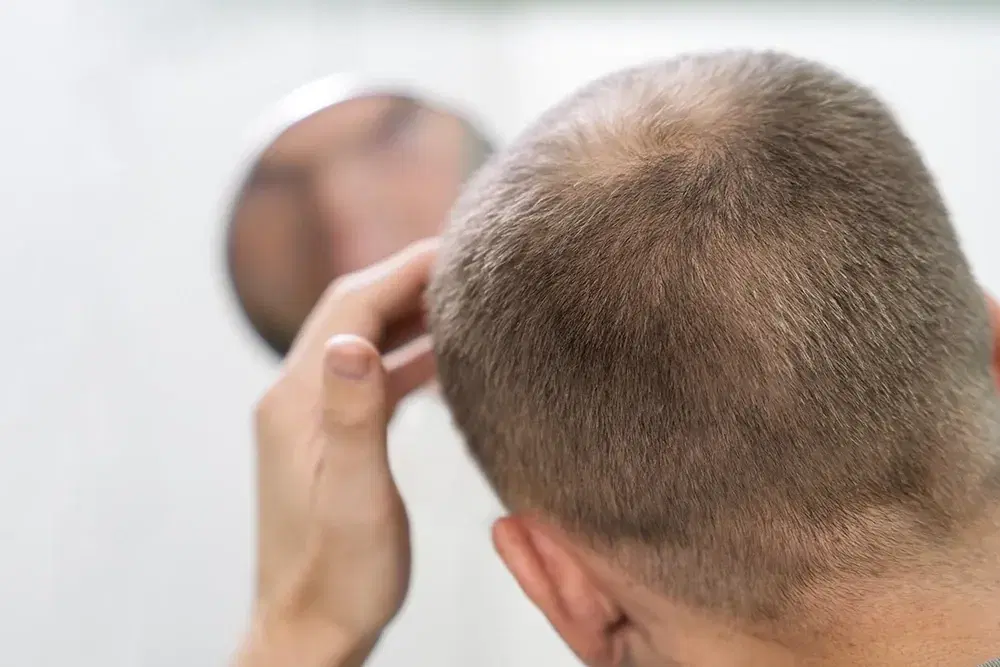
What Is Shock Loss After a Hair Transplant?
Shock loss describes the shedding of existing hair following the physical stress of hair transplantation. In its more precise medical usage, the term refers to native follicles around the recipient area that temporarily stop producing visible hair after surgery.
The disruption can also affect hairs remaining in the donor region.
Patients often use shock loss to describe every strand that falls after transplantation, including the expected shedding of newly implanted hairs. Although these events can occur together, they have different causes and implications.
The distinction matters most when a previously thinning area appears even sparser than it did before surgery.
Why Do Native Hair and Transplanted Hair Shed for Different Reasons?
A transplanted follicular unit experiences a temporary interruption to its original blood supply when it is removed and transferred to another part of the scalp. During its adjustment to the recipient tissue, the existing hair shaft commonly sheds.
Native follicles have not been moved. Instead, they may react to nearby surgical incisions, inflammation and temporary changes in their surrounding environment.
These follicles can shift into a resting phase or experience another form of surgery-related growth disruption.
The visible result may look identical, with hairs collecting during washing, even though one process involves relocated follicles and the other involves untouched follicles responding to surgical stress.
Is Shock Loss the Same as Normal Transplanted Hair Shedding?
The terms overlap in everyday conversation, but they should not be treated as completely interchangeable.
Normal transplanted hair shedding involves the shafts carried by newly implanted follicular units. This is an expected stage of recovery for many patients, and the follicles generally remain beneath the skin.
Shock loss, in the narrower clinical sense, involves hair that was already growing in or around the treated area before surgery.
Not everyone experiences noticeable native hair shock loss, particularly when grafts are placed into an area that was already almost completely bald.
Both types of shedding can occur during the same weeks, creating considerable confusion.
What Happens to the Follicle When a Hair Shaft Falls Out?
A hair shaft is the visible strand, while the follicle is the living structure within the skin that produces it.
When a hair enters a resting phase and subsequently sheds, the follicle may remain capable of starting another growth cycle.
This explains why an apparently empty area can regain coverage several months later.
A transplanted shaft may also fall while its implanted follicle remains viable.
However, shedding and follicular destruction are not the same process. Significant surgical injury, scarring or advanced follicular miniaturization can compromise future growth.
The presence of shed hairs alone cannot establish which of these outcomes has occurred.
How Can You Distinguish Native Hair Shock Loss From Transplanted Hair Shedding?
The most useful clues come from the location, timing and original distribution of the hair rather than the appearance of an individual strand.
Shedding within the implanted pattern: Loss of the short shafts initially visible on newly placed grafts is generally consistent with expected transplanted hair shedding.
Thinning between existing hairs: A reduction in previously established hair around the implanted sites suggests that native follicles may be experiencing shock loss.
Changes around the donor region: A temporary thinning patch near extraction sites may represent donor shock loss, which differs from the follicles permanently removed during harvesting.
Comparison with earlier photographs: Images taken before surgery and during the first postoperative days can help identify which regions contained native hair and which received transplanted grafts.
When Does Shock Loss Usually Begin After Hair Transplant Surgery?
Recipient-area shock loss commonly becomes noticeable between two and eight weeks after transplantation.
Some patients first notice increased shedding while washing their hair around the third or fourth week. Others see a more gradual reduction in density during the second month.
Transplanted hair shafts often shed within a similar period.
The overlapping timing makes it difficult to identify the source simply by counting hairs in the shower.
Shedding that begins immediately after surgery, particularly when accompanied by bleeding or physical injury, raises different considerations from the ordinary hair-cycle changes that develop several weeks later.
Why Can Hair Look Worse Two Months After a Transplant?
The second month can be a particularly frustrating stage because two separate processes may temporarily reduce visible coverage.
Newly transplanted shafts may already have fallen out, while the follicles beneath them have not yet produced substantial new growth.
At the same time, neighboring native hairs may be shedding in response to surgical stress.
Imagine someone who received grafts between existing, relatively thin frontal hairs. If both groups lose their visible shafts temporarily, the scalp can appear less dense than it did before surgery.
This appearance does not necessarily predict the final result, although it should be monitored as growth resumes.
What Causes Native Hair to Shed Around the Recipient Area?
Native hair shock loss is considered a multifactorial response to surgery rather than the consequence of one isolated event.
Creating recipient sites can disturb nearby follicles. Postoperative inflammation, swelling and temporary changes in local circulation may also interrupt normal hair cycling.
The density and depth of incisions can influence how much tissue is affected.
Some research describes the resulting shedding as telogen effluvium, while other observations suggest that anagen-phase disruption can also contribute.
In practical terms, surrounding follicles react to an abrupt change in their local environment, and some temporarily stop producing visible strands.
Are Miniaturized Native Hairs More Vulnerable to Shock Loss?
Hairs already affected by androgenetic alopecia are particularly important when evaluating shock loss.
Under the influence of hereditary follicular sensitivity, these hairs gradually become finer and contribute less coverage to the scalp.
A strongly miniaturized follicle may have less capacity to recover after additional surgical stress.
For example, a recipient area containing many thin, weakened native hairs can look noticeably worse if those hairs shed after transplantation.
Some may return, while others may not recover their previous cosmetic contribution.
This is why assessing miniaturization before surgery matters as much as calculating how many grafts can be placed.
Can Native Hair Shock Loss Become Permanent?
Most postoperative native hair shock loss is temporary, with regrowth developing as the affected follicles resume their normal cycles.
However, permanent loss of visible density is possible, particularly when the original native follicles were already severely miniaturized.
In these situations, surgery may coincide with the disappearance of hairs that were approaching the limits of their useful growth.
Direct damage to a follicle or substantial scarring can also prevent recovery, although these mechanisms differ from ordinary temporary shedding.
The key distinction is between a follicle that has paused and one that can no longer produce meaningful hair.
Time, scalp examination and evidence of new growth help clarify the outcome.
How Does Donor Area Shock Loss Differ From Overharvesting?
Donor shock loss involves the temporary shedding of hairs that remain around an FUE extraction zone or an FUT incision.
It can develop within several weeks, sometimes as a localized patch that looks unexpectedly sparse.
Overharvesting is different. It occurs when too many follicular units have been permanently removed from the donor region.
Those completely extracted follicles do not normally regenerate.
A donor area affected by temporary effluvium may regain coverage over the following three to six months, while true overharvesting leaves a lasting reduction in available follicles.
An early photograph cannot always establish the difference, especially when surrounding hairs are still recovering.
Can Both FUE and FUT Cause Shock Loss?
Both Follicular Unit Extraction and Follicular Unit Transplantation can lead to postoperative shedding because both involve surgical manipulation of scalp tissue.
In FUE, the donor region contains many individual extraction sites. Remaining hairs near those wounds may temporarily shed in response to inflammation or local tissue disturbance.
In FUT, a strip of scalp is removed and the wound closed. Hair near the incision may react to tissue tension or temporary circulatory changes.
Recipient-area shock loss can occur with either technique because new follicles must be implanted into the destination scalp.
Neither harvesting method completely eliminates the possibility of temporary shedding.
Why Can Women With Diffuse Thinning Experience More Noticeable Shock Loss?
A person with diffuse thinning often retains numerous native follicles across the area selected for transplantation.
Placing grafts between these existing hairs creates more opportunities for surrounding follicles to experience surgical stress.
This pattern can be particularly relevant in women with female pattern hair loss, where thinning may be spread across a broad region rather than concentrated in an established bald patch.
Some clinical observations have identified women, especially those with advanced miniaturization, as more susceptible to noticeable recipient-area effluvium.
The underlying concern is not sex alone but the condition and distribution of the native follicles that remain.
Does Dense Graft Placement Increase the Risk of Shock Loss?
Placing many grafts into a small area can improve potential coverage, but it also requires creating numerous recipient sites close together.
When substantial native hair remains between those sites, dense implantation may increase the risk of disturbing existing follicles.
Excessive incision depth, crowded placement and unnecessary tissue trauma can add to that burden.
This does not mean that all high-density transplantation is unsafe.
It means the appropriate density must account for how much hair already exists in the recipient area, not simply how many additional follicles can physically fit.
Protecting surviving native hair may be more valuable than pursuing the highest possible immediate graft count.
Can Surgical Inflammation and Reduced Blood Flow Trigger Shedding?
Hair follicles depend on a healthy surrounding tissue environment to maintain their growth cycles.
Surgical incisions, swelling and inflammation can temporarily alter that environment, while excessive local pressure or vascular disturbance may further stress nearby follicles.
These mechanisms are among the explanations proposed for postoperative shock loss.
However, a temporary disturbance in circulation should not be confused with severe tissue ischemia or necrosis.
The latter conditions can damage the scalp and threaten follicular survival.
Persistent severe pain, darkened skin, worsening wounds or unusual discharge therefore require assessment rather than being attributed to ordinary shock loss.
Will Transplanted Hair Grow Again After Its Initial Shedding?
Transplanted follicles that establish themselves successfully generally resume producing hair after the initial shafts have shed.
Visible regrowth commonly begins around the third or fourth month.
Early strands may be fine, short or unevenly distributed because individual follicles do not all restart growth simultaneously.
Coverage usually becomes more noticeable between six and nine months, while further maturation can continue to twelve months or longer.
This process explains why the absence of visible transplanted hairs at eight weeks does not establish graft failure.
The important outcome is whether viable follicles eventually produce sustained growth, not whether the original transplanted shafts remain attached during the first month.
How Long Does Native Hair Take to Recover From Shock Loss?
Native hair affected by temporary recipient-area effluvium often begins growing again around three months after surgery.
However, a new strand must reach a sufficient length before it contributes visible coverage.
For that reason, the appearance of the scalp may improve more gradually than the biological restart of follicular activity.
Donor-area shock loss can follow a similar course, with substantial recovery commonly occurring over three to six months.
The process may take longer when the affected hairs were already thin or when the scalp experienced considerable postoperative inflammation.
Persistent loss beyond the expected recovery period deserves a fresh assessment rather than an automatic assumption that regrowth will eventually occur.
How Can You Tell the Difference Between Shedding and Graft Dislodgement?
Ordinary shedding involves loss of a hair shaft, whereas graft dislodgement involves physical displacement of recently implanted tissue.
Timing: Graft displacement is principally an early postoperative concern, while routine transplanted hair shedding commonly develops over subsequent weeks.
Bleeding: A graft pulled from a fresh recipient site may cause bleeding, whereas ordinary hair-shaft shedding generally does not.
Visible tissue: A shed strand may carry a small pale root-related structure, which does not by itself establish that an entire transplanted follicular unit has been removed.
Physical trauma: Pulling crusts, scratching the scalp or striking the recipient area during early healing creates a different concern from loose hairs noticed during gentle washing weeks later.
Does Heavy Shedding Mean the Hair Transplant Has Failed?
The amount of hair visible during shedding does not reliably measure how many transplanted follicles remain viable.
A person may lose nearly all the initially visible implanted shafts and still develop substantial new growth months later.
Heavy native hair shock loss can also exaggerate the appearance of poor surgical growth during the early stages.
However, not every disappointing result should be dismissed as normal shedding.
Persistent empty areas, significant tissue damage or a lack of meaningful growth after the expected maturation period require investigation.
A reliable evaluation considers the original graft placement, condition of the recipient scalp and actual evidence of regrowth rather than the number of loose hairs collected after washing.
How Is Shock Loss Different From Continuing Pattern Hair Loss?
Shock loss generally follows a recognizable postoperative timeline, with shedding developing during the first weeks and recovery expected over subsequent months.
Androgenetic alopecia is a progressive condition in which susceptible follicles gradually produce thinner strands over repeated hair cycles.
The two processes can overlap.
For example, a patient may experience temporary native hair shedding shortly after surgery and continue losing unrelated, genetically susceptible hair behind the transplanted region over the following year.
If density does not recover, trichoscopy may help identify ongoing miniaturization rather than a prolonged temporary shedding response.
Distinguishing these processes is essential before considering additional surgery.
Can Minoxidil or Finasteride Help With Shock Loss?
Minoxidil may support hair regrowth in suitable patients, and finasteride can help manage androgenetic alopecia in men by reducing the hormonal influence responsible for follicular miniaturization.
These treatments address different aspects of hair health.
Finasteride primarily aims to preserve susceptible native follicles over time, while minoxidil can support growth in certain forms of thinning.
Neither medication reliably prevents every episode of postoperative shock loss.
Topical products should not be applied prematurely to healing recipient sites, and oral medications require assessment of potential adverse effects and contraindications.
The choice to use treatment should therefore reflect the underlying hair-loss diagnosis rather than a promise of completely avoiding postoperative shedding.
Do PRP, Laser Therapy or Supplements Prevent Shock Loss?
Platelet-rich plasma, low-level light therapy and nutritional supplements are frequently discussed as ways to improve postoperative hair growth.
However, evidence that these interventions consistently prevent shock loss is limited.
Some treatments have been investigated for supporting follicular activity or recovery, but the findings do not establish a dependable method for preventing native hair from shedding after surgical stress.
Supplements are most useful when an actual deficiency contributes to hair problems. Taking large amounts of vitamins without a demonstrated need does not automatically accelerate follicular recovery.
These options should not distract from the fundamentals of sound surgical planning, appropriate scalp care and treatment of any ongoing hair-loss condition.
Which Aftercare Measures Support Recovery Without Damaging Grafts?
Early aftercare should protect the transplanted follicles while allowing the recipient and donor wounds to heal normally.
Gentle washing, performed according to the postoperative instructions, helps remove residue without unnecessary rubbing or pulling.
Crusts should not be forcibly removed because attached hairs and healing tissue can be disturbed.
Avoiding accidental head trauma and excessive pressure is especially important during the first days.
Good aftercare cannot guarantee that native hair shock loss will not occur. It can, however, reduce avoidable injury and inflammation that would complicate recovery.
Once the wounds have healed, ordinary hair hygiene and appropriate management of the underlying hair-loss condition become more relevant than special cosmetic products.
Which Symptoms After Hair Transplantation Require Medical Attention?
Ordinary shedding should not cause progressive tissue damage or significant systemic illness, so certain changes need evaluation rather than reassurance alone.
Increasing redness, pain or warmth: Symptoms that intensify instead of settling may indicate infection or another inflammatory complication.
Pus, fever or worsening swelling: Discharge accompanied by systemic symptoms requires prompt medical assessment and should not be attributed to a normal hair-growth cycle.
Darkened skin or wounds that fail to heal: Unusual discoloration, thick persistent crusting or tissue breakdown can indicate compromised healing and possible injury to the scalp.
Progressive bald patches without regrowth: Persistent or expanding loss, particularly beyond the usual recovery window, should be assessed for scarring, autoimmune hair loss or continuing follicular miniaturization.
How Can Photographs and Trichoscopy Help Assess Hair Recovery?
Photographs taken under consistent lighting provide a practical way to follow recovery without relying on daily impressions.
The most useful comparisons include images from before surgery, immediately after graft placement and subsequent monthly stages.
Hair length, camera angle and lighting should remain as similar as possible.
Trichoscopy adds information that photographs cannot provide by revealing follicular openings, short regrowing hairs and differences in shaft diameter.
It can also identify patterns of miniaturization or inflammation that suggest another explanation for persistent thinning.
The combination of chronological photographs and magnified scalp examination offers a more reliable picture than judging recovery from the amount of hair shed during washing.
When Should Persistent Hair Loss Be Reassessed Before Another Transplant?
A second hair transplant should not be planned simply because the recipient area looks sparse during the first few postoperative months.
At that stage, transplanted follicles may still be entering a new growth cycle, while native hairs affected by shock loss may only be beginning to recover.
A more meaningful assessment usually becomes possible after the expected growth and maturation period, often around twelve months.
Persistent gaps may reflect poor graft growth, continuing pattern hair loss or damage to previously existing follicles.
Each possibility has different implications for further treatment.
Reassessment should establish the cause of the remaining density problem and evaluate the donor reserve before committing more follicles to surgery.
What Is a Realistic Recovery Outlook for Native and Transplanted Hair?
The most important distinction is that the visible loss of a hair shaft does not necessarily represent permanent loss of its follicle.
Newly implanted hairs commonly shed during the first several weeks, with growth gradually returning from around the third or fourth month.
Native hair shock loss can develop during a similar period, especially when grafts were placed among existing thinning hairs. Most affected follicles recover, although severely miniaturized hairs may not regain their previous density.
Donor-area shock loss is also often temporary, but it must be distinguished from permanent depletion caused by extensive extraction.
A realistic recovery assessment considers all three regions separately: the transplanted follicles, the native hair surrounding them and the remaining donor hair.
Early photographs may show a discouraging loss of coverage, yet they rarely reveal the final outcome. Understanding which follicles are shedding, which are recovering and which remain vulnerable provides a much clearer basis for judging the transplant over time.