
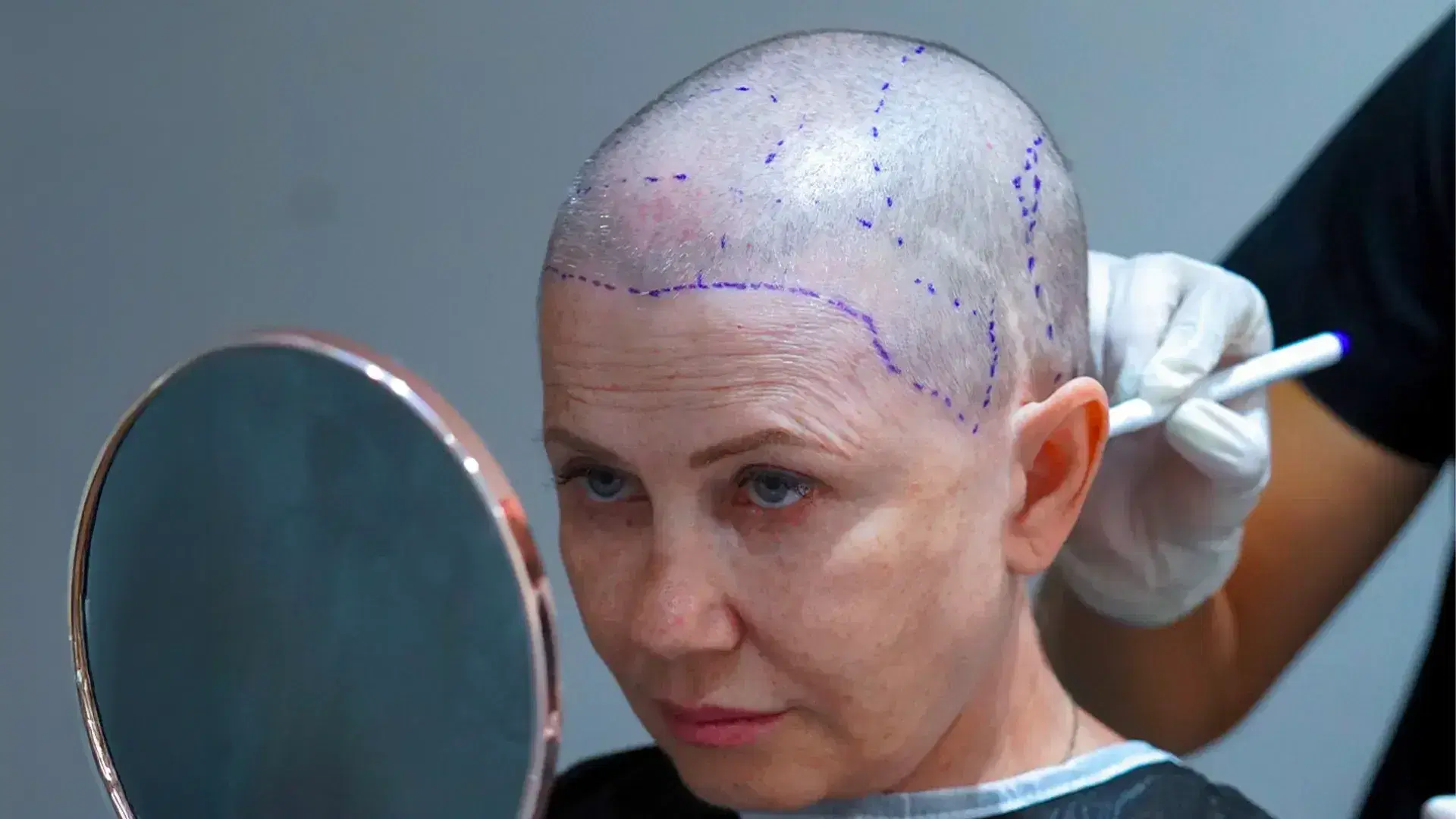
What Is Body Hair Transplant (BHT)?
Body Hair Transplant (BHT) is a hair restoration technique that uses hair follicles taken from areas of the body other than the scalp. When the donor area on the scalp does not provide enough grafts, surgeons may harvest hair from the beard, chest, back, shoulders, or other suitable body areas and transplant it to the scalp.
BHT is most commonly used in patients with advanced hair loss, limited scalp donor hair, or those who require additional grafts for a repair procedure. It is generally considered a supplementary technique rather than a replacement for traditional scalp donor hair, as scalp hair usually provides the most natural and consistent results.
The beard is often the preferred source of body hair because its follicles tend to be stronger and thicker than hair from other body areas. Beard grafts can be particularly useful for increasing density in the mid-scalp or crown. Chest hair may also be used in selected cases, although its texture, growth cycle, and characteristics can differ significantly from scalp hair.
Body hair transplantation is typically performed using the FUE (Follicular Unit Extraction) technique. Individual follicles are carefully extracted and then implanted into areas affected by hair loss. Because body hair differs from scalp hair in terms of thickness, curl, growth rate, and length, careful planning is essential to achieve a natural-looking result.
How Does Body Hair Transplant Work?
Body Hair Transplant (BHT) works by extracting healthy hair follicles from body areas such as the beard, chest, back, or shoulders and transplanting them into areas of the scalp affected by hair loss. The procedure is typically used when the scalp donor area does not contain enough grafts to achieve the desired level of coverage or density.
The process begins with a detailed consultation and donor hair assessment. The surgeon evaluates the quality, thickness, density, and growth characteristics of both the scalp and body hair to determine whether BHT is a suitable option. Not all body hair is appropriate for transplantation, so careful planning is essential.
During the procedure, individual follicles are usually harvested using the FUE (Follicular Unit Extraction) technique. A specialized tool is used to extract grafts one by one from the selected donor area. These follicles are then carefully prepared and preserved before implantation.
Once the grafts are ready, the surgeon creates recipient sites in the thinning or bald areas of the scalp. The body hair follicles are implanted according to the natural angle, direction, and pattern of hair growth. This step is particularly important because body hair often differs from scalp hair in texture, thickness, and growth behavior.
After transplantation, the grafts go through a healing phase similar to a traditional hair transplant. The transplanted hairs typically shed within the first few weeks, followed by a period of new growth that develops over several months. Final results usually become visible within 12 to 18 months.
Which Body Hair Can Be Used for Hair Transplant?
Body hair that can be used for a hair transplant usually includes beard, chest, abdomen, back, arm, and leg hair, depending on hair quality and donor availability. This technique is often called body hair transplant and may be considered when the scalp donor area does not have enough healthy follicles.
Beard hair: Beard grafts are commonly used because they are often thick and strong. They may help improve density, especially in the crown or mid-scalp area.
Chest hair: Chest hair can be used in selected patients, but it usually has a different texture and growth cycle than scalp hair.
Abdomen hair: Abdominal hair may be an option if the follicles are strong enough, though it is usually used as a secondary donor source.
Back hair: Back hair can be used in some cases, but the quality, thickness, and growth pattern must be evaluated carefully.
Arm hair: Arm hair is generally finer, so it may be suitable only for small areas or soft blending.
Leg hair: Leg hair can be used in selected cases, but it is usually thinner and may not provide strong density.
Neck or under-chin hair: In some patients, hair under the chin may be used as part of the beard donor area.
Who Is a Good Candidate for Body Hair Transplant?
A body hair transplant may be considered for individuals who have limited scalp donor hair but require additional grafts for hair restoration. In this procedure, hair follicles are typically harvested from areas such as the beard, chest, or other parts of the body and transplanted to the scalp.
Not everyone is a suitable candidate. The quality, density, and characteristics of body hair play an important role in determining whether this approach is appropriate.
Candidate Type | Why It May Be Considered |
|---|---|
Individuals with Limited Scalp Donor Hair | Additional graft sources may be needed |
Patients with Advanced Hair Loss | Larger areas may require more grafts than the scalp donor area can provide |
People Seeking Increased Density | Body hair may be used to supplement scalp grafts |
Individuals with Strong Beard Density | Beard hair is often considered a useful secondary donor source |
Patients Undergoing a Repair Procedure | Additional grafts may be needed after a previous transplant |
Body Hair Transplant Techniques
Body hair transplant techniques are methods that use hair from areas such as the beard, chest, abdomen, back, arms, or legs when the scalp donor area is limited. These techniques require careful planning because body hair often has a different thickness, growth cycle, and texture than scalp hair.
FUE body hair transplant: Follicular Unit Extraction is the most common body hair transplant technique. Individual grafts are taken from the body and implanted into thinning or bald areas of the scalp.
Beard-to-scalp transplant: Beard hair is often preferred because it is usually thicker and stronger. It can help increase density in the crown, mid-scalp, or scarred areas.
Chest-to-scalp transplant: Chest hair may be used when beard or scalp donor hair is not enough. It is generally used for added coverage rather than hairline design.
Combination technique: Scalp hair and body hair can be used together. Scalp grafts are usually placed in visible areas like the hairline, while body hair supports density behind them.
Manual extraction technique: Some surgeons use manual punches to remove body hair grafts with better control, especially in curved or delicate follicles.
Motorized FUE technique: A motorized punch can speed up graft extraction, but it requires skill to avoid damaging body hair follicles.
Recipient site creation: Tiny channels are opened in the scalp at the right angle, direction, and density before graft placement.
Direct implantation method: In some cases, grafts may be placed with implanter pens to control depth, angle, and direction.
Can Beard Hair Be Used for the Hairline?
Yes, beard hair can be used for the hairline, but it is usually done selectively and with careful planning. Because beard hair is often thicker, coarser, and stronger than scalp hair, it can be a valuable source of additional grafts in hair transplant procedures. However, its characteristics make it less suitable for creating the very front edge of a natural hairline.
Most experienced surgeons prefer to use finer scalp hair for the first few rows of the hairline. This helps create a soft, natural transition that closely resembles natural hair growth. Beard hair is then often placed behind the hairline to add density and improve overall coverage.
In patients with limited scalp donor hair, beard grafts can play an important role in achieving the desired result. They are particularly useful for increasing density in the mid-scalp, crown, or areas behind the hairline where the slightly thicker texture is less noticeable. The success of using beard hair depends on factors such as hair color, curl pattern, thickness, and how well it matches the existing scalp hair.
Can Body Hair Behave Like Scalp Hair After Transplant?
Body hair does not fully transform into scalp hair after transplantation. While body hair can successfully grow in the scalp, it generally retains many of its original characteristics, including its texture, thickness, curl pattern, growth rate, and maximum length.
For example, beard hair typically remains thicker and coarser than scalp hair even after it is transplanted. Chest hair may continue to be finer, shorter, or more curled than the surrounding scalp hair. Although the scalp environment can influence growth to some extent, body hair does not completely adopt the properties of native scalp hair.
This is why body hair transplantation is often used as a supplementary technique rather than a primary source of grafts. Surgeons carefully select where body hair is placed to ensure it blends naturally with existing hair. Beard grafts are commonly used to increase density in the mid-scalp or crown, while scalp hair is usually preferred for the front hairline because of its softer appearance.
Is Body Hair Transplant Permanent?
Yes, a Body Hair Transplant (BHT) is generally considered permanent because the transplanted follicles continue to grow in their new location. Once the grafts successfully establish a blood supply and heal in the recipient area, they typically remain there for the long term.
Like traditional hair transplants, body hair follicles retain their genetic characteristics after transplantation. This means that beard, chest, or other body hair used during the procedure will continue to grow according to their natural growth patterns. While the transplanted hair may adapt slightly to its new environment, it does not completely change into scalp hair.
It is important to understand that a body hair transplant does not stop future hair loss in non-transplanted areas of the scalp. If a patient continues to experience pattern hair loss, the native hair surrounding the transplanted grafts may continue to thin over time. For this reason, long-term hair loss management may still be recommended.
Does Body Hair Keep Its Original Characteristics?
Yes, body hair generally keeps its original characteristics after being transplanted to the scalp. Although the hair will continue to grow in its new location, it usually retains many of the traits it had in the donor area, including its thickness, texture, curl pattern, growth cycle, and maximum length.
For example, beard hair is typically thicker, coarser, and stronger than scalp hair. When transplanted, it usually continues to display these qualities. Similarly, chest hair often remains finer, softer, and shorter than natural scalp hair, even after transplantation.
The reason for this is that hair characteristics are largely determined by the follicle's genetics rather than the area where it grows. Moving a follicle from the body to the scalp does not fundamentally change its biological properties.
When Do BHT Results Start to Grow?
Body Hair Transplant (BHT) results typically begin to grow around three to four months after the procedure. Like a traditional hair transplant, the transplanted follicles go through a natural growth cycle before producing visible new hair.
In the first few weeks after surgery, it is normal for the transplanted hairs to shed. This process, often called shock loss, is a temporary phase and does not mean the grafts have failed. The follicles remain alive beneath the scalp and enter a resting period before new growth begins.
By the third or fourth month, patients usually start to notice the first signs of new hair growth. At this stage, the hairs may appear thin, fine, or uneven. As the months pass, the transplanted follicles continue to mature and produce thicker, stronger hair.
Most patients see noticeable improvements between six and nine months after the procedure. Hair density gradually increases, and the transplanted area begins to blend more naturally with the surrounding hair. Full results typically develop within 12 to 18 months, although growth timelines can vary depending on the individual and the type of body hair used.