
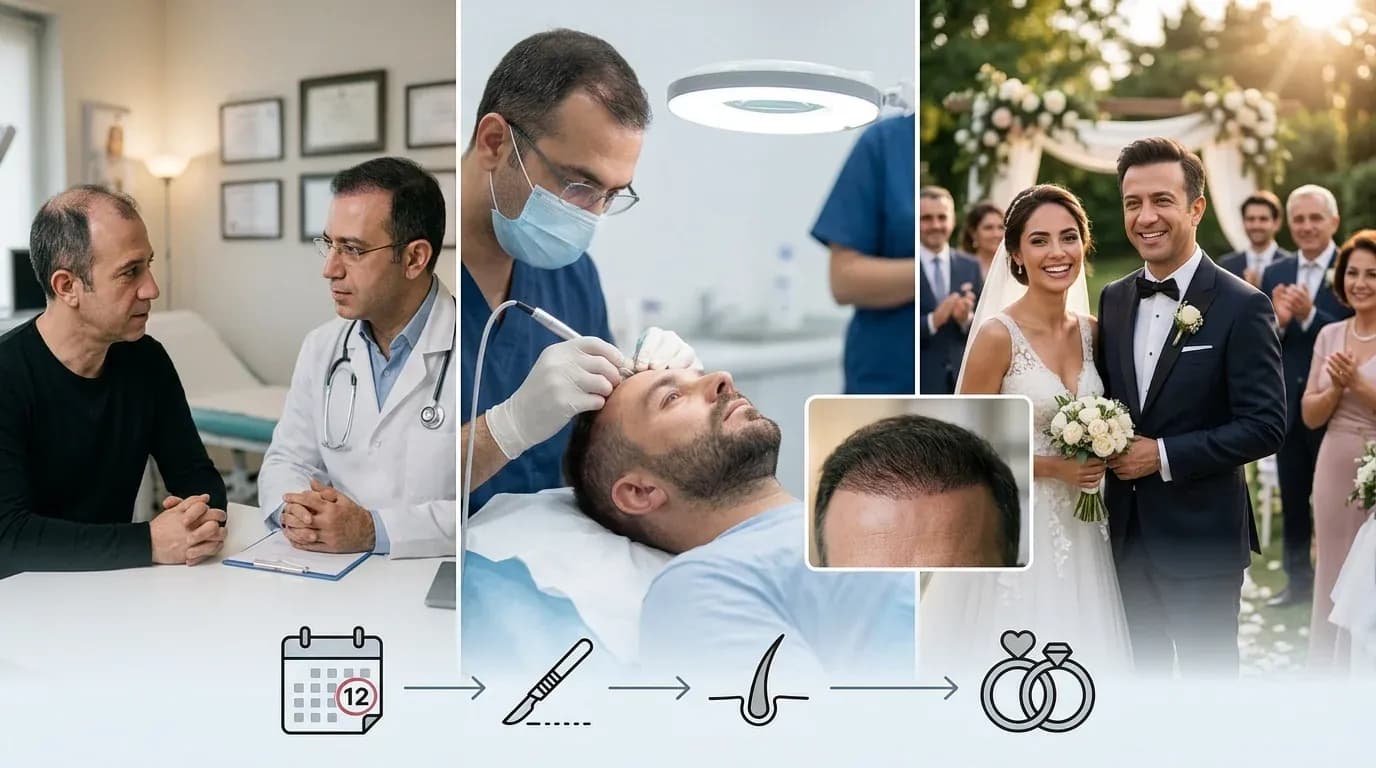
Planning a hair transplant before a wedding requires enough time for the scalp to heal, temporary shedding to pass and new hair to develop naturally. Scheduling the procedure approximately 12 months before the wedding offers a practical timeline for visible hair growth, while earlier planning provides additional flexibility for styling, photography and final results.
How Far Before a Wedding Should You Get a Hair Transplant?
The ideal time to undergo a hair transplant before a wedding is approximately 12 months in advance, although planning 12 to 18 months ahead provides a more comfortable margin. Hair transplantation does not create immediate permanent density because the implanted follicles must pass through a natural recovery and growth cycle before the final appearance develops.
Most patients begin noticing new hair around the third or fourth month, followed by more substantial improvements between six and nine months. By approximately one year, much of the visible result has developed, although some areas, particularly the crown, may continue maturing afterward.
The wedding date is not the only consideration. Engagement photographs, pre-wedding celebrations and international travel may all take place months earlier, making it important to plan around the first occasion when the appearance of the hair will matter.
Hair Transplant Before a Wedding: Month-by-Month Timeline
A realistic wedding hair transplant timeline should account for both the early healing period and the slower process of follicular growth. Although individual recovery experiences differ, the general sequence of shedding, regrowth and maturation follows a recognizable pattern.
12 to 18 Months Before the Wedding: The Ideal Planning Window
Scheduling hair transplantation at least one year before the ceremony creates enough time for the transplanted follicles to complete most of their visible growth cycle. It also allows the hair to gain length, making styling easier once the new strands become established.
This window is particularly useful for people restoring the frontal hairline and crown together. Crown hair can take longer to reach its mature appearance, so additional preparation time reduces the chance of evaluating the result prematurely.
Planning this far ahead also leaves room for postoperative appointments and adjustments to the wedding hairstyle without placing unnecessary pressure on the recovery process.
9 to 12 Months Before the Wedding: A Practical Alternative
A procedure performed nine to twelve months before the wedding can still provide meaningful improvements in visible coverage by the ceremony. During this period, many transplanted follicles have entered their growth phase, and emerging strands gradually become thicker and longer.
However, nine months should not be treated as a guarantee of complete density. Some areas may still appear uneven, especially when the operation involves extensive restoration or follicles that mature more slowly.
Choosing a hairstyle that works with the developing density can help create a balanced appearance while the hair continues improving.
6 to 9 Months Before the Wedding: Expect Developing Results
Six to nine months provides a shorter preparation window, during which noticeable growth is possible but the final outcome may remain incomplete. The new hairs can still be fine, uneven in length or less dense than the surrounding native hair.
A limited hairline restoration may become visually useful during this period, but extensive coverage cannot be assumed. People considering surgery within this timeframe should distinguish between achieving some improvement and having a fully mature result.
The most practical objective is to preserve flexibility in hairstyling rather than expecting the transplanted area to reach its final appearance before the ceremony.
Less Than 6 Months Before the Wedding: Consider the Timing Carefully
A hair transplant performed less than six months before a wedding may leave insufficient time for substantial new growth. During the first few months, the scalp may look similar to its preoperative condition because many transplanted hair shafts have shed and their follicles have not yet produced visible replacement strands.
This is especially relevant when the wedding involves close-up photography, outdoor celebrations or hairstyles that expose the frontal hairline. Although the initial surgical signs usually settle much earlier, the cosmetic benefit develops more slowly.
When the wedding is approaching quickly, postponing transplantation until afterward may be more appropriate than scheduling surgery around an unrealistic expectation of rapid regrowth.
What Happens During the First Two Weeks After Surgery?
The first two weeks after a hair transplant focus on protecting the implanted follicles and allowing the donor and recipient areas to heal. Small crusts develop around the grafts, while temporary swelling, redness and tenderness may appear during the early postoperative period.
These changes are normal features of surgical recovery, but they can be noticeable in photographs and social settings. A procedure scheduled immediately before an engagement party or important family gathering may therefore create unnecessary concerns about appearance.
During this stage, the scalp should be protected from scratching, rubbing, excessive sweating and pressure from unsuitable headwear. Gentle washing and the prescribed aftercare routine help support healing without disturbing the recipient sites.
The hair transplant aftercare guide provides further information about scalp protection, washing and the gradual return to everyday activities after transplantation.
Why Temporary Hair Shedding Matters Before a Wedding
One of the most misunderstood stages of hair transplantation is the temporary shedding period. Many transplanted hair shafts fall out within approximately two to eight weeks after surgery, even when the underlying follicles remain healthy.
This process can be concerning because the recipient area may initially appear fuller immediately after implantation, only to lose much of that visible coverage during the following weeks. Some surrounding native hairs may also shed temporarily after surgery, making the overall appearance seem thinner for a period.
The shedding phase does not mean that the procedure has failed. The transplanted follicles generally remain beneath the skin and enter another growth cycle, but visible improvement requires patience.
For wedding planning, this means that having a transplant three months before the ceremony may produce less visible benefit than expected. Allowing enough time for the shedding phase to pass is essential when the goal is improved hair coverage in wedding photographs.
How Hair Growth Changes Between Months Three and Twelve
New hair growth commonly begins around the third or fourth month, but the earliest strands may not resemble the final result. They can appear fine, uneven and relatively sparse because individual follicles do not begin producing visible hair simultaneously.
Between six and nine months, more follicles usually contribute to coverage, while existing strands gradually develop greater length and thickness. This is often when patients begin noticing a clearer difference in their everyday appearance.
By twelve months, the frontal hairline may have developed most of its visible result, creating greater flexibility for combing and styling. However, some transplanted hairs can continue maturing after the first year, particularly in the crown.
Understanding this progression prevents a common planning mistake: scheduling surgery based on how quickly the scalp heals rather than how long transplanted follicles need to produce mature hair.
Why Hairline Design Matters for Wedding Photography
Wedding photographs place particular emphasis on the face, making the frontal hairline one of the most visible aspects of a hair transplant result. Close-up portraits, side profiles and photographs taken in bright daylight may reveal details that are less noticeable during ordinary daily activities.
A natural frontal hairline should include appropriate height, subtle irregularities and a gradual transition from fine single hairs to denser coverage farther behind. Correct growth direction also matters because transplanted strands should respond naturally to styling rather than project outward at unusual angles.
An excessively low or perfectly straight hairline may appear artificial even when the procedure achieves good graft survival. Designing the frontal border around facial proportions and long-term hair loss patterns therefore matters more than creating the greatest possible immediate density.
The article on natural-looking hairline results after transplantation explores how graft selection, placement angles and hairline shape contribute to a convincing appearance.
Does the Hair Transplant Technique Affect Wedding Planning?
FUE and DHI are commonly discussed when choosing a hair transplant method, but neither technique eliminates the biological waiting period required for new hair growth. The transplanted follicles still undergo healing, temporary shedding and gradual regrowth.
FUE involves extracting individual follicular units from the donor region, while DHI commonly describes an implantation method using a specialized instrument. Both approaches can produce natural results when grafts are handled carefully and placed in suitable positions.
The appearance of the donor area may influence short-term wedding planning. Some procedures involve shaving a substantial portion of the scalp, while selected unshaven approaches can preserve more of the existing hairstyle during early recovery.
However, avoiding a fully shaved appearance does not accelerate graft maturation. A procedure selected for discretion should not create unrealistic expectations about how quickly the new hair will become visible.
When Should You Schedule Wedding Haircuts and Coloring?
Haircut planning becomes easier once the scalp has healed and transplanted strands have developed enough length to blend with existing hair. During the early recovery period, aggressive styling and unnecessary contact with the recipient area should be avoided.
A preliminary haircut several weeks before the wedding can help establish a suitable shape, particularly when the transplanted area contains hairs of different lengths. This also provides an opportunity to understand how the new growth responds to brushing, drying and ordinary styling products.
Chemical coloring, bleaching and intensive straightening require more caution because they can irritate sensitive scalp tissue and weaken existing strands. These treatments should not be applied to healing recipient sites, and their timing should follow complete skin recovery.
Avoiding dramatic last-minute changes is particularly important. A familiar haircut and previously tested products are less likely to create unexpected irritation or styling problems immediately before the ceremony.
Planning Engagement Photos and Pre-Wedding Events
Engagement photography often takes place several months before the wedding, making it a separate milestone when scheduling hair restoration. A person who plans surgery twelve months before the ceremony may have only six months of growth by the time engagement portraits are taken.
This does not mean the photographs must be postponed. It means the expected hair appearance should be considered in advance, particularly if the hairstyle exposes the temples, crown or frontal hairline.
Pre-wedding events also create practical considerations. Bachelor celebrations, destination gatherings and formal family occasions may involve travel, outdoor activities or extensive photography, all of which are easier to manage once the scalp has recovered.
Creating a calendar that includes these events provides a more realistic picture than planning around the wedding date alone.
What If Your Wedding Is Only Three Months Away?
Three months is usually too short to expect significant cosmetic improvement from a new hair transplant. At this stage, many follicles are only beginning to emerge from their resting phase, and the appearance may still resemble the original hair loss pattern.
For someone whose main priority is the wedding hairstyle, non-surgical options may be more practical in the short term. Hair fibers, suitable concealing products or a professionally fitted hair system can sometimes improve the appearance of thinning areas without requiring immediate surgery.
These products should be tested before the wedding to assess how they look under different lighting conditions and whether they remain comfortable during a long event. A hairstyle that uses existing coverage effectively may also reduce the visibility of thinning.
Transplantation can then be considered after the wedding, when the recovery period no longer competes with an important personal deadline.
Wedding Day Styling After a Hair Transplant
When the transplant has had sufficient time to mature, the wedding hairstyle should highlight the natural direction and density of the new hair. A style that works with the existing growth pattern is often more convincing than one that requires excessive heat, heavy products or aggressive brushing.
A trial styling session before the wedding can help identify how the frontal hairline looks from different angles. This is particularly useful for photographs taken outdoors, where bright light may make the scalp more visible through areas that have not reached full density.
Hair products should be chosen for their familiarity and compatibility with the scalp. Introducing a new adhesive, chemical treatment or strongly fragranced product on the wedding day creates an avoidable risk of irritation.
The goal is to establish a reliable hairstyle in advance so that the final preparation involves only minor adjustments.
Planning a Honeymoon After Hair Transplant Surgery
Honeymoon plans should also influence the timing of hair transplantation, especially when the trip involves beaches, swimming, hiking or intense sun exposure. These activities can be difficult to manage during early postoperative healing because the scalp needs protection from friction, ultraviolet radiation and unnecessary irritation.
A wedding followed immediately by a tropical holiday is therefore another reason to avoid scheduling transplantation shortly before the ceremony. Even after superficial healing, the scalp may remain sensitive, and newly implanted areas should not be exposed to avoidable stress.
When the transplant takes place many months before the wedding, honeymoon activities are less likely to interfere with the early healing process. Normal sun protection remains important, particularly when thinning areas of the scalp are still exposed.
Allowing adequate recovery time makes it easier to enjoy both the wedding and the subsequent travel without planning activities around fresh surgical wounds.
Common Mistakes When Planning a Hair Transplant Before Marriage
One frequent mistake is assuming that the transplanted hair will remain visible exactly as it appears immediately after surgery. This overlooks temporary shedding and can lead to disappointment when the scalp looks thinner during the first few months.
Another problem involves choosing a very low hairline solely to achieve a dramatic transformation before the wedding. A successful design should remain appropriate as the person ages, especially when native hair behind the transplanted region may continue thinning.
Scheduling surgery too close to engagement photographs or important celebrations can also create unnecessary pressure. Although crusts and swelling generally resolve much earlier than hair regrowth occurs, the cosmetic result continues developing long after the scalp appears healed.
Finally, planning the wedding hairstyle without considering the donor region can leave unexpected limitations. Both the transplanted area and the surrounding hair should be included when deciding how short to cut the hair and how to style it for formal photographs.