
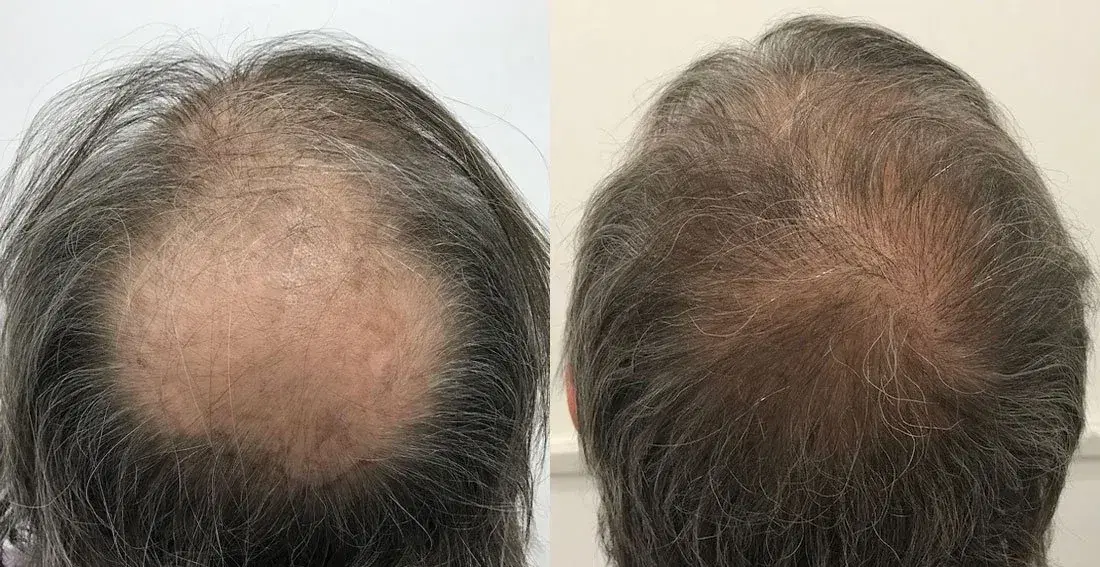
Vertex Hair Transplant Success Rate
The success rate of a vertex hair transplant is generally high, with most patients achieving significant hair growth and improved coverage when the procedure is performed by an experienced surgeon. In many cases, transplanted graft survival rates can exceed 90%, provided that the donor hair is healthy, the surgical technique is appropriate, and post-operative care instructions are followed.
The vertex, also known as the crown area, presents unique challenges compared to the hairline or frontal scalp. Crown hair naturally grows in a spiral or whorl pattern, which means grafts must be placed at carefully planned angles and directions to create a natural appearance. This makes surgical expertise particularly important when treating the vertex.
Success is not measured solely by graft survival. The overall result also depends on achieving natural density, proper hair direction, and a balanced distribution of grafts. Because the crown often covers a larger surface area than the hairline, patients may require a higher number of grafts to achieve satisfactory coverage.
Hair characteristics can also influence the perceived success of the procedure. Thicker, curlier, or darker hair may provide better visual coverage than fine or light-colored hair, sometimes requiring fewer grafts to achieve a fuller appearance.
FUE Vertex Hair Transplant Success Rate
FUE vertex hair transplant success rate is generally high when donor quality, graft survival, and crown planning are suitable.
The vertex area is technically demanding because hair grows in a spiral pattern around the crown. This means graft angle, direction, and density must be planned differently from the frontal hairline. FUE can restore visible coverage by transferring individual follicles from the donor area to the crown. However, crown hair loss often needs more grafts because the area spreads in multiple directions.
DHI Vertex Hair Transplant Success Rate
DHI vertex hair transplant success rate depends on graft handling, implantation angle, donor strength, and crown hair loss pattern. DHI uses an implanter pen to place grafts directly into the recipient area. In the vertex, this can help control angle and direction when rebuilding the natural crown swirl. The result still depends on how well grafts survive and how accurately the pattern is designed. Crown restoration may appear less dense than frontal restoration because light reflects strongly from this area.
Sapphire FUE Vertex Hair Transplant Success Rate
Sapphire FUE vertex hair transplant success rate can be high when the crown pattern and graft distribution are planned carefully. Sapphire FUE uses sapphire-tipped blades to create recipient channels before graft placement. In vertex restoration, these channels must follow the natural circular growth direction of the crown. Good results depend on correct channel angle, graft quality, donor density, and realistic coverage goals.
What Does Vertex Mean in Hair Transplant?
In hair transplant terminology, the vertex refers to the crown area located at the top and back of the scalp. It is the region where hair naturally grows in a circular or spiral pattern, often called a whorl. The vertex is one of the most common areas affected by male pattern baldness and age-related hair thinning.
The crown area differs from the hairline and frontal scalp because of its unique hair growth direction. Hair in the vertex grows outward from a central point, creating a natural swirl pattern. For this reason, restoring the vertex requires careful planning and precise graft placement to ensure the transplanted hair follows the natural flow of surrounding hair.
Hair loss in the vertex often begins as a small thinning spot and can gradually expand over time. In advanced cases, the crown may become completely bald. Because the vertex covers a relatively large surface area, restoring full density in this region may require a significant number of grafts.
Why Is Vertex Hair Transplant Different?
Vertex hair transplant is different because the crown area has a spiral hair growth pattern, lower blood supply compared to the frontal scalp, and often needs more grafts for natural-looking density. The vertex, also called the crown, is one of the most challenging areas in hair restoration.
Whorl growth pattern: Hair in the vertex grows in a circular or spiral direction. The surgeon must follow this natural pattern for a realistic result.
Larger thinning area: Crown hair loss can spread over time, so the transplant plan must consider future hair loss.
Higher graft demand: The vertex often needs many grafts because hair must be placed at different angles to create visual coverage.
Density challenges: Crown hair reflects light more easily, so thin areas may look more visible than other parts of the scalp.
Slower visible results: Vertex hair transplant results may take longer to appear because crown hair can grow more slowly after surgery.
Careful donor planning: Using too many grafts in the crown may limit future options for the hairline or mid-scalp.
Natural angle placement: Grafts must be implanted at the correct depth, angle, and direction to match the existing swirl.
Progressive hair loss risk: If surrounding native hair continues to thin, the crown may need additional treatment later.
Is Vertex Hair Transplant Successful?
Yes, a vertex hair transplant can be highly successful when performed by an experienced surgeon and supported by a strong donor area. Modern hair transplant techniques can effectively restore density in the crown area and create natural-looking results that blend with the surrounding hair.
The vertex, or crown, is one of the most challenging areas to treat because of its unique spiral hair growth pattern. Unlike the hairline, where hair generally grows in a single direction, crown hair grows in multiple directions around a central point. To achieve a natural appearance, grafts must be implanted at carefully planned angles and orientations.
Success depends on several factors, including the extent of hair loss, the number of available grafts, hair characteristics, and the quality of the surgical technique. Patients with thick or curly hair often achieve better visual coverage because each graft provides more scalp coverage.
What Is Considered a Successful Vertex Hair Transplant?
A successful vertex hair transplant is one that creates natural-looking coverage in the crown area while maintaining realistic density and preserving donor hair for future needs. Success is not simply about placing a large number of grafts; it is about achieving a result that blends seamlessly with the surrounding hair and looks natural from every angle.
The crown, or vertex, has a unique spiral growth pattern that makes it one of the most technically demanding areas to restore. A successful procedure recreates this natural whorl pattern by carefully matching the direction, angle, and distribution of the transplanted grafts. When done correctly, the restored crown should not appear artificial or draw attention.
Another important measure of success is graft survival. Healthy transplanted follicles should grow consistently and provide visible improvement in coverage over time. While achieving the same density as a full head of natural hair is not always possible, a successful outcome creates the appearance of fuller hair and reduces the visibility of the scalp.
Long-term planning is also a key factor. Because hair loss can continue after the procedure, a successful vertex hair transplant takes future thinning into account. The surgeon must use donor hair strategically to ensure the result remains balanced and natural as the patient ages.