
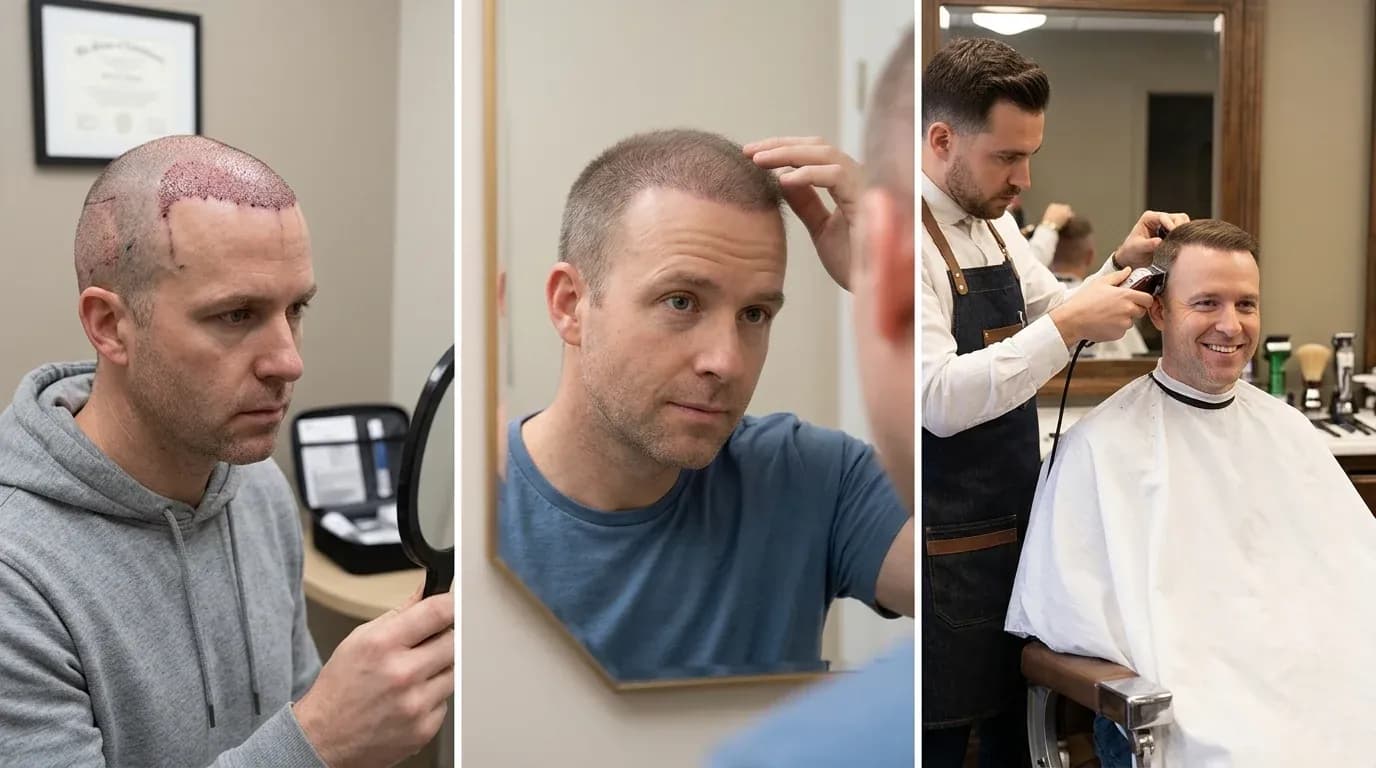
You can generally get a gentle haircut around one month after a hair transplant, provided the scalp has healed and the treatment does not disturb the transplanted area. Scissor trimming is usually the first option, while electric clippers, close fades and razor shaving require additional caution because they create more direct contact with the recovering skin.
How Long to Wait Before Your First Haircut After a Hair Transplant?
Waiting approximately four weeks before your first haircut is a cautious approach to protecting the scalp during its initial recovery. Hair transplantation involves removing healthy follicular units from a donor region and placing them into small openings in the recipient area, creating surgical wounds that need time to heal.
Although transplanted grafts become more securely anchored during the first several days, the surrounding skin continues recovering afterward. Small crusts, redness and sensitivity may remain even when the follicles are no longer easily displaced. Cutting the hair too early can introduce unnecessary pulling, friction or pressure against these healing areas.
The first haircut should therefore focus on improving the hairstyle without disturbing the scalp. Scissors offer greater control when only the ends need trimming, whereas electric clippers and razors may contact the skin repeatedly. Understanding the difference between these tools is essential because a haircut is not one uniform procedure.
Haircut Timeline After Hair Transplant Surgery
The safest way to plan your first haircut is to consider both the healing stage and the technique used. A gentle trim performed above the scalp places different demands on the recipient area than a close shave that runs directly across the skin.
First 10 to 14 Days: Avoid Cutting the Hair
During the first two weeks, the priority is protecting the implanted follicles and allowing the surgical openings to close. Small crusts commonly form around the recipient sites, while the donor region may remain tender or slightly swollen.
Even a simple haircut can involve combing, pulling, sectioning and repeated contact with the scalp. These actions are best avoided while crusts remain attached, particularly because forcibly removing them can disturb healing tissue.
Research into graft anchoring has shown that transplanted follicles become increasingly secure during the first postoperative days. However, becoming securely anchored does not mean the scalp is immediately ready for cutting, shaving or vigorous handling. The surrounding skin still needs time to recover.
Weeks Three to Four: Consider a Gentle Trim
By the third or fourth week, many patients have completed most of the initial surface healing. Crusts have usually disappeared, and ordinary washing and light hair handling have become more comfortable.
At this stage, a limited scissor trim may be considered when the scalp has no remaining wounds, significant tenderness or active inflammation. Hair around the sides and back may be easier to tidy because these areas often contain longer existing strands that can be shortened without touching the skin.
The transplanted region requires greater care. Even when the skin looks healthy, the first haircut should avoid pulling the new hair or pressing styling tools directly against the recipient area.
Months Two to Three: Gradually Resume More Styling Options
During the second and third months, the scalp has generally progressed well beyond the earliest healing stage. Scissor cuts become easier to perform, while some forms of guarded clipper trimming may become appropriate on fully healed areas.
However, the recipient region should still be treated differently from an ordinary, unaffected scalp. Clippers can cause friction when repeatedly passed over the skin, particularly when short guards are used or pressure is applied to achieve an even cut.
A conservative approach is to postpone close clipping of the transplanted area until approximately three months after surgery. More aggressive shaving should be delayed further when the scalp remains sensitive.
After Three Months: Returning Toward Normal Haircuts
After approximately three months, many patients can gradually return to their preferred haircut, including carefully performed clipper cuts on healed skin. By this stage, the main concern is usually scalp comfort and preventing unnecessary irritation rather than dislodging newly implanted grafts.
However, close razor shaving deserves more caution than ordinary trimming. Removing hair directly at skin level creates greater contact with the scalp, and repeated blade passes may irritate areas that still have altered sensation.
Starting with a longer haircut and gradually reducing the length is often more practical than immediately returning to a very short shave.
Donor Area vs Recipient Area: Why Haircut Timing Is Different
The donor area and recipient area undergo different surgical processes, which explains why they may not be ready for the same haircut at the same time. The donor region, usually located along the back and sides of the scalp, supplies the follicles used during transplantation.
With FUE, extraction leaves numerous small wounds that gradually close as the skin heals. The remaining donor hair may grow unevenly because some sections were shortened during surgical preparation, making an early tidy-up appealing.
The recipient area contains the newly implanted follicles and often requires greater protection from mechanical contact. Scissors can trim surrounding hair without touching the skin, but clippers placed directly against the transplanted region may cause unnecessary friction.
A donor-area trim may therefore become practical before a complete haircut involving the frontal hairline or crown. For additional guidance on this distinction, the hair transplant aftercare guide explains how scalp protection and gentle washing support early healing.
Scissors, Clippers or Razor: Which Is Safest After a Hair Transplant?
The cutting tool makes a considerable difference because each method applies a different amount of contact and pressure.
Scissor Haircuts
Scissors are generally the preferred option for the first haircut because they can shorten the hair without running across the scalp. When the strands are long enough, a careful trim can improve their shape while leaving the roots and surrounding skin undisturbed.
However, scissor cutting still requires appropriate handling. Pulling the hair tightly with a comb or repeatedly brushing across sensitive areas can create discomfort, even when the blades themselves never touch the scalp.
Electric Clippers
Electric clippers are useful for creating consistent lengths, but they typically involve closer contact with the scalp. The shorter the guard, the more likely the tool is to rub against the skin while passing over the treated region.
For the first clipper haircut, using a longer guard and avoiding repeated passes provides a gentler approach. The recipient area should not be exposed to aggressive clipping simply because the donor region already tolerates a normal haircut.
Razor Shaving
A razor produces the closest result and also introduces the greatest direct skin contact. Blades can scrape sensitive tissue, irritate small scars and create minor cuts when used over an area that has not fully recovered.
For this reason, razor shaving is best left until the scalp has healed completely, typically several months after transplantation. Anyone considering a fully shaved hairstyle should allow additional recovery time rather than treating razor shaving as equivalent to a scissor trim.
Does FUE, FUT or DHI Affect When You Can Cut Your Hair?
The transplantation method can influence how the donor area heals, but it does not eliminate the need to protect the recipient region. FUE involves removing individual follicular units, leaving small extraction sites that heal separately.
FUT uses a strip of donor scalp that is surgically removed before the wound is closed. The resulting linear incision may require additional consideration when cutting hair around the back of the head, especially if stitches, tenderness or wound tension remain present.
DHI commonly refers to implanting grafts with a specialized instrument. Although this changes the implantation process, the transplanted follicles still require time to become established within the recipient tissue.
Haircut decisions should therefore reflect the condition of both surgical areas and the amount of contact involved in the proposed hairstyle. A technique associated with relatively quick early healing does not automatically make a close shave appropriate after only a few days.
How Can You Tell When Your Scalp Is Ready for a Haircut?
The condition of the scalp provides important information beyond the number of days since surgery. A healthy recipient area should no longer contain attached crusts, open wounds or signs of active inflammation before ordinary cutting begins.
Tenderness also matters because the scalp may remain sensitive even after its surface appears healed. A haircut that requires repeated combing or pressure can be uncomfortable when altered sensation or tightness persists.
The donor area should be assessed separately. Small extraction marks may remain visible after FUE, while an FUT incision must heal sufficiently before tools are moved across the surrounding hair.
Persistent redness, increasing discomfort, discharge or areas that have not closed require medical assessment rather than a routine barber appointment. Waiting for complete healing is more important than achieving a particular hairstyle by a fixed date.
How to Prepare for Your First Barber Visit After Hair Transplantation
Your first haircut should be planned around the areas that received grafts rather than approached as an ordinary appointment. Before cutting begins, explain which parts of the scalp underwent transplantation and identify any regions that remain sensitive.
The barber should avoid pressing combs, clipper guards or other tools against the transplanted area. A gentle trim using scissors is often sufficient to improve the hairstyle without disturbing sections that are still recovering.
Clean equipment is also important. Clippers, combs and scissors should be properly maintained and disinfected, particularly when the scalp has recently undergone surgery.
It is useful to begin with a modest adjustment rather than attempting a dramatic transformation. Once the first haircut feels comfortable and the scalp continues healing normally, later appointments can gradually introduce more styling options.
Can You Get a Fade Haircut After a Hair Transplant?
A fade haircut can be possible after transplantation, but its timing depends on where the fading begins and how closely the hair is cut. A low fade around the lower sides may avoid much of the recipient region, while a high fade can expose areas affected by donor extraction.
The main concern is the degree of contact between the clipper and the recovering skin. Very short guards may reveal small extraction scars or temporary gaps in donor density, making the hairstyle look less even than expected.
For people who prefer fades, waiting until the donor region has recovered and surrounding hair has regained some length can produce a better appearance. Starting with a longer guard also reduces the risk of unnecessary irritation.
A skin fade deserves additional caution because it involves cutting extremely close to the scalp. The appearance of the donor area should be considered before returning to a hairstyle that leaves very little hair covering the extraction sites.
Why Hair May Look Uneven During the First Few Months
Many patients expect a haircut to improve the appearance of their transplanted hair immediately, but the early growth cycle can make uniform styling difficult. Transplanted hair shafts commonly shed during the first several weeks as the follicles temporarily enter a resting phase.
During this period, existing hair may continue growing while the recipient area remains relatively sparse. This creates uneven lengths that cannot always be corrected through cutting alone.
The shedding phase is a normal part of recovery for many patients and does not automatically indicate graft failure. The follicles can remain healthy beneath the skin and begin producing new strands around the third or fourth month.
The article on shock loss after a hair transplant explains why both transplanted and surrounding native hairs may temporarily shed during recovery.
Understanding this process helps prevent unnecessary attempts to shave the entire scalp merely to create a uniform appearance before new growth begins.
Can Cutting Your Hair Too Soon Damage Transplanted Follicles?
Haircutting itself does not alter the biological growth cycle of a healthy follicle. Once the scalp has healed and the grafts are established, shortening the visible hair shaft does not remove the follicle or prevent it from producing new hair.
The risk during early recovery comes from mechanical injury rather than the simple act of cutting a strand. Pulling attached crusts, pressing clippers against healing wounds or scraping the scalp with a razor can damage sensitive tissue.
A careful scissor trim performed above the scalp presents different risks from a close shave that repeatedly contacts the recipient sites. This explains why haircut recommendations should distinguish between cutting methods instead of treating every approach as equally safe.
If accidental contact causes bleeding, significant pain or visible tissue damage during an early haircut, the procedure should stop and the affected area should be assessed.
How to Care for Your Scalp After the First Haircut
The first haircut should not introduce unnecessary scalp irritation. After trimming, gently remove loose hair fragments through the washing routine already established during postoperative recovery.
Avoid aggressive brushing, vigorous towel drying or intensive scalp massage, particularly when the skin remains sensitive. Hair products should also be introduced cautiously because strongly fragranced gels, sprays and other styling preparations can cause irritation in some individuals.
If electric clippers were used, pay attention to whether the scalp develops new tenderness or redness. Mild temporary sensitivity may settle, but persistent burning, increasing pain or unusual inflammation should not be ignored.
Long-term hair care can gradually become more flexible as healing progresses. However, maintaining clean equipment, avoiding unnecessary friction and choosing comfortable styling methods remain sensible habits beyond the initial recovery period.
Planning Haircuts for Work, Weddings and Special Occasions
People often want to schedule their first haircut around returning to work, attending a wedding or preparing for an important social event. However, a haircut cannot instantly create the density that transplanted follicles need months to develop.
During the first few weeks, a modest trim of existing hair may make the overall hairstyle tidier without requiring direct treatment of the recipient area. More extensive styling becomes easier once new growth begins and surrounding hair can be blended naturally.
For an important event, scheduling the haircut well before the occasion allows time to see how the hair settles. Experimenting with an unfamiliar close shave immediately before a major event can reveal donor scars or uneven density that a longer style would have concealed.
Planning ahead is particularly valuable for people who normally keep their hair very short. Allowing several months before returning to close clipping gives the scalp time to recover and provides a clearer view of the developing transplant result.