
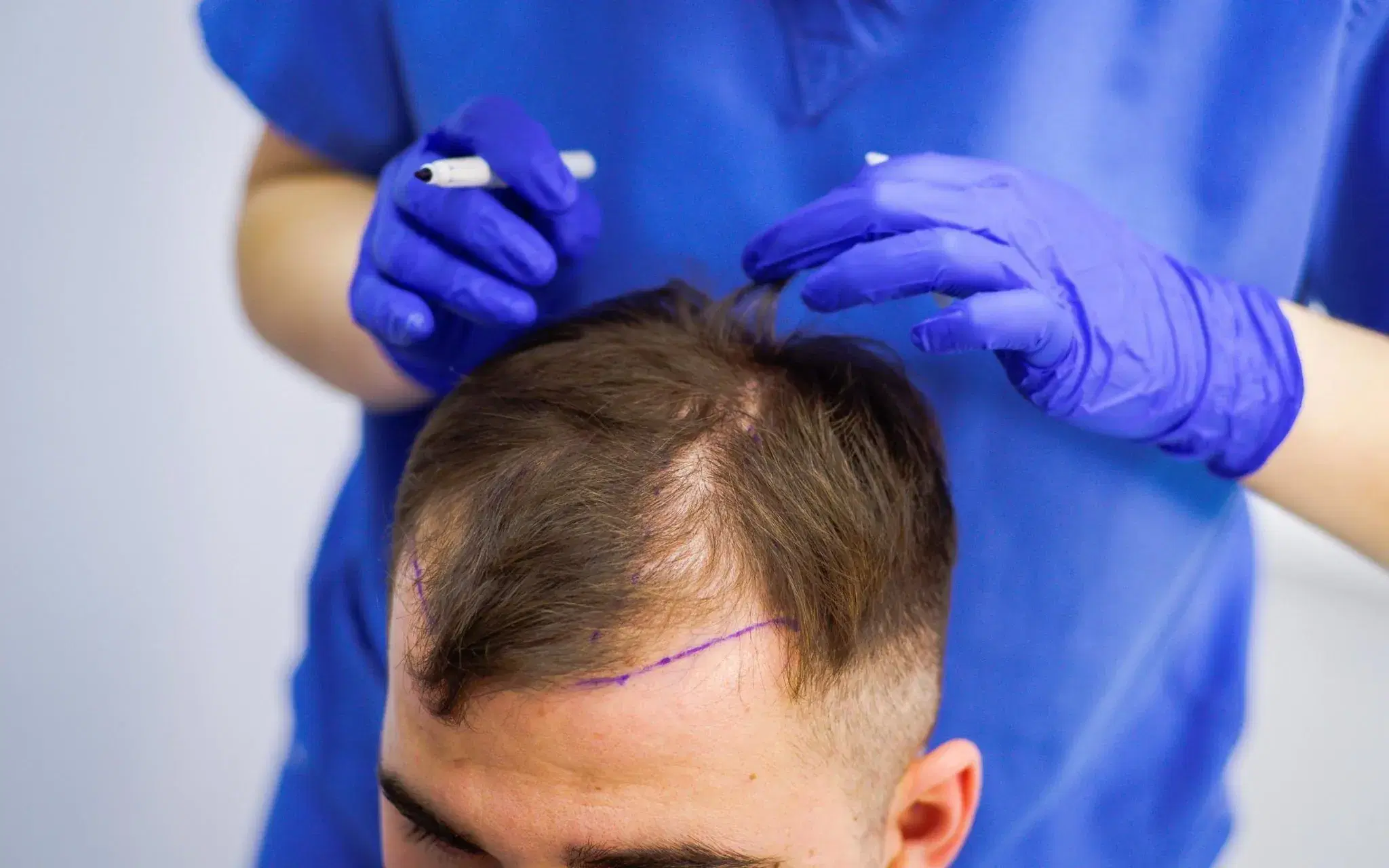
Are 3000 Grafts Enough for a Hair Transplant?
Three thousand grafts can be enough for a substantial hair transplant when treatment is concentrated on the frontal region or a moderate area of thinning.
Published surgical estimates place frontal coverage in advanced baldness at approximately 3000 to 3500 grafts. Front and mid-scalp coverage may require closer to 4500 to 5000 grafts in larger areas. Full coverage of advanced baldness can require around 6000 grafts or more across multiple sessions. These figures are planning examples rather than universal rules. Hair caliber, existing density, scalp size, follicular-unit composition, and future loss can significantly change what 3000 grafts achieve.
How Much Area Can 3000 Hair Grafts Cover?
Three thousand grafts can cover roughly 67 to 86 square centimeters when implanted at approximately 35 to 45 follicular units per square centimeter.
Published transplantation guidelines have recommended recipient densities around 35 to 45 units per square centimeter for appropriate cosmetic coverage. Dividing 3000 grafts across a larger surface inevitably lowers the average density. However, mathematical area alone cannot predict the final appearance. Existing native hair can contribute coverage, while thick or curly hair creates greater visual density than fine straight hair. Hairline areas also require strategic distribution rather than completely uniform implantation throughout the recipient scalp.
Are 3000 Grafts Enough for the Hairline and Frontal Area?
Three thousand grafts are often sufficient to reconstruct a hairline and provide meaningful frontal coverage when the treatment area is reasonably limited.
One analysis of advanced hair-loss surgery estimated approximately 3000 to 3500 grafts for frontal coverage. A smaller frontal forelock may require considerably fewer grafts, leaving additional follicles for transitions toward the mid-scalp. The actual design matters because a low, broad hairline consumes more donor supply than a conservative mature hairline. Temporal recession also increases surface area. Therefore, 3000 grafts can create strong frontal improvement when they are concentrated strategically instead of being spread across every thinning region.
Are 3000 Grafts Enough for the Front and Mid-Scalp?
Three thousand grafts may improve both the frontal and mid-scalp regions, but extensive thinning across both areas usually requires lower density or additional grafts.
Published planning estimates for advanced baldness place combined frontal and mid-frontal coverage around 4500 to 5000 grafts. That estimate assumes a relatively large recipient area and should not be applied universally. Someone who still has substantial native hair between miniaturized areas may require fewer transplanted follicles. In contrast, a completely bald frontal and mid-scalp region needs more grafts to produce equivalent density. Prioritizing the frontal zone usually creates the strongest visual framing when donor supply is limited.
Are 3000 Grafts Enough for the Crown?
Three thousand grafts can provide substantial crown coverage, but using the entire graft supply on the crown may not be the best long-term strategy.
The crown can occupy a large surface area, and its whorl pattern spreads hairs in several directions. Consequently, considerable graft numbers may be needed before the area appears visually dense. Allocating 3000 grafts entirely to the vertex can produce meaningful improvement in selected patients. However, future frontal or mid-scalp thinning may create a greater cosmetic priority. Donor hair is finite, so crown restoration should be planned alongside the probable lifetime pattern of androgenetic alopecia rather than treated as an isolated circle.
What Determines Whether 3000 Grafts Are Enough?
The usefulness of 3000 grafts depends on several anatomical factors rather than the graft number alone.
Size of the recipient area
Existing native hair density
Hair shaft diameter
Straight, wavy, or curly texture
Number of hairs within each follicular unit
Contrast between hair and scalp color
Planned hairline height and width
Crown involvement
Remaining donor density
Expected future hair loss
These factors determine visual coverage because one graft does not provide identical cosmetic value in every patient.
Does Norwood Stage Affect Whether 3000 Grafts Are Enough?
Norwood stage strongly affects whether 3000 grafts are sufficient because higher stages generally involve a larger bald surface requiring more coverage.
A patient with limited frontal recession may obtain significant restoration from 3000 grafts. Advanced Norwood patterns can involve the hairline, frontal scalp, mid-scalp, and crown simultaneously. One surgical analysis estimated approximately 6000 grafts for full coverage in advanced cases. Another report calculated that extensive grade VII baldness could require around 9000 grafts for broad cosmetic coverage. These numbers illustrate why 3000 grafts cannot be interpreted without considering the total area requiring treatment.
Does Hair Thickness Change the Result of 3000 Grafts?
Hair thickness can significantly change the visible result because thicker shafts cover more scalp than the same number of fine hairs.
Donor evaluation should therefore measure both follicular-unit density and hair caliber. A person with thick, wavy hair may achieve substantial visual coverage from 3000 grafts. Fine, straight hair with strong contrast against the scalp can require greater density to create a similar impression. The number of hairs contained within individual follicular units also matters. Two people receiving exactly 3000 grafts can therefore finish with noticeably different visual density even when graft survival is equally successful.
Does the Number of Hairs per Graft Matter?
The number of hairs within each graft matters because follicular units naturally contain different numbers of hair shafts and therefore provide different amounts of visual coverage.
A graft refers to a follicular unit rather than one individual hair. Some units contain a single hair, while others contain several hairs. Single-hair grafts are particularly useful near the frontal edge because they help create a soft transition. Multi-hair units provide greater bulk behind the hairline and across larger thinning areas. Consequently, a 3000-graft procedure containing many multi-hair units can create more visual mass than another 3000-graft procedure dominated by single-hair units.
Is 3000 Grafts a Large Hair Transplant Session?
Three thousand grafts represents a substantial single hair transplant session and falls near the average optimal upper harvesting range stated in published practice guidance.
Current practice guidelines describe approximately 2500 to 3000 scalp grafts as an average optimal upper limit for one session without visible donor depletion. This is not a universal safety threshold. Donor density, safe-zone dimensions, scalp characteristics, age, and previous procedures all influence safe harvesting. A dense donor region may tolerate a different plan from a naturally sparse donor region. The objective should therefore be preserving a normal donor appearance rather than reaching a predetermined numerical target.
Can Taking 3000 Grafts Cause Donor Overharvesting?
Three thousand grafts can cause overharvesting when the donor area is too small, naturally sparse, miniaturized, or harvested with excessive concentration.
Recent evidence suggests many authors limit single-session FUE extraction to approximately 10 to 20 percent of baseline follicular-unit density. Older guidance commonly recommends about 10 to 15 extractions per square centimeter in an average donor scalp. Distribution matters as much as the total. Removing many follicles from neighboring points can leave visible thinning even when the overall graft count appears acceptable. Extracted follicular units do not regrow at their original donor locations, making excessive depletion potentially permanent.
Can 3000 Grafts Give Natural Hair Density?
Three thousand grafts can create natural-looking density when the available follicles are distributed according to scalp anatomy rather than spread uniformly across an excessively large area.
Natural appearance depends on more than maximizing recipient density. The frontal edge normally benefits from finer single-hair units, while stronger follicular groups can build volume farther behind it. Existing native hairs can also be integrated into the design. When 3000 grafts are stretched across the frontal scalp, mid-scalp, and crown simultaneously, each area receives fewer units. Concentrating coverage where it contributes most to facial framing can therefore provide a stronger visual result than attempting thin coverage everywhere.
Is One 3000-Graft Hair Transplant Enough for Life?
One 3000-graft transplant may provide long-lasting correction, but it cannot guarantee that another procedure will never be needed because androgenetic alopecia can continue progressing.
Transplanted follicles from a stable donor zone can remain resistant to pattern hair loss. Native follicles surrounding them may still miniaturize over subsequent years. A patient can therefore retain a transplanted hairline while developing thinning behind it. Published guidelines emphasize considering age and the likelihood of future sessions when determining safe donor harvesting. Using every available graft to maximize immediate density can reduce future treatment options if the bald area later expands.
How Many Grafts Can the Donor Area Provide Over a Lifetime?
A commonly cited planning range is approximately 4000 to 6500 scalp grafts over multiple sessions, although lifetime donor capacity varies substantially between individuals.
This range comes from practice guidance and should not be treated as a guaranteed personal allowance. Donor density, head size, hair caliber, safe-zone boundaries, skin characteristics, extraction technique, and future miniaturization all influence the usable supply. Other mathematical models estimate around 6000 transplantable follicular units in an average donor scalp, with greater or lower availability depending on density. Long-term planning should therefore protect donor reserves instead of assuming an unlimited number of future grafts.
Should 3000 Grafts Be Used in One Area or Spread Across the Scalp?
Three thousand grafts usually produce stronger visible density when concentrated on priority areas rather than divided thinly across a very large bald scalp.
The frontal third often receives priority because it frames the face and strongly influences the overall perception of hair restoration. Mid-scalp coverage can then transition behind the frontal zone. Crown treatment may be reduced or postponed when donor supply is limited. In extensive baldness, trying to cover every square centimeter can create uniformly low density. Research on coverage patterns shows that distribution strategy materially affects cosmetic appearance. The optimal plan therefore balances immediate priorities with future hair-loss progression.
Can Another Hair Transplant Be Done if 3000 Grafts Are Not Enough?
Another hair transplant can be considered when the first 3000 grafts do not provide complete coverage and sufficient stable donor follicles remain after healing.
The second procedure should not be planned merely from the original graft number. Donor density needs reassessment because previous FUE reduces the follicular population permanently. Repeat harvesting from the same small zones increases the risk of visible thinning. The remaining recipient requirement also matters because continued native hair loss can create new areas needing treatment. Preserving grafts during the first surgery is especially important for younger patients whose eventual pattern may become considerably more extensive.
How Should You Decide if 3000 Grafts Are Enough?
Three thousand grafts are enough when they can achieve the desired priority coverage without exhausting the donor area or compromising future hair restoration options.
The decision should begin with measured recipient surface area and donor density rather than an advertised graft number. Hair caliber, follicular-unit composition, existing native hair, Norwood stage, crown involvement, and expected progression then refine the plan. Published evidence suggests 3000 grafts can provide meaningful frontal restoration, while broader front-to-crown coverage often requires substantially more follicles. The most useful question is therefore not simply whether 3000 grafts are enough, but what those 3000 grafts are expected to cover.