
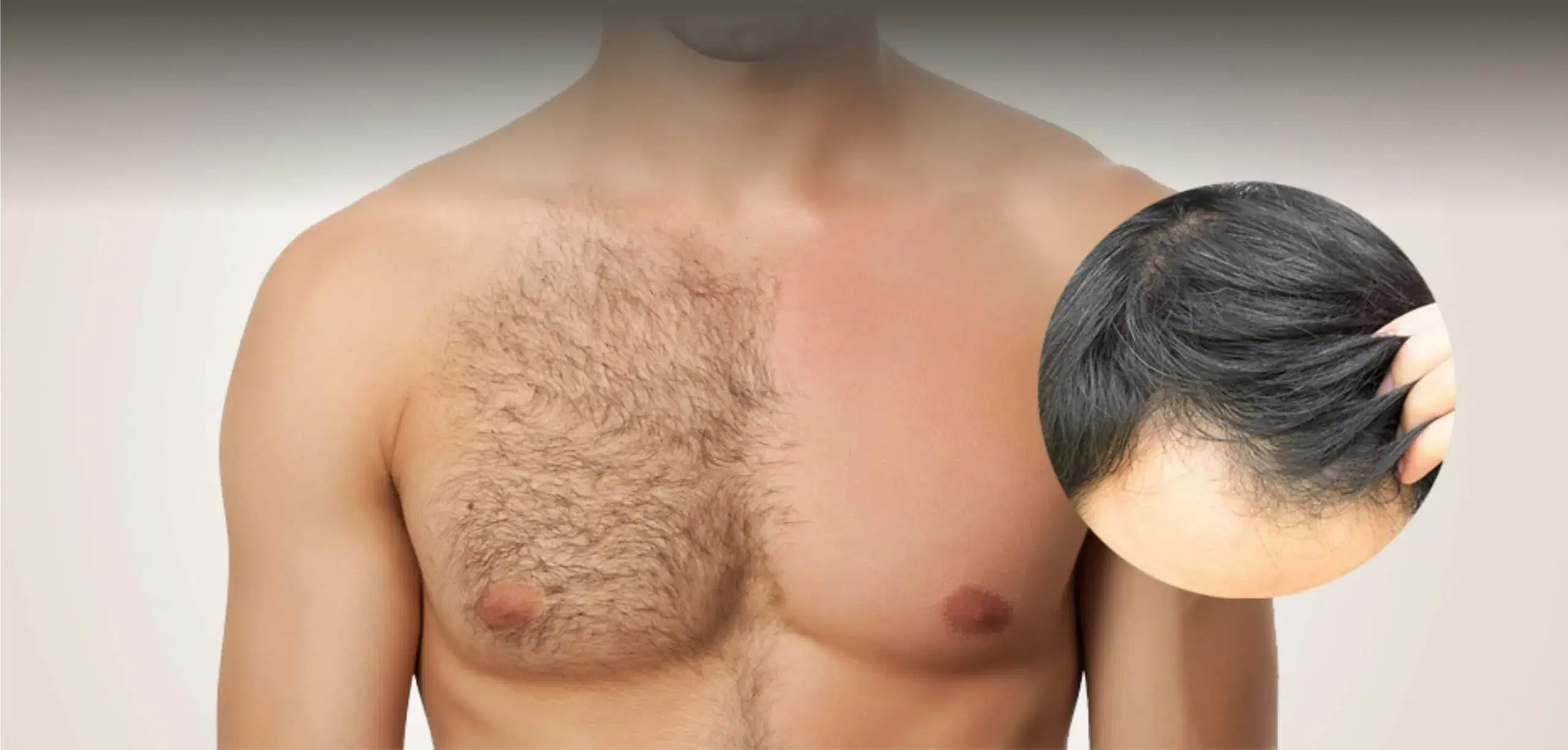
What Are Body Hair Donor Sites in Hair Transplantation?
Body hair donor sites are non-scalp areas from which suitable terminal hair follicles can be harvested and transplanted when additional donor supply is needed.
The scalp remains the preferred donor source for most hair transplant procedures because scalp follicles usually provide the closest match in growth length, texture and cycling behavior to the hair being restored. Body hair is generally considered an additional resource rather than a routine replacement for a healthy scalp donor area.
Suitable non-scalp hair can come from the beard, chest and other areas where sufficiently thick terminal hair is present. Modern FUE has made these regions accessible because individual follicles can be extracted without removing a strip of skin.
Current international practice data underline how selective this remains. In a 2025 hair restoration practice census, approximately 91.7% of FUE donor harvesting came from the scalp, compared with 6.1% from the beard and 1.1% from the chest. Abdomen, leg and other donor sites represented much smaller proportions.
The practical question is therefore not simply whether body hair exists. The hair must be dense enough, strong enough and sufficiently compatible with the intended recipient area to add meaningful cosmetic value.
Is the Beard the Best Body Hair Donor Site?
The beard is generally considered the most useful non-scalp donor source for scalp restoration because beard hair is often thicker, grows longer and spends more time in active growth than hair from most other body areas.
Harvesting is commonly concentrated beneath the jaw and in the submental region, where reducing density may be less noticeable than removing follicles from the visible cheeks or moustache. The exact safe region depends on beard distribution and the patient's usual facial hairstyle.
Beard follicles can provide substantial visual bulk because individual shafts are often coarse. This makes them useful for increasing coverage in areas such as the mid-scalp or crown when scalp donor supply is limited.
However, that same thickness can make beard hair less suitable for certain positions. A coarse beard graft placed directly at the leading edge of a fine natural hairline may look visually abrupt. Surgeons may instead mix beard grafts behind finer scalp follicular units so that the scalp hair creates a softer transition.
Recent clinical work evaluating beard donor suitability has emphasized density, diameter, emergence angle, curl and contrast with native scalp hair rather than treating every beard as an equally useful donor source.
Which Part of the Beard Is Usually Used as a Donor Area?
The area below the jawline is commonly preferred because follicles can often be removed there while preserving the more cosmetically important beard visible on the cheeks, chin and moustache.
The donor plan still needs to respect the patient's natural beard pattern. Someone with dense submandibular growth may have a useful secondary reservoir, while someone whose beard is concentrated mainly around the mouth may have very little expendable donor hair.
Beard harvesting is performed with FUE rather than strip excision. Follicles often leave the skin at acute and variable angles, so extraction requires different punch positioning from standard scalp FUE.
Overharvesting remains possible. Removing too many grafts from a limited patch can produce visible thinning or small areas of irregular density beneath the jaw.
For this reason, the beard should be mapped as a donor area rather than treated simply as an unlimited source of thick follicles.
Is Chest Hair a Good Donor Source for Hair Transplantation?
Chest hair can provide useful additional grafts in selected patients, but it is usually less predictable and less scalp-like than beard hair.
The chest and anterior torso are generally considered the next most useful non-scalp sources after the beard. A modern clinical review identified the beard and anterior torso as the strongest nonscalp options for scalp restoration when appropriate hair is available.
Chest follicles differ widely between individuals. Some men have dense, relatively thick terminal chest hair that can contribute meaningful coverage. Others have predominantly fine or sparse body hair that would add little cosmetic density even if hundreds of follicles were harvested.
Growth length is another limitation. Chest hair usually has a shorter active growth phase than scalp hair, which means it often reaches a shorter terminal length.
The texture may also be curlier or more irregular than native scalp hair. These characteristics need to be considered before choosing where the grafts will be implanted.
Can Hair From the Abdomen or Back Be Used?
Abdominal and back hair can sometimes be harvested, but these areas are generally secondary options used only when the follicles are sufficiently terminal and cosmetically useful.
The abdomen can contain hair similar to chest hair, although density and diameter vary considerably. Some patients have a continuous field of strong torso hair extending from the chest toward the abdomen, while others have only fine scattered follicles.
Back hair may also be available in particularly hirsute patients. Access and extraction can be technically less convenient, and the harvested hairs may still differ substantially from scalp hair in length and cycling.
The 2025 international practice census shows how uncommon these sites are in routine FUE harvesting. Abdominal hair represented approximately 0.4% of reported donor harvesting, while sites outside the scalp, beard and chest were collectively uncommon.
These regions should therefore be viewed as potential reserves for carefully selected cases rather than standard donor zones.
Can Leg or Arm Hair Be Transplanted to the Scalp?
Leg and arm hair can technically be transplanted, but it is usually a lower-priority donor source because the follicles are often finer and have shorter growth cycles than scalp or beard hair.
This does not make extremity hair useless. In selected patients, finer body hair may have specific applications where a softer caliber is desirable. Historical body-hair transplantation series have included grafts from the extremities and demonstrated that such follicles can survive transplantation in selected individuals.
The challenge is cosmetic contribution. A very fine leg hair may grow successfully yet provide little visible scalp coverage.
That distinction is important. Graft survival and cosmetic usefulness are not the same outcome.
For restoring substantial scalp density, a smaller number of thick beard grafts may sometimes create more visual effect than a considerably larger number of thin extremity hairs.
Can Pubic or Underarm Hair Be Used as Donor Hair?
Terminal hair from the pubic or axillary regions can theoretically be used in selected circumstances, but these are uncommon donor sites for scalp restoration.
These follicles can be coarse and curly, and their growth characteristics may differ significantly from scalp hair. Their extraction also involves additional anatomical and privacy considerations.
For most patients, scalp, beard and suitable torso hair provide more practical donor options before these regions are considered.
The existence of terminal follicles in a body area should never be interpreted as evidence that those follicles are automatically appropriate for the scalp. Hair needs to be evaluated for caliber, curl, color, length potential and growth pattern before transplantation.
How Does Body Hair Differ From Scalp Hair?
Body hair differs from scalp hair in growth cycle, maximum length, caliber, curl, follicular grouping and the angle at which the hair exits the skin.
Scalp hair has a comparatively long anagen, or active growth, phase. This allows individual shafts to continue growing for years and reach considerable length.
Most body hair has a much shorter growth phase and a larger proportion of follicles in resting phases at any given time. Consequently, many body hairs remain shorter even when they are never cut.
Body follicular units also more frequently contain a single hair. Scalp follicular units commonly contain multiple hairs, which can create more visual density from the same number of grafts.
Beard hair is an important exception to the general pattern because it is frequently thicker than scalp hair and has a more favorable growth cycle than chest or extremity hair.
These differences explain why the phrase body hair transplant covers donor material with very different cosmetic properties.
Does Body Hair Become Like Scalp Hair After Transplantation?
Body hair should not be expected to become identical to scalp hair after it is transplanted.
The recipient environment may influence some growth behavior, but donor characteristics remain important. Clinical observations have shown that transplanted beard and body hairs can retain features such as their original caliber, color and curl.
A thick, curly beard hair should therefore not be expected to transform into fine, straight scalp hair simply because it has been implanted on the head.
Some transplanted body hair may grow somewhat differently in its new environment, including potentially achieving greater length than it did at the original site. However, the extent of this adaptation is variable and should not be relied upon when planning the cosmetic result.
The safest planning assumption is that a donor hair will continue to resemble its original characteristics substantially.
Why Does the Hair Growth Cycle Matter When Choosing Body Donor Hair?
The growth cycle matters because body follicles spend less time actively growing and a greater proportion of time resting compared with scalp hair.
This difference influences both harvesting and the eventual appearance of the transplant.
A follicle in the active anagen phase is generally easier to identify and can be more desirable for body-hair FUE. Older clinical protocols have therefore used pre-shaving to help distinguish actively growing hairs from follicles remaining in a resting phase.
Beard hair usually has more favorable anagen characteristics than chest and extremity hair, which is another reason it receives priority when additional donor hair is required.
Growth-cycle differences also affect apparent density after transplantation. Even if every transplanted body follicle survived, not all hairs would necessarily be visible in active growth simultaneously.
This makes graft-count comparisons between scalp and body hair potentially misleading.
How Are Body Hair Grafts Harvested?
Body hair donor grafts are usually harvested through FUE because individual follicles are scattered across broad anatomical regions where strip excision would be impractical.
FUE involves using a small punch to separate each follicular unit from surrounding tissue before extraction.
Body-hair FUE can be technically more demanding than standard scalp harvesting. The follicles may lie more superficially, exit the skin at sharper angles and curve beneath the surface. These features increase the importance of understanding follicular direction.
Different body regions also require different patient positioning and anesthesia strategies.
The harvesting technique should therefore be adapted to the donor anatomy rather than simply copying the same punch angle and depth used on the scalp. Clinical reviews emphasize that body and beard FUE require modified techniques and careful patient selection.
Which Body Hair Donor Site Is Best?
There is no universally best body donor site, but beard hair usually offers the strongest combination of caliber, growth characteristics and visual density for scalp supplementation.
A practical hierarchy in an appropriate male patient is often scalp first, beard second and strong chest or anterior torso hair after that. Other body regions become increasingly case-specific.
The following characteristics should be evaluated before a site is selected:
Density of usable terminal follicles
Hair shaft diameter
Similarity to native scalp hair
Curl and texture
Color contrast with existing hair
Length and growth-cycle characteristics
Visibility of donor thinning after extraction
Follicle exit angle and extraction difficulty
Recipient area where the hair will be used
A donor region with thousands of visible hairs is not necessarily valuable if those hairs are extremely fine or incompatible with the intended recipient area.
Is Beard Hair Better Than Chest Hair?
Beard hair is generally more useful than chest hair for adding density to the scalp because it tends to be thicker and has more favorable growth characteristics.
A small comparative clinical study directly examining scalp, beard and chest grafts also found better one-year survival for beard hair than chest hair. However, the study involved only 30 grafts from each donor source in the assessed areas, so its percentages should not be treated as universal survival rates for every patient or clinic.
The cosmetic trade-off is that beard hair can sometimes be too coarse for delicate regions such as the first rows of the frontal hairline.
Chest hair is usually finer and may blend more easily in some situations, but its shorter growth cycle and variable density can reduce its contribution to overall coverage.
The choice is therefore not simply stronger versus weaker. It depends on where the graft will be placed and what native hair surrounds it.
Where Should Beard and Body Hair Be Placed on the Scalp?
Beard and body hair are usually most useful when placed strategically rather than distributed identically to scalp grafts.
Fine scalp hair is generally preferred at the leading edge of the frontal hairline because natural hairlines contain soft, irregular single hairs.
Coarse beard grafts can be placed farther behind the hairline or mixed among scalp grafts to improve visual bulk. They can also be useful in the mid-scalp and crown where greater shaft diameter may contribute to coverage.
Chest and other body hairs may be blended with scalp hair when their texture is compatible.
This mixed-donor approach can reduce abrupt differences between donor hair types. It also allows the surgeon to reserve cosmetically valuable scalp grafts for positions where their natural characteristics matter most.
The recipient plan should therefore consider both graft quantity and graft quality.
Who May Need a Body Hair Transplant?
Body hair is most useful for patients whose scalp donor supply cannot fully meet their restoration needs but who have suitable non-scalp terminal hair.
This situation can occur in advanced androgenetic alopecia, particularly when a large recipient area remains but the permanent scalp donor zone is relatively limited.
Another important group includes patients who have already undergone multiple hair transplants and have depleted part of their scalp donor reserve.
Body and beard grafts can also contribute to repair surgery after overharvesting, plug transplantation or other previous procedures.
Published clinical series have demonstrated body-hair FUE in selected patients with severe baldness and inadequate scalp donor supply.
However, body hair should not be used simply because a patient wants an unusually high graft number. An adequate scalp donor remains preferable when it can safely provide the required grafts.
Can Body Hair Solve a Depleted Scalp Donor Area?
Body hair can expand the donor pool, but it cannot fully eliminate the biological limitations created by a depleted scalp donor area.
A patient with severe baldness may have thousands of potentially harvestable beard and torso hairs, but they are not equivalent to having the same number of additional scalp follicular units.
Many body follicles are single-hair units. Their growth length and cycling may also limit the density they create.
The total visual result therefore depends on which donor sources are available and how effectively they can be blended.
Body hair can turn an otherwise impossible restoration into a more practical one in selected patients, but it should be thought of as supplemental donor capital rather than unlimited replacement hair.
This distinction becomes especially important in repair cases, where future surgical options may already be restricted.
Can Body Hair Be Used for the Hairline?
Body hair can sometimes contribute to a hairline, but donor selection must be particularly conservative because the frontal edge requires the most delicate visual transition.
Coarse beard grafts are usually not ideal as the first visible row when native frontal hair is substantially finer.
Some patients may have finer beard hairs that match their scalp more closely, and a recent beard-donor classification study specifically considered diameter, curl and color contrast when assessing suitability for hairline correction.
Fine body hair from another site can theoretically provide softness, but its growth characteristics may be less predictable than scalp hair.
Whenever possible, appropriate single-hair scalp follicular units remain the preferred material for constructing the leading edge. Body grafts can then reinforce density farther behind it.
What Are the Risks and Limitations of Body Hair Transplantation?
Body hair transplantation has both the general risks of FUE surgery and additional limitations caused by differences between donor regions.
Small extraction scars can remain in the beard, chest or other harvested areas. Overharvesting can create visible patchiness, particularly when follicles are taken too densely from a limited area.
Follicular transection can occur during extraction because body follicles may curve beneath the skin or emerge at difficult angles.
The resulting transplanted hair may also differ visibly from native scalp hair in curl, thickness or maximum length.
Most importantly, growth can be less predictable than with appropriate scalp donor hair. Evidence supporting body-hair transplantation is considerably smaller than the evidence base for conventional scalp hair transplantation. A current clinical reference likewise notes that alternative donor regions can be used when needed, while their efficacy remains less extensively studied and their hair characteristics may differ substantially from scalp hair.
Patients should therefore be cautious with guarantees of identical survival or density from every body donor source.
How Should Body Hair Donor Sites Be Assessed Before Surgery?
Body donor evaluation should determine whether the available follicles will produce enough cosmetic value to justify harvesting them.
The assessment starts with visible density but should go further. Hair caliber, curl, color, average length, follicular grouping and compatibility with the scalp all matter.
The surgeon may examine several regions independently because one patient can have excellent beard hair but unusable chest hair, while another may have a dense torso that meaningfully expands the donor pool.
Donor visibility is also important. Hair should not be removed simply because it can be extracted. The remaining body area should still look acceptable afterward.
In complex restoration cases, a small test session may sometimes provide useful information about healing and growth before relying heavily on an unfamiliar donor source.
Is Body Hair Transplantation a Replacement for Scalp Donor Hair?
Body hair transplantation is usually a supplement to scalp donor hair rather than a complete substitute for it.
Scalp follicles remain the preferred donor material because they naturally match the recipient scalp in growth behavior and cosmetic characteristics.
Beard hair can provide valuable additional thickness. Chest and other torso hair may add further coverage in suitable patients. Extremity and other donor regions can expand options in highly selected situations.
The strongest strategy is often not to choose one donor source exclusively, but to assign each hair type to the recipient area where its characteristics are most useful.
For a patient with advanced baldness or depleted scalp reserves, that approach can make the available donor supply go considerably further.
The key limitation remains unchanged: transplantation redistributes existing follicles. Body hair increases the number of places from which those follicles may be obtained, but it does not create an unlimited donor supply.