
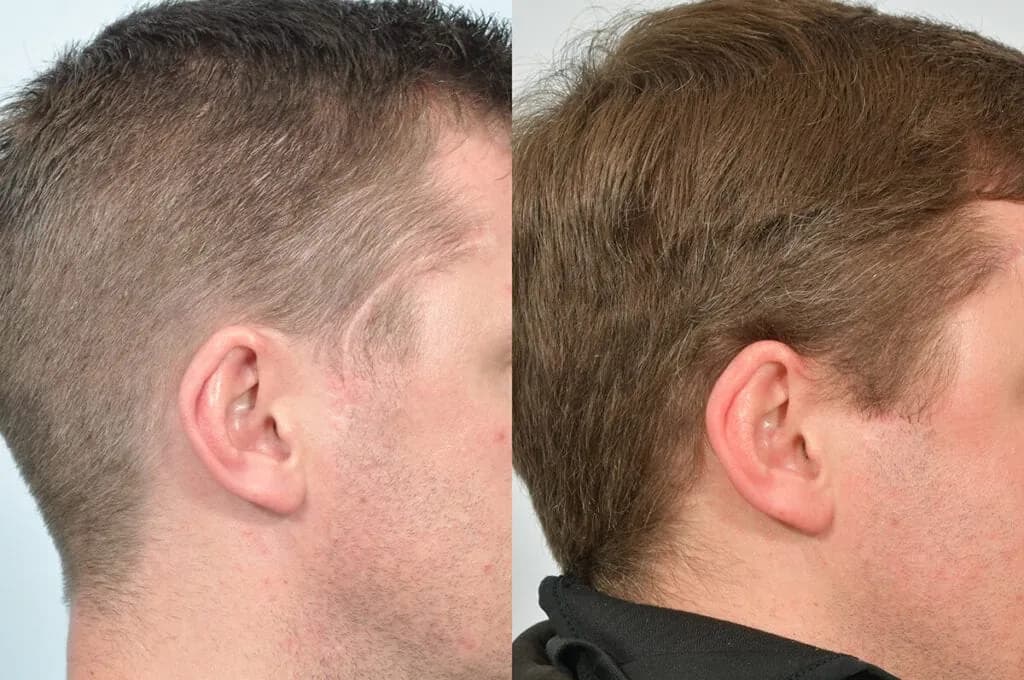
Hair can be transplanted into scar tissue when the affected skin has healed completely and provides sufficient blood circulation to support new follicles. Hair transplantation can restore coverage over selected surgical scars, burn injuries and traumatic wounds, although graft survival and achievable density are less predictable than in healthy scalp tissue.
Is Hair Transplantation Into Scar Tissue Possible?
Hair transplantation into scar tissue is a reconstructive procedure that involves relocating healthy hair follicles into areas where scarring has permanently disrupted natural hair growth. Unlike ordinary hair thinning, which often develops through gradual follicular miniaturization, scar-related hair loss occurs when injury or inflammation destroys the structures responsible for producing hair.
Modern hair restoration techniques make it possible to introduce new follicles into selected scars on the scalp, eyebrows, beard and hairline. When these follicles establish an adequate blood supply, they can begin producing new strands and gradually improve the appearance of the affected area.
However, scar tissue presents challenges that do not usually exist in healthy skin. Its thickness, flexibility, blood circulation and underlying structure can influence how successfully transplanted follicles survive. The objective is therefore to create sustainable hair coverage while respecting the biological limitations of the scar rather than attempting to reproduce the density of unaffected scalp at any cost.
Why Does Hair Stop Growing on Scar Tissue?
Hair follicles are living structures located beneath the skin, where they depend on surrounding blood vessels, specialized cells and connective tissue to maintain their growth cycle. When an injury damages these structures beyond their ability to recover, the body replaces the affected area with fibrous scar tissue.
This replacement tissue contains collagen arranged differently from normal skin and may lack the follicular structures required for natural hair production. Although a mature scar can remain healthy and stable, it generally cannot regenerate follicles that were completely destroyed during the original injury.
The depth of the damage is particularly important. Superficial cuts and minor skin injuries may leave follicles intact, allowing hair to resume growing after healing, whereas deep burns or surgical wounds can permanently eliminate hair-producing structures. In these situations, transplanting healthy follicles from another region may offer a way to restore coverage that would not return naturally.
What Types of Scars Can Be Treated With Hair Transplantation?
Different types of scars respond differently to hair restoration because their underlying tissue characteristics are not identical. Establishing how the scar developed helps determine whether transplantation is appropriate and what level of improvement may be realistic.
Hair Transplantation Into Surgical Scars
Surgical procedures can leave linear or irregular scars where hair follicles have been removed or permanently damaged. These may develop after scalp operations, removal of skin lesions or previous hair transplantation procedures.
One common example is the linear donor scar associated with follicular unit transplantation, also known as FUT. This method involves removing a strip of hair-bearing scalp, which leaves a permanent incision line that can become visible when the surrounding hair is worn short.
Modern follicular grafting may help conceal selected surgical scars by placing individual follicular units into or around the scarred region. Understanding the hair transplant strip method and donor scarring provides useful context for why these scars develop and how their appearance may be improved.
Hair Transplantation Into Burn Scars
Burn injuries can cause extensive follicular destruction, particularly when heat damages deeper layers of the skin. The resulting scar may become thicker, tighter or less flexible than the surrounding tissue, making hair restoration more technically demanding.
Selected mature burn scars can support transplanted follicles, but the condition of their blood supply becomes especially important. Deep scars with severe tissue damage may require reconstructive treatment before follicular implantation can be considered.
Hair Transplantation Into Injury Scars
Accidents, cuts and other traumatic injuries can leave permanent hairless patches on the scalp or face. Once these wounds have healed and the scar has matured, hair transplantation may improve coverage and help the affected region blend with surrounding hair.
Smaller, relatively flat scars with adequate circulation often present more favorable conditions than extensive scars involving substantial tissue loss. However, even a small scar requires assessment of its underlying structure before follicles are implanted.
Can Hair Be Transplanted Into Scarring Alopecia?
Scarring alopecia, also known as cicatricial alopecia, differs from scars caused by physical injuries because some forms involve an ongoing inflammatory disease that attacks hair follicles. Conditions such as lichen planopilaris and frontal fibrosing alopecia can progressively destroy follicles and replace them with scar tissue.
Transplantation into these areas requires particular caution because introducing new follicles does not eliminate the disease responsible for the original hair loss. If inflammation returns, the newly transplanted follicles may also become damaged, potentially reducing the long-term success of the procedure.
Hair restoration is generally considered only after the condition has remained inactive for a substantial period. In some forms of primary scarring alopecia, a period of approximately one to two years without active progression has been suggested, although this timeframe does not guarantee lasting disease control.
A detailed scalp examination and, in selected cases, a biopsy can help identify whether inflammatory activity remains present. Distinguishing a stable traumatic scar from an inflammatory scalp disorder is essential because the two conditions have different treatment risks.
What Makes Scar Tissue More Difficult for Hair Transplantation?
The main challenge of transplanting hair into scarred skin is establishing a suitable environment for follicular survival. Healthy scalp tissue contains an extensive network of blood vessels that supplies oxygen and nutrients to growing follicles, whereas scar tissue may have reduced or irregular circulation.
The physical structure of the scar creates additional limitations. Thick fibrous tissue can make recipient-site preparation more difficult, while very thin or depressed scars may provide insufficient depth for proper follicular placement. Reduced elasticity can also affect how the tissue responds to surgical instruments.
Scar appearance alone does not reliably establish its suitability for transplantation. A relatively pale, flat scar may still have limited circulation, while another scar with visible texture changes may retain enough vascular support for graft survival.
These differences explain why placing more grafts into a scar does not automatically produce greater density. Excessive implantation can create additional tissue trauma and place greater demands on an already limited blood supply.
How Is a Hair Transplant Into Scar Tissue Performed?
The procedure follows the basic principles of conventional hair transplantation but places greater emphasis on recipient-site evaluation, graft spacing and preservation of surrounding tissue.
Examining the Scar and Donor Area
Before transplantation, the scar is assessed for thickness, flexibility, stability and signs of ongoing inflammation. The available donor region is also examined to determine whether sufficient healthy follicles can be collected without creating noticeable thinning elsewhere.
In selected cases involving uncertain tissue quality, a small test transplantation may help evaluate whether the scar can support new growth before proceeding with a more extensive procedure.
Extracting and Preparing Healthy Follicles
Healthy follicular units are commonly collected from the back or sides of the scalp using follicular unit extraction, or FUE. Each graft contains one or more hairs and must be handled carefully to preserve the structures required for continued growth.
Hair thickness, texture and color are considered during graft selection because these characteristics influence how effectively the transplanted strands will conceal the scar. Matching the surrounding hair becomes especially important near visible hairlines or facial regions.
Implanting Hair Into the Scar
The prepared follicles are inserted into carefully created recipient sites, with attention to depth, angle and spacing. Scar tissue may not tolerate the same implantation density as healthy scalp, so a conservative approach can help reduce additional trauma.
The objective is to establish reliable follicular growth before considering whether additional density is necessary. Larger or more complex scars may benefit from staged transplantation rather than attempting complete coverage in one operation.
Is FUE or FUT Better for Hair Transplantation Into Scars?
FUE and FUT are established methods of obtaining donor follicles, but their differences primarily concern how grafts are collected rather than whether scar tissue can support them.
FUE removes individual follicular units through small extraction sites distributed across the donor region. This avoids creating a continuous linear incision and may be particularly useful when treating smaller scars or when preserving the appearance of the donor scalp is important.
FUT involves surgically removing a narrow strip of donor tissue before separating it into individual follicular units. Although it can provide suitable grafts for transplantation, it also produces an additional linear scar that must be considered during treatment planning.
Neither technique guarantees better graft survival within scarred skin. The condition of the recipient tissue, preservation of the extracted follicles and careful implantation play a more direct role in determining whether new hair establishes itself successfully.
What Is the Success Rate of Hair Transplantation Into Scar Tissue?
Hair transplantation can produce meaningful improvement in selected scars, but there is no single success percentage that accurately represents every type of scar tissue. Published clinical results vary because scar thickness, circulation, previous injuries and underlying diseases influence follicular survival.
Research involving traumatic and surgical scars has demonstrated successful hair growth, while investigations into primary scarring alopecia have identified a greater risk of declining graft survival over time. This distinction is important because stable injury-related scars do not carry the same risk of recurrent inflammatory follicular destruction.
The achievable density may also be lower than in unaffected skin. Placing grafts too close together can compromise the limited circulation available within certain scars, making a gradual approach more appropriate for some patients.
A successful result should therefore be measured by improvement in visible coverage and scar concealment rather than an expectation that the area will become indistinguishable from naturally dense scalp.
When Is Scar Tissue Ready for Hair Transplantation?
Hair transplantation should generally be delayed until the original wound has healed completely and the scar has reached a stable condition. Although the skin surface may close within weeks, collagen remodeling and changes in tissue circulation can continue for many months.
For traumatic and surgical scars, a waiting period of approximately six to twelve months or longer is often considered before transplantation. This allows the tissue time to mature and helps avoid operating on a scar that is still changing in thickness, color or texture.
However, the passage of time alone does not establish that a scar is ready. Persistent inflammation, increasing thickness, tenderness or ongoing changes in appearance may indicate that the tissue has not stabilized sufficiently.
Scarring alopecia requires additional precautions because the absence of visible redness does not necessarily confirm that the underlying inflammatory condition has become inactive.
What Is the Recovery Timeline After Scar Tissue Hair Transplantation?
Recovery after transplantation into scar tissue shares several characteristics with conventional hair restoration, although the altered recipient tissue may require closer observation during healing.
During the first week, small crusts, redness and mild tenderness can develop around the implanted follicles. The scalp should be kept clean using gentle washing methods, while unnecessary friction, scratching and aggressive skincare products should be avoided.
Many transplanted hair shafts begin shedding during the following weeks as the follicles temporarily enter a resting phase. This process does not automatically indicate graft failure because surviving follicles can remain beneath the skin and begin producing new strands later.
Early hair growth often becomes noticeable around the third or fourth month, with visible coverage improving during the following six to twelve months. Scarred areas may develop uneven density when some follicles establish themselves more successfully than others, and the final appearance may continue changing beyond the first year.
Can Hair Transplantation Completely Hide a Scar?
Hair transplantation can make selected scars considerably less noticeable, particularly when the scar is surrounded by healthy hair that helps blend the restored region into the existing hairstyle.
However, transplanted hair does not remove the scar itself. Changes in skin color, contour or texture can remain visible beneath the growing strands, particularly in scars that are raised, depressed or substantially wider than the surrounding hair coverage.
The contrast between hair color and skin tone also affects concealment. Thick, textured strands may provide greater visual coverage, while fine hair can require more follicles to achieve a similar effect.
For larger scars, an initial procedure may improve appearance without producing complete coverage. Additional transplantation can sometimes increase density after the first grafts have established growth, provided sufficient donor hair and suitable recipient tissue remain available.
Can Hair Transplant Scars From Previous Surgery Be Repaired?
Corrective hair transplantation can improve some scars left by earlier hair restoration procedures, including linear FUT scars, irregular graft placement and visible marks associated with older transplantation techniques.
When the donor area contains a narrow linear scar, introducing individual follicles into selected sections may help reduce the contrast between the scar and surrounding hair. More extensive damage can require a combination of scar revision, follicular transplantation or non-surgical camouflage.
Previous surgery also affects the amount of donor hair remaining for corrective treatment. Follicles extracted during an earlier transplant do not normally regenerate in their original locations, meaning every additional procedure must account for the remaining donor supply.
Understanding the options for correcting older hair transplants and visible donor scars helps explain why scar repair sometimes involves more than simply adding new grafts.
A well-planned correction aims to improve the existing appearance without creating additional donor damage or placing unrealistic demands on scarred recipient tissue.
What Are the Risks of Transplanting Hair Into Scar Tissue?
Hair transplantation into scar tissue carries the general risks associated with surgical hair restoration, including infection, bleeding, temporary swelling, folliculitis and unsuccessful graft growth. The altered structure of scarred skin introduces additional concerns because circulation and wound-healing capacity may be less predictable.
Excessively dense implantation can increase trauma to tissue that already has limited vascular support. In unfavorable circumstances, poor circulation may contribute to delayed healing, additional scarring or loss of transplanted follicles.
Patients with a history of raised or keloid scars may also require special consideration because further surgical injury could produce abnormal scar formation. Likewise, individuals with inflammatory scarring alopecia remain at risk of disease recurrence even after an initially successful procedure.
These limitations make a conservative restoration strategy particularly important. Preserving healthy tissue and available donor follicles should take priority over attempting the highest possible graft count in a single session.
What Are the Alternatives to Hair Transplantation for Scars?
Hair transplantation is not the only option for improving the appearance of hairless scars. Other treatments may be more appropriate when the affected tissue has poor circulation, insufficient thickness or an ongoing inflammatory condition that makes follicular implantation unsuitable.
Scalp micropigmentation can reduce the visual contrast between a scar and surrounding hair by introducing pigment that resembles short hair or scalp shading. Although it does not restore actual follicles, it may improve the appearance of selected scars without requiring extensive graft transplantation.
Surgical scar revision offers another possibility when changing the width, shape or contour of a scar would improve its appearance. More complex injuries may benefit from tissue expansion or other reconstructive procedures that redistribute healthy hair-bearing skin.
Some patients may also achieve sufficient cosmetic coverage through hairstyle adjustments or hair replacement systems. The most appropriate approach depends on the condition of the tissue, the remaining donor supply and whether the main objective is actual hair growth or reduced scar visibility.
Frequently Asked Questions About Hair Transplants Into Scar Tissue
The following questions address common concerns about hair growth, burn scars and the long-term effectiveness of transplanting follicles into previously damaged skin.
Can transplanted hair grow normally in scar tissue? Transplanted follicles can produce healthy strands when the scar provides adequate blood circulation and sufficient tissue support. However, growth may be less predictable than in normal scalp because fibrous tissue can restrict circulation and complicate implantation, making realistic density planning particularly important.
Can hair grow back naturally on a burn scar? Natural regrowth is unlikely when a deep burn has permanently destroyed the original hair follicles, although superficial injuries may leave enough follicular structures intact for recovery. Transplantation can restore coverage in selected mature burn scars when the remaining tissue is sufficiently healthy to support implanted grafts.
Is hair transplantation into scar tissue permanent? Successfully established follicles can continue producing hair for many years within stable scar tissue. However, long-term survival depends on the condition of the surrounding skin, and follicles may be lost if circulation deteriorates or an underlying inflammatory disease becomes active again.
Final Thoughts on Hair Transplantation Into Scar Tissue
Hair transplantation into scar tissue offers a reconstructive option for people experiencing permanent hair loss following surgery, burns or traumatic injuries. When the scar has matured and provides adequate circulation, transplanted follicles may establish themselves and improve coverage in areas where natural regrowth is no longer possible.
The main challenge lies in the biological differences between scarred and healthy skin. Reduced vascularity, altered tissue thickness and limited elasticity can affect graft survival, making conservative implantation and realistic expectations essential.
Although complete scar concealment cannot be guaranteed, carefully planned transplantation can provide lasting cosmetic improvement in suitable cases. Evaluating scar stability, donor availability and the potential for future tissue changes remains central to achieving a balanced and sustainable result.