
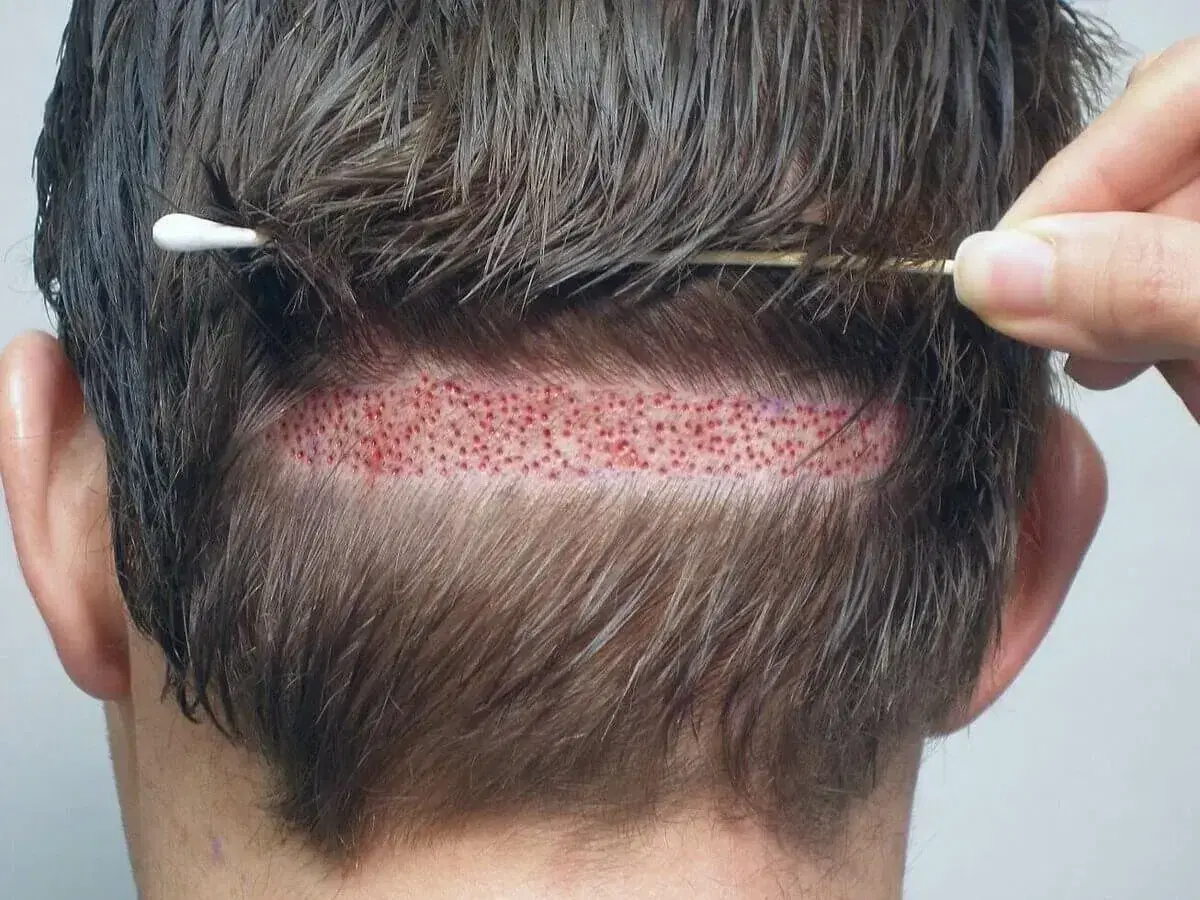
What Is the Hair Transplant Strip Method?
The hair transplant strip method is a donor-harvesting technique in which a narrow section of hair-bearing scalp is surgically removed and divided into individual follicular unit grafts for transplantation.
The procedure is commonly known as Follicular Unit Transplantation, or FUT. More precise terminology may describe it as linear strip excision because the defining feature is how donor follicles are obtained: a linear section of scalp is removed from the permanent donor region.
The individual follicular units are then separated from this strip under magnification. These grafts can contain one, two, three or more hairs and are subsequently implanted into the recipient area.
The strip method should not be confused with older plug transplantation. Modern FUT preserves naturally occurring follicular units and can produce natural-looking results when hairline design, graft preparation and implantation are performed appropriately.
Its most important difference from FUE occurs in the donor area. FUT removes follicles within one strip and closes the wound, whereas FUE extracts follicular units individually through numerous small punch incisions.
How Does the Strip Hair Transplant Procedure Work?
A strip hair transplant usually involves donor planning, surgical removal of the strip, microscopic graft preparation and implantation into the thinning area.
Before surgery, the donor region at the back and sides of the scalp is evaluated. The surgeon considers density, hair characteristics, previous surgery and the amount of scalp tissue that can be removed while still allowing appropriate wound closure.
After local anesthesia, a narrow strip of hair-bearing scalp is removed from the selected donor area. Published surgical descriptions show that strip dimensions vary according to donor characteristics and the number of grafts required rather than following one standard size for every patient.
The edges of the donor wound are then brought together using sutures or staples. This closure eventually produces a linear scar.
Meanwhile, the removed tissue is processed by the surgical team. Rather than implanting pieces of scalp, the strip is carefully dissected into individual follicular units. Those units become the grafts used to reconstruct the hairline and improve density elsewhere on the scalp.
What Happens to the Strip After It Is Removed?
The donor strip is dissected under magnification into naturally occurring follicular units rather than being transplanted as one piece of tissue.
Human scalp hair naturally grows in small groupings. A follicular unit may contain a single hair or several hairs along with associated structures.
Modern strip transplantation aims to preserve these natural groupings during graft preparation. Microscopic dissection helps the surgical team separate follicular units while reducing unnecessary damage to the follicles.
Single-hair units can be particularly useful around the leading edge of a hairline, where finer and irregular distribution contributes to a natural appearance. Multi-hair follicular units can then provide greater visual density farther behind the hairline.
This development was one of the changes that separated modern follicular unit transplantation from historical plug techniques, which transplanted much larger groups of hairs and could produce an artificial appearance.
Does the Strip Method Leave a Scar?
Yes, the strip method leaves a permanent linear scar in the donor area because a section of scalp is surgically removed and the resulting wound is closed.
The final scar does not look identical in every patient. Surgical technique, wound tension, individual healing characteristics and previous operations can all influence its appearance. When healing is favorable, surrounding hair can often conceal the line.
However, FUT should never be described as scarless.
Some patients develop a fine linear scar, while others may develop a wider or more noticeable scar. Multiple previous donor surgeries can also affect the region.
Hair length matters. Patients who normally keep enough hair over the donor area may find the scar relatively easy to cover. Someone who intends to shave the back and sides extremely short may consider the linear scar more significant.
This is one of the practical reasons FUE has become popular among patients who prefer very short hairstyles.
Is FUE Really Scarless Compared With the Strip Method?
No, FUE is not literally scarless; it creates a different pattern of donor scarring.
Instead of removing one linear strip, FUE uses small punches to remove follicular units individually. Each extraction produces a small wound that heals separately. When thousands of grafts are harvested, thousands of small extraction sites are distributed through the donor region.
The scars are usually much smaller and more dispersed than the linear FUT scar, making them less conspicuous with short hairstyles in many patients.
However, aggressive harvesting can reduce overall donor density and create an uneven or visibly depleted appearance. Small hypopigmented dots may also become visible when the scalp is shaved extremely closely.
The accurate comparison is therefore not scar versus no scar. It is a linear scar concentrated in one area versus numerous small scars distributed throughout the donor region.
Who May Be a Good Candidate for the Strip Method?
FUT can be appropriate for selected patients who have a suitable donor area, adequate scalp characteristics and treatment goals compatible with a linear donor scar.
The relationship between donor supply and recipient demand is particularly important. A patient with extensive hair loss may require substantial numbers of grafts over one or more procedures. Strip harvesting can sometimes provide an efficient way to obtain many follicular units while avoiding diffuse extraction across the entire donor zone.
Scalp laxity also matters because the wound edges must be brought together after the strip is removed. Excessive closure tension may increase the likelihood of an unfavorable scar.
Hairstyle preference should be discussed before surgery. A patient who regularly wears longer hair at the back may view the linear scar differently from someone who wants a skin fade or completely shaved donor area.
Previous FUE or FUT surgery, donor density, hair caliber and anticipated future hair loss also influence whether the method is appropriate.
Why Is Scalp Laxity Important in FUT?
Scalp laxity affects how much donor tissue can be removed and how much tension is created when the wound is closed.
A flexible donor scalp may allow the edges to come together more comfortably after strip removal. A tight scalp can limit the width of tissue that can be safely excised.
This does not mean that a more flexible scalp should automatically lead to the widest possible strip. The surgeon still needs to balance graft requirements against donor preservation and wound healing.
Excessive tension is undesirable because it can contribute to a wider scar or healing problems. Surgical planning therefore considers both donor density and the mechanical characteristics of the scalp.
This factor is much more relevant to FUT than to FUE because individual FUE punch wounds are not closed by drawing two long wound edges together.
How Many Grafts Can Be Obtained With the Strip Method?
The number of grafts available from FUT depends on the dimensions and density of the donor strip rather than a predetermined number promised before assessment.
A patient with high follicular density can potentially provide more grafts from the same amount of donor tissue than someone with lower density. The proportion of one-, two- and multi-hair follicular units also influences the total number of hairs obtained.
Strip surgery has historically been valued for its ability to harvest a relatively large number of follicular units during a single procedure.
However, a high graft count should not be the only objective. Removing an unnecessarily wide strip can increase closure tension, while aggressive treatment planning can consume donor resources that may be needed if hair loss progresses.
The correct number therefore depends on lifetime donor planning as much as the requirements of one operation.
Does FUT Produce Better Grafts Than FUE?
Neither FUT nor FUE can be considered universally superior for graft quality in every patient.
Both techniques are capable of producing viable follicular unit grafts. A comparative review concluded that both FUT and FUE can provide high-quality grafts, while their most obvious differences involve donor harvesting and scar patterns.
Strip dissection can allow follicular units to be separated under direct microscopic visualization. Because the follicles remain within the removed tissue until dissection, the process differs mechanically from FUE, where the follicle must first be separated from surrounding tissue while it remains inside the scalp.
FUE creates its own technical challenges, including transection during extraction if the punch does not accurately follow the follicle beneath the skin.
FUT also has potential graft injury during strip removal and dissection. Surgeon technique, staff experience and tissue handling therefore matter with both approaches.
Technique alone cannot guarantee graft survival.
FUT vs FUE: What Is the Main Difference?
The fundamental difference between FUT and FUE is how follicular units are harvested from the donor region.
FUT removes a strip containing many follicles and then separates it into individual grafts. FUE removes those follicular units individually from the scalp using punches.
After harvesting, the recipient side of the transplant can be broadly similar. Follicular units from either method can be inserted into recipient sites using forceps, implanters or other implantation approaches.
The practical differences include:
FUT produces a linear donor scar, while FUE produces numerous small extraction scars.
FUT requires surgical closure with sutures or staples, while FUE punch sites generally heal without sutures.
Very short donor hairstyles tend to expose an FUT scar more readily.
FUE distributes harvesting over a larger donor surface.
FUT may be useful when maximizing scalp donor utilization is an important long-term consideration.
Previous procedures, scalp laxity and donor density can make one approach more appropriate than the other.
Neither method creates new follicles. Both redistribute a limited supply of donor hair.
Is the Strip Method Outdated?
No, strip harvesting is an older technique than modern FUE, but age alone does not make it medically obsolete.
A 2025 review of contemporary hair transplantation described both follicular unit excision and linear strip excision as current state-of-the-art donor-harvesting methods.
FUE has become more popular for several practical reasons, particularly because it avoids a long linear donor scar and can be attractive to people who wear shorter hairstyles.
Popularity does not prove universal superiority.
There remain situations in which FUT can be useful, particularly when donor management across multiple procedures is important. Some patients may even undergo both methods at different stages of their lifetime treatment plan.
The relevant question is therefore not whether FUT is old. It is whether its donor-harvesting characteristics fit the patient's anatomy, hairstyle and long-term needs.
What Is Recovery Like After a Strip Hair Transplant?
FUT recovery involves healing in both the recipient area and the surgically closed donor incision.
The transplanted area generally develops the same early healing changes seen after other modern hair transplant procedures. Redness, crust formation and temporary shedding of transplanted hair shafts can occur before new growth develops.
The donor region has an additional linear incision. Sutures or staples may remain temporarily depending on the closure method and surgeon's protocol.
Tightness, tenderness or altered sensation can occur during early donor healing. Physical activity may also be restricted for a period because excessive stretching or tension across the wound can interfere with healing.
The external incision can heal relatively quickly, but scar maturation continues for much longer. The final appearance should therefore not be judged from the first few weeks.
What Are the Risks of the Hair Transplant Strip Method?
FUT shares general surgical hair-transplant risks while adding risks related specifically to removal and closure of the donor strip.
Possible problems include bleeding, infection, temporary numbness, postoperative discomfort, folliculitis, swelling and an unfavorable cosmetic result. The donor incision can also develop wound-healing problems or a wider-than-expected scar.
Temporary shedding around the donor or recipient area can occur as part of postoperative shock loss.
There is also the possibility of reduced sensation around the donor incision because small sensory nerves can be affected during surgery. Sensation often changes during healing, but persistent sensory symptoms can occur in some cases.
Recipient-side limitations remain the same as with other transplantation methods. FUT cannot stop progressive androgenetic alopecia, manufacture additional follicles or guarantee that every transplanted graft will survive.
Can the Strip Method Be Performed More Than Once?
Yes, selected patients can undergo more than one FUT procedure, but every additional operation requires reassessment of the remaining donor scalp and existing scar.
A later strip may sometimes incorporate or remove part of an earlier scar rather than automatically creating a completely separate parallel scar. Whether this is possible depends on previous surgery, scalp laxity and the position and quality of the existing scar.
Repeated procedures gradually reduce available donor resources.
This is why the first operation should not be planned as though future hair loss will never occur. A very aggressive first session may compromise later options even if the immediate cosmetic result appears attractive.
Long-term donor planning is especially important in younger patients whose final pattern of androgenetic alopecia has not yet become obvious.
Can FUT Be Combined With FUE?
Yes, FUT and FUE can be used in the same patient's lifetime and, in selected circumstances, as complementary donor-harvesting strategies.
The two techniques access donor follicles differently. FUT removes follicles from tissue within a linear strip, while FUE can extract additional follicular units individually from suitable areas outside or around the strip-harvest region.
This can potentially expand the usable donor supply in patients who require extensive restoration, although it does not make donor hair unlimited.
Combined planning must still avoid excessive extraction and visible donor thinning.
A patient who previously underwent FUT can therefore sometimes receive FUE later, and someone with previous FUE may potentially remain suitable for strip surgery if adequate donor density and scalp characteristics remain.
The correct sequence depends on the patient's previous surgery and long-term restoration goals.
Does the Strip Method Give Permanent Results?
Transplanted follicles taken from an appropriately selected stable donor region can provide long-lasting growth, but FUT does not make the patient's entire scalp permanently resistant to hair loss.
The principle behind transplantation is donor dominance. Follicles taken from more stable areas generally retain many of their donor characteristics after relocation.
The patient's existing non-transplanted hair can continue miniaturizing because FUT does not treat the underlying androgenetic process.
This can create a situation where transplanted hair remains while nearby native hair becomes thinner over time.
A durable cosmetic plan therefore requires consideration of future loss. Hairline position, graft distribution and remaining donor reserve should be planned with the patient's expected lifetime pattern in mind.
Should You Choose the Strip Method or FUE?
The choice between FUT and FUE should be based on donor anatomy, expected graft requirements, hairstyle preference, previous surgery and long-term donor strategy rather than the assumption that one method is always superior.
FUE may be particularly attractive to someone who regularly keeps the donor area extremely short and wants to avoid a linear scar. FUT may remain useful when efficient scalp donor harvesting and preservation of unharvested donor surface are important considerations.
Some patients are reasonable candidates for either approach. Others have characteristics that make one method more practical.
The recipient result also depends on much more than extraction. Diagnosis, hairline design, graft handling, implantation direction, donor preservation and realistic density planning all influence the outcome.
The strip method is therefore best understood as one of the two principal ways of obtaining follicular units for modern hair transplantation. Its defining trade-off is straightforward: it can provide efficient donor harvesting from a concentrated area, but it requires a surgical incision and leaves a permanent linear scar.