
Are Hair Plugs the Same as a Hair Transplant?
Hair plugs are a historical type of hair transplantation, but they are not the same as the small follicular-unit grafting commonly used in modern procedures.
The relationship is best understood as follows:
Every hair plug procedure was a form of hair transplantation.
Not every hair transplant is a plug procedure.
“Hair plugs” is not the correct general medical term for modern FUE or FUT.
FUE and FUT describe ways of obtaining donor grafts.
The size, preparation and placement of the grafts determine how closely the transplanted hair resembles natural growth.
Hair plugs were one historical form of hair transplantation. Modern FUE and FUT procedures generally transplant individual follicular units rather than large round plug grafts.
Hair restoration surgery developed gradually rather than changing from one older technique directly into one current method. Punch grafting was followed by smaller graft approaches, including mini- and micrografting, before follicular-unit transplantation became established. FUE later provided another way to harvest those naturally occurring units.
What Were Hair Plugs?
A hair plug was a comparatively large, round portion of hair-bearing scalp removed from a donor area and placed into an opening in a bald or thinning recipient area.
The donor area is the region from which hair-bearing tissue is taken, usually at the back or sides of the scalp. The recipient area is the region into which the graft is placed.
A plug contained several follicles together with surrounding skin and supporting tissue. Because each graft represented a relatively large island of hair, several sessions could be required to distribute plugs across a broad area.
Plug grafts were capable of producing growing hair. Their main cosmetic limitation was not necessarily an inability to grow. The problem was that large clusters, visible spacing and limited transitions could make the transplanted pattern obvious.
Some historical results were described as having a “doll’s hair” appearance because separate tufts emerged at regular or visible intervals. This phrase describes the clustered pattern rather than the patient or the quality of the individual hairs.
Historical reviews describe a progression from larger punch grafts toward smaller mini-grafts, micrografts and eventually naturally occurring follicular units. Outcomes varied according to the surgeon, graft size, placement and treatment plan, so not every historical procedure produced the same appearance.
What Is a Modern Hair Transplant?
A modern hair transplant transfers carefully selected hair follicles or follicular units from a donor area to a recipient area.
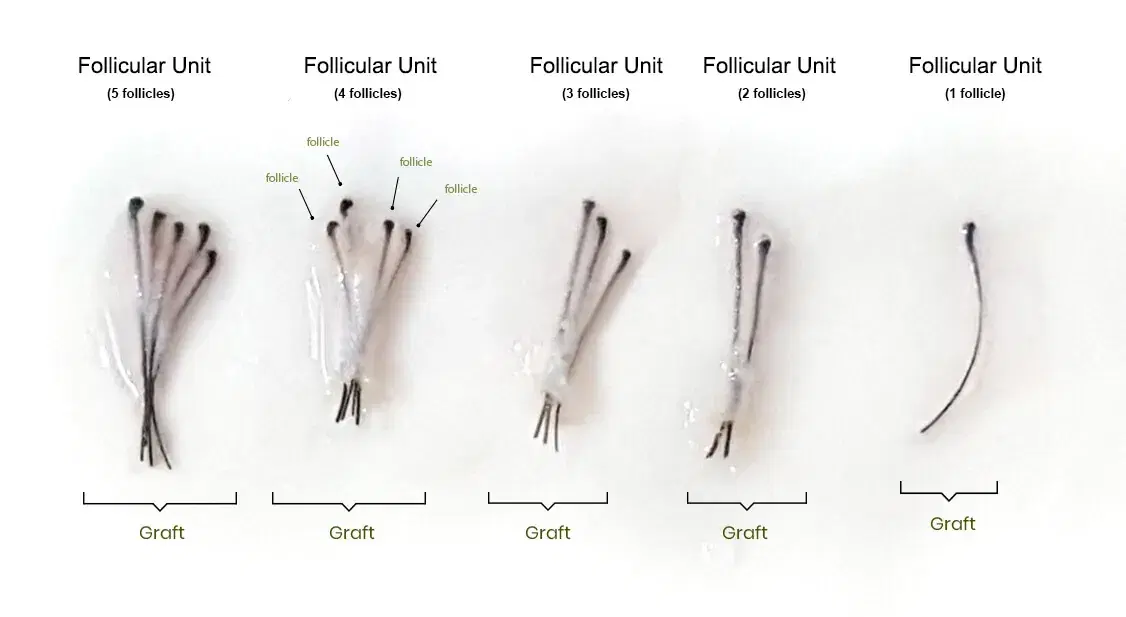
A follicular unit is a naturally occurring group of one or more hairs with related supporting structures. Scalp hair naturally emerges in these small groups rather than as evenly separated individual hairs.
Modern treatment planning may include:
Examination of the cause and progression of hair loss.
Measurement of donor density and hair calibre.
Selection of suitable one-, two-, three- or multi-hair follicular units.
Hairline design.
Recipient-site creation.
Control of graft angle and direction.
Distribution of density across different zones.
Preservation of donor hair for future needs.
Planning for continued loss of native hair.
One-hair follicular units may be selected for the leading edge of a hairline, while larger naturally occurring units may support density behind it. The exact distribution depends on the treatment area and clinical plan.
“Modern hair transplant” does not describe one single procedure. FUE and FUT are two donor-harvesting approaches, while graft preparation, site design and implantation form separate parts of the operation.
Hair Plugs vs Modern Hair Transplant
Feature | Historical hair plugs | Modern follicular-unit hair transplant |
|---|---|---|
Historical status | An earlier grafting approach | Current category using refined graft preparation and placement |
Graft structure | Round portions of scalp containing multiple follicles | Naturally occurring follicular units |
Approximate graft scale | Comparatively large grafts | Much smaller individual units |
Donor harvesting | Circular punch removal of hair-bearing tissue | Individual FUE excision or strip harvesting followed by dissection |
Graft preparation | Large plugs could be implanted substantially as removed | Grafts are selected and prepared as follicular units |
Hairline precision | Gradual transitions were harder to create | Different unit sizes can be distributed across hairline zones |
Angle and direction | Large grafts limited fine directional control | Small recipient sites allow more detailed directional planning |
Density distribution | Hair was concentrated within visible islands | Units can be distributed more gradually |
Spacing | Larger spaces could remain between grafts | Smaller units allow finer spacing, subject to scalp safety and donor supply |
Scarring pattern | Round donor and recipient changes could be visible | FUE creates multiple small donor wounds; FUT creates a linear donor scar |
Sessions | Broad coverage could require several procedures | One or more sessions may still be required |
Visual appearance | Could appear clustered or regularly spaced | Can appear more gradual when properly planned and performed |
Donor management | Long-term planning was less refined in some historical cases | Donor density, safe harvesting and future loss form part of planning |
Suitability today | Not generally used as a standard cosmetic approach | Follicular-unit methods are current practice |
Corrective options | Camouflage, reduction, excision or combined repair may be considered | Revision depends on the original problem and remaining donor supply |
Modern transplantation offers more detailed control, but it does not guarantee a natural result. Poor selection, inappropriate graft placement, incorrect angles, donor overharvesting or inadequate long-term planning can still produce an unsatisfactory outcome.
Why Did Hair Plugs Often Look Unnatural?
Large Groups of Hairs Were Placed Together
Natural hair does not normally emerge from the frontal edge in large, isolated groups. It transitions gradually from finer, more widely spaced hairs into greater density behind the hairline.
Large plug grafts concentrated many follicles in one location. When placed near the frontal edge or surrounded by bare scalp, they could create a tufted appearance that differed visibly from natural distribution.
Smaller grafts were progressively introduced partly to address the cosmetic limitations associated with larger punch grafts.
Visible Spaces Could Develop Between Grafts
Plug procedures required enough space between recipient openings to allow the skin to heal. This could leave obvious areas of scalp between growing clusters.
Spacing could become more noticeable over time if the patient’s surrounding native hair continued to thin. The plugs might still grow, but the untreated scalp around them could become increasingly exposed.
The result could therefore appear less natural years later even when the transplanted follicles remained viable.
Hairline Transition Was Less Refined
A natural-looking hairline does not normally begin as a straight, dense wall. It contains variation in height, spacing, direction and hair calibre.
Large plugs made it difficult to create a soft transition at the frontal boundary. Modern planning can use individual one-hair follicular units along the leading edge and place larger units farther behind, although the quality of the result still depends on design and execution.
Angle and Direction Could Be Difficult to Reproduce
Hair direction strongly affects the visible outcome. Frontal hairs often emerge at relatively low angles and follow patterns that vary across the temples, central hairline and side regions.
A large round graft contains several follicles with their own internal directions. Moving the entire tissue section limited how precisely each follicle could be aligned with neighbouring native hair.
Modern recipient sites can be planned individually, but unsuitable angles can still create an unnatural result even when small grafts are used.
Progressive Hair Loss Exposed the Transplanted Clusters
Transplanted donor follicles and surrounding native hair may behave differently over time. Native hair affected by androgenetic alopecia can continue to miniaturise after surgery.
As surrounding coverage disappears, previously concealed plugs can become isolated. A result that initially blended with native hair may therefore develop visible rows, islands or gaps years later.
This is one reason current planning should consider likely future hair loss rather than treating only the bald area visible on the day of surgery.
What Replaced Hair Plugs?
Hair plugs were not replaced in one single step.
The development of surgical hair restoration included:
Punch grafting: Comparatively large, round grafts.
Smaller grafts: Reduced sections intended to produce less obvious clusters.
Mini-grafting: Smaller groups containing several hairs.
Micrografting: Very small grafts, including one- and two-hair grafts.
Follicular-unit transplantation: Dissection and placement based on natural follicular groupings.
FUE harvesting: Individual follicular units excised directly from the donor area.
Refined implantation: Improved hairline planning, recipient-site design and density distribution.
The transition toward follicular-unit transplantation reflected a better understanding that scalp hair grows in naturally occurring groups. Microscopic preparation helped preserve those groups rather than cutting donor tissue into arbitrary pieces.
FUE changed the donor-harvesting stage by allowing individual units to be excised directly. It did not eliminate the need for appropriate graft handling, recipient-site design and implantation.
Hair Plugs vs FUE Hair Transplant
Hair plugs describe the size and grouping of the transplanted tissue. FUE describes how individual follicular units are removed from the donor area.
During FUE, small punches are used to excise individual follicular units. These units are then prepared and implanted into recipient sites. FUE does not itself define the hairline, graft distribution or implantation method.
Feature | Hair plugs | FUE |
|---|---|---|
What the term describes | Historical large-graft transplantation | A donor-harvesting method |
Donor removal | Round portions containing several follicles and skin | Individual follicular units excised separately |
Graft type | Comparatively large plug grafts | Naturally occurring follicular units |
Donor scar pattern | Larger round donor changes could remain | Multiple small round or dot-like scars |
Hairline planning | Limited by graft size | Can use different follicular units across zones |
Main limitation | Clustered appearance and visible spacing | Transection, overharvesting, scarring and poor planning remain possible |
Current use | Not a standard modern cosmetic approach | Widely used harvesting approach |
FUE is not scarless. Every excision creates a small wound, and visible donor thinning or scarring may occur if too many units are removed, punches are poorly distributed or healing is unfavourable.
FUE also does not automatically guarantee naturalness. A plug-like appearance can still result if unsuitable multi-hair units are placed along the frontal edge or if angle, direction and spacing are poorly planned.
Hair Plugs vs FUT Hair Transplant
Modern FUT is not the same as historical plug grafting.
In FUT, also commonly called strip harvesting, a section of hair-bearing donor scalp is surgically removed. The donor wound is closed, generally leaving a linear scar. The removed strip is then dissected under magnification into individual follicular-unit grafts.
The main distinctions are:
FUT removes donor tissue as a strip.
Hair plugs removed separate round portions.
Modern FUT divides the strip into small follicular units.
Plug grafting transplanted much larger tissue sections.
FUT usually leaves a linear donor scar.
Plug harvesting could leave multiple larger circular donor changes.
The recipient-area result depends on the follicular units selected, hairline design, site creation and implantation—not only on whether the donor hair was harvested through FUE or FUT.
Neither FUE nor FUT is universally superior. Both have advantages and limitations related to scarring, donor management, hair length, previous surgery and future graft requirements.
Hair Plugs vs DHI
DHI is commonly used to describe an implantation workflow involving an implanter device. It does not describe how donor follicular units were obtained.
The grafts still need to be harvested, often through FUE. A sharp implanter may create a recipient opening and place the graft in one action, while a dull implanter places a graft into a previously created site.
DHI is therefore not the direct modern opposite of plug grafting. The relevant distinctions are:
Hair plugs describe large historical grafts.
FUE and FUT describe donor-harvesting approaches.
DHI generally describes an implantation approach.
FUE extraction and DHI-labelled implantation may be used in the same procedure.
Professional hair-restoration guidance states that DHI should not be treated as a separate biological method of hair transplantation. The implanter alone does not guarantee natural direction, superior density or graft survival.
FUE vs FUT vs DHI: Terminology Box
Term | What it primarily describes |
|---|---|
FUE | Individual follicular-unit excision from the donor area |
FUT | Strip donor harvesting followed by follicular-unit dissection |
DHI | A term generally associated with implanter-based placement |
Hair plug | A historical large graft containing several follicles |
Follicular unit | A naturally occurring group of one or more hairs |
Do Modern Hair Transplants Ever Look Like Hair Plugs?
Yes. A modern transplant can still develop a plug-like appearance if graft selection, design or placement is poor.
Possible causes include:
Multi-hair grafts positioned directly at the frontal edge.
A straight or abrupt hairline.
Hair emerging at unsuitable angles.
Uniform rows or repeated spacing.
Large visible gaps between grafts.
Dense islands surrounded by thin scalp.
Poor transitions between treated and untreated areas.
Progressive loss of surrounding native hair.
Inadequate planning for future baldness.
Grafts placed in the wrong direction.
These features do not automatically prove misconduct or technical failure. Hair characteristics, previous surgery, scar tissue, healing and progressive loss must also be considered.
The use of smaller grafts creates the opportunity for a more natural result, but it does not replace careful diagnosis, design and surgical execution.
Are Hair Plugs Permanent?
Viable follicles within an old plug graft may continue producing hair for many years.
However, “permanent” should not be interpreted as a guarantee that the appearance will never change. Long-term appearance may be influenced by:
Continued loss of surrounding native hair.
Changes in hair calibre.
Ageing.
Scalp disease.
Scarring.
The original donor location.
Later surgical procedures.
Altered styling and hair length.
A plug can become more conspicuous even when its follicles continue growing because the scalp around it loses coverage.
Unexpected loss from transplanted or donor areas should be medically assessed. It should not automatically be attributed to ordinary ageing or assumed to mean that all grafts have failed.
Can Old Hair Plugs Be Repaired?
Some old plug results can be improved, but correction may be complex and complete reversal is not always possible.
A corrective plan may include:
Camouflage grafting
Smaller follicular-unit grafts can sometimes be placed around or in front of visible plugs. The aim is to soften the hairline, fill gaps and reduce the contrast between dense clusters and exposed scalp.
Camouflage generally requires sufficient donor hair and suitable recipient skin.
Hairline softening
One-hair follicular units may be placed in front of an abrupt plug-style hairline to create a more gradual transition.
The existing hairline position matters. If plugs sit too low, adding grafts in front may not be appropriate.
Filling visible spaces
Additional follicular units may be distributed between old grafts when the scalp and donor reserve permit.
This approach does not remove the plugs. It attempts to integrate them into a more continuous pattern.
Plug reduction or graft excision
Selected plug grafts may sometimes be surgically reduced or removed. Hair-bearing tissue from an excised plug may, in selected circumstances, be divided into smaller grafts and redistributed.
Excision can leave additional scars, contour changes or areas requiring later camouflage. It should not be described as simple or universally suitable.
Donor-scar correction
Older procedures may leave visible donor scarring. Depending on the scar, possible approaches may include scar revision, graft placement into or around the scar, hairstyle changes or scalp micropigmentation.
Staged treatment
Complex corrections may require more than one procedure. One stage may address plug removal, another may reconstruct the hairline, and later treatment may improve density or donor scarring.
Medical literature on unfavourable older transplants describes combinations of graft excision, reduction, redistribution and camouflage. The appropriate method depends on the individual pattern and remaining donor resources.
What Determines Whether Plug Repair Is Possible?
Corrective surgery depends on more than the visibility of the plugs.
Plug-repair suitability checklist
The scalp and hair-loss diagnosis have been assessed.
The position and number of old plugs are documented.
Existing scars have been examined.
Remaining donor density is sufficient for the proposed plan.
The original donor area has not been excessively depleted.
Hairline position can be improved without creating another unnatural design.
Graft direction and angle have been evaluated.
Current native-hair miniaturisation has been assessed.
Future hair loss has been included in the strategy.
The patient understands that more than one session may be needed.
The patient accepts that complete removal or scar elimination may not be possible.
Important factors include:
Remaining donor capacity.
Number, size and location of plug grafts.
Existing scar tissue.
Hairline height and shape.
Hair angle and direction.
Hair calibre and curl.
Hair-to-skin colour contrast.
Native-hair density.
Progressive loss pattern.
Previous donor harvesting.
Scalp health.
Repair priorities.
Realistic expectations.
Donor hair is limited. Using too much of the remaining supply to conceal one area may reduce the ability to manage future hair loss elsewhere.
How Does a Specialist Assess an Old Hair Plug Transplant?
A proper assessment examines the entire scalp rather than only the visible frontal plugs.
Medical and hair-loss history
The clinician may ask about:
The original diagnosis.
Age when surgery was performed.
Approximate procedure dates.
Number of operations.
Later hair loss.
Previous medication.
Scalp symptoms.
Other health conditions.
Previous surgical information
Useful records include:
Operative reports.
Original photographs.
Graft or plug numbers where available.
Donor-harvesting methods.
Later corrective procedures.
Complications.
Postoperative records.
Donor-area assessment
The donor region should be examined for:
Density.
Hair calibre.
Miniaturisation.
Round or linear scars.
Previous overharvesting.
Remaining safe donor supply.
Potential alternative donor sources where clinically appropriate.
Recipient-area assessment
The assessment may review:
Plug size.
Plug distribution.
Hairline position.
Hair direction and angle.
Scar tissue.
Skin contour.
Gaps between grafts.
Native-hair density.
Miniaturisation.
Areas likely to lose further hair.
Magnified scalp examination may support donor and recipient analysis. Photographs can help with initial review, but they cannot fully assess skin texture, scar mobility, follicular density or scalp disease.
Repair objectives
The specialist and patient should agree on priorities, such as:
Softening the frontal edge.
Concealing gaps.
Reducing selected plugs.
Improving direction.
Managing donor scars.
Preserving grafts for future loss.
A realistic plan should also state what cannot be achieved safely.
Hair Plugs vs Modern Hair Transplant Results
A natural-looking result depends on the complete treatment process, not simply the name of the technique.
Important factors include:
Correct diagnosis.
Appropriate candidate selection.
Adequate donor supply.
Suitable graft size.
Hairline position and shape.
Placement of one-hair and multi-hair units.
Angle and direction.
Density distribution.
Graft handling.
Recipient-site quality.
Scalp condition.
Healing.
Future hair-loss planning.
Availability of follow-up.
Modern follicular-unit grafting allows much finer distribution than historical plugs. However, small grafts can still be placed in an unnatural pattern, and an initially good result can become isolated if native hair continues to thin.
“Modern” should therefore describe the approach, not function as a guarantee of quality.
How to Avoid a Plug-Like Hair Transplant Result
Ask who performs each surgical stage
Confirm who:
Assesses the hair-loss diagnosis.
Designs the hairline.
Administers anaesthesia.
Performs donor incisions or excisions.
Creates recipient sites.
Prepares grafts.
Implants grafts.
Provides medical supervision.
Review comparable cases
Look for examples involving similar:
Hair-loss patterns.
Hair calibre.
Curl.
Hair-to-skin contrast.
Donor density.
Treatment areas.
One highly selected photograph does not establish consistent quality.
Examine close-up hairlines
Useful images should show:
The frontal edge.
Temple transitions.
Hair direction.
Density behind the edge.
Results under ordinary lighting.
Photographs should use consistent distance, angle, hair length and styling.
Ask about graft selection
Discuss where one-hair follicular units will be used and how larger naturally occurring units will be distributed.
Single-hair grafts alone do not guarantee naturalness, but inappropriate multi-hair clusters at the leading edge can create a harsh result.
Discuss donor limits
A high graft count should not automatically be treated as a benefit. Ask how the plan protects the donor area from visible thinning and preserves options for future hair loss.
Ask about long-term planning
The treatment plan should account for:
Likely progression.
Untreated native hair.
Future frontal or crown loss.
Possible need for medical management.
Remaining donor reserve.
Avoid guarantees
Be cautious with:
Guaranteed density.
Perfect naturalness.
Zero scarring.
Fixed survival percentages.
Promises that one method suits everyone.
Claims based only on graft count or device names.
Understand revision policies
Ask how the provider evaluates poor growth, visible scarring, design concerns or future repair requests.
Questions to Ask Before Corrective Hair Transplant Surgery
Is my result caused by visible plugs, progressive native hair loss, scarring or a combination of problems?
Can the existing grafts be camouflaged rather than removed?
Would reducing or excising plugs leave additional scars or contour changes?
How much usable donor hair remains?
Has my previous donor area been overharvested or scarred?
How will future hair loss affect the repair plan?
Will the correction require more than one session?
Which existing grafts should remain in place?
Who will perform each surgical stage?
Can I review comparable, consented corrective cases?
How will grafts be allocated between the hairline, gaps and other thinning areas?
What result cannot realistically or safely be achieved?
Clear answers should explain limitations as well as potential improvements.
Hair Plug Correction at Esthetic Hair
An assessment for an old plug-style transplant should consider the original recipient pattern, remaining donor supply, existing scars, current native hair and likely future loss.
Readers seeking an assessment can provide:
Clear frontal, side, top and donor-area photographs.
Approximate dates of previous procedures.
Available surgical records.
Photographs taken before and after the original transplant.
Information about scalp symptoms.
Details of later hair loss or treatment.
Photographs can support preliminary review, but final corrective planning may require an in-person scalp and donor-area examination.
A proposed plan should explain:
Whether camouflage, graft reduction, excision or a combined approach may be considered.
Which old grafts should remain.
How much donor hair may be available.
Whether staged correction may be necessary.
What limitations scar tissue creates.
How future loss affects the plan.
What postoperative follow-up will involve.
No corrective procedure should be presented as capable of guaranteeing complete plug removal, scar elimination or a particular density.
Frequently Asked Questions
Are hair plugs and hair transplants the same thing?
Hair plugs were one historical form of hair transplantation, but the terms are not interchangeable. Plug procedures moved comparatively large portions of hair-bearing scalp. Modern FUE and FUT procedures generally transplant smaller, naturally occurring follicular units, allowing more detailed control over distribution, angle and hairline design.
Are hair plugs still used today?
Large plug grafts are not generally used as a standard modern cosmetic hair-restoration approach. Current procedures usually rely on follicular-unit grafts. However, many patients still have older plug-style transplants and may seek camouflage, reduction, redistribution or other corrective treatment.
What is the main difference between hair plugs and FUE?
Hair plugs describe large historical grafts, while FUE describes a method of excising individual follicular units from the donor area. FUE uses smaller grafts, but naturalness still depends on recipient planning, graft selection, angle, direction and density distribution.
Are hair plugs permanent?
Viable follicles in plug grafts may continue producing hair for many years. However, the surrounding native hair can continue thinning, making the plugs more visible. Scarring, ageing, scalp disease and donor characteristics may also affect the long-term appearance, so “permanent” should not be treated as an appearance guarantee.
Why did hair plugs look unnatural?
Large groups of follicles were placed together, often with visible spaces between them. The size of the grafts made gradual hairline transitions and precise directional control more difficult. Progressive native hair loss could later expose previously concealed clusters.
Can modern hair transplants look like hair plugs?
Yes. A modern procedure may look plug-like if large multi-hair units are placed along the frontal edge, the hairline is abrupt, grafts follow incorrect angles, spacing is uneven or native hair later disappears. The use of FUE, FUT or an implanter does not by itself guarantee a natural result.
Can old hair plugs be removed?
Selected plugs may sometimes be reduced or excised, but removal can leave scars or contour changes. Some cases are better treated by adding smaller camouflage grafts. The correct option depends on plug position, scar tissue, hairline design and remaining donor supply.
Can FUE repair hair plugs?
FUE may provide follicular units for softening a plug-style hairline, filling spaces or camouflaging visible clusters. It may also be used in some combined repair plans. Suitability depends on remaining donor capacity and does not mean that every old plug can be removed or concealed completely.
Does correcting hair plugs leave scars?
It can. Excising or reducing plug grafts creates additional wounds, while donor harvesting through FUE or FUT also produces scars. Scar visibility depends on the procedure, skin response, previous surgery, hair length and healing. Corrective planning should include a realistic discussion of these changes.
How many grafts are needed to repair hair plugs?
There is no universal number. The estimate depends on the number and location of plugs, treatment surface, hairline position, donor density, scar tissue, hair calibre, existing native hair and future loss. A responsible estimate requires a complete scalp and donor assessment.
Is FUT the same as hair plugs?
No. FUT removes a donor strip that is divided under magnification into small follicular-unit grafts. Historical plug surgery removed and implanted larger round portions of hair-bearing scalp. FUT usually creates a linear donor scar, while plug harvesting could create multiple circular donor changes.
Is DHI better than hair plugs?
DHI usually refers to graft placement with an implanter device, while hair plugs describe large historical grafts. They are not equivalent categories. An implanter may form part of a modern procedure, but it does not automatically guarantee better direction, density, survival or naturalness.
When were hair plugs replaced by modern techniques?
The change occurred gradually. Larger punch grafts were followed by mini-grafts and micrografts, then follicular-unit transplantation and FUE harvesting. There was no single date when every practitioner stopped using plugs or adopted the same modern approach.
Can hair plugs continue growing after many years?
Yes. Viable transplanted follicles may continue producing hair. They can nevertheless become more visible as native hair around them thins. Unexpected shedding, inflammation or loss from transplanted areas should receive professional assessment rather than being attributed automatically to the age of the procedure.
How can I tell whether I have hair plugs?
Possible signs include large, separate clusters, regular spaces, a sharply tufted hairline or round donor scars. However, mini-grafts, poorly distributed follicular units and progressive native hair loss can create similar appearances. Operative records and scalp examination provide a more reliable assessment than photographs alone.
Final Comparison
Hair plugs were an early form of hair transplantation. They moved comparatively large groups of follicles, which could grow but often created visible clusters and spaces.
Modern transplantation generally uses smaller, naturally occurring follicular units. FUE removes those units individually, while FUT obtains them from a surgically removed donor strip. DHI generally describes an implantation workflow rather than a separate method of donor harvesting.
Smaller grafts and refined planning allow greater control over hairline transitions, angle, direction and distribution. They do not guarantee quality, naturalness or freedom from scarring.
Old plug grafts may sometimes be camouflaged, reduced, redistributed or removed, but corrective options depend on donor supply, scar tissue, hairline position, scalp health and future hair loss.
Readers concerned about an old plug-style result can request an individual scalp and donor-area assessment to understand which improvements may be technically possible and which limitations should guide the plan.