
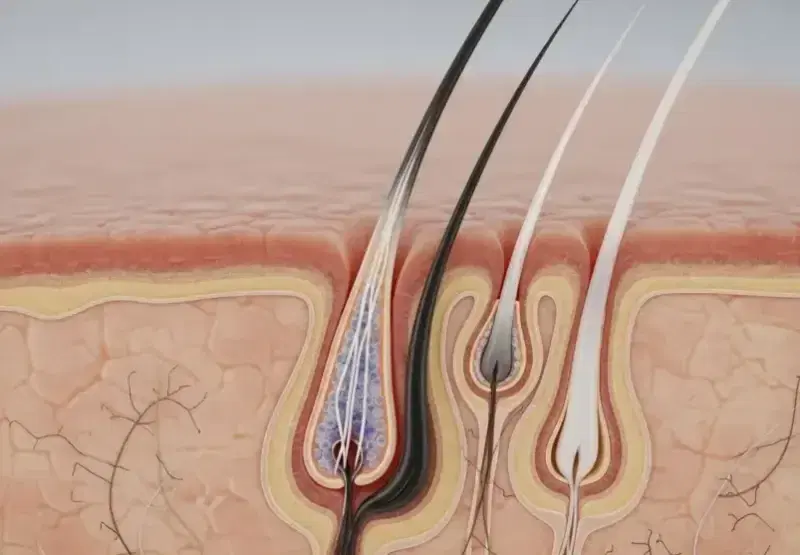
What Does It Mean When a Hair Follicle Dies?
A hair follicle is effectively lost when permanent structural damage prevents it from producing another functional hair shaft. This usually happens when scarring or severe tissue destruction replaces important parts of the follicle.
The word dead can be misleading because many follicles that stop producing visible hair are not permanently destroyed. Some are resting, while others have become progressively miniaturized and produce hairs too fine to notice easily.
True permanent loss is more closely associated with destruction of the follicular structure itself. That distinction matters because an inactive follicle may recover, while a completely scarred follicle generally cannot restart normal growth.
Can a Hair Follicle Stop Growing Hair Without Being Dead?
A hair follicle can stop producing visible hair for a period without being permanently destroyed. Hair follicles naturally cycle through active growth, transition, rest, and shedding phases throughout life.
During the resting phase, a follicle may temporarily contain no visible growing shaft. Telogen effluvium can increase the number of follicles entering this state at roughly the same time.
Miniaturized follicles can also remain alive while producing increasingly short and fine hairs. The absence of a thick visible strand therefore does not prove follicular death. Biological inactivity and permanent structural destruction represent two very different situations.
What Can Permanently Destroy a Hair Follicle?
Permanent follicle destruction usually occurs when inflammation, scarring, severe injury, or another damaging process destroys the structures required for future hair production.
Important causes include:
Scarring forms of alopecia
Deep burns
Severe physical trauma
Repeated untreated inflammatory damage
Advanced traction injury
Certain severe infections
Surgical scarring through follicle-bearing skin
Once scar tissue replaces the functioning follicular unit, normal regrowth becomes unlikely because the original growth structures are no longer intact. Temporary shedding, ordinary shaving, and routine haircuts do not create this type of permanent destruction.
Can Androgenetic Hair Loss Kill Hair Follicles?
Androgenetic hair loss gradually miniaturizes genetically susceptible follicles rather than suddenly destroying them. Over repeated hair cycles, affected follicles produce shorter, finer, and less pigmented hairs until visible density becomes progressively lower.
Early in this process, many follicles remain biologically active and may still respond to treatment. As miniaturization advances over many years, recovery becomes increasingly difficult because the follicle becomes extremely small and functionally weak.
This is different from scarring alopecia, where inflammation can physically destroy the follicular structure. Pattern hair loss therefore involves progressive miniaturization rather than immediate follicular death.
What Happens When a Hair Follicle Miniaturizes?
A miniaturizing hair follicle gradually becomes smaller and begins producing thinner, shorter hairs with each successive growth cycle. The visible strand may eventually resemble fine body hair rather than a strong terminal scalp hair.
This process commonly occurs in androgenetic alopecia. The growth phase becomes shorter, while the resulting hair loses diameter and contributes less to visible coverage.
A miniaturized follicle may still remain alive for a considerable period, which is why early treatment can sometimes improve hair caliber. Once miniaturization becomes very advanced, however, the potential for meaningful recovery becomes much lower.
Can Dormant Hair Follicles Start Growing Again?
Dormant or resting hair follicles can often begin producing hair again when the underlying follicular structure remains intact. This commonly occurs after temporary telogen effluvium caused by illness, stress, major weight loss, or another physiological trigger.
The follicle does not need to be recreated. It simply needs to return from a resting state into active anagen growth.
Recovery takes time because hair cycling operates over months rather than days. Even after the trigger resolves, visible regrowth may appear slowly and initially look fine. A dormant follicle therefore behaves very differently from one destroyed by permanent scarring.
How Can You Tell If a Hair Follicle Is Still Alive?
A follicle is more likely to remain active when fine hairs, short regrowth, or varying hair diameters are still visible in the affected area.
Several clues may suggest continuing follicular activity:
Fine or miniaturized hairs remain present
Short new hairs appear over time
The scalp surface is not scarred
Follicular openings remain visible
Hair density changes gradually rather than disappearing abruptly
Regrowth follows a temporary shedding episode
These signs cannot always determine follicle viability with certainty, but they provide useful context. Completely smooth, shiny, scarred skin with absent follicular openings raises greater concern for permanent destruction.
Can Scarring Alopecia Destroy Hair Follicles?
Scarring alopecia can permanently destroy hair follicles because inflammation attacks the follicular structures and replaces them with scar tissue. Once this happens, the affected follicles can no longer produce normal new hair.
Different scarring disorders may progress slowly or rapidly, and some create redness, burning, scaling, tenderness, or pustules before obvious permanent loss develops. Others become noticeable only after density has already decreased.
Early recognition matters because treatment usually aims to stop further destruction rather than regenerate follicles that have already disappeared. Hair restoration becomes a separate consideration only after the inflammatory process has become inactive and stable.
Can Burns or Injuries Kill Hair Follicles?
Deep burns and severe injuries can permanently destroy hair follicles when tissue damage extends into the deeper skin where the follicular structures are located. Superficial irritation generally does not produce the same effect.
When healing replaces damaged skin with dense scar tissue, follicular openings may disappear and normal hair growth may not return. The degree of permanent loss depends on how deeply the injury affected the scalp.
Minor cuts or abrasions may heal without lasting hair loss if the follicular structures remain intact. More extensive trauma can create permanent bald areas when the underlying follicles are physically destroyed.
Does Pulling Out Hair Kill the Follicle?
Pulling out a hair usually removes the visible shaft and part of the root structure without destroying the entire follicle. In most cases, the follicle remains within the skin and can produce another hair.
Repeated forceful plucking creates a different situation. Chronic mechanical trauma can inflame and damage the follicular environment, particularly when the same hairs are repeatedly removed over long periods.
Occasional plucking therefore differs significantly from prolonged traction or repetitive injury. A hair can be removed many times before permanent damage occurs, but repeated trauma can eventually reduce regrowth in susceptible areas.
Can Tight Hairstyles Permanently Damage Hair Follicles?
Tight hairstyles can permanently damage follicles when repeated tension continues long enough to cause traction alopecia. Early traction may produce broken hairs and temporary thinning, but prolonged pulling can eventually cause irreversible follicular loss.
The hairline and temples are often vulnerable because these areas carry strong mechanical tension in tightly pulled styles. Soreness, small bumps, broken hairs, or a widening hairline can appear before permanent loss develops.
Reducing traction early gives follicles a better chance to recover. Once the area becomes smooth and scarred, however, natural regrowth becomes much less likely.
Can Inflammation Cause Permanent Follicle Damage?
Persistent inflammation can permanently damage follicles when it targets the structures responsible for hair regeneration and eventually leads to scarring. The risk depends on the underlying condition and how long inflammation remains active.
Temporary dandruff or mild irritation does not usually destroy follicles. More aggressive inflammatory disorders can penetrate deeper and progressively eliminate follicular units.
Warning signs may include continuing scalp pain, burning, redness, pustules, scaling, or rapidly expanding areas of hair loss. When inflammation and hair loss occur together, identifying the cause matters because preventing further destruction becomes more important than stimulating existing hair growth.
Can Hair Follicles Recover After Telogen Effluvium?
Hair follicles usually remain structurally intact during telogen effluvium, so they can return to normal growth once the underlying trigger resolves. The condition changes the timing of the hair cycle rather than permanently destroying follicles.
A large number of hairs may enter the resting phase and shed several weeks or months after illness, stress, nutritional restriction, or another trigger. The resulting thinning can look dramatic despite preserved follicular health.
Regrowth then develops gradually as follicles re-enter anagen. Because new hair grows slowly, full visual recovery often takes substantially longer than the reduction in shedding.
Can a Smooth Bald Area Still Contain Living Follicles?
A smooth bald area can sometimes contain follicles that are highly miniaturized or temporarily inactive, but a shiny scarred surface with absent follicular openings suggests more significant structural damage. Surface appearance alone does not always provide a definitive answer.
Alopecia areata, for example, can create very smooth bald patches while follicles remain present beneath the skin. Those follicles may later restart growth because the condition does not necessarily destroy them permanently.
Scarring alopecia is different because scar tissue can replace the follicular structures themselves. This distinction explains why two equally smooth bald areas can have very different possibilities for regrowth.
Can Minoxidil Revive Dead Hair Follicles?
Minoxidil cannot recreate a follicle that has been completely destroyed and replaced by scar tissue. Its potential benefit depends on having living follicles capable of responding to growth stimulation.
It can support some miniaturized or inactive follicles by encouraging more productive growth, especially when those follicles still retain functional structures. This is why early thinning may respond better than a long-standing completely scarred area.
The phrase reviving dead follicles can therefore create false expectations. Treatment may stimulate weakened follicles, but it cannot reconstruct a follicular unit that no longer exists biologically.
Can Hair Transplantation Replace Destroyed Hair Follicles?
Hair transplantation can restore hair to some areas where original follicles have been permanently lost by moving resistant follicles from another donor region. The procedure does not repair or reactivate the destroyed follicles themselves.
Instead, healthy donor grafts are inserted into the affected area and begin producing hair from their new positions. This principle can sometimes help with stable scars or long-standing permanent loss.
The recipient skin still needs sufficient blood supply and a stable environment to support transplanted grafts. Active inflammatory scarring disease must therefore be distinguished from an old, inactive scar before transplantation is considered.
How Long Can a Hair Follicle Stay Inactive?
A hair follicle can remain nonproductive for months and sometimes much longer without necessarily being permanently destroyed. The duration depends on why growth stopped and whether the follicle remains structurally intact.
Normal resting phases last for a limited period before the next growth cycle begins. Medical conditions, severe stress, hormonal changes, or immune activity can prolong or disrupt that process.
Long-term absence of visible hair makes spontaneous recovery less predictable, especially when miniaturization or scarring has progressed. Duration alone cannot prove follicular death, but prolonged inactivity generally lowers expectations for rapid natural regrowth.
Do Hair Follicles Die With Age?
Aging can reduce hair density and follicular productivity, but follicles do not all simply die at a certain age. Hair growth becomes influenced by genetics, hormones, cellular aging, changing growth cycles, and gradual miniaturization.
Some follicles continue producing strong terminal hairs throughout life, while others become thinner and spend less time in active growth. This creates increasing differences in density between individuals as they age.
Age-related thinning may overlap with androgenetic alopecia, which accelerates miniaturization in genetically susceptible follicles. Permanent follicular destruction remains different from the gradual decline in productivity commonly associated with aging.
Can Damaged Hair Follicles Repair Themselves?
Mildly stressed follicles can recover when the injury does not destroy their regenerative structures. Temporary inflammation, telogen effluvium, and early traction can therefore improve when the underlying trigger is removed.
The situation changes once scar tissue replaces important follicular tissue. A follicle cannot simply rebuild itself after complete structural destruction.
Recovery potential depends on whether the follicle is resting, miniaturized, inflamed, mechanically stressed, or permanently scarred. This is why the cause of hair loss matters more than simply describing the follicle as damaged. Different types of damage carry very different possibilities for regrowth.
How Can You Protect Hair Follicles From Permanent Damage?
Hair follicles are best protected by addressing ongoing inflammation, excessive traction, scalp disease, and progressive hair loss before irreversible structural damage develops. Early intervention preserves more biological options than waiting until an area becomes completely bald.
Avoiding chronically tight hairstyles reduces mechanical stress, while treating persistent scalp inflammation can help prevent deeper injury. Recognizing progressive miniaturization also allows hair-loss management to begin while follicles remain active.
The central distinction is simple: temporary shedding often preserves follicles, while scarring destroys them. Protecting follicular structure therefore matters more than reacting only after visible hair has already disappeared.