
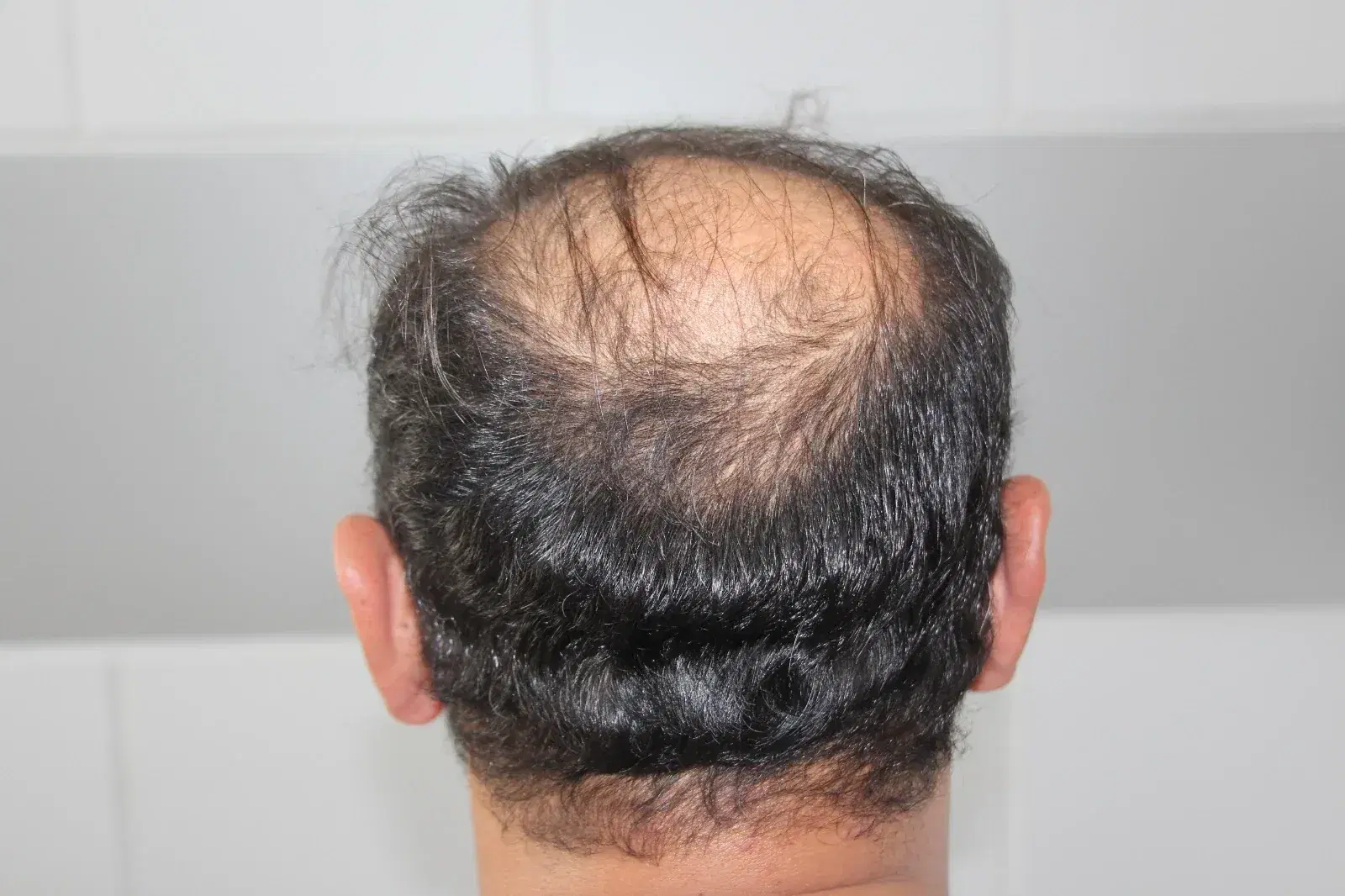
Can You Get a Hair Transplant With a Weak Donor Area?
A hair transplant can sometimes be performed with a weak donor area, but the procedure usually requires fewer grafts, conservative coverage, and careful donor preservation.
Low density alone does not automatically prevent transplantation. Hair shaft thickness, donor surface area, follicular-unit composition, recipient size, and future hair loss also influence what can be achieved. A weak but stable donor can sometimes support focused frontal restoration. An unstable donor containing extensive miniaturized follicles creates greater concern because transplanted hairs may also lose density later. Confirmed absence of a stable donor zone can make transplantation unsuitable.
What Does a Weak Donor Area Mean?
A weak donor area means the scalp has limited stable follicular resources because density, hair caliber, safe-zone size, or follicular stability is below ideal levels.
The back and sides of the scalp normally provide follicles for transplantation because these regions are relatively resistant to androgenetic hair loss. However, donor quality differs substantially between people. Some have naturally low follicular-unit density, while others have fine hair that provides less visual coverage. Miniaturization can also affect the donor region. A donor should therefore be judged by measurable follicular characteristics rather than simply by how dense it appears in photographs.
How Is Donor Area Strength Measured?
Donor area strength is measured through follicular-unit density, total hair density, shaft diameter, miniaturization, safe-zone dimensions, and the distribution of previous extractions.
Trichoscopy allows close examination of follicular units and differences in hair-shaft diameter. This makes it useful for identifying miniaturization that may not be obvious during routine visual inspection. Donor measurements also help estimate how many follicular units can be removed without making the scalp visibly thin. Hair caliber matters because thicker shafts provide greater visual coverage after transplantation. A donor assessment should therefore evaluate both the number and quality of available follicles.
What Donor Density Is Considered Low?
Donor density below approximately 60 follicular units per square centimeter is considered low in one surgical framework, while densities below 40 are particularly unfavorable.
These numbers should be used as reference points rather than universal eligibility thresholds. The average stable donor region is often described around 65 to 85 follicular units per square centimeter. Someone with lower density can still have useful donor resources when the safe area is large and hair shafts are thick. Conversely, apparently adequate density may provide poor long-term donor value when extensive miniaturization is present. Density therefore needs to be interpreted alongside stability and hair quality.
Why Does Donor Miniaturization Matter?
Donor miniaturization matters because follicles already becoming thinner may continue deteriorating after transplantation and can make donor harvesting visibly deplete the scalp.
A stable donor should contain follicles expected to maintain their characteristics after relocation. Significant variation in hair-shaft diameter can suggest androgen-related involvement within the donor region. Removing follicles from these unstable areas weakens two locations simultaneously. The donor becomes thinner after extraction, while transplanted miniaturized hairs may provide disappointing long-term coverage. Current practice guidance therefore recommends evaluating the safe donor area for miniaturization before deciding how aggressively it can be harvested.
Can Someone With DUPA Have a Hair Transplant?
Diffuse unpatterned alopecia usually makes conventional hair transplantation unsuitable because thinning extends into areas that would normally supply permanent donor follicles.
DUPA can involve the frontal, temporal, parietal, and occipital scalp rather than preserving a clearly stable donor fringe. Transplantation depends on donor dominance, meaning transplanted follicles should retain reliable long-term growth after relocation. When the occipital scalp is also miniaturizing, that assumption becomes unreliable. Recent case evidence confirms that quantitative trichoscopy can identify occipital involvement that might otherwise be missed. Treatment is therefore commonly deferred when no dependable donor zone can be demonstrated.
Can a Weak Donor Area Still Support a Small Hair Transplant?
A weak but stable donor can sometimes support a smaller transplant focused on the area that creates the greatest cosmetic benefit.
The frontal region often receives priority because it frames the face and can create substantial visual improvement with fewer grafts than full scalp coverage. A conservative hairline also protects future donor reserves. Attempting to treat the hairline, mid-scalp, and crown simultaneously can spread limited grafts too thinly. Current clinical guidance specifically emphasizes realistic expectations and conservative design when donor availability is restricted. The objective becomes strategic coverage rather than attempting to recreate the density of an unaffected scalp.
How Many Grafts Can Be Taken From a Weak Donor Area?
There is no fixed safe graft number for a weak donor area because harvesting capacity depends on density, safe-zone size, hair caliber, age, and future hair-loss risk.
Practice guidance suggests a broad lifetime scalp donor range of approximately 4000 to 6500 grafts across multiple sessions for suitable patients. This range should not be applied automatically to low-density donors. A weak donor may safely provide substantially fewer follicles. Modern complication evidence also links large extraction sessions and insufficient donor density with visible overharvesting. The safe number should therefore be determined from residual donor coverage rather than a predetermined package size.
What Signs Suggest a Weak Donor Area?
A weak donor area usually shows measurable or visible features indicating that safe follicular supply may be limited.
Low follicular-unit density across the occipital scalp
Fine hair shafts that provide limited visual coverage
Noticeable scalp visibility through the donor region
Significant variation in hair-shaft diameter
Miniaturized hairs within the expected safe zone
Diffuse thinning extending around the sides and back
Retrograde thinning near the lower donor border
Previous FUE leaving patchy or uneven extraction areas
Progressive donor thinning documented over time
Insufficient stable follicles for the planned recipient area
These findings should be measured rather than judged from photographs alone.
Can FUE Make a Weak Donor Area Look Worse?
FUE can make a weak donor area look worse when too many follicular units are removed or extractions are concentrated within already sparse regions.
Each FUE extraction permanently removes a follicular unit from its original donor position. The surrounding hair must therefore provide enough residual coverage to conceal the small extraction sites. A low-density scalp has less reserve for doing this. Overharvesting can produce patchy areas where the scalp becomes clearly visible, sometimes described as a window effect. Recent evidence notes that this complication is increasingly associated with high graft counts performed despite insufficient donor density.
Can FUT Be Better Than FUE for a Weak Donor Area?
FUT can sometimes preserve useful donor options differently from FUE, but it does not solve genuinely inadequate or unstable donor hair.
FUT removes a narrow strip from the donor scalp and closes the area with a linear scar. This concentrates harvesting within one selected region instead of distributing thousands of individual punches across the donor area. In selected patients, this can preserve other scalp regions for future extraction. However, the strip itself still requires adequate density and a stable safe donor zone. Scalp laxity, hairstyle preferences, previous scars, and expected future sessions also influence whether FUT provides a practical advantage.
Can Beard Hair Be Used When the Scalp Donor Is Weak?
Beard hair can supplement a weak scalp donor in selected patients because FUE allows individual facial follicles to be harvested and transplanted into the scalp.
Beard follicles often have thick shafts and can contribute considerable visual bulk. Research comparing donor sources reported one-year survival around 95 percent for beard hair in a small controlled study. However, beard hair does not become identical to scalp hair after transplantation. Its caliber, texture, curl, and growth characteristics largely remain those of beard hair. It is therefore often mixed with scalp follicles rather than used alone for delicate frontal hairline reconstruction.
Can Body Hair Replace a Weak Scalp Donor?
Body hair can expand the donor supply in selected patients, but it cannot be considered a complete equivalent to good-quality scalp donor hair.
Chest and other body follicles differ from scalp hair in shaft length, diameter, growth-cycle duration, and texture. One comparative study reported one-year survival around 76 percent for chest hair, compared with 89 percent for scalp hair. Larger case series also show that body-hair FUE can provide useful cosmetic improvement in carefully selected patients with limited scalp reserves. Because transplanted body hair retains many original characteristics, matching it appropriately with recipient areas remains important.
Can Medical Treatment Improve a Weak Donor Area?
Medical treatment may stabilize some donor areas affected by androgenetic miniaturization, but it cannot recreate follicular units that have already been permanently lost or extracted.
When donor weakness reflects active androgen-related thinning, treatment can be considered before surgery. Current practice guidance specifically recommends medical management when donor miniaturization is identified. Recent observations in DUPA also documented short-term improvement in non-vellus hair density after medical therapy, although this does not establish permanent surgical eligibility. Repeat trichoscopy can determine whether the donor region becomes sufficiently stable over time. A naturally sparse donor without active miniaturization has less potential for meaningful density improvement.
Which Areas Should Be Prioritized With a Weak Donor?
The frontal hairline and frontal scalp are usually prioritized when donor resources are limited because these areas provide the strongest effect on facial framing.
Using scarce grafts in the crown can consume a large percentage of the available donor supply because the vertex covers a broad circular surface. Future progression can also enlarge the crown further. Contemporary guidance therefore recommends conservative hairline design and warns against exhausting donor grafts on isolated vertex restoration. A limited donor requires accepting that complete coverage may not be achievable. Strategic placement can create the appearance of stronger density where it contributes most to the overall hairstyle.
What Are the Main Risks of Hair Transplantation With a Weak Donor?
The main risks are visible donor depletion, inadequate recipient density, unstable transplanted follicles, limited future options, and an unnatural distribution of scarce grafts.
A weak donor provides less margin for planning mistakes. Excessive extraction can permanently expose the scalp at the back and sides, while spreading too few grafts over a large recipient area can produce disappointing coverage. Harvesting miniaturized follicles may also reduce long-term reliability. Future androgenetic hair loss can create additional bald areas after donor resources are already depleted. These risks explain why maximum graft count should not be the primary objective when the donor supply is limited.
Can Someone With a Weak Donor Have a Second Hair Transplant Later?
A second transplant may be possible with a weak donor only when enough stable follicular units remain after the first procedure and further harvesting will not expose the scalp.
The first operation therefore needs to preserve future options from the beginning. Aggressive FUE can make a later session impossible even when new hair loss develops. Repeat assessment should measure residual density, previous extraction distribution, miniaturization, and the remaining dimensions of the safe donor area. Beard hair may supplement scalp follicles in selected patients when further scalp harvesting becomes limited. Planning the first transplant as if it will be the only procedure can be risky in progressive androgenetic alopecia.
When Should Hair Transplantation Be Avoided Because of a Weak Donor?
Hair transplantation should generally be avoided when no reliably stable donor zone exists or when harvesting would create greater cosmetic damage than the recipient improvement.
Confirmed DUPA is an important example because follicular miniaturization extends into the conventional donor scalp. Severe low density, extensive previous overharvesting, active scarring alopecia, or unstable diffuse thinning can also make surgery inappropriate. A transplant cannot overcome the biological limitation of insufficient permanent follicles. In these situations, preserving existing hair and managing the underlying condition may provide a more sustainable strategy than transferring an inadequate donor supply into a larger recipient area.