
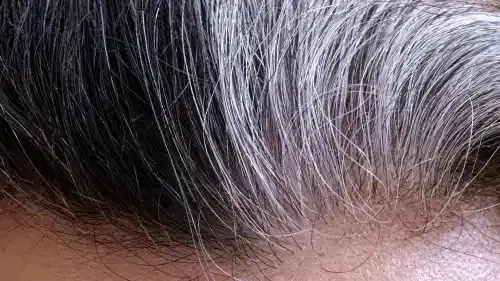
What Is a Grey Hair Transplant?
A grey hair transplant is a standard hair restoration procedure in which grey or white follicles are moved from a donor area into thinning scalp regions.
The surgery follows the same fundamental principle used for pigmented hair. Follicular units are harvested from a stable donor zone, usually around the back and sides of the scalp. They are then implanted into areas requiring additional coverage. Grey hair does not require a separate biological transplantation method. The main differences involve visibility during harvesting, graft preparation, and placement. White shafts can become difficult to distinguish from surrounding tissue, making careful visual management particularly important during surgery.
Can Grey Hair Be Transplanted?
Grey hair can be transplanted successfully because loss of pigment does not prevent a healthy follicle from being harvested, implanted, and producing hair.
Hair becomes grey because pigment production within the follicle decreases, not because the follicle automatically loses its ability to grow. A suitable grey follicle can therefore behave like another donor graft after transplantation. Surgical planning still depends on donor density, follicle quality, scalp health, and the stability of the donor region. Grey colour alone does not make someone unsuitable for hair restoration. Published surgical experience has documented successful transplantation in patients with grey and completely white hair, including considerably older adults.
Does Transplanted Grey Hair Stay Grey?
Transplanted grey hair will generally continue producing hair with the pigmentation characteristics of its donor follicle rather than becoming dark simply because its location changes.
Hair transplantation moves the entire functional follicular unit rather than transferring only the visible shaft. Donor follicles commonly retain important characteristics after relocation, a principle known as donor dominance. Long-term clinical observations have shown that transplanted hairs can maintain their original pigmentation. Rare cases of repigmentation have been reported, showing that follicular pigmentation can occasionally change after transplantation. However, this is not a predictable outcome. Someone receiving grey donor follicles should therefore expect the resulting transplanted hair to remain predominantly grey or white.
Can White Hair Be Used as Donor Hair?
White hair can be used as donor hair when the follicles come from a stable region with sufficient density and suitable hair characteristics.
The absence of visible pigment does not make a follicle unusable. The greater difficulty involves seeing the white shaft clearly during extraction and graft preparation. White hair can appear almost transparent against surrounding scalp and soft tissue, especially under bright surgical illumination. This reduced contrast can complicate identification of follicular direction and graft boundaries. Techniques that increase contrast can make harvesting more controlled. Donor assessment should still focus primarily on follicular density, stability, calibre, distribution, and available long-term donor supply rather than colour alone.
Is Grey Hair Harder to Transplant?
Grey hair can be technically harder to transplant because white or lightly pigmented shafts provide less visual contrast against the scalp and surrounding graft tissue.
The biological process of graft growth remains similar, but surgical handling can require additional preparation. During FUE, accurate alignment between the extraction punch and follicle direction helps reduce graft transection. Poorly visible white shafts make that alignment more challenging. After extraction, transparent hairs can also become difficult to distinguish while grafts are inspected, sorted, and prepared for implantation. These difficulties relate to visibility rather than weakness of the follicle. Increasing contrast around white hairs can significantly improve identification during several stages of transplantation.
Why Is Grey Hair Harder to See During FUE?
Grey hair is harder to see during FUE because reduced melanin makes white shafts blend with the scalp and appear faint or partially transparent under magnification.
FUE requires accurate recognition of each follicular unit before the extraction punch enters the skin. With dark hair, the shaft creates a clear visual reference for direction and position. White hair produces much less contrast, particularly against lighter skin. Surgical lighting can further reduce visibility through reflection. Research examining white-haired transplantation describes difficulty identifying follicles during punching, trimming, and loading. These visual limitations explain why additional contrast techniques may be used when substantial portions of the donor area have become grey.
How Is Grey Hair Prepared Before a Hair Transplant?
Grey hair can be prepared for transplantation by increasing visual contrast so individual shafts and follicular units remain easier to identify during surgery.
Temporary colouring strategies may be used before or during transplantation when white hair is difficult to distinguish. Research has described scalp staining methods that create contrast around white follicular units during FUE. More recent surgical guidance also discusses preoperative hair colouring as a practical approach when substantial white hair is present. Colour preparation is intended to improve visibility rather than change the biological quality of the graft. Any colouring method must also consider scalp sensitivity because hair dyes and related products can cause contact reactions in susceptible individuals.
Can FUE Be Used for Grey Hair?
FUE can be used successfully for grey hair when individual follicular units can be accurately identified and harvested from an appropriate donor region.
The procedure extracts follicles individually using small punches. Grey hair creates an additional visual challenge because the shaft may offer limited contrast with the scalp. Appropriate preparation can improve identification of the follicular centre and direction during extraction. Once successfully removed, grey grafts can be inspected and implanted using standard hair restoration principles. FUE has been specifically described for white-haired patients, including techniques designed to improve surgical visibility. Grey colour therefore changes some technical details but does not prevent the use of follicular unit extraction.
Can DHI Be Used for Grey Hair?
DHI can be used for grey hair because white or grey follicles can be loaded into implantation devices and placed into recipient areas after successful harvesting.
DHI primarily describes the implantation stage rather than creating a separate type of follicle. Grey grafts still need careful extraction from the donor area before placement occurs. Their limited visibility can make graft inspection and loading more demanding because white shafts may blend with surrounding soft tissue. Contrast-enhancing preparation can help the transplant team identify and handle these grafts more clearly. The eventual ability of an implanted follicle to grow depends on graft quality and survival rather than whether an implanter device or another placement method was used.
Does Grey Hair Affect Graft Survival?
Grey colour itself does not appear to reduce graft survival because pigmentation loss and the follicle structures responsible for hair production are different biological processes.
Hair greying primarily involves declining melanocyte function and changes within the follicular pigmentary system. A follicle can stop producing pigment while continuing to generate a terminal hair shaft. Transplant survival instead depends on factors such as atraumatic harvesting, appropriate storage, careful implantation, blood supply, and postoperative healing. Consequently, a healthy white follicle can remain a useful graft. The technical concern is avoiding damage during extraction and handling when poor visibility makes the follicular unit harder to identify accurately.
Does Age Affect Grey Hair Transplant Candidacy?
Age alone does not exclude someone with grey hair from transplantation because candidacy depends more strongly on donor quality, hair-loss pattern, scalp health, and overall surgical suitability.
Grey hair becomes increasingly common with ageing, so many potential transplant patients are middle-aged or older. Ageing can also reduce average hair diameter and density, making careful donor assessment important. Published hair restoration experience includes successful transplantation in patients in their seventies and eighties. However, grey hair should not be confused with healthy donor capacity. An older person can have excellent donor characteristics, while a younger person may have limited donor reserves or unstable progressive hair loss.
Can a Grey Hair Transplant Look Natural?
A grey hair transplant can look highly natural when the hairline design, graft direction, density, calibre, and colour distribution match the patient's existing hair.
Grey hair can provide an aesthetic advantage because reduced contrast between hair and scalp may soften visible differences in density. Earlier hair restoration literature observed that fair or grey hair often provides favourable visual coverage compared with dark hair against pale skin. Natural appearance still depends on positioning individual follicular units appropriately. Single-hair grafts can create softer frontal transitions, while larger units provide density farther behind the hairline. Maintaining the person's existing mixture of pigmented and grey hair can also support visual continuity.
Does Grey Hair Make the Scalp Look Thinner?
Grey or white hair can make the scalp appear thinner even when the actual follicle count and hair shaft diameter have not significantly decreased.
The effect develops because non-pigmented shafts create less contrast against the underlying scalp. Some white hairs can become difficult to distinguish even under magnification, making more skin appear visible between strands. Recent research describes this as an important visual effect that can be mistaken for worsening alopecia. This distinction matters before transplantation because apparent thinning should not automatically lead to unnecessary graft placement. Objective assessment of density, shaft diameter, miniaturization, and hair-loss pattern provides more useful information than scalp visibility alone.
Can Grey and Pigmented Hair Be Transplanted Together?
Grey and pigmented follicles can be transplanted together, allowing the recipient area to reflect the natural colour mixture already present within the donor region.
This approach can produce a visually consistent result when someone has salt-and-pepper hair rather than completely white hair. Transplanted follicles usually retain important donor characteristics, including pigmentation tendencies. Selective harvesting is also possible when colour distribution has a specific aesthetic purpose, although white follicles can be difficult to distinguish during extraction. Recent guidance notes that colouring strategies need careful planning when selective transplantation is intended. The objective is a balanced distribution rather than creating an obvious separation between grey and darker transplanted regions.
How Many Grafts Are Needed for Grey Hair?
The graft number for grey hair depends on the size of the thinning area, existing density, hair calibre, donor capacity, and the amount of coverage required.
Grey colour does not create a separate universal graft requirement. Reduced contrast between grey hair and scalp can sometimes make moderate density appear visually fuller than the same density with dark hair and pale skin. However, white hair can also increase apparent scalp visibility under certain lighting conditions, so visual assessment alone can be misleading. Planning should therefore consider measured density and the intended recipient area while preserving sufficient donor follicles for possible future hair loss.
What Are the Challenges of a Grey Hair Transplant?
The main challenges of grey hair transplantation involve visibility and planning rather than an inability of grey follicles to grow.
White shafts can blend into the scalp during FUE extraction.
Follicular direction can become harder to identify accurately.
Transparent grafts can be difficult to inspect and prepare.
Recipient hairs may be harder to see during implantation.
Mixed grey and pigmented hair requires careful colour distribution.
Apparent scalp thinning can be exaggerated by reduced visual contrast.
Age-related decreases in density can limit available donor supply.
These issues can be addressed through detailed donor assessment and techniques that improve visual contrast during the procedure.
Can Transplanted Pigmented Hair Turn Grey Later?
Transplanted pigmented hair can turn grey later because follicles continue ageing after relocation and can gradually lose their ability to produce melanin.
Transplantation does not freeze a follicle at its colour on the day of surgery. The moved follicle generally retains its donor characteristics while continuing through normal biological ageing. Hair greying is associated with changes involving melanocyte stem cells, oxidative stress, and declining pigmentation-related activity within follicles. Consequently, dark donor hair transplanted at a younger age can eventually become grey as the person ages. This colour change does not necessarily indicate graft failure because the follicle may continue producing healthy hair without pigment.
Are Grey Hair Transplant Results Permanent?
Grey hair transplant results can remain long lasting when follicles are harvested from a stable donor zone and survive the transplantation process successfully.
Modern hair restoration relies on donor dominance, meaning follicles from relatively resistant scalp regions generally maintain important characteristics after relocation. Grey transplanted follicles can therefore continue producing hair for many years. Their colour may remain grey, while pigmented transplanted hairs can gradually lose pigment through normal ageing. Surrounding native hair can also continue thinning when progressive androgenetic alopecia remains active. Long-term appearance therefore reflects both transplanted graft survival and future changes occurring within the untreated scalp rather than grey pigmentation itself.