
Can Stopping Birth Control Cause Hair Loss?
Stopping birth control can trigger temporary diffuse hair shedding in some people because the hormonal change can shift more follicles from the growing phase into the resting phase. This process commonly behaves like telogen effluvium.
The hair follicles usually remain alive, so increased shedding does not automatically mean permanent follicle loss. Instead, many affected hairs complete their resting phase and release several weeks later.
Not everyone experiences this response after discontinuing hormonal contraception. When it occurs, the timing and diffuse pattern often provide useful clues that distinguish temporary shedding from progressive patterned thinning.
Why Does Hair Start Shedding After Birth Control Is Stopped?
Hair can start shedding because stopping hormonal birth control changes the hormonal environment that previously influenced the hair-growth cycle. Some combined contraceptives also reduce circulating free androgen activity while they are being used.
Once treatment stops, follicles must adjust to a different hormonal balance. A proportion of actively growing hairs may enter the resting stage earlier than expected, but those hairs do not immediately fall.
This delay explains why someone may initially see normal hair after stopping contraception and then suddenly notice much heavier shedding several months later.
How Long After Stopping Birth Control Does Hair Loss Start?
Hair shedding commonly becomes noticeable around two to four months after stopping birth control because telogen hairs remain attached for a period before they are released.
This delayed reaction often creates confusion. A person may stop contraception in January, feel completely normal through February, and then begin noticing considerably more hair during washing in March or April.
Because of that lag, recent illness, rapid weight loss, surgery, emotional stress, or medication changes during the same period should also be considered rather than automatically blaming one hormonal event.
What Does Hair Loss After Stopping Birth Control Usually Look Like?
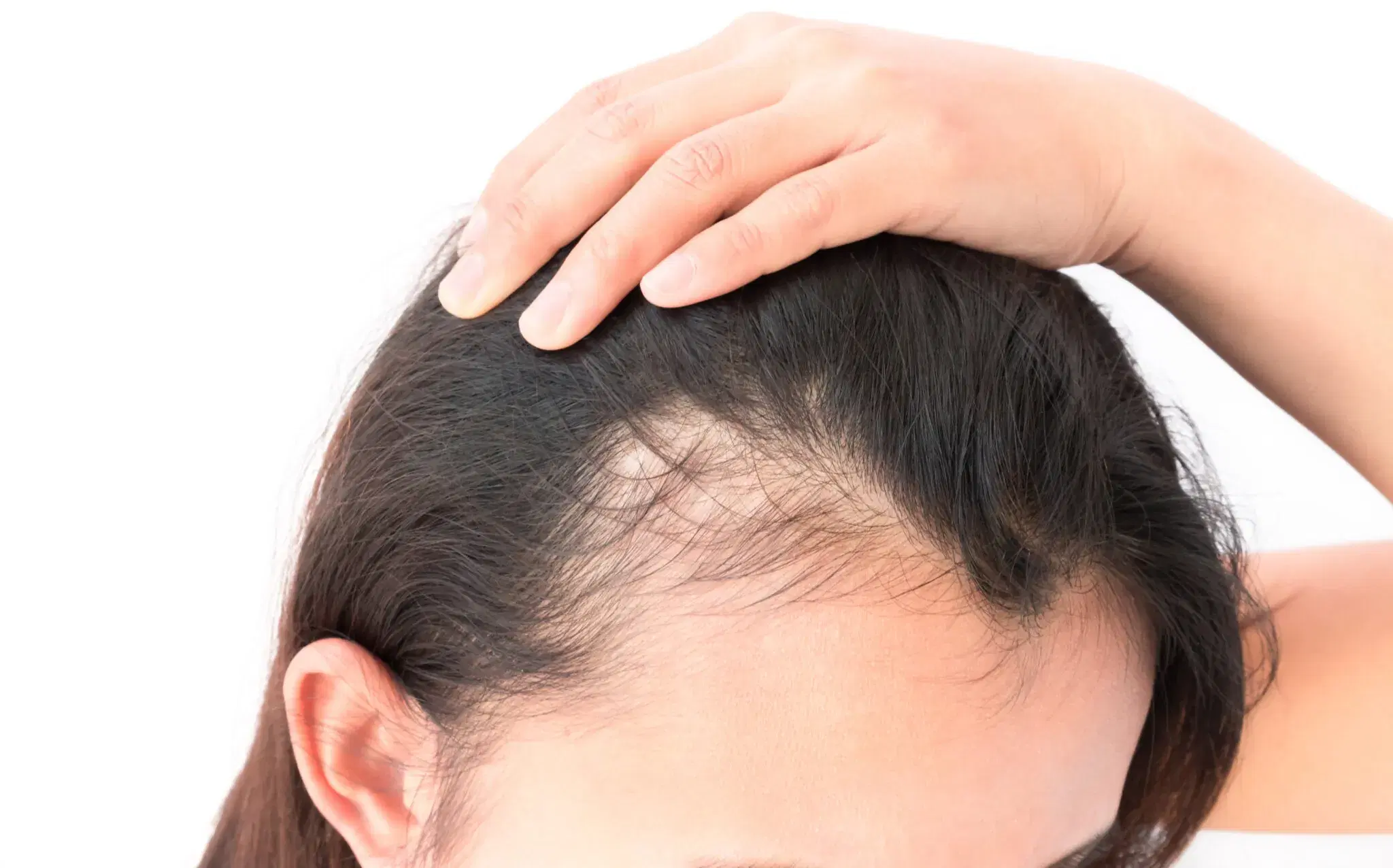
Post-birth-control telogen effluvium usually creates widespread shedding across the scalp rather than one sharply defined bald area. Hair may appear less full even though the scalp still contains actively growing follicles.
Common features can include:
More hair collecting in the shower
Increased strands on a pillow or clothing
Larger amounts of hair coming out during brushing
Reduced ponytail volume
Diffuse thinning across the top and sides
Increased shedding without smooth bald patches
Short new hairs becoming visible as recovery begins
A distinctly patterned or patchy appearance deserves separate assessment because another form of hair loss may be present.
How Much Hair Shedding Is Normal After Coming Off Birth Control?
Normal daily shedding commonly involves roughly 50 to 100 hairs, while telogen effluvium can make the amount noticeably greater than a person normally experiences.
Counting every fallen strand usually creates more anxiety than useful information because washing frequency, hair length, and styling habits strongly affect what appears in the shower.
Changes from personal baseline are more informative. Someone who suddenly needs to clear large amounts of hair from a brush or notices a rapidly smaller ponytail has a meaningful change even without counting individual strands.
The scalp pattern and duration matter more than one unusually heavy wash day.
How Long Does Hair Loss After Stopping Birth Control Last?
Temporary telogen effluvium often sheds actively for several months before the cycle begins settling, although visible density can take longer to recover. Hair shedding from telogen effluvium frequently lasts around three to six months.
The recovery process feels slow because reducing shedding and restoring previous hair volume are separate events. New hairs first need to enter active growth and then gain enough length to contribute noticeable density.
If heavy shedding continues beyond the expected recovery period, another ongoing trigger may exist, or temporary shedding may have exposed underlying patterned hair loss.
Will Hair Grow Back After Stopping Birth Control?
Hair usually grows back when birth-control withdrawal has triggered uncomplicated telogen effluvium because this condition changes the hair cycle without permanently destroying the follicles.
New growth may begin before shedding has completely stopped, which can seem contradictory. Short hairs around the part or hairline can appear while longer resting hairs continue falling.
Restoring the previous visual density takes longer because scalp hair grows gradually. Someone with long hair may therefore continue feeling that overall volume remains reduced even after the biological shedding episode has already improved.
Persistent thinning should be reassessed rather than assumed to be ordinary recovery.
Can Stopping Birth Control Reveal Female Pattern Hair Loss?
Stopping birth control can sometimes make previously subtle female pattern hair loss more noticeable, especially when temporary shedding reduces density that had been masking gradual follicle miniaturization. Telogen effluvium itself can expose an underlying genetic tendency.
Pattern hair loss behaves differently from a single temporary shedding episode. The central part may progressively widen, top-of-scalp density can decline, and individual hairs may become finer over time.
Some hormonal contraceptives also reduce free androgen activity during use, so discontinuation may alter a hormonal environment that had been helping certain androgen-related symptoms.
Does the Type of Birth Control Affect Post-Pill Hair Shedding?
The hormonal composition of birth control can influence the environment around the hair follicle, but predicting exactly who will shed after stopping a specific contraceptive remains difficult.
Combined hormonal contraceptives can suppress ovarian androgen production and increase proteins that reduce circulating free androgens. Different contraceptive formulations also contain different progestins and hormone doses.
That does not mean one particular pill will universally protect hair while another will cause hair loss. Genetics, baseline androgen sensitivity, iron status, recent stressors, nutrition, and existing hair disorders can all influence what becomes noticeable after hormonal contraception changes.
Can Hair Loss Happen After Switching Birth Control Instead of Stopping It?
Hair shedding can occur after changing hormonal contraception because a significant hormonal transition may disturb the timing of the hair cycle even when contraception continues. Medication-related telogen shedding has been associated with starting, changing, and stopping hormonal treatments.
The delayed timing remains important. Hair that enters the resting phase after a contraceptive change can remain on the scalp for several weeks before shedding becomes obvious.
Someone who changes contraception repeatedly within a short period may therefore find the timeline difficult to interpret. Looking back several months rather than only several days can reveal more useful triggers.
Can Stopping Birth Control Make the Hairline Recede?
Stopping birth control more often causes diffuse shedding than an isolated receding hairline, so obvious recession deserves closer examination rather than being automatically attributed to contraception.
Temporary shedding can make the temples look thinner because naturally lower-density areas reveal scalp more easily when overall volume falls. This appearance can improve as the shedding resolves.
Progressive recession, widening around the temples, increasingly fine hairs, or continuing loss despite reduced shedding can point toward another process. Pattern hair loss, traction, inflammatory scalp disorders, or other causes may need consideration when thinning follows a clearly localized pattern.
What Else Can Cause Hair Loss After Stopping Birth Control?
Several other events can produce diffuse shedding during the same months that follow birth-control discontinuation, which makes the timeline especially important when identifying the most likely trigger.
Other possibilities include:
Iron deficiency
Thyroid dysfunction
Rapid weight loss
Significant calorie restriction
Low protein intake
Recent fever or illness
Surgery
Major psychological stress
New medications or medication changes
Female pattern hair loss
Scalp inflammation
Pregnancy-related hormonal changes
More than one trigger can occur together, so finding a recent contraceptive change does not necessarily end the investigation when the shedding appears unusually severe or persistent.
Does Iron Deficiency Make Post-Birth-Control Hair Loss Worse?
Iron deficiency can contribute to diffuse hair shedding independently of birth-control withdrawal, which means both issues may occur during the same period. Correcting an identified iron abnormality forms part of evaluating telogen effluvium.
This becomes especially relevant when stopping contraception leads to heavier menstrual bleeding than someone experienced while using hormonal birth control.
Taking iron without confirming a need is not the best approach, because supplementation should match actual dietary and laboratory findings.
When diffuse shedding persists, a medical assessment can determine whether blood tests for iron status, thyroid function, or other relevant factors make sense.
Can PCOS Become More Noticeable After Stopping Birth Control?
PCOS-related features can become more noticeable after stopping hormonal contraception when treatment had previously suppressed androgen-related symptoms such as acne or excess facial hair.
Combined oral contraception can lower free androgen activity, so discontinuation removes that effect.
Hair thinning alone cannot diagnose PCOS. However, scalp hair changes accompanied by irregular periods, increased facial or body hair, persistent acne, or other signs of androgen excess justify further assessment.
In that situation, assuming every lost hair represents temporary post-pill shedding could delay recognition of a hormonal condition that requires a broader evaluation.
Should You Restart Birth Control Because of Hair Loss?
Restarting birth control solely because shedding appeared after stopping it should not be treated as the automatic solution, because the correct decision depends on contraceptive needs and the actual cause of hair loss.
If the shedding represents temporary telogen effluvium, follicles can recover without recreating the previous hormonal state. Restarting medication may also introduce another hormonal transition.
Birth control decisions involve pregnancy prevention, menstrual symptoms, medical history, side effects, and individual risk factors beyond hair.
Someone considering restarting or changing contraception should discuss those factors with an appropriate healthcare professional rather than adjusting hormonal medication exclusively in response to shedding.
Does Minoxidil Help Hair Loss After Stopping Birth Control?
Minoxidil can support hair growth in some types of hair loss, but uncomplicated acute telogen effluvium often improves once the trigger has passed and does not automatically require long-term medication.
The situation changes when evaluation reveals female pattern hair loss alongside temporary shedding. In that setting, treatment may target the underlying miniaturization rather than simply waiting for the temporary episode to resolve.
Minoxidil can also produce an early increase in shedding when follicles shift into a new growth cycle, which may make an already stressful period harder to interpret.
Treatment choice should therefore follow the diagnosis instead of assuming every post-pill shedding episode needs the same medication.
Which Hair-Care Habits Help During Temporary Shedding?
Gentle hair care cannot instantly stop telogen effluvium, but it can reduce unnecessary breakage and make the recovery period easier while the hair cycle gradually stabilizes.
Helpful habits include:
Wash the scalp according to actual oil and hygiene needs
Detangle without aggressive pulling
Reduce repeated high-tension hairstyles
Avoid excessive heat on already fragile lengths
Use conditioner to lower friction
Maintain adequate dietary protein
Avoid severe calorie restriction
Correct confirmed nutritional deficiencies
Treat persistent dandruff or scalp inflammation
Judge progress monthly rather than checking density every day
Normal washing does not create telogen effluvium; it mainly releases hairs that were already ready to shed.
When Should Hair Loss After Stopping Birth Control Be Checked?
Hair loss deserves medical evaluation when the pattern, duration, or associated symptoms do not fit a straightforward temporary shedding episode.
Assessment becomes particularly useful when:
Shedding remains heavy for many months
The central part keeps widening
Temples progressively recede
Smooth bald patches develop
The scalp becomes painful, red, or heavily scaly
Eyebrow or body hair also disappears
Menstrual cycles become markedly irregular
New facial hair or severe acne appears
Significant fatigue or other systemic symptoms develop
Density continues worsening despite reduced shedding
Early evaluation can distinguish temporary shedding from pattern hair loss, hormonal disorders, deficiencies, or inflammatory scalp conditions.
How Can You Tell Whether Your Hair Is Recovering?
Recovery usually becomes noticeable when daily shedding gradually decreases and short new hairs begin appearing throughout previously thinned areas. The improvement often looks subtle from week to week.
Monthly photographs taken with the same lighting, hairstyle, part placement, and camera distance provide a better comparison than daily mirror checking.
New growth initially contributes very little visual volume because the hairs are short. Over subsequent months, those strands lengthen and begin filling the overall hairstyle.
A stable part, improving ponytail thickness, and reduced shedding together provide stronger evidence of recovery than the presence of a few short hairs alone.
What Is the Most Important Thing to Know About Post-Birth-Control Hair Loss?
The most important point is that shedding after stopping birth control is often a delayed hair-cycle response rather than evidence that the follicles have suddenly died. Discontinuing contraceptive pills is a recognized trigger for telogen effluvium.
The delay between stopping contraception and seeing hair fall can make the connection easy to miss, while the volume of shedding can make a temporary process feel permanent.
Recovery still deserves observation rather than assumption. When density keeps declining, the part progressively widens, or shedding continues well beyond the expected period, another cause may be contributing and should be evaluated.