
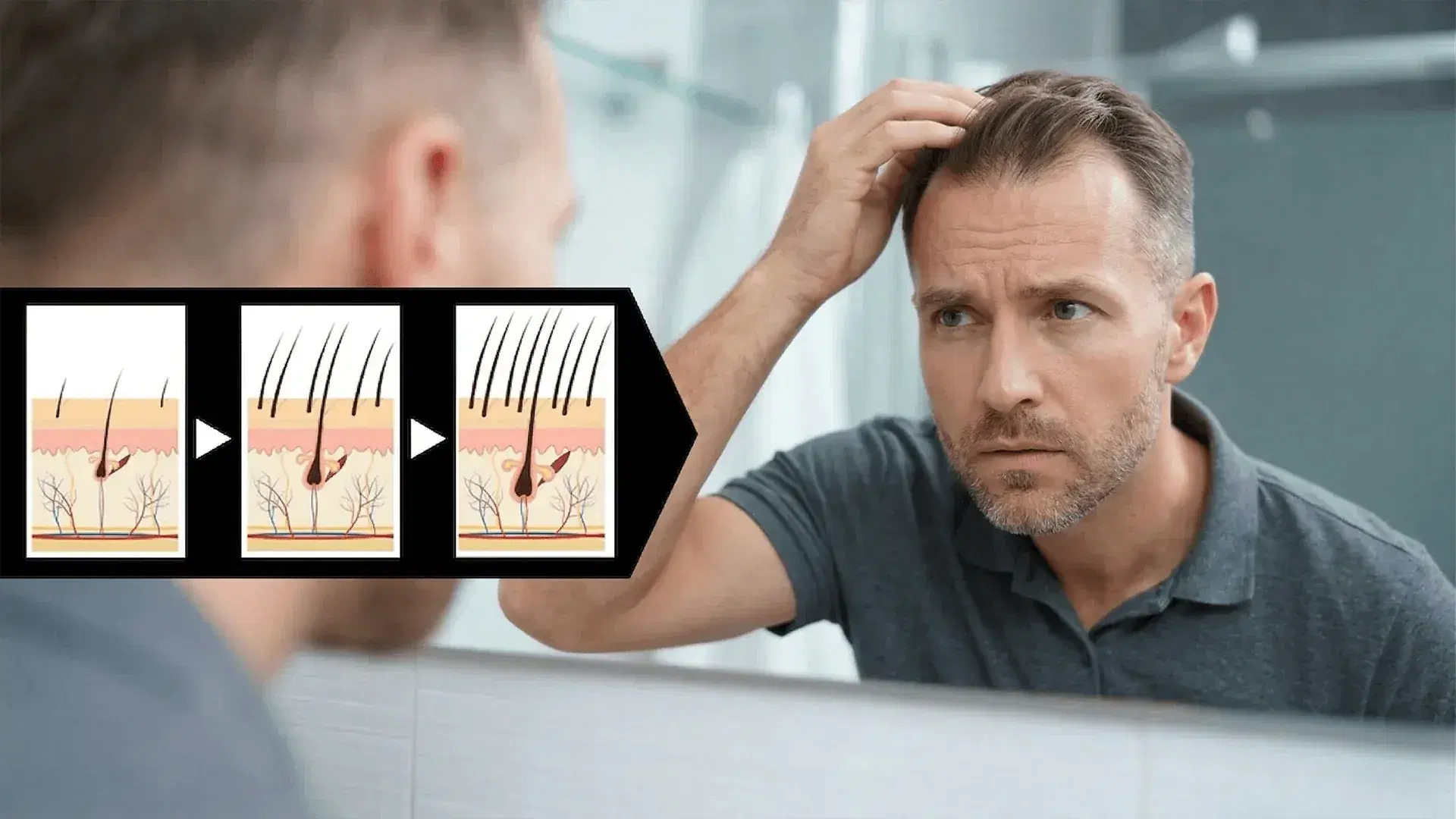
Hair miniaturization is the gradual process in which a hair follicle begins producing finer, shorter and less pigmented hairs instead of a normal thick terminal hair. It is one of the central biological changes behind androgenetic alopecia, commonly called male or female pattern hair loss. Miniaturization usually develops slowly, which means the first sign may not be obvious baldness but reduced volume, greater scalp visibility or a hairline that looks softer and less dense. Recognizing the process early matters because a miniaturizing follicle is not necessarily a dead follicle, and some treatments may help preserve or improve affected hairs.
What Is Hair Miniaturization?
Hair miniaturization is a progressive reduction in the size and quality of hair produced by a follicle. A follicle that once generated a thick terminal strand may gradually produce a thinner, shorter and less visible hair.
This process is especially characteristic of androgenetic alopecia. As miniaturization progresses, individual hairs contribute less coverage even before the area becomes obviously bald.
The change does not usually happen all at once. Different follicles progress at different speeds, which is why early thinning can look uneven or subtle.
Miniaturization is therefore better understood as a gradual change in follicle performance rather than sudden destruction of the follicle.
What Happens to a Hair Follicle During Miniaturization?
A miniaturizing follicle produces progressively smaller hair shafts and usually spends less time in the active growth phase. Healthy terminal hairs can grow for years, but affected follicles may enter shorter growth cycles.
As the anagen phase becomes shorter, the resulting hairs do not have enough time to reach the same length or diameter as before. They may also lose pigment and begin to resemble vellus-like hairs.
The follicle itself becomes smaller over successive cycles. This creates a characteristic mixture of thick terminal hairs and much finer hairs in the same region.
That variation in shaft diameter is an important clue when specialists examine suspected pattern hair loss.
What Causes Hair Miniaturization?
Hair miniaturization most commonly develops because genetically susceptible follicles respond to androgen-related signalling, but several conditions can affect hair calibre.
Common causes and contributing factors include:
Androgenetic alopecia
Genetic sensitivity to androgens
Dihydrotestosterone activity in susceptible follicles
Female pattern hair loss
Age-related changes in hair calibre
Chronic traction in repeatedly stressed areas
Some inflammatory scalp disorders
Scarring alopecias that damage follicular structures
Long-standing disease affecting follicle function
Hormonal conditions that worsen an existing pattern of hair loss
Not every thin hair represents true progressive miniaturization. Fine natural hair, breakage and temporary shedding can sometimes create a similar appearance.
Is Hair Miniaturization the Same as Hair Loss?
Hair miniaturization is related to hair loss but is not exactly the same process. A person can have many hairs still present while experiencing substantial loss of visible density because those hairs have become much finer.
This explains why early androgenetic alopecia can make the scalp appear more visible even before there is obvious bald skin.
Shedding refers to hairs leaving the follicle, while miniaturization describes the follicle producing progressively smaller hairs over repeated cycles. Both can occur at the same time.
Someone with pattern hair loss may therefore notice increased shedding, reduced strand thickness or simply less overall volume.
What Does Miniaturized Hair Look Like?
Miniaturized hair usually looks noticeably finer, shorter and sometimes lighter than neighbouring healthy terminal hair. Affected areas often contain a mixture of different shaft diameters instead of strands that are relatively uniform.
At the hairline, miniaturized hairs can look like short wispy strands that never seem to gain the thickness of surrounding hair. In the crown, they may create a see-through effect under overhead lighting.
The hairs are not necessarily broken. Many remain attached to functioning follicles but grow with reduced calibre.
A single fine hair does not prove miniaturization. The pattern becomes more meaningful when many progressively thinner hairs appear in an androgen-sensitive region.
How Can You Tell If Your Hair Is Miniaturizing?
Hair miniaturization is more likely when thinning develops gradually and the affected area contains a growing mixture of thick and very fine hairs.
Useful signs include:
Increasing scalp visibility under consistent lighting
A softer or less defined frontal hairline
Fine short hairs replacing thicker terminal hairs
Progressive thinning at the temples
Reduced density at the crown
A widening central part in women
Noticeable variation in hair-shaft thickness
Hair that reaches a shorter maximum length than before
Gradual reduction in ponytail thickness
Similar pattern hair loss in close relatives
Changes that progress over months or years rather than days
Photographs taken under the same lighting and hairstyle can help reveal progression that is difficult to notice from day to day.
Where Does Hair Miniaturization Usually Begin?
In men with androgenetic alopecia, miniaturization commonly begins around the temples, frontal hairline or crown. The sides and back usually remain more resistant, although individual patterns vary.
The earliest change may be a reduction in hair calibre rather than clear recession. The border of the hairline can start to contain progressively finer hairs before the overall position changes noticeably.
In women, miniaturization more often affects the central and upper scalp while the frontal hairline can remain relatively preserved.
The distribution matters diagnostically. Diffuse thinning across the entire scalp may suggest another process, although pattern hair loss can sometimes coexist with diffuse shedding.
Does DHT Cause Hair Miniaturization?
Dihydrotestosterone contributes to follicular miniaturization in people whose hair follicles are genetically susceptible to androgenetic alopecia. DHT binds to androgen receptors and influences signalling within these follicles over repeated growth cycles.
The important point is susceptibility. DHT is present in many people who never develop significant pattern baldness because their follicles do not respond in the same way.
In affected follicles, progressive exposure can shorten the growth phase and reduce hair diameter.
This biological relationship explains why androgen-modifying treatments can slow pattern hair loss in appropriate patients. It does not mean every form of thinning is caused by DHT.
Can Women Develop Hair Miniaturization?
Women can develop significant hair miniaturization, particularly with female pattern hair loss. The pattern often differs from classic male-pattern recession and may appear as widening through the central part or reduced density across the top of the scalp.
Hormonal factors can influence the process, but women do not need to have abnormally high androgen levels to develop pattern hair loss. Follicular sensitivity can matter even when hormone testing is normal.
Menopause, genetic predisposition and age can make thinning more noticeable.
Women with rapid progression, irregular periods, acne or increased facial hair may need additional medical evaluation because these features can suggest an underlying androgen-related condition.
Can Stress Cause Hair Miniaturization?
Stress more commonly causes increased shedding than true follicular miniaturization. Significant physical or psychological stress can trigger telogen effluvium, which shifts more hairs into the resting phase and produces diffuse shedding several weeks or months later.
Telogen effluvium usually does not create the classic progressive diameter variation of androgenetic alopecia.
However, increased shedding can expose a pre-existing pattern of miniaturization that was previously difficult to see. Someone may therefore first notice temple or crown thinning after a stressful period.
Stress can also coexist with pattern hair loss.
A sudden increase in full-length hairs falling from the scalp should not automatically be interpreted as follicles rapidly miniaturizing.
Can Nutritional Deficiencies Miniaturize Hair Follicles?
Nutritional deficiencies can affect hair growth and contribute to diffuse thinning, but they do not typically reproduce the classic androgen-driven miniaturization pattern by themselves. Iron deficiency, inadequate protein intake and some other deficiencies can interfere with normal hair cycling.
The resulting problem is often increased shedding or reduced hair quality rather than selective temple or crown miniaturization.
A restrictive diet, major weight loss or prolonged illness can therefore make existing pattern hair loss appear worse.
Laboratory testing is most useful when history or symptoms suggest a deficiency. Taking supplements without evidence of deficiency is not guaranteed to increase hair density and can sometimes create unnecessary risks.
Is Hair Miniaturization Reversible?
Hair miniaturization can sometimes improve, particularly when treatment begins before follicles become severely miniaturized. The degree of recovery varies considerably between individuals.
A follicle producing a thin hair can still be biologically active. Treatments that improve the growth phase or reduce the process driving androgenetic alopecia may allow some hairs to become thicker.
Advanced miniaturization is generally harder to reverse. Very small follicles that have been producing extremely fine hairs for a long period may respond less strongly.
For this reason, treatment often focuses as much on preserving existing follicles as on attempting to restore previously lost density.
Can Minoxidil Help Miniaturized Hair?
Minoxidil can help some miniaturized follicles produce thicker or longer-growing hairs by supporting the active growth phase. It is widely used for male and female pattern hair loss.
Response varies. Some patients experience meaningful improvement in density, while others mainly achieve stabilization or modest thickening.
An early increase in shedding can occur after starting treatment as hair cycles shift. This does not automatically mean the condition is worsening.
Continued use is generally necessary to maintain benefits from minoxidil. If treatment is discontinued, hair supported by the medication can gradually return toward the pattern expected without therapy.
Suitability and formulation should be discussed with a clinician when medical conditions or scalp sensitivity are relevant.
Can Finasteride Stop Hair Miniaturization?
Finasteride can slow androgen-related miniaturization in appropriate men by reducing conversion of testosterone to DHT. Its main value is often stabilization of androgenetic alopecia, although some users also experience visible thickening.
Results are not immediate because follicle changes occur over multiple hair cycles. Several months are usually needed before progress can be assessed meaningfully.
Finasteride is a prescription medication and is not suitable for everyone. Potential adverse effects and reproductive considerations should be discussed with a qualified clinician.
It should also not be used as a general treatment for every form of hair thinning. If the underlying problem is inflammatory, nutritional or scarring, reducing DHT does not address the primary cause.
How Long Does It Take for Miniaturization to Improve?
Improvement in miniaturized hair usually requires months because hair follicles operate through slow biological cycles. Even when treatment is effective, a follicle must transition into a healthier growth phase and produce a new strand before visible change appears.
Early treatment assessment often focuses on stabilization rather than immediate regrowth. Reduced progression can itself be a meaningful result.
Visible thickening may become easier to assess after several months, while a clearer judgment often requires six to twelve months depending on the treatment and severity.
Photographs taken under standardized lighting are more reliable than daily mirror checks.
Hair density can fluctuate temporarily, making very short-term comparisons misleading.
Can Miniaturized Hair Become Terminal Hair Again?
Some miniaturized hairs can become thicker and more terminal-like when the follicle still retains enough function and responds to treatment. The possibility is generally better in earlier stages.
Recovery is not all-or-nothing. A hair may improve in diameter without completely returning to its previous thickness.
Different follicles in the same region can also respond differently, which is why an area may become visibly denser without every affected follicle fully recovering.
Very advanced miniaturization is less predictable.
The presence of tiny hairs should therefore not be interpreted as either guaranteed recovery or certain permanent loss. The condition of the follicle and the cause of miniaturization both matter.
What Is the Difference Between Miniaturization and Breakage?
Miniaturization begins inside the follicle, while breakage damages the hair shaft after it has already emerged from the scalp. They can look similar because both may create short, fine-looking hairs.
Broken hairs often have irregular lengths, frayed ends or signs of chemical and mechanical damage. Bleaching, excessive heat, tight styling and friction can increase breakage.
Miniaturized hairs, by contrast, are naturally produced with a smaller diameter by the follicle. They often appear in a recognizable pattern associated with thinning.
Looking only at hair length is therefore not enough.
A scalp examination can help distinguish follicles producing fine hairs from healthy follicles whose strands are simply snapping above the skin.
Can Hair Miniaturization Be Seen With a Trichoscope?
Hair miniaturization can often be identified more clearly with trichoscopy, which uses magnification to examine the scalp and hair shafts. One important finding is increased variability in hair diameter within the same region.
The examination may also show a mixture of terminal and finer hairs, changes in follicular units and other features associated with particular hair-loss conditions.
Trichoscopy is useful because early pattern hair loss may be difficult to judge with the naked eye.
It can also help specialists distinguish androgenetic alopecia from several other causes of thinning.
The findings still need to be interpreted in context because no single visual feature should replace a complete medical history and scalp examination.
Does Miniaturization Mean the Follicle Is Dying?
Miniaturization does not automatically mean that the follicle is dead. A miniaturized follicle may continue producing hair for many cycles, although the strand becomes progressively less cosmetically significant.
This distinction is important because a functioning miniaturized follicle may still respond to treatment.
True permanent follicular destruction is more characteristic of scarring alopecias, deep trauma, burns or other processes that replace follicular structures with scar tissue.
Areas that become smooth and shiny with loss of visible follicular openings require a different level of concern.
Pattern miniaturization and follicular destruction are therefore not interchangeable concepts, even though both can eventually create visible scalp exposure.
Can Hair Transplantation Fix Miniaturized Areas?
Hair transplantation can improve selected areas affected by stable pattern hair loss, but miniaturizing native hair must be considered carefully during planning. Transplanted follicles are usually taken from more resistant donor regions and moved into thinning areas.
The challenge is that native hairs surrounding the transplant can continue to miniaturize after surgery.
A densely transplanted hairline placed in front of actively progressing loss may therefore look unnatural later if the untreated hair behind it becomes thinner.
Donor supply is also finite. Surgery should be planned around likely future progression rather than only today's visible gap.
Medical stabilization may be discussed before or after transplantation when appropriate for the individual patient.
How Can You Protect Miniaturizing Hair?
Protecting miniaturizing hair begins with identifying the cause and reducing avoidable damage while appropriate treatment is considered.
Practical steps include:
Obtain a proper diagnosis before starting multiple treatments
Monitor progression with standardized photographs
Treat androgenetic alopecia early when medically appropriate
Avoid repeatedly pulling tight hairstyles
Reduce unnecessary bleaching and excessive heat
Maintain adequate protein and overall nutrition
Investigate iron deficiency when clinically indicated
Treat persistent scalp inflammation
Avoid aggressively scratching irritated areas
Use medications consistently when prescribed
Review treatment response over months rather than days
Seek reassessment if thinning becomes rapidly progressive
Do not assume every fine hair means permanent follicle death
Hair care alone cannot reverse genetically driven miniaturization, but unnecessary shaft damage can make already thin areas look considerably worse.
When Should Hair Miniaturization Be Assessed by a Dermatologist?
Hair miniaturization should be medically assessed when thinning is progressive, the diagnosis is uncertain or scalp symptoms accompany the change. Early evaluation is particularly useful when hair density is decreasing even though obvious bald areas have not yet developed.
A dermatologist can examine the distribution of thinning, compare shaft diameters and look for signs that suggest androgenetic alopecia, alopecia areata, inflammatory disease or scarring hair loss.
Rapid loss, clearly defined bald patches, scalp pain, burning, pustules, heavy scaling or smooth shiny areas deserve prompt assessment.
Gradual miniaturization is often manageable, but treatment works best when it targets the correct cause. The most important distinction is whether follicles are simply producing progressively finer hairs or whether another disease process is actively damaging them.