
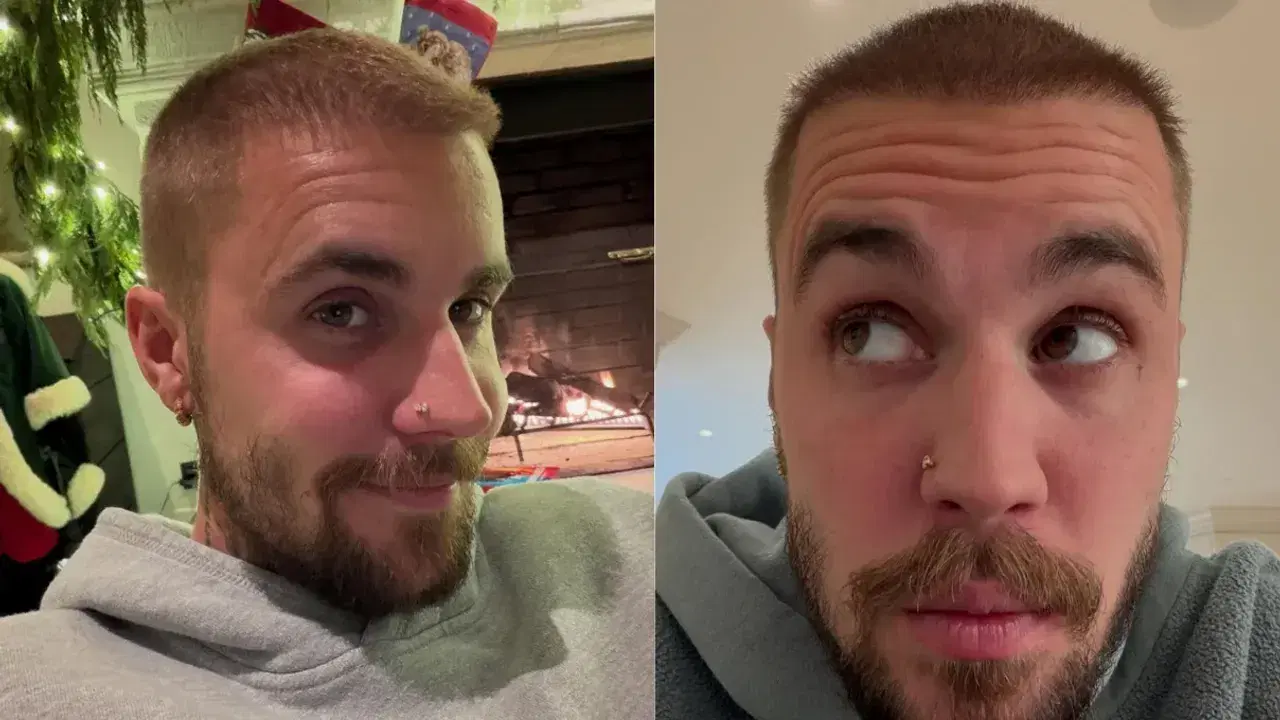
Justin Bieber’s hair has been part of his public image since the beginning of his career. His long, side-swept fringe became instantly recognisable during his teenage years, while later appearances included bleached styles, buzz cuts, longer hair and closely cropped looks. These changes have naturally led to close public attention whenever his hairline has appeared different.
In recent years, online discussions have suggested that Justin Bieber may have undergone a hair transplant. Some observers point to changes around his temples or the apparent density of his frontal hairline. Others believe that styling, hair length, lighting and natural maturation provide a more likely explanation.
The most important fact is that Justin Bieber has not publicly confirmed having a hair transplant. There is no verified statement from him, his representatives, a surgeon or a clinic establishing that such a procedure took place. Claims based only on photographs should therefore be treated as speculation rather than medical fact.
Did Justin Bieber Have a Hair Transplant?
It is not possible to give a definite yes or no based on publicly available photographs. A hair transplant cannot be diagnosed simply by comparing two images taken several years apart.
Photographs may make the hairline appear lower, straighter or denser for many reasons. The angle of the head, camera lens, flash, styling products and direction of the hair can all alter what you see. Wet or separated hair may expose more scalp, while a forward-styled cut can hide the corners of the hairline almost completely.
Hair fibres, concealers and professional styling can also create the impression of increased density. Conversely, harsh lighting can make healthy hair look unusually thin.
A genuine assessment would require close examination of the scalp. A specialist would look for follicular miniaturisation, donor-area changes, extraction marks and differences in hair direction. None of these can be evaluated reliably through ordinary celebrity photographs.
For that reason, it is more accurate to describe the Justin Bieber hair transplant story as an unconfirmed rumour.
Why Has His Hairline Attracted Attention?
Justin Bieber became famous at a very young age. Millions of people remember his dense teenage fringe, so even normal adult changes can appear dramatic when compared with images from that period.
A mature male hairline often sits slightly higher than a teenage hairline. The corners may become more defined, producing a less rounded shape. This does not automatically mean that progressive baldness has begun.
The challenge is that early male pattern hair loss can also start at the temples. The frontal corners may gradually recede while the central hairline remains relatively stable. Later, thinning can develop at the crown or across the upper scalp. This pattern is influenced by genetics and the sensitivity of follicles to hormonal activity.
Without a scalp examination, you cannot reliably distinguish a mature hairline from early androgenetic alopecia in another person. You certainly cannot confirm surgery based on that appearance alone.
Could Hairstyles Explain the Difference?
Hairstyling can transform the apparent shape of a hairline.
Long hair falling forward covers the temples and creates a soft frame around the face. When the same hair is pushed backward, tied up or cut very short, the natural corners become more visible.
Bleaching may make the hair appear finer because light strands provide less contrast against the scalp. Darker hair usually creates stronger contrast and may look denser in photographs. Hair that has been washed, flattened or exposed to stage lighting can also reveal more scalp than dry, textured hair.
A buzz cut presents another visual challenge. Very short hair may expose the exact outline of the hairline, but it can also make density look more even because every strand has a similar length.
These factors mean that several different photographs are needed before even a cautious visual comparison can be made. A single image is rarely useful evidence.
What Might a Justin Bieber Hair Transplant Involve?
Any description of a possible Justin Bieber hair transplant technique is hypothetical. However, if a person with mild temple recession wanted restoration, the procedure might focus on the frontal corners rather than the entire scalp.
A surgeon could move follicular units from the back and sides of the head into carefully designed recipient sites around the hairline. The aim would be to soften the corners, create a balanced frame and preserve a natural adult shape.
The number of grafts would depend on the width of the recessed areas, desired density, hair thickness and donor supply. Quoting a precise graft number for a celebrity without examining the scalp is little more than guesswork.
A conservative plan would usually avoid creating an extremely low or perfectly straight hairline. A youthful hairline may look appealing initially, but it can become unnatural if the surrounding native hair continues to thin with age.
FUE and FUT Hair Transplant Techniques
Modern hair transplantation is commonly performed using follicular unit excision or follicular unit transplantation.
During FUE, individual follicular units are removed using small circular punches. These grafts are prepared and inserted into tiny recipient sites. The donor area heals with numerous small marks that may be difficult to notice when extraction is distributed carefully.
FUT involves removing a narrow strip of hair-bearing skin from the donor area. The strip is divided into individual grafts, and the incision is closed, leaving a linear scar.
Both approaches can produce natural growth when they are performed correctly. The main differences involve donor harvesting, scarring, recovery and management of the available follicles. Hair transplantation is a well-established method for relocating suitable follicular units into areas affected by permanent thinning.
The term DHI is also used frequently in marketing. It generally describes an implantation method involving a pen-shaped device rather than an entirely separate source of donor follicles.
What Makes a Celebrity Hairline Look Natural?
A natural hairline is not a perfectly straight row of equally spaced hairs. Real hairlines contain subtle irregularities, varied density and finer single-hair follicles at the leading edge.
The design should suit the forehead, facial proportions, age and predicted progression of hair loss. The hairs must also be placed at the correct angle. Frontal follicles normally emerge in a forward direction and lie relatively close to the scalp.
Using thick multi-hair grafts directly at the front may produce a plug-like appearance. These grafts are generally more useful behind the transition zone, where additional density is required.
Temple work is particularly delicate. The angle is flatter, the hairs are often finer and a small design error can change the entire appearance of the face.
A successful result should not immediately announce that surgery has taken place. It should look believable at different hair lengths and remain appropriate as the patient gets older.
Could Medication Explain Improved Density?
A fuller appearance does not necessarily mean that hair has been transplanted. Medical treatment can sometimes stabilise progressive thinning and improve the quality of miniaturising hairs.
Minoxidil may be used to support growth in suitable cases. Finasteride may be considered for certain adult men with androgenetic alopecia after a discussion of its potential benefits and adverse effects. Clinical studies have found that finasteride can slow progression and increase hair growth in men with pattern hair loss.
These treatments do not rebuild a completely absent hairline in the same way that transplantation can. However, they may make existing hair look thicker and reduce further loss.
A person may also combine medication with transplantation. The operation moves follicles, while medical treatment may help preserve the surrounding non-transplanted hair. This distinction is important because surgery does not stop the biological process affecting the rest of the scalp.
There is no verified public information showing whether Justin Bieber has used any hair-loss medication.
Can Stress or Illness Change Hair Density?
Temporary shedding can occur after illness, fever, major emotional strain, rapid weight loss, nutritional problems or changes in medication. This type of shedding often affects the scalp more diffusely than genetic hair loss.
The trigger may occur several weeks or months before the increased shedding becomes obvious. Hair may later recover once the underlying issue has resolved, although the process takes time.
Celebrity schedules can involve travel, irregular sleep, intense work and public pressure, but it would be inappropriate to assume that any of these factors caused hair loss in a particular person.
A photograph showing reduced density during one period does not prove permanent baldness. Temporary shedding, haircut changes and styling may all affect the appearance.
Why Celebrity Hair Transplant Claims Can Be Misleading
Celebrity hair stories attract attention because they offer dramatic before-and-after comparisons. The difficulty is that many comparisons use photographs taken under entirely different conditions.
One image may show wet hair under overhead lighting, while the other shows professionally styled hair in a studio. The head may be tilted differently, and the photographs may have been sharpened or edited.
Some articles also assign a specific graft number, technique, operation date and clinic without presenting any evidence. Repetition can make these details appear credible even when they began as speculation.
You should separate three different ideas:
A celebrity’s hairline appears different.
A specialist thinks a transplant is possible.
The celebrity has confirmed the procedure.
Only the third provides direct confirmation. In Justin Bieber’s case, that confirmation is not publicly available.
What Can You Learn From the Discussion?
The interest surrounding Justin Bieber’s hair demonstrates how difficult it is to judge hair loss from appearance alone. It also shows why a personalised diagnosis matters.
Your hairline should not be compared directly with a celebrity’s. Hair texture, colour, forehead shape, donor density and family history all influence what is possible.
A photograph can be useful for explaining the style you like, but it should not be treated as a surgical template. A low, dense celebrity hairline may be unsuitable if you have limited donor hair or advanced thinning.
Your surgeon should design a result that can be supported by your available follicles over the long term. Preserving donor reserves is particularly important because transplanted follicles cannot simply be replaced once they have been used.
Are You a Suitable Candidate for a Similar Hairline Procedure?
You may be considered for a hair transplant when your hair loss has been diagnosed, the donor region is sufficiently strong and your expectations are realistic.
The pattern should ideally be reasonably stable. Performing aggressive hairline restoration while thinning is rapidly progressing can leave transplanted hair isolated as the surrounding follicles disappear.
Your scalp should also be healthy. Active infection, severe inflammation or certain scarring hair-loss conditions may require treatment before surgery.
A responsible assessment includes:
Examination of the frontal hairline and crown
Measurement of donor density
Evaluation of hair thickness and texture
Review of family history
Discussion of previous treatments
Planning for future hair loss
Estimation of a realistic graft range
Modern reviews of transplant candidacy emphasise diagnosis, donor assessment and medical optimisation rather than treating every person who dislikes their hairline as an automatic surgical candidate.
How Long Does a Hair Transplant Result Take?
A hair transplant does not create an immediate finished result. During the first weeks, many transplanted hair shafts shed. The follicles remain beneath the skin and later begin producing new hairs.
Early growth may become noticeable after several months. Density and texture continue to develop gradually, and the frontal result can take close to a year to mature. Crown growth may appear slower.
Redness, swelling, crusting and temporary numbness can occur during early recovery. Small differences between the two sides are not unusual while the scalp heals.
The quality of the result depends on graft survival, hairline design, donor management and the future behaviour of the native hair. Surgery should therefore be viewed as long-term planning rather than a quick cosmetic fix.