
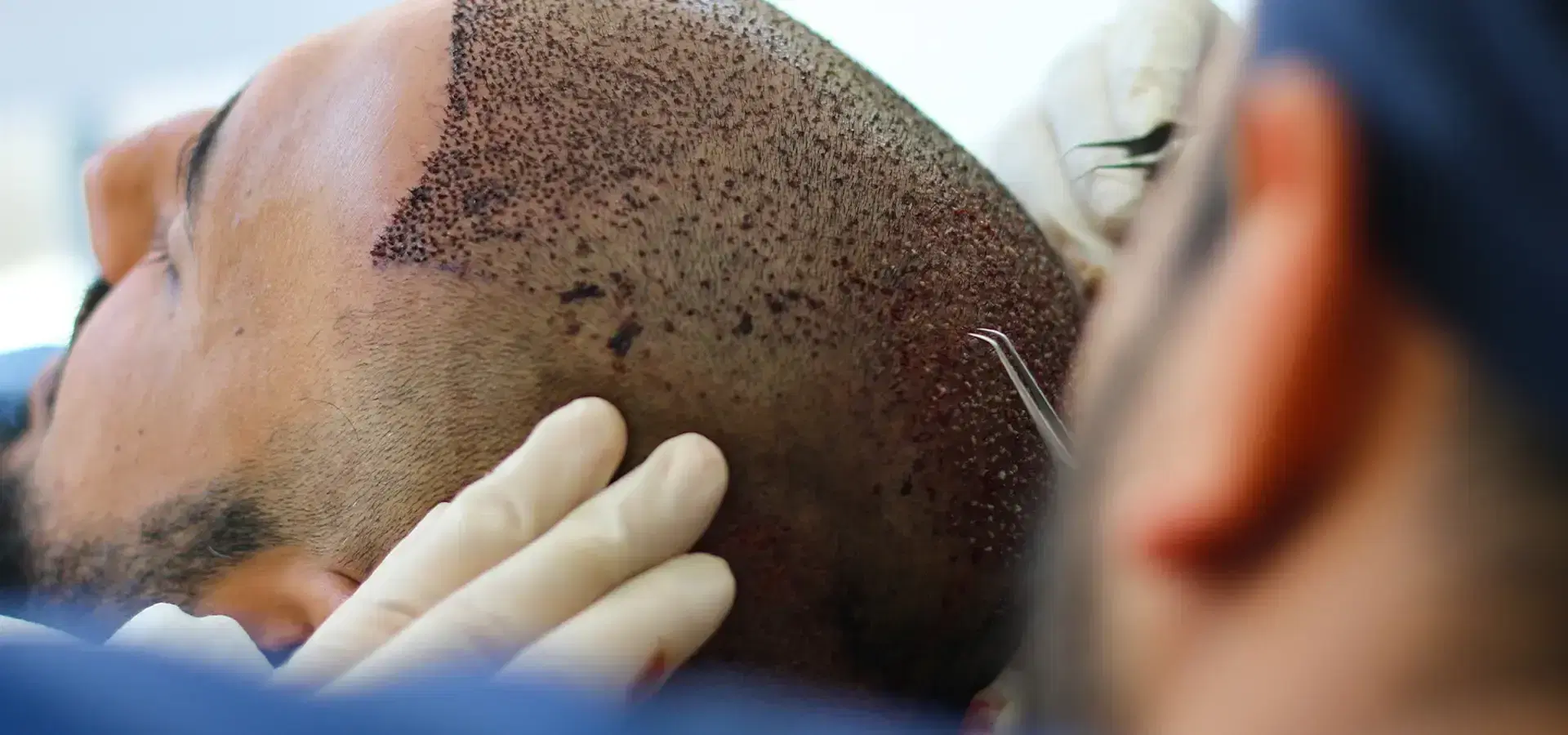
What Is the Difference Between Micro FUE and Regular FUE?
The main difference between Micro FUE and regular FUE is usually the advertised punch diameter rather than a fundamentally different hair transplant method.
Standard follicular unit excision already removes individual follicular units using small circular punches. Modern FUE punches generally range from approximately 0.7 to 1.2 millimetres. The term Micro FUE is commonly used when particularly small punches are emphasized during harvesting. However, it is not recognized as a separate standardized FUE technique within accepted professional terminology. Therefore, comparing both terms requires examining actual punch dimensions, extraction method, graft quality, and donor management rather than relying on the Micro FUE label alone.
What Is Micro FUE?
Micro FUE generally describes FUE hair transplantation performed with small punches designed to remove individual follicular units from the donor scalp.
The procedure still follows the standard principles of follicular unit excision. Individual grafts are isolated with a circular punch, removed from surrounding tissue, and later implanted into recipient areas. The word Micro usually emphasizes the small diameter of the extraction instrument. However, modern FUE already uses micro punches, so this label does not establish a separate surgical category. Professional terminology does not formally recognize Micro FUE as a distinct technique. The exact equipment and punch diameter therefore provide more useful information than the name itself.
What Is Regular FUE?
Regular FUE is a hair transplant harvesting method that removes natural follicular units individually using small circular punches rather than removing a strip of scalp.
Each follicular unit commonly contains between one and four hairs. During extraction, a punch enters the skin around the unit and separates it from surrounding tissue. The graft is then removed and preserved before implantation into the thinning area. Modern FUE can use manual, motorized, or robotic devices. Punches can also have sharp, dull, hybrid, serrated, or other specialized edges. Consequently, regular FUE is already a varied surgical method rather than one procedure performed with a single standardized instrument.
Is Micro FUE a Different Hair Transplant Technique?
Micro FUE is not formally recognized as a separate hair transplant technique and generally represents a marketing description for FUE performed with smaller extraction punches.
Accepted FUE terminology describes follicular unit excision according to harvesting technique, instrumentation, graft characteristics, and procedural steps. It does not establish Micro FUE as a separate category. Professional guidance specifically lists Micro FUE among promotional terms that are not formally recognized. This distinction matters because standard FUE already uses punches measured in fractions of a millimetre. A procedure described as Micro FUE may therefore be technically similar to another procedure simply described as FUE.
What Punch Size Is Used in Micro FUE and Regular FUE?
Modern FUE punches generally measure about 0.7 to 1.2 millimetres, while the Micro FUE label usually emphasizes instruments toward the smaller end of that range.
Published technical reviews describe approximately 0.9 to 1.0 millimetres as common punch sizes for scalp follicle harvesting. Smaller punches around 0.7 to 0.8 millimetres are also used in selected circumstances, including some body-hair procedures. However, punch selection cannot be based on size alone. The follicular unit must fit inside the instrument without excessive compression or transection. Hair calibre, follicle grouping, exit angle, curvature, and tissue characteristics all influence the appropriate diameter.
Does Micro FUE Cause Less Scarring Than Regular FUE?
Smaller FUE punches can create smaller individual extraction wounds, but Micro FUE does not guarantee less visible scarring than well-planned standard FUE.
Every FUE extraction removes tissue and normally leaves a small circular scar. Reducing punch diameter can decrease the volume of each scar, which may make individual extraction points less noticeable after healing. However, final donor appearance also depends on extraction density and distribution. Thousands of small punches concentrated within one area can still produce visible thinning and scarring. Larger punches may create greater scar volume, while excessively small instruments can create other technical problems. Scar quality therefore depends on overall harvesting strategy rather than punch diameter alone.
Does Micro FUE Heal Faster Than Regular FUE?
Micro FUE may create slightly smaller extraction wounds, but healing speed is not determined solely by using the smallest available punch.
FUE donor wounds are already small and generally heal without a linear incision. A reduced punch diameter can decrease the amount of tissue removed at each extraction site. This may support less visible wound size during early recovery. However, healing also depends on extraction depth, total graft numbers, spacing between wounds, scalp characteristics, and postoperative care. An extremely large session using small punches can still create substantial donor trauma. The practical difference in recovery can therefore be smaller than promotional descriptions sometimes imply.
Is Micro FUE Less Painful Than Regular FUE?
Micro FUE is not necessarily less painful than regular FUE because both approaches use similar local anesthesia and create numerous small donor extraction sites.
Patients usually experience minimal discomfort during harvesting once the donor scalp has been adequately anesthetized. Tenderness can develop afterward as the anesthetic effect decreases. Using smaller punches may reduce the dimensions of individual wounds, but total discomfort also depends on the number of extractions and treatment area. Thousands of closely spaced small wounds can still produce postoperative sensitivity. Since Micro FUE normally remains an FUE procedure rather than a distinct surgical method, pain differences cannot reliably be predicted from the label alone.
Does Micro FUE Produce Better Graft Survival?
Micro FUE does not automatically produce better graft survival because successful transplantation depends more strongly on obtaining intact follicles and handling them carefully.
A smaller extraction punch removes less surrounding tissue, but reducing diameter excessively can increase the possibility of cutting follicles during harvesting. Published technical evidence describes this trade-off clearly. Larger punches can reduce transection risk but remove more donor tissue, while smaller punches may produce thinner grafts and increase follicular injury. Graft survival also depends on extraction skill, hydration, storage conditions, implantation trauma, and recipient blood supply. Therefore, the smallest punch should not automatically be interpreted as the instrument producing the highest survival rate.
Can a Smaller FUE Punch Damage Hair Grafts?
An excessively small FUE punch can increase graft transection when the instrument does not provide enough space for the complete follicular unit.
Important punch-related considerations include:
Larger follicular units may contain several hairs.
Follicles can curve beneath the skin.
Thick hair may require additional internal punch space.
Very small punches can remove less protective tissue.
Reduced diameter can increase transection in unsuitable follicles.
Larger punches can increase donor scar volume.
Punch choice should match follicular anatomy rather than marketing terminology.
The objective is obtaining an intact follicular unit while minimizing unnecessary donor tissue removal.
Does Micro FUE Create More Natural Results?
Micro FUE does not automatically create more natural-looking hair because final appearance depends primarily on recipient design, graft selection, direction, angle, and distribution.
Punch diameter relates mainly to how follicles are harvested from the donor area. Natural appearance is created later through decisions about where those follicles are implanted. A realistic frontal hairline commonly requires careful placement of appropriate follicular units with suitable angles and irregularity. Density must also transition naturally into existing hair. A perfectly harvested graft can still look unnatural when implanted incorrectly. Therefore, using a smaller donor punch does not by itself make the final hairline softer, denser, or more aesthetically convincing.
Can Micro FUE Achieve Higher Hair Density?
Micro FUE does not inherently create higher recipient density because punch size mainly affects donor harvesting rather than the number of grafts safely placed into thinning areas.
Recipient density depends on available donor follicles, recipient scalp characteristics, existing hair, hair calibre, graft distribution, and the planned transplantation area. Smaller donor punches may help reduce extraction wound size, but they do not create additional follicular units. Attempting to harvest excessive graft numbers can instead deplete the donor region. FUE performed improperly can produce diffuse donor thinning and visible scarring. Consequently, a high-density result must balance recipient coverage against the finite amount of donor hair available for current and future restoration.
Which Technique Is Better for Donor Area Preservation?
Neither Micro FUE nor regular FUE preserves the donor area automatically because preservation depends mainly on punch selection, extraction spacing, graft numbers, and long-term donor planning.
Smaller punches remove less tissue from each extraction point and can reduce individual scar volume. However, concentrating too many extractions within one region can still create visible thinning. Every successfully harvested follicular unit is permanently removed from its donor location. Therefore, donor preservation requires controlled extraction across an adequately sized safe zone. The surgeon must balance graft quality against scar size instead of simply choosing the smallest possible punch. Proper distribution is ultimately more important than whether the procedure carries a Micro FUE label.
Is Micro FUE Better for Fine Hair?
Micro FUE can be suitable for fine hair because smaller follicular units may fit comfortably within reduced punch diameters, but fine hair does not automatically require Micro FUE.
Punch size should correspond to the dimensions and anatomy of each follicular unit. Fine single-hair units may allow a smaller instrument while still preserving adequate tissue around the follicle. Multi-hair grafts can require additional space even when individual shafts are fine. Using an unnecessarily narrow punch may increase transection or produce fragile grafts. Therefore, matching the instrument to follicular anatomy provides a more rational approach than assigning one punch diameter to every person with fine hair.
Is Micro FUE Suitable for Thick or Curly Hair?
Micro FUE can be used with thick or curly hair, but very small punches may not be appropriate when follicular units are broad or curved beneath the skin.
Visible hair direction does not always reveal the entire path of a follicle below the scalp. Curved follicles can diverge after entering the skin, increasing the risk of transection during punch advancement. Thick multi-hair units can also require more internal space than small instruments provide. Punch design, diameter, edge type, depth control, and extraction technique therefore become especially important. In these cases, a slightly larger suitable punch may protect graft integrity better than selecting the smallest available diameter.
What Are the Advantages and Limitations of Micro FUE?
Micro FUE can reduce individual wound size, but its advantages must be balanced against graft transection, instrument limitations, and the absence of standardized Micro FUE criteria.
The appeal of smaller punches comes from removing less skin around each follicular unit. This can reduce individual scar volume and support a less noticeable donor pattern. However, shrinking the punch does not improve every aspect of surgery. A diameter that is too narrow for the follicular anatomy can increase transection and produce thinner or damaged grafts. Micro FUE also has no universally accepted technical definition. Two procedures using the same label can therefore involve different punch sizes, devices, and harvesting approaches.
Which Is Better: Micro FUE or Regular FUE?
Neither Micro FUE nor regular FUE is inherently better because the most appropriate approach uses a punch that safely fits the follicles while preserving donor appearance.
Modern FUE already relies on small punches, commonly within a range of approximately 0.7 to 1.2 millimetres. Smaller instruments can reduce scar volume, yet going too small can increase transection or compromise graft quality. Larger punches can protect certain follicular units more effectively but remove additional donor tissue. The strongest comparison therefore focuses on actual punch diameter, extraction pattern, graft integrity, and donor management. Micro FUE should not be considered automatically superior simply because its name suggests a smaller or more advanced procedure.