
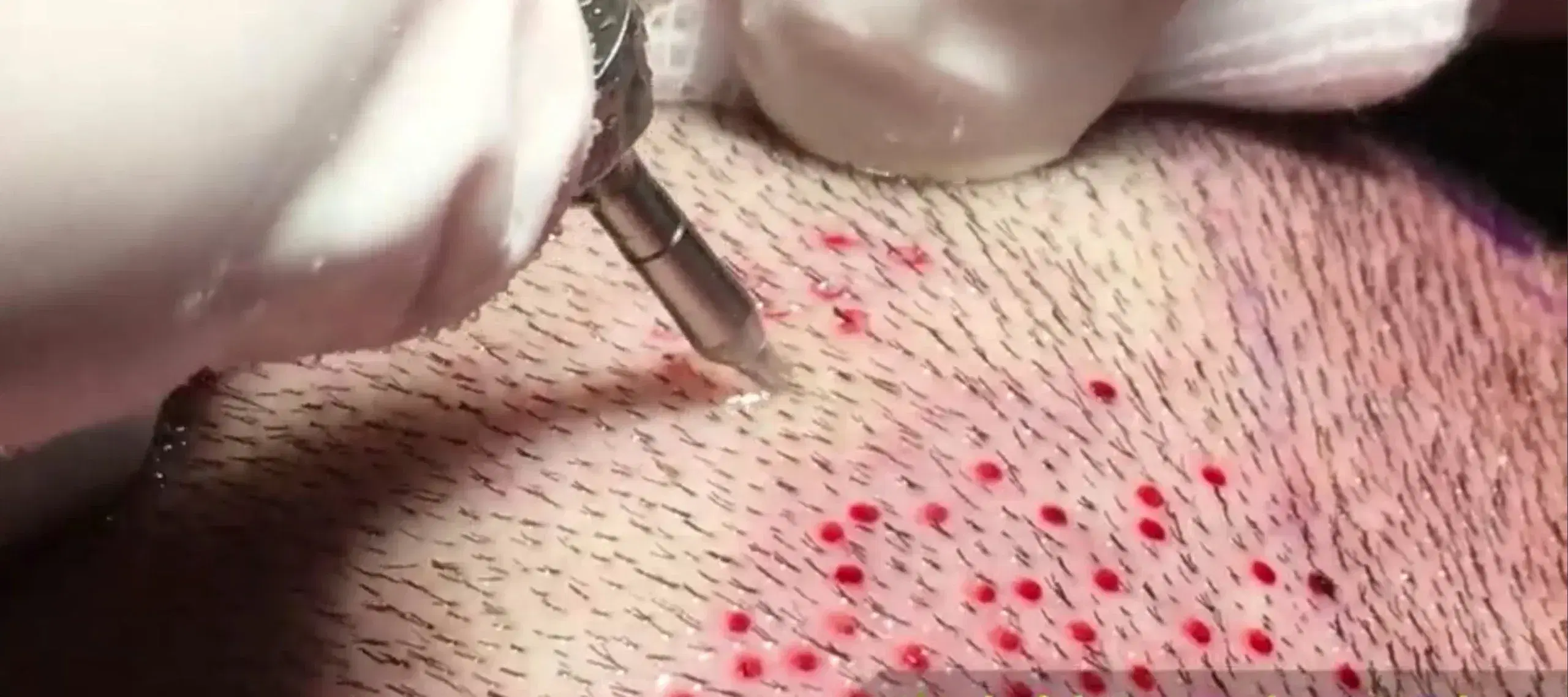
What Is a No-Shave FUE Hair Transplant?
No-shave FUE is a variation of follicular unit excision, or FUE, in which the patient avoids a complete visible head shave.
A follicular unit is a naturally occurring group that usually contains one or more hairs. Once removed for transplantation, the follicular unit is commonly called a graft. During FUE, individual units are isolated from the donor area with small punch instruments and moved to the recipient area.
The donor area is usually located at the back and sides of the scalp, where suitable follicles are selected for extraction. The recipient area is the thinning or bald region into which the grafts will be implanted.
Existing hair can be preserved in several ways:
A narrow donor section may be shortened and concealed beneath longer hair.
Only selected donor follicular units may be trimmed.
The punch may cut the visible shaft during direct extraction.
Long hair shafts may remain attached to the grafts.
The recipient area may remain fully or partly unshaven.
The International Society of Hair Restoration Surgery separates donor shaving, recipient shaving and graft-hair length because these are independent decisions. This is why clinics may use “no shave” to describe different procedures.
Does No-Shave FUE Require Any Hair to Be Cut?
No-shave FUE normally means that the patient does not undergo a complete visible head shave. It does not necessarily mean that no hair is shortened.
No-shave FUE usually means that the patient does not receive a complete visible head shave. It does not necessarily mean that every hair remains at its original length.
Possible approaches include:
Term | What may be trimmed? | What may remain long? |
|---|---|---|
Full-head shaved FUE | Most or all donor and recipient hair | Little or none |
Donor-only trimming | Donor hair | Recipient hair |
Hidden-strip trimming | One or more concealed donor sections | Hair above the trimmed section and often the recipient hair |
Pretrimmed nonshaven FUE | Individually selected donor hairs | Surrounding donor hair |
Direct nonshaven FUE | Target hairs are not shortened beforehand, but the punch may cut the shafts | Surrounding donor hair |
Long-hair FUE | Ideally, selected shafts remain attached at length | Donor and potentially recipient hair |
ISHRS terminology guidance recognises fully shaved, partly shaved and unshaven donor preparation. It also explains that unshaven FUE may produce either short-hair or long-hair grafts depending on how each follicular unit is excised.
Ask the clinic to explain exactly which areas will be shortened and what the grafts will look like after extraction.
Types of No-Shave FUE
Partial-Shave FUE
What is trimmed: A limited donor section or several narrow sections.
What remains long: Hair above and around the trimmed zone, which may cover it when released.
Visibility: The donor preparation may be difficult to see when the surrounding hair is sufficiently long and dense.
Main advantage: It can provide clearer access than a fully unshaven procedure while preserving the overall hairstyle.
Main limitation: Short or thin surrounding hair may not conceal the donor section. The size of the shaved area also depends on the number of follicular units required.
The precise trimming pattern must be confirmed before treatment.
Donor-Only Shave FUE
What is trimmed: The donor area.
What remains long: Hair in the recipient area.
Visibility: The donor region may be clearly visible until the surrounding hair provides sufficient coverage.
Main advantage: The medical team gains easier access to donor follicles while preserving existing recipient-area hair.
Main limitation: Long native hair in the recipient area may make site creation, implantation and postoperative cleaning more technically demanding. ISHRS guidance notes that recipient-area hair can obstruct incision making and placement.
Pretrimmed Nonshaven FUE
What is trimmed: Selected follicular units are shortened individually before extraction.
What remains long: Neighbouring donor hair.
Visibility: The shortened hairs may remain concealed among longer surrounding hair.
Main advantage: The chosen follicles can be identified before punching while the patient avoids a broad shaved donor area.
Main limitation: Individual pretrimming adds another detailed step. A comparative study found that pretrimmed punching took longer than the direct method in the studied procedures, although total operating time depends on many additional factors.
The technique should not be described as long-hair FUE because the extracted shafts are shortened.
Direct Nonshaven FUE
What is trimmed: Target hairs are not cut before extraction. During punching, the visible shaft may be intentionally shortened.
What remains long: Surrounding donor hair.
Visibility: The donor area can retain its general appearance because neighbouring hairs remain unshaven.
Main advantage: It avoids separately pretrimming each target hair.
Main limitation: The extracted graft normally contains a short visible shaft rather than a long one. In one comparative study, direct nonshaven grafts had shorter shafts than pretrimmed grafts. The results of that study should not be converted into a universal performance claim.
Long-Hair FUE
What is trimmed: The aim is to avoid cutting the selected hair shafts, although shaft breakage may still occur during extraction.
What remains long: Selected hairs remain attached to harvested follicular units, while surrounding donor hair also stays long.
Visibility: Long donor and recipient hair may help conceal treatment signs.
Main advantage: Preserved shafts can assist with visualising hair curl, direction and the immediate distribution of implanted hairs.
Main limitation: Long-hair extraction is technically demanding. Existing hairs can obstruct access and become tangled, and the punch must follow the follicle without damaging it. ISHRS guidance notes a potential risk of increased follicle transection when long-hair unshaven FUE is not performed accurately.
Published long-hair FUE reports involve selected patient groups and specialist techniques. They do not prove that the approach suits every hair-loss pattern or clinical team.
How Is No-Shave FUE Performed?
The sequence varies according to the selected nonshaven method, implantation approach and clinical plan. The fundamental stages usually include the following.
1. Medical and hair-loss assessment
The clinician evaluates the cause and pattern of hair loss, medical history, scalp condition, likely future progression and realistic goals.
Hair transplantation should not proceed solely because a patient wants to avoid shaving. Diagnosis and long-term planning remain more important than the shaving preference.
2. Donor-area evaluation
The assessment considers:
Follicular-unit density.
Hair calibre.
Miniaturisation.
Hair direction and curl.
Previous extraction.
Scarring.
Safe donor boundaries.
Expected future donor requirements.
FUE guidelines identify donor density, hair quality, safe-zone limits and the risk of depletion as central parts of surgical planning.
3. Hairline or recipient-area planning
The intended hairline, frontal zone, mid-scalp or crown is marked according to the patient’s anatomy, existing hair and long-term loss pattern.
Keeping the recipient area unshaven may allow the team to observe native direction, but existing hair can also obstruct access.
4. Selection of hairs or follicular units
The chosen units may be:
Exposed through sectioning.
Individually pretrimmed.
Left untrimmed for direct punching.
Preserved at length for long-hair extraction.
5. Local anaesthesia
Local anaesthesia is used to numb the treatment areas. The exact medication, method and responsibility for administration must be confirmed by Esthetic Hair’s medical team.
6. Individual graft extraction
A small punch is positioned around each selected follicular unit. The unit is isolated and removed from the donor area.
FUE includes both an incision and an extraction stage. Professional guidance treats the incision as a surgical step.
7. Graft inspection and preservation
The extracted grafts are examined and stored in an appropriate holding environment until implantation. Careful handling matters because mechanical injury and excessive trauma can affect graft quality.
8. Recipient-site creation
Depending on the implantation approach, recipient sites may be created before or during placement. Their angle, direction, distribution and depth influence how the transplanted hair blends with native hair.
9. Graft implantation
Grafts may be placed into premade sites using forceps or an implanter, or inserted with another medically appropriate technique.
DHI terminology usually refers to implantation with a sharp implanter. It does not describe how the donor grafts were harvested.
10. Initial postoperative review
The team checks the recipient and donor areas, provides written care instructions and explains how to seek help if unexpected symptoms arise.
Before treatment, patients should receive clear answers about who performs or supervises every surgical stage.
Who May Be Suitable for No-Shave FUE?
No-shave FUE may be considered when several favourable factors are present.
Possible suitability checklist
The recipient area is limited or moderate.
The donor area has adequate density and quality.
Existing hair is long enough to conceal limited trimming.
The required graft number is realistic for the proposed method.
The hair-loss pattern has been medically assessed.
The patient wants to preserve their current hairstyle.
A discreet early appearance is an important preference.
The patient accepts that the procedure may be more complex.
Future hair loss has been included in the plan.
Expectations about density and visibility are realistic.
Published nonshaven FUE series include men and women with different indications, but these reports reflect selected cases and specific technical experience. They should not be interpreted as universal suitability criteria.
An individual assessment remains necessary even when every item above appears favourable.
Who May Not Be an Ideal Candidate?
No-shave FUE may be less practical when:
The recipient area is very extensive.
A high number of grafts is required.
Donor density is weak.
The donor area has already been heavily harvested.
Existing hair is too short or sparse to conceal trimming.
Hair loss appears unstable or rapidly progressive.
Expectations exceed the available donor supply.
Active inflammation or scalp disease is present.
Significant scarring affects extraction or implantation.
Existing hair prevents safe visualisation.
Maximum extraction efficiency is a greater priority than discretion.
Clinical FUE guidance advises careful counselling when advanced hair loss requires many grafts or when the safe donor area is narrow. These limits apply regardless of whether the hair is shaved.
Age or sex alone should not determine eligibility. The diagnosis, donor reserve, health, treatment area and future loss pattern matter more.
No-Shave FUE vs Standard Shaved FUE
Factor | No-shave FUE | Standard shaved FUE |
|---|---|---|
Donor preparation | Surrounding hair is preserved; selected hairs or concealed zones may be shortened | Donor hair is broadly shortened |
Recipient preparation | May remain long or be partly trimmed | Commonly shortened for access |
Visibility after surgery | Existing hair may conceal some treatment signs | Extraction and implantation areas may be more apparent |
Extraction access | Existing hair can obstruct punch positioning | Follicles are generally easier to visualise |
Procedure complexity | Often higher | Usually more straightforward |
Procedure duration | May be longer depending on the variation and graft requirement | May allow faster access and workflow |
Potential graft capacity | May be limited by access, time and concealment requirements | Often more practical for broad sessions |
Existing-hair management | Requires sectioning, clipping and careful movement | Less hair obstructs the field |
Postoperative cleaning | Long hair can make cleaning more detailed | Treated sites may be easier to inspect |
Suitability for large areas | May be less practical | Often more practical |
Cost considerations | May cost more because of time and workflow | May involve a simpler preparation process |
Final-result objective | Natural coverage based on donor and recipient planning | The same overall objective |
Shaving does not directly cause transplanted follicles to grow. Its main surgical effects involve access, visibility, workflow and management of existing hair.
ISHRS guidance states that recipient-area shaving can prevent long hairs from obstructing incision creation and implantation. It also notes that leaving hair long can support concealment and allow existing density and direction to remain visible.
Neither method provides universally better graft survival. The appropriate strategy depends on the treatment area, donor supply, graft requirement and team’s experience.
No-Shave FUE vs No-Shave DHI
FUE and DHI are not direct opposites.
FUE describes how individual follicular units are excised from the donor area. DHI is commonly used to describe implantation with a sharp implanter device. A procedure marketed as DHI may still use FUE to obtain the grafts.
Shaving and implantation are also separate decisions. A patient may have:
Shaved FUE extraction with implanter placement.
Unshaven FUE extraction with implanter placement.
Unshaven FUE extraction with premade recipient sites.
A shaved donor area and unshaven recipient area.
Factor | No-shave FUE | No-shave DHI |
|---|---|---|
Extraction | Individual follicular units are removed by FUE | Usually also involves FUE-based extraction |
Recipient-site preparation | Sites may be created before placement or during another implantation workflow | Sharp implanters may create a site and place a graft in one action |
Implantation | Forceps, dull implanters, sharp implanters or another planned method may be used | Commonly associated with sharp implanter use |
Existing-hair management | Donor and recipient hair may remain long | Existing hair may also remain long |
Treatment-area considerations | Depends on access, graft requirement and plan | Depends on implanter workflow, recipient density and plan |
Main limitation | Extraction can be complex among long hair | The DHI label does not explain donor preparation, staffing or the entire surgical plan |
DHI is not automatically the only no-shave option, and it should not be presented as inherently superior to another implantation approach. ISHRS describes DHI as an implantation technique rather than a separate method of harvesting donor hair.
Benefits of No-Shave FUE
It may preserve the visible hairstyle
The patient can avoid the sudden appearance change associated with a full head shave. Selected or concealed trimming may still be necessary.
Longer hair may conceal donor preparation
When hair length and density permit, surrounding hair may cover a trimmed donor section or individual extraction sites.
Early recovery may be less obvious
Existing hair can partially hide redness, crusting and donor preparation. The procedure is not guaranteed to be undetectable.
It may support a more discreet return to routine
Some patients feel more comfortable returning to professional or social settings when their overall hairstyle remains intact. The actual return-to-work decision should also account for healing, occupation and medical advice.
Existing direction remains visible
Long native hair can help the medical team observe growth angle, curl, parting and distribution. Long-hair approaches have also been described as useful for previewing how transplanted shafts relate to existing hair.
It may appeal to women and long-haired patients
Women may particularly value donor concealment because broad donor shaving can significantly change their appearance. No-shave options are recognised within female FUE planning, although diffuse donor thinning requires careful assessment.
It removes the psychological barrier of a full shave
For some patients, the need to shave is a major reason for postponing treatment. A no-shave option may make consultation easier, provided it does not compromise safe planning.
Limitations of No-Shave FUE
Greater technical complexity
Long hair must be sectioned and controlled so that the punch can follow the selected follicle accurately.
More detailed extraction
The operator may need to identify, isolate or pretrim individual units rather than work across a uniformly shortened donor field.
Existing hairs can obstruct access
Long hair may interfere with punch placement, recipient-site creation, graft insertion and visual assessment.
Cleaning may require additional care
Long surrounding hair can trap dried material or make the treated areas harder to inspect. Patients must follow the clinic’s washing instructions rather than relying on ordinary styling habits.
Potential graft-number limitations
Large sessions may be impractical when concealment, working-space or operating-time requirements restrict access.
Limited suitability for extensive bald areas
Broad recipient areas may require more grafts than can reasonably be obtained through the chosen unshaven workflow.
Operator experience matters
Published nonshaven methods involve specific skills, assistants, instruments and workflows. Results from one clinical series should not be assumed to transfer automatically to every provider.
Additional cost may apply
More detailed preparation and a longer workflow may influence the quotation. This should be explained transparently rather than presented as evidence of superior quality.
Concealed trimming may still be necessary
Patients may feel misled when “no shave” is interpreted literally. The planned donor and recipient preparation should be documented before the operation.
How Many Grafts Can Be Transplanted With No-Shave FUE?
There is no universal maximum graft number for no-shave FUE.
The feasible number depends on:
Follicular-unit density.
Safe donor-area size.
Hair calibre.
Hair curl and direction.
Existing hair length.
Chosen extraction variation.
Recipient-area surface.
Previous procedures.
Scalp characteristics.
Operating workflow.
Need to prevent visible donor thinning.
Future donor requirements.
Published nonshaven FUE studies have treated cases with different graft requirements, but their case numbers should not be converted into a universal clinic limit.
A relatively conservative graft estimate may reflect responsible donor preservation rather than inferior care. FUE guidelines emphasise measuring donor density and considering future loss before deciding how much can safely be removed.
The dedicated graft-planning guide should explain how surface area, density goals and donor supply affect the estimate.
Does No-Shave FUE Provide the Same Results as Shaved FUE?
It can pursue the same overall goal: transferring suitable donor follicles to create natural-looking coverage. However, no method guarantees the same result for every patient.
Shaving itself does not determine hair growth. The visible result depends more directly on:
Accurate diagnosis.
Patient selection.
Donor quality.
Graft excision.
Transection control.
Graft handling and preservation.
Recipient-site design.
Angle and direction.
Density distribution.
Healing.
Progressive loss of native hair.
A study comparing pretrimmed and direct nonshaven extraction found both methods useful in the authors’ selected cases, but it assessed technical variables rather than proving universal equivalence between all shaved and unshaven procedures.
Compare results only when patient characteristics, treatment areas, graft requirements, techniques and follow-up conditions are reasonably similar.
Does No-Shave FUE Leave Scars?
FUE does not create the linear donor scar associated with strip harvesting, but it is not scarless.
Each extracted follicular unit leaves a small donor wound. After healing, dot-like colour or texture changes may remain. Their visibility varies according to:
Punch dimensions.
Extraction distribution.
Skin response.
Hair length.
Donor density.
Healing.
Previous procedures.
Overharvesting.
FUE clinical guidelines specifically state that FUE is not scarless and that punch size and overharvesting can influence scar appearance.
Long hair may conceal extraction sites, but concealment does not mean that no scars exist.
Is No-Shave FUE Suitable for Women?
No-shave FUE may appeal to women because it can preserve long hair and help conceal donor preparation. It may be considered for selected hairline, temple or density-restoration cases.
However, female hair loss must be diagnosed before surgery. Some women have diffuse thinning that also affects the traditional donor region. Extracting follicles from a weak or miniaturising donor area may reduce coverage or worsen visible thinning.
ISHRS guidance highlights careful donor selection in women because diffuse hair loss can affect follicles within the expected donor zone.
Suitability should consider:
The cause of hair loss.
Pattern and stability.
Donor density.
Miniaturisation.
Recipient-area size.
Existing parting and direction.
Hair calibre.
Future progression.
Realistic density goals.
Being female or having long hair does not automatically make someone a suitable candidate.
Recovery After No-Shave FUE
No-shave FUE has the same basic donor and recipient healing requirements as other FUE procedures. Keeping hair long changes visibility and day-to-day care; it does not remove the need for recovery.
Donor area
Patients may notice:
Small extraction sites.
Temporary redness.
Sensitivity or numbness.
Mild swelling.
Crusting.
Concealed trimmed hairs.
Recipient area
The implanted region may show:
Redness.
Small crusts.
Temporary swelling.
Short graft shafts or longer implanted shafts, depending on the method.
Sensitivity.
Existing surrounding hair
Native hair may temporarily shed after surgery. This does not necessarily indicate that the transplanted follicles have failed. Temporary telogen shedding is a recognised postoperative effect.
Washing and drying
Long hair can make cleansing more detailed because patients must reach the treated scalp without rubbing, pulling or tangling the surrounding hair.
Follow the written instructions supplied for:
First washing.
Water pressure.
Shampoo or foam.
Drying.
Crust management.
Styling products.
Combing.
Use of heat.
Return to work
Long hair may help conceal the donor area and some recipient redness, but visibility varies. Swelling, occupation, styling, lighting and treatment size also affect when a patient feels ready to return.
A full aftercare guide should cover recovery instructions in detail.
When Will the Results Become Visible?
Preserved long hair can make the scalp appear fuller immediately after placement, but those shafts do not represent the final result.
Early healing
The priority is graft protection and wound recovery. Redness, crusting and temporary swelling may be visible.
Temporary shedding
Many transplanted shafts shed while the follicles enter a resting period. Existing native hair may also shed temporarily.
Initial regrowth
New hairs gradually begin to emerge. Early growth may be fine, uneven and difficult to assess.
Progressive maturation
As more hairs grow and their shafts lengthen, coverage becomes easier to evaluate.
Later density assessment
A fuller assessment generally requires many months, and complete visual development may take a year or longer in some patients. The schedule varies, so one fixed “final month” should not be promised.
Long shafts attached to freshly transplanted grafts provide a preview of placement, not proof of final survival or density.
Risks and Possible Complications
No-shave FUE remains a surgical procedure. Potential temporary effects and complications include:
Bleeding.
Swelling.
Redness.
Crusting.
Temporary discomfort.
Temporary numbness.
Temporary shedding.
Folliculitis.
Infection.
Poor graft growth.
Donor thinning.
Overharvesting.
Unnatural direction.
Low visual density.
Scarring.
Need for further treatment.
These risks are not unique to the no-shave variation. Hair transplant literature reports both temporary postoperative effects and less common surgical complications.
Contact the treating team promptly if you develop worsening pain, spreading redness, significant swelling, discharge, persistent bleeding, fever or other unexpected symptoms.
Is No-Shave FUE More Expensive?
It may cost more when the procedure requires:
Individual hair selection.
Pretrimming.
Long-hair control.
Slower extraction.
Additional assistants.
More complex graft handling.
Longer use of the operating room.
Specialised instruments or workflow.
The pretrimmed method took longer than direct nonshaven punching in one comparative study, supporting the principle that different unshaven workflows can require different amounts of time. That study does not establish a universal procedure duration or price.
A written quotation should clarify:
Estimated graft number.
Donor preparation.
Extraction approach.
Implantation approach.
Medical-team involvement.
Tests.
Medication.
Postoperative products.
Follow-up.
Accommodation and transfers, where relevant.
Circumstances that could change the price.
A higher price should not be treated as proof of better graft survival or clinical quality.
How to Choose Between No-Shave and Standard FUE
The decision should combine clinical and practical factors.
Question | May favour no-shave FUE | May favour standard shaved FUE |
|---|---|---|
How large is the treatment area? | Limited or moderate | Broad or extensive |
How many grafts are likely to be required? | Lower or manageable within the chosen workflow | High requirement or broad harvesting |
Is the existing hair long enough to conceal trimming? | Yes | No |
Is discretion a major priority? | Yes | Less important |
Does long hair obstruct safe access? | No or manageable | Yes |
Is donor capacity limited? | Requires particularly conservative selection | Clearer broad donor planning may help |
Is the patient comfortable with a longer procedure? | Yes | A more efficient workflow is preferred |
Is the budget flexible? | Potential extra cost is acceptable | Simpler preparation is preferred |
Is future hair loss accounted for? | It must be | It must be |
What does the medical assessment recommend? | No-shave approach is technically reasonable | Shaving improves safety, access or planning |
Discretion should not override donor safety, accurate recipient planning or realistic graft allocation.
Questions to Ask Before Choosing No-Shave FUE
Will any part of my donor area be trimmed?
Will the recipient area remain completely unshaven?
Will selected grafts be pretrimmed before extraction?
Will the punch shorten the shafts during direct extraction?
Will long hair shafts remain attached to the implanted grafts?
How many grafts can be extracted safely in my case?
Why is no-shave FUE preferable to standard shaved FUE for my treatment plan?
Who will design the hairline, perform extraction, create recipient sites and implant the grafts?
How will the donor area be protected from visible thinning and overharvesting?
Can I review consented cases with a similar hair-loss pattern and hair length?
How should I wash and separate my existing long hair after treatment?
What happens if the required graft number is higher than expected?
The answers should describe the actual procedure rather than relying solely on labels such as “no shave,” “DHI” or “long hair.”
No-Shave FUE at Esthetic Hair
An individual assessment should determine whether full shaving, partial trimming, donor-only preparation or a nonshaven approach provides the most appropriate balance between discretion and surgical access.
The assessment should review:
Clear photographs of the front, sides, crown and donor region.
Hair-loss pattern.
Donor density.
Existing hair length.
Hair calibre and curl.
Recipient-area surface.
Likely graft requirement.
Previous surgery.
Future hair-loss risk.
Coverage priorities.
The recommended shaving strategy should be explained before treatment, including which hairs will be shortened and whether the recipient area will remain long.
International patients should also receive clear written information about preoperative preparation, postoperative care, follow-up and the services included in their treatment plan.
To explore whether no-shave FUE may be technically suitable, you can request a personalised scalp and donor-area assessment. A photograph-based review can support initial planning, but final suitability may require medical examination.
Frequently Asked Questions
What is a no-shave FUE hair transplant?
No-shave FUE is a variation of follicular unit excision that avoids shaving the entire head. Individual grafts are removed with small punches while surrounding hair remains long. Depending on the variation, selected hairs or concealed donor sections may still be shortened. Suitability depends on donor quality, treatment size and graft requirements.
Is no-shave FUE completely unshaven?
Not always. Some procedures preserve the overall hairstyle while shortening selected follicular units or a hidden donor strip. Direct nonshaven FUE may also cut the shaft during punch insertion. Ask for a precise explanation of what will be trimmed rather than relying on the general “no shave” label.
Can FUE be performed without shaving the donor area?
Yes, selected FUE procedures can be performed without broadly shaving the donor area. Follicular units may be extracted after individual pretrimming, direct punching or long-hair extraction. These approaches require detailed hair management and may be less practical for some large graft sessions.
What is the difference between no-shave FUE and long-hair FUE?
No-shave FUE describes avoiding a broad donor shave, but extracted grafts may still have short shafts. Long-hair FUE aims to preserve long shafts on the harvested follicular units. Every long-hair FUE is unshaven, but an unshaven FUE procedure is not necessarily a long-hair procedure.
What is the difference between no-shave FUE and DHI?
No-shave FUE describes donor extraction and shaving strategy. DHI commonly describes implantation with a sharp implanter. A DHI-labelled procedure may still use FUE to extract grafts. Shaving and implantation are separate choices, so neither term automatically determines the other.
Is no-shave FUE suitable for women?
It may suit selected women who want to preserve long hair or conceal donor preparation. However, female hair loss can involve diffuse thinning within the donor region. A clinical assessment must confirm the diagnosis, donor stability and realistic graft requirement before recommending surgery.
How many grafts can be transplanted without shaving?
There is no universal number. The estimate depends on donor density, safe donor size, hair length, extraction technique, recipient-area size, previous procedures and the need to prevent visible thinning. Published case numbers should not be used as a guaranteed clinic limit.
Does no-shave FUE take longer?
It can. Existing hair must be controlled, and individual follicular units may require selective trimming or more detailed extraction. A study comparing two nonshaven techniques found that pretrimming increased punching time compared with direct extraction, but total duration still varies by case and workflow.
Is no-shave FUE more expensive?
It may carry an additional cost because preparation, extraction and graft handling can be more time-consuming. Pricing also depends on graft requirements, medical-team involvement, facility costs and included care. A written quotation should explain both the procedure and all included services.
Does no-shave FUE leave scars?
It does not create the linear scar associated with strip surgery, but FUE is not scarless. Each extracted follicular unit can leave a small dot-like change. Visibility depends on punch size, extraction distribution, skin response, hair length and whether the donor area was overharvested.
Are the results as effective as standard FUE?
No-shave and shaved FUE can share the same treatment objective. Results depend more on patient selection, donor quality, graft handling, placement and healing than on shaving alone. Evidence does not support a universal claim that either approach produces better survival or density.
Can no-shave FUE treat advanced hair loss?
It may be technically possible in selected cases, but extensive loss often requires a high graft number and broad donor access. Standard shaved FUE or another plan may be more practical. Advanced cases also require careful donor preservation and realistic coverage priorities.
Is recovery less visible after no-shave FUE?
It may be less noticeable because long surrounding hair can cover donor preparation and some recipient redness. However, swelling, crusting and treated areas may still be visible. Hair length, density, treatment size, styling and lighting all affect concealment.
Will the transplanted long hairs fall out?
They may. Preserved long shafts can shed during the normal postoperative hair cycle even when the follicles remain in place. Long shafts provide an early preview of placement, not the final result. New growth develops gradually over subsequent months.
How should long hair be washed after the procedure?
Follow the clinic’s written protocol. Long hair should be separated carefully so that cleansing reaches the scalp without rubbing, scratching or pulling grafts. Water pressure, shampoo, drying and combing instructions may change during recovery, so avoid copying another patient’s routine.
Final Assessment
No-shave FUE avoids a complete visible head shave, but selected follicular units or concealed donor sections may still be shortened. It remains a variation of FUE rather than a completely separate type of surgery.
Its principal advantage is discretion. Its main limitations include more complex access, potentially longer extraction, detailed postoperative cleaning and possible graft-capacity restrictions.
Standard shaved FUE may be more practical for extensive recipient areas or large graft requirements. A safe recommendation should consider donor density, existing hair, recipient-area size, future hair loss and long-term donor preservation.
Request an individual hair and donor-area analysis to determine whether full shaving, partial preparation or a no-shave approach is technically appropriate for your case.
Source: https://ishrs.org/fue-what-is-it/