
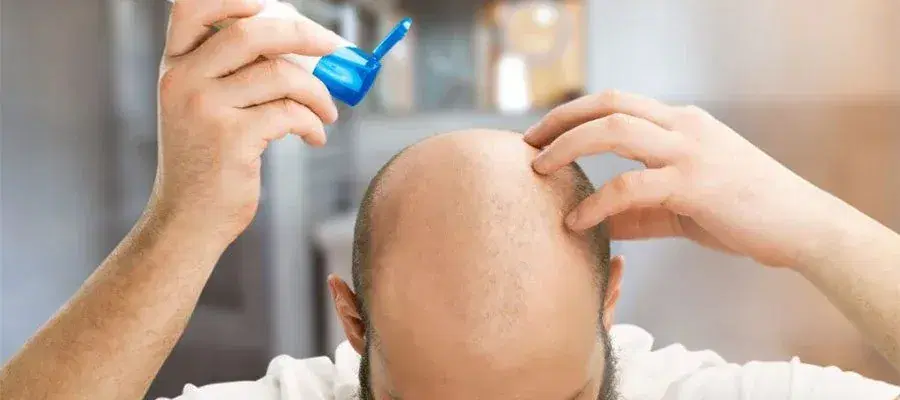
There is no universal day for starting panthenol spray after a hair transplant. Use it only when your treating team’s protocol says to begin. Some clinics introduce a panthenol foam, lotion, or spray around the first gentle wash, while others initially use sterile saline. The correct timing depends on the formulation, whether it is rinse-off or leave-on, and whether it is intended for the recipient or donor area.
What Is Panthenol Spray?
Panthenol, often called dexpanthenol or provitamin B5, is converted in the body to pantothenic acid, a form of vitamin B5. Topical dexpanthenol appears in moisturisers, wound-care products, lotions, foams, creams, and sprays because it can support skin hydration and barrier restoration.
General dermatology and superficial wound-care research supports dexpanthenol’s role in moisturisation and skin-barrier recovery. However, this evidence does not establish one universal application schedule for newly transplanted follicular units.
Panthenol is an aftercare ingredient, not a hair-growth medication. It has not been shown to guarantee graft survival, accelerate transplanted hair growth, or prevent all postoperative complications.
A spray, foam, lotion, cream, or panthenol-containing shampoo may have a different concentration, vehicle, preservative system, fragrance, alcohol content, and method of use. Products with the same headline ingredient are therefore not automatically interchangeable.
When Can You Start Panthenol Spray After a Hair Transplant?
Start panthenol only at the point specified in the written protocol provided by the team that performed your operation.
On the operation day
Do not independently apply a cosmetic panthenol product to fresh recipient sites on the day of surgery. The recipient area is the part of the scalp into which the follicular-unit grafts were implanted.
The surgical team may use or prescribe particular solutions during this period, but that does not mean an over-the-counter body spray, lotion, or cream is suitable for freshly treated skin.
Before the first wash
Some clinics use sterile saline or another approved mist before the first wash. Others prescribe a specific panthenol product as part of first-wash preparation.
The product name alone does not tell you which schedule applies. Confirm whether the item is:
Intended for use before washing.
Approved for direct application to the recipient area.
A leave-on mist or rinse-off product.
Intended only for the donor area.
Part of the clinic’s current protocol.
Around the first gentle wash
Some postoperative plans apply panthenol foam or lotion before the first wash to moisturise the surface and help soften dried material. Panthenol being used as part of its first-wash process, but the exact timing and contact period require confirmation against the patient’s current discharge instructions.
During the early crust-management period
An approved panthenol product may continue for a limited period as part of washing or superficial scalp care. It does not replace gentle cleansing, and patients should not use it to rub, pick, or force crusts from the scalp.
Hair transplantation can involve postoperative dryness, itching, and crusting in both recipient and donor areas, but the care of these areas may differ.
Use panthenol only when your clinic instructs you to start. Do not apply an unapproved cosmetic spray to freshly implanted grafts simply because it contains panthenol.
The patient’s written discharge plan takes priority over general online instructions.
What to Confirm Before First Use
Before opening or applying the product, confirm:
The exact product name.
Its panthenol or dexpanthenol concentration.
Whether it is a spray, foam, lotion, cream, or shampoo.
Whether it belongs on the recipient area, donor area, or both.
Whether it starts before, during, or after the first wash.
Whether it must be rinsed away.
How often it should be used.
How long each application should remain.
When its use should stop.
Which symptoms require you to contact the clinic.
A clear photograph of the front and back labels can help the postoperative team identify the product and its instructions.
Why Do Starting Times Differ Between Clinics?
Hair transplant aftercare has not been reduced to one globally standardised panthenol schedule. Timing can vary for several practical reasons.
Product formulation
A light pump mist is not the same as an aerosol, dense foam, moisturising lotion, or occlusive cream. Additional ingredients can change whether the product is appropriate for recently treated skin.
Leave-on or rinse-off use
One product may be intended to evaporate or remain on the scalp. Another may be used temporarily before a wash and then removed.
Recipient-area sensitivity
The recipient area contains newly implanted grafts and numerous small treatment sites. Early instructions usually aim to avoid unnecessary pressure, friction, scratching, and unapproved products.
Donor-area care
The donor area is the region from which follicles were removed. After FUE, it contains many small extraction sites. Its moisture, dressing, cleansing, and topical-product instructions may differ from those for the recipient area.
First-wash schedule
Clinics may arrange or recommend the first wash at different points depending on their protocol and the individual operation. Both a post-48-hour first wash and a third-day wash, confirming the need for one internally approved schedule rather than assumptions based on older web content.
Scalp findings and procedure details
The amount of dried blood, crusting, surface irritation, dressing, and postoperative sensitivity may affect the instructions. The fact that someone underwent FUE or DHI does not, by itself, establish when panthenol must begin.
Panthenol Spray vs Saline Spray After Hair Transplant
Panthenol and sterile saline may both be used within postoperative protocols, but they serve different purposes and should not automatically replace one another.
Feature | Panthenol product | Sterile saline spray | Important limitation |
|---|---|---|---|
Primary purpose | Skin hydration and barrier support | Moistening or gentle irrigation | Neither guarantees graft survival |
Typical formulation | Dexpanthenol plus a product vehicle and possible additional ingredients | Usually sterile 0.9% sodium chloride solution | Check sterility, label, and intended medical use |
Early postoperative use | Depends on clinic approval and formulation | May be used early in some protocols | Timing remains procedure- and protocol-specific |
Hydration | Can support moisture retention in the skin | Provides temporary surface moisture | Effects are not identical |
Crust-softening role | Some foams or lotions are used before washing | Moistening may help prevent excessive dryness | Neither should be used to force crust removal |
Need for clinic approval | Yes | Yes | “Saline” products may differ in sterility and delivery pressure |
Rinse-off or leave-on | Depends on product | Often allowed to evaporate, but follow instructions | Do not assume from the ingredient name |
Additional ingredients | May include fragrance, alcohol, preservatives, propellants, or emollients | Medical sterile saline is comparatively simple | Cosmetic salt-water sprays are not equivalent to sterile saline |
Normal saline is typically a 0.9% sodium chloride solution and is widely used as a tissue-compatible irrigation fluid. This does not make every saline spray suitable for postoperative scalp use; the product must be sterile, appropriately packaged, and approved by the surgical team.
Panthenol provides an active moisturising and barrier-support ingredient within a formulation. Saline is primarily a salt-and-water solution used for moisture or irrigation. Neither is universally superior, and one should not be substituted for the other without approval.
Panthenol Spray, Foam or Lotion: Are They the Same?
No. The terms describe different delivery systems and application methods.
Pump or aerosol spray
A spray may distribute a light layer without direct hand contact. However, its force, aerosol propellant, alcohol content, fragrance, and preservatives must be considered. Do not assume that a cosmetic face, body, or hair spray is suitable for grafts.
Foam
A clinic may provide foam for use before a wash. Foam can cover the surface without immediate rubbing, but some products must remain for a defined period and then be rinsed away.
Lotion
A lotion may be used to moisturise the donor area or soften surface crusting before cleansing. Application may require more contact than a spray, making technique and timing particularly important.
Cream
A cream is generally thicker and more occlusive. It may also require rubbing to distribute it. Do not place a cream over an unhealed recipient area unless the treating team specifically prescribed that product and method.
Panthenol shampoo
A shampoo containing panthenol is a cleansing product rather than a substitute for a dedicated spray or foam. It is designed to be rinsed away and may contain surfactants, fragrances, and other ingredients.
Read the complete product label rather than relying on the word “panthenol.”
Can Panthenol Be Applied to the Recipient Area?
Only use panthenol on the recipient area when the surgical team has approved the exact product.
The recipient area contains the newly implanted follicular units. During early healing, avoid unnecessary touching, rubbing, scratching, or pressure. Hair restoration guidance emphasises careful postoperative washing and handling to avoid accidentally pulling or disturbing transplanted hair.
When a spray is approved:
Keep the nozzle from touching the scalp.
Do not aim a forceful jet at the grafts.
Apply only the amount stated in the instructions.
Do not rub or massage it into freshly implanted sites.
Do not use cotton pads, towels, or fingers to spread it unless instructed.
Follow the stated leave-on or rinse-off method.
The clinic should provide any product-specific spraying distance. A universal distance should not be copied from another brand or patient.
Can Panthenol Be Used on the Donor Area?
It may be used on the donor area if the postoperative team approves it.
The donor and recipient areas have different wound patterns. After FUE, the donor area contains multiple small extraction sites; the recipient area contains implantation sites and grafts that should not be exposed to unnecessary friction.
An approved moisturising product may help with donor-area dryness, tightness, or superficial irritation. General evidence shows that dexpanthenol can support hydration and barrier recovery, but this does not prove that every formulation is suitable for every postoperative donor area.
A product prescribed for the donor area should not automatically be placed on the recipient area. Confirm both locations separately.
How to Apply Panthenol Spray Safely
Your discharge instructions take priority. The following framework shows what to verify rather than providing a universal dose or schedule.
Confirm the exact product.
Check the full name, formulation, expiry date, and ingredient list.Read both sets of instructions.
Compare the clinic’s written plan with the manufacturer’s label. Contact the clinic if they conflict.Clean your hands.
Wash or sanitise them before handling the bottle, cap, or nearby dressings.Avoid touching the grafts.
Do not use your fingers to spread the product over freshly implanted areas unless instructed.Position the product as directed.
Follow the supplied instructions for holding the pump or aerosol. Do not invent a spraying distance.Apply a light, even layer if prescribed.
More product does not necessarily provide more benefit.Do not rub, scratch, or massage.
Allow an approved spray or foam to settle naturally.Observe the stated contact period.
Leave it in place only as long as the protocol requires.Rinse only when instructed.
Some foams and lotions are pre-wash products; some sprays are leave-on formulations.Use gentle water flow where washing is approved.
Avoid directing strong water pressure at the grafts.Stop and contact the clinic if a reaction develops.
Burning, rash, rapidly increasing redness, swelling, or other unexpected symptoms require advice.
Should Panthenol Be Used Before the First Wash?
Sometimes—but only when the prescribed product and protocol specifically require it.
Another protocol may initially use sterile saline or a different clinic-supplied product. Saline can provide tissue-compatible moisture or irrigation, while panthenol adds a moisturising and barrier-support ingredient. They are not the same product.
Do not begin either the first wash or a panthenol application solely because a general article says that a certain postoperative day has arrived. Confirm the schedule with the treating team.
How Often Should You Use Panthenol Spray?
There is no safe universal frequency for every product and patient.
Frequency depends on:
The product concentration and vehicle.
Whether it is a leave-on spray or pre-wash foam.
Whether it belongs on the recipient or donor area.
The washing schedule.
Scalp dryness and clinical findings.
The clinic’s postoperative plan.
Whether irritation or residue develops.
Applying more than recommended may create unnecessary residue, expose the skin to additional ingredients, or increase irritation. It does not guarantee better healing or greater graft survival.
When the written plan says only “use panthenol” without a frequency, request clarification rather than copying another patient’s schedule.
How Long Should Panthenol Remain on the Scalp?
The formulation determines the contact time.
Leave-on spray
A leave-on spray may remain on the approved area and dry naturally. Do not wash it away unless the instructions say to do so.
Pre-wash foam
A foam may remain for a specified period to moisturise or soften the surface before gentle rinsing. It should not automatically be left overnight.
Rinse-off lotion
A lotion may be applied temporarily before washing. Follow the stated waiting period and rinsing technique.
Donor-area moisturiser
A product intended for donor-area comfort may have a different application and removal schedule from the recipient-area product.
How Many Days Should Panthenol Be Used?
The duration should follow the clinic’s postoperative plan.
Use may end when:
The planned early-care period is complete.
The washing technique changes.
Crusting has resolved sufficiently.
The team switches you to another approved product.
The donor or recipient area no longer requires it.
Irritation develops.
A clinician advises you to discontinue it.
Do not keep using panthenol indefinitely because the bottle still contains product. Conversely, do not stop a prescribed product early without asking the team when you are uncertain.
When Should You Avoid or Stop Panthenol Spray?
Do not use the product until you have clarified its safety when:
You cannot identify all ingredients.
It is a cosmetic body or hair spray rather than a clinic-approved aftercare product.
It contains alcohol or fragrance that the team has not approved.
You previously reacted to panthenol, dexpanthenol, preservatives, fragrances, or another component.
The packaging is damaged or expired.
The label conflicts with your discharge instructions.
You do not know whether it is intended for the recipient area.
Stop using it and seek advice if you develop:
Increasing burning.
A new rash.
Worsening redness.
Significant swelling.
Unexpected bleeding.
Discharge.
Increasing pain.
Blistering or widespread itching.
Dexpanthenol is generally well tolerated, but allergic contact dermatitis has been reported and may be overlooked. A reaction may also arise from another ingredient in the formulation rather than from panthenol itself.
Severe or worsening symptoms require clinical assessment rather than repeated use of moisturisers or cosmetic sprays.
Common Panthenol Mistakes After Hair Transplant
Starting without checking the protocol
A product that was appropriate for another patient may not match your operation, scalp findings, or first-wash schedule.
Confusing saline with panthenol
Sterile saline and panthenol formulations have different compositions and purposes. Do not refill one bottle with the other or substitute products without approval.
Using a cosmetic body or hair spray
A cosmetic spray may contain fragrance, drying alcohol, propellants, oils, or preservatives not intended for newly treated scalp skin.
Spraying too forcefully
A concentrated stream can place unnecessary pressure on the recipient area. Use only the delivery method approved for the supplied product.
Touching the nozzle to the scalp
The nozzle should not scrape the grafts or contact healing skin.
Rubbing the product into the grafts
Rubbing adds friction and pressure. An approved spray or foam should usually settle without massage unless the medical team provides different instructions.
Leaving a rinse-off foam on overnight
Longer contact is not automatically better. Use the specified waiting period.
Washing off a leave-on product
Unnecessary washing may disrupt the planned care schedule and remove a product intended to remain on the skin.
Applying cream without approval
A heavy cream may be unsuitable for the recipient area or require contact that the early protocol is designed to avoid.
Increasing the frequency
Extra applications do not guarantee faster healing and may increase residue or irritation.
Copying another patient’s schedule
Different clinics—and sometimes different patients at one clinic—may receive different formulations and instructions.
Continuing after irritation develops
A worsening reaction should be assessed. Do not assume burning proves that a product is “working.”
What If Your Clinic Did Not Recommend Panthenol?
Not every hair transplant protocol includes panthenol.
A plan using sterile saline, gentle washing, or another approved moisturising product is not automatically incomplete. The supporting evidence for dexpanthenol relates mainly to general skin hydration, barrier restoration, and superficial wound care; it does not establish that panthenol is required after every hair transplant.
Do not independently purchase a panthenol spray and apply it to fresh grafts. Ask the treating team whether they intentionally excluded it and which product, if any, should be used instead.
What If Online Advice Conflicts With Your Clinic’s Instructions?
Contact the treating team before combining or changing protocols.
Online advice may refer to:
A different concentration.
A different spray mechanism.
A leave-on rather than rinse-off product.
A donor-area product rather than a recipient-area product.
A different washing schedule.
A different surgical method or dressing.
An older version of a clinic protocol.
Send the team clear photographs of:
The product front.
The full ingredient list.
The manufacturer’s directions.
Your written discharge sheet.
The scalp area in question, when requested.
Ask for written clarification so you do not need to combine several uncertain instructions.
When Should You Contact the Clinic?
Routine clarification
Contact the clinic during its normal postoperative-support hours when:
The application frequency is unclear.
You do not know whether the product is rinse-off.
You are unsure whether it belongs on the donor or recipient area.
You missed one planned application.
The bottle was lost, damaged, or unavailable.
The label and discharge sheet appear to conflict.
You are unsure whether to continue after the first-wash phase.
Do not compensate for a missed application by doubling the amount unless the team tells you to do so.
Prompt medical contact
Seek timely clinical advice for:
Increasing pain.
Worsening or spreading redness.
Significant or rapidly increasing swelling.
Persistent bleeding.
Pus or other unexpected discharge.
Fever or feeling systemically unwell.
A rapidly developing rash.
Strong or persistent burning after application.
Blistering.
Facial, lip, tongue, or throat swelling.
Breathing difficulty.
Increasing pain, redness, swelling, discharge, and fever can be warning signs of a wound complication, although symptoms alone cannot establish a diagnosis.
Breathing difficulty or swelling involving the mouth or throat requires emergency medical care.
Frequently Asked Questions
When should I start panthenol spray after a hair transplant?
Start it only when your surgical team’s written instructions say to begin. Some protocols introduce an approved panthenol product around the first gentle wash, while others use sterile saline initially. The exact product, application area, and leave-on or rinse-off instructions determine the timing.
Can I use panthenol spray on the day of surgery?
Do not independently apply it on the operation day. The medical team may use selected products as part of its protocol, but an over-the-counter spray should not be placed on fresh recipient sites without approval. Contact the clinic if your discharge sheet does not clearly address the operation day.
Is panthenol spray safe for newly transplanted grafts?
A clinic-approved formulation can form part of postoperative care, but not every product labelled “panthenol” is suitable for newly implanted grafts. Additional alcohol, fragrance, preservatives, propellants, or oils may affect suitability. Confirm the exact product and avoid rubbing or forceful spraying.
Should panthenol spray be used before the first wash?
Some clinics use a specific panthenol foam or lotion before washing to moisturise the scalp and soften surface crusting. Other protocols begin with saline or another product. Do not introduce panthenol or start washing based only on an online schedule; follow your treating team’s plan.
Is panthenol spray the same as saline spray?
No. Sterile saline is generally a sterile sodium chloride solution used for moisture or irrigation. Panthenol products contain dexpanthenol within a formulation designed for skin hydration or barrier support. Their ingredients, functions, and rinse instructions differ, so they should not be substituted automatically.
Can panthenol be applied to the donor area?
It may be applied when the clinic approves the product for donor-area care. The donor area contains extraction sites and may need different care from the recipient area. A product approved for donor-area dryness or tightness is not automatically appropriate for newly implanted grafts.
How often should I use panthenol after a hair transplant?
Use it at the frequency stated in your individual aftercare plan. Frequency varies according to the formulation, treatment area, washing schedule, and whether the product is leave-on or rinse-off. More frequent use does not guarantee better healing and may increase residue or irritation.
Should I wash panthenol spray off?
That depends on the product. A leave-on spray may remain on the scalp, while a foam or lotion may be intended for temporary pre-wash use. Read the label and discharge instructions. Contact the clinic rather than guessing when the two appear inconsistent.
How long should I use panthenol after a hair transplant?
Continue only for the period prescribed by your team. The duration may end when the washing protocol changes, crusting resolves, the clinic introduces another product, or irritation occurs. There is no single stopping day that applies to all hair transplant patients.
Can panthenol damage hair grafts?
Panthenol itself is commonly used in skin-care products, but an unsuitable formulation, forceful spraying, rubbing, or incorrect application could disturb early care or irritate the scalp. Use only the approved product and technique. Panthenol does not make every spray safe for grafts.
What should I do if panthenol causes burning?
Stop the application and contact the clinic, particularly if burning persists or is accompanied by rash, swelling, worsening redness, or blistering. Dexpanthenol reactions are uncommon but reported, and another product ingredient may also cause irritation or contact dermatitis.
Is panthenol necessary after every hair transplant?
No. Clinics use different postoperative plans, and evidence supporting dexpanthenol for general skin hydration and barrier care does not prove that it is essential after every hair transplant. A protocol based on saline, gentle washing, or another approved product is not automatically inadequate.
Final Guidance
Panthenol may support scalp hydration, comfort, and skin-barrier care, but it is not a hair-growth treatment or a guarantee of better graft survival. General skin research cannot determine the correct postoperative schedule for every hair transplant patient.
Source: https://pubmed.ncbi.nlm.nih.gov/12113650/