
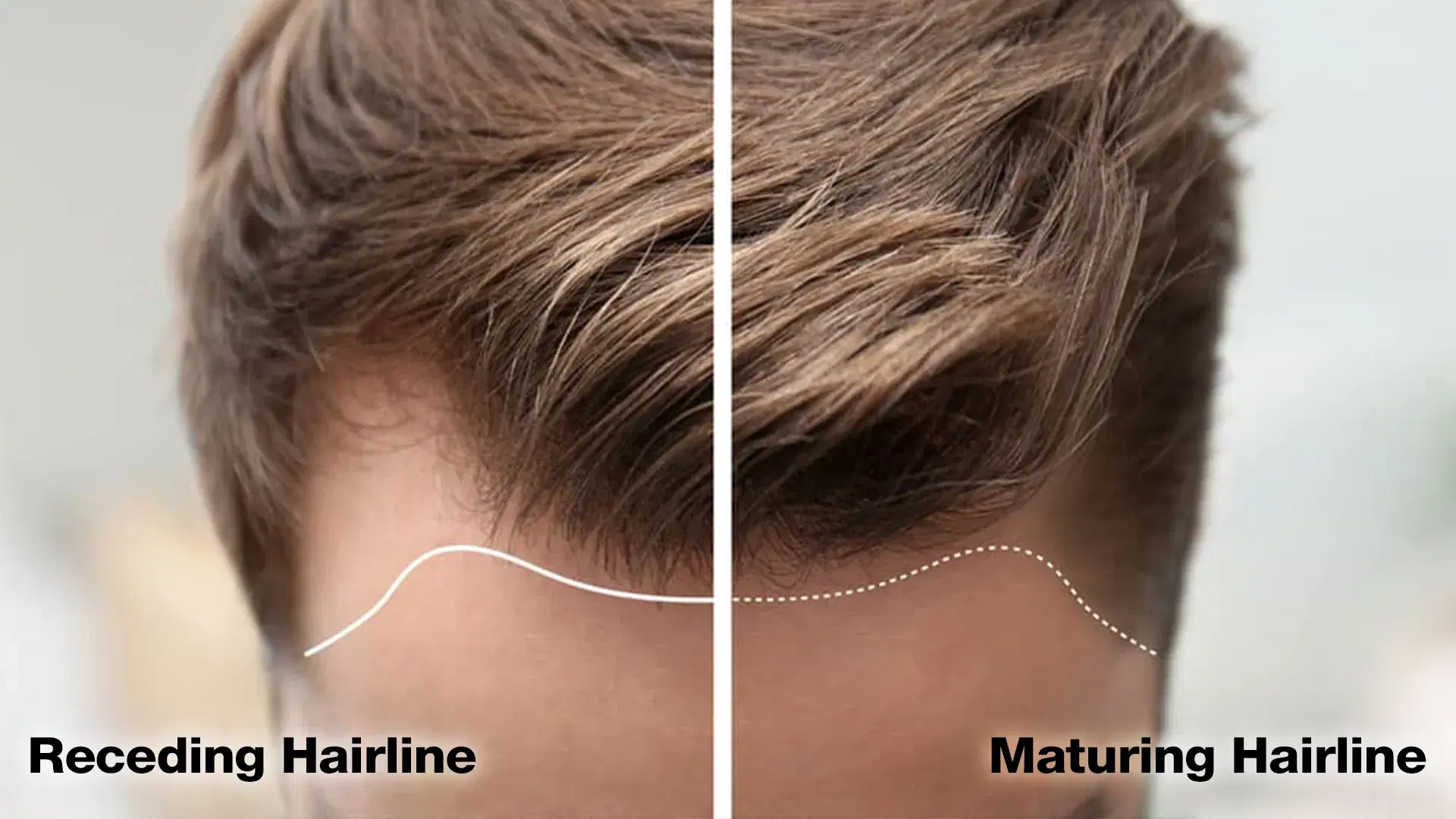
Is a Receding Hairline Always Male Pattern Baldness?
No, a receding hairline does not always mean male pattern baldness. Androgenetic alopecia commonly starts above both temples and gradually changes the frontal outline. However, repeated hairstyle tension can also damage frontotemporal follicles. Frontal fibrosing alopecia produces another distinctive form of recession. It can permanently destroy affected follicles through inflammation and scarring. Hairline position alone therefore cannot confirm the diagnosis. Progression, scalp appearance, hair thickness, eyebrow changes, and grooming habits provide additional clues. A stable high hairline differs significantly from progressive follicle miniaturization.
How Can You Tell Whether a Hairline Is Actively Receding?
Active recession usually shows progressive thinning and miniaturization rather than a higher hairline alone. Compare photographs taken several months apart under identical lighting and angles. Look for increasingly visible scalp around the temples. Shorter and finer hairs near the boundary can suggest follicle miniaturization. Dermatologists can examine these changes using trichoscopy. Androgenetic alopecia commonly produces variable hair diameters and increased vellus hairs. These findings provide stronger evidence than forehead measurements alone. Gradual change across repeated photographs also matters more than differences between unrelated selfies.
Why Does a Receding Hairline Often Start at the Temples?
The temples commonly recede because frontal follicles respond differently to androgens than many occipital follicles. Research has found regional differences in androgen receptors and androgen-processing enzymes. These differences help explain the recognizable distribution of androgenetic alopecia. Sensitive follicles gradually produce thinner, shorter hairs through repeated growth cycles. Meanwhile, many hairs around the back remain comparatively resistant. This regional biology also explains why hair transplantation typically uses suitable occipital donor follicles. However, temple recession alone cannot prove androgenetic alopecia. Other disorders can target the same area.
What Causes a Receding Hairline Besides Genetics?
Several different processes can cause or accelerate a receding hairline.
Androgenetic alopecia progressively miniaturizes genetically susceptible follicles.
Its inheritance is polygenic, not simply a single gene inherited through the maternal line.
Tight hairstyles can create traction alopecia around the frontal and temporal edges.
Frontal fibrosing alopecia causes inflammatory scarring and permanent follicle loss.
Some women develop androgen-related thinning without the classic male recession pattern.
Identifying the mechanism matters because these conditions require different treatments. Treating every receding hairline identically can waste valuable time.
Can Hair Thickness Reveal Recession Before the Hairline Moves?
Yes, differences in hair thickness can reveal androgenetic miniaturization before dramatic recession becomes obvious. Trichoscopy measures variation between thicker terminal hairs and increasingly fine miniaturized hairs. A systematic review identified hair-diameter variability among the most common androgenetic alopecia findings. Research has also validated approximately 20% hair-diameter diversity as a useful diagnostic threshold. However, researchers caution that ethnicity can influence the appropriate interpretation. This makes follicle caliber more informative than simply measuring forehead height. A hairline can appear similar while its underlying follicle population changes progressively.
Can Women Develop a Receding Hairline?
Yes, women can develop hairline recession, but the pattern deserves careful evaluation. Female pattern hair loss usually causes diffuse frontal and crown thinning while relatively preserving the frontal boundary. Clear frontotemporal recession can therefore suggest another process. Frontal fibrosing alopecia deserves particular attention when recession accompanies eyebrow thinning. It can also produce itching, discomfort, facial papules, or follicular redness. Traction from repeatedly tight hairstyles can create a similar frontal pattern. Women should therefore avoid assuming every changing hairline represents ordinary genetic thinning. Pattern recognition can substantially change treatment priorities.
When Is a Receding Hairline a Medical Warning Sign?
A receding hairline needs faster evaluation when inflammation, scarring, or eyebrow loss appears alongside recession. Frontal fibrosing alopecia can progressively destroy follicular stem cells. Trichoscopy may show disappearing follicular openings, perifollicular redness, and scaling around affected hairs. Traction alopecia also deserves early action. It begins as potentially reversible damage but can eventually become scarring and permanent. Pain, burning, persistent itching, bumps, or shiny hairless skin should therefore change your response. These features suggest more than uncomplicated cosmetic recession and justify professional assessment.
Can a Receding Hairline Grow Back?
A receding hairline can sometimes improve when functioning miniaturized follicles remain in the affected area. Complete restoration becomes less predictable as recession advances. Importantly, frontotemporal areas are not automatically unresponsive to treatment. A randomized study found measurable benefits from 5% topical minoxidil foam in men with frontotemporal androgenetic alopecia. Longer follow-up found stabilization of hair density, width, and scalp coverage over 104 weeks. These results support realistic goals such as thickening and stabilization. They do not prove that medication can recreate every previously lost temple hair.
Which Treatments Can Help a Receding Hairline?
Treatment can slow or improve recession when it matches the underlying diagnosis.
Topical minoxidil can support growth in responsive follicles, including some frontotemporal areas.
Finasteride can slow male androgenetic hair loss and improve frontal scalp growth in appropriate men.
United States labeling has not established finasteride efficacy specifically for bitemporal recession.
Removing hairstyle tension remains essential when traction causes the problem.
Scarring alopecia requires treatment aimed at controlling destructive inflammation.
Hair transplantation can reposition resistant follicles after suitable medical assessment.
Early treatment generally offers more viable follicles to preserve.
Sources
https://pubmed.ncbi.nlm.nih.gov/39119311/
https://pmc.ncbi.nlm.nih.gov/articles/PMC11012765/
https://pmc.ncbi.nlm.nih.gov/articles/PMC10966279/
https://pubmed.ncbi.nlm.nih.gov/9284093/
https://pubmed.ncbi.nlm.nih.gov/25765348/
https://pubmed.ncbi.nlm.nih.gov/26387973/
https://pubmed.ncbi.nlm.nih.gov/10365924/
https://pubmed.ncbi.nlm.nih.gov/29035284/
https://pubmed.ncbi.nlm.nih.gov/33293846/
https://pubmed.ncbi.nlm.nih.gov/30785992/
https://dailymed.nlm.nih.gov/dailymed/drugInfo.cfm?setid=e3728709-e805-4b46-9954-2c433a865987