
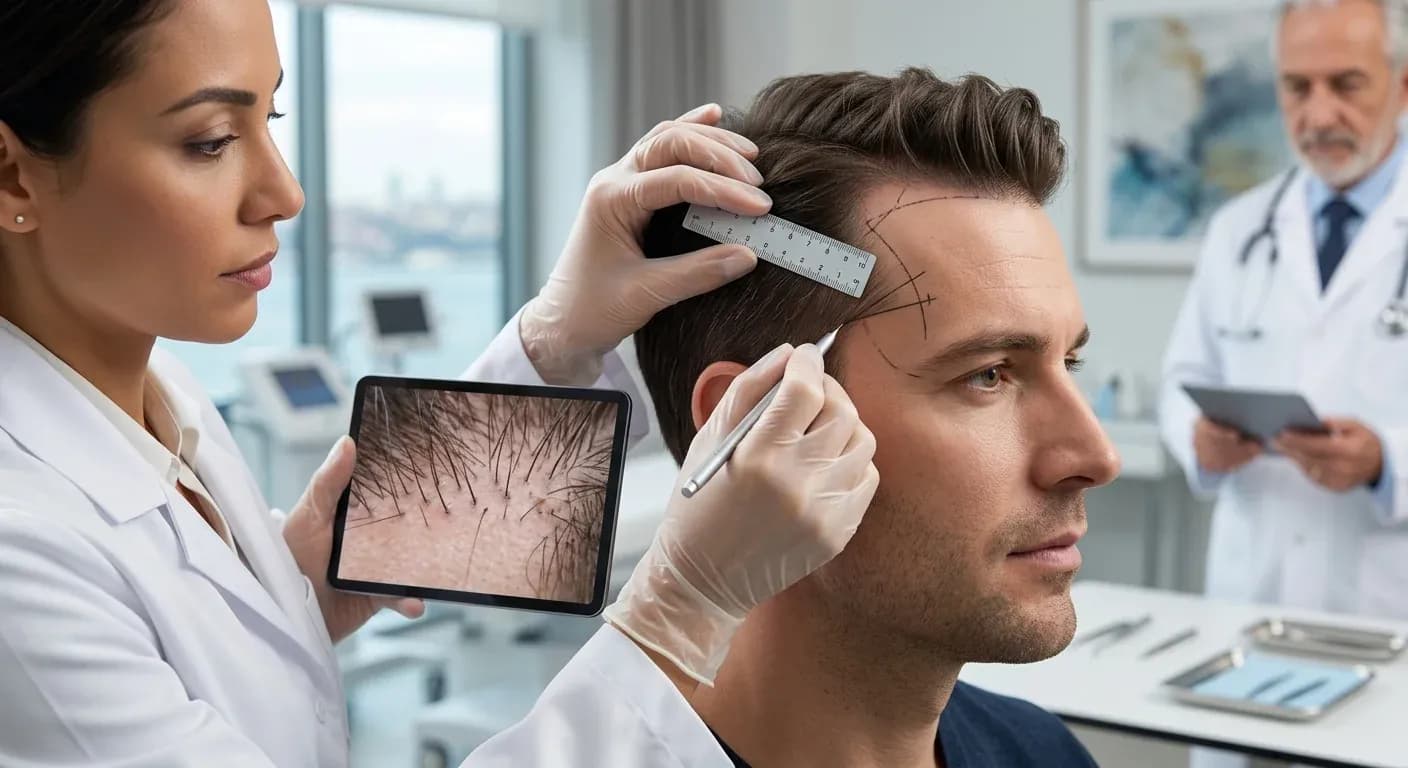
Temple point restoration is a specialized hair transplant procedure that rebuilds the natural hair projections along the sides of the forehead, improving facial framing and the transition between the frontal hairline and sideburns. Achieving natural results requires careful hairline design, fine single-hair grafts, precise implantation angles and a long-term approach to hair loss progression.
What Is Temple Point Restoration?
Temple point restoration involves transplanting healthy hair follicles into the temporal regions to reconstruct hair that has become thin, recessed or completely absent. The temple points are small, often triangular areas of hair located along the sides of the forehead, where the frontal hairline transitions toward the sideburns.
Although these regions occupy a relatively small area, they have a considerable influence on facial appearance. Well-defined temple points create a natural connection between the forehead and lateral hairline, while significant recession can make the face appear wider or change the perceived proportions of the upper facial region.
Unlike conventional frontal hair transplantation, temple point reconstruction requires particularly delicate follicular placement. The existing hairs in this region are often finer and grow at very shallow angles, making the selection and orientation of transplanted grafts essential for achieving a convincing appearance.
The objective is not necessarily to create sharply defined temples. A natural restoration should complement the surrounding hair, facial anatomy and expected changes in hair density over time.
Why Are Temple Points Important for a Natural Hairline?
The frontal hairline is often the main focus of hair transplantation, but the temple points contribute significantly to how the entire hairline frames the face. Their shape and position influence the connection between the central forehead, frontotemporal corners and sideburns.
When temple points remain well defined, they help create a balanced transition from the frontal scalp toward the sides of the face. If these areas become severely recessed, even a relatively full frontal hairline may appear disconnected from the surrounding hair.
This relationship becomes especially noticeable when the face is viewed from an angle or in profile. The temple points create part of the lateral outline of the hairstyle, meaning relatively small changes in their position can affect the overall appearance.
A successful restoration therefore considers the temple points as part of a complete hairline design rather than treating them as isolated patches requiring maximum density.
Temple Point Recession vs Receding Hairline
Temple point recession and frontal hairline recession are closely related, but they do not necessarily describe the same pattern of hair loss. The frontotemporal corners are located along the upper sides of the frontal hairline, while the temple points project farther down the lateral forehead toward the sideburn region.
Male pattern hair loss commonly begins with recession around the frontal corners, gradually creating a more pronounced M-shaped hairline. Temple points may also become thinner or retreat, although some individuals maintain relatively strong temporal projections despite significant frontal recession.
Understanding this anatomical difference is important because filling the upper corners does not automatically reconstruct the lower temple points. Each area has its own characteristic hair direction, density and relationship with the surrounding scalp.
Recognizing the different patterns of receding hairline and temple hair loss helps clarify why an appropriate restoration plan must consider the entire frontal and lateral hairline together.
Why Do Temple Points Become Thin or Recede?
Genetic hair loss is one of the potential causes of temple recession, particularly when follicles become progressively sensitive to androgen-related changes. Over time, affected follicles may produce shorter and finer strands, reducing visible density and altering the natural shape of the temporal region.
However, not every change in temple appearance indicates progressive baldness. Some people naturally have less prominent temple points, while others develop subtle changes in hairline shape as they mature. Differences between the left and right sides can also exist without an underlying hair disorder.
Repeated tension from tight hairstyles, previous surgical procedures and certain inflammatory scalp conditions may contribute to localized hair loss around the temples. When scarring damages the follicles permanently, natural regrowth may no longer be possible.
Identifying the cause of thinning helps determine whether transplantation can provide lasting improvement or whether an underlying condition should first be addressed.
Who Is a Suitable Candidate for Temple Point Restoration?
Temple point transplantation may benefit individuals who have experienced noticeable temporal recession and still possess sufficient healthy donor hair for reconstruction. It can also be considered when previous hair transplantation has restored the frontal hairline but left the lateral regions looking disproportionately recessed.
A suitable candidate generally has a stable donor area, healthy recipient skin and realistic expectations about the achievable hair density. The existing direction and texture of the surrounding temple hair are equally important because the transplanted strands must blend with delicate natural growth patterns.
Age and the likelihood of further hair loss also influence the planning process. Restoring aggressively low temple points in a young person with rapidly progressing androgenetic alopecia can create an appearance that becomes increasingly difficult to maintain as surrounding hair recedes.
For this reason, a conservative reconstruction may provide a more sustainable result than attempting to reproduce the fullest possible temple shape.
How Is a Natural Temple Point Designed?
Natural temple point design begins with examining the relationship between the forehead, eyebrows, frontal hairline and sideburns. The restored contour should follow the existing facial structure rather than reproduce a standardized triangular shape.
Temple Point Shape and Facial Proportions
The shape of the temporal region influences how the upper face is perceived, particularly when viewed from the side. A prominent temple point can create stronger facial framing, while a softer contour may complement a more mature hairline.
An excessively sharp or forward-positioned temple point can appear artificial when it does not match the surrounding hair distribution. Similarly, restoring the lateral hairline too low may create an unnatural boundary between the scalp and forehead.
The design should maintain a believable transition between the reconstructed region and the existing side hair. Small irregularities along the border help prevent the transplanted area from resembling a sharply outlined geometric shape.
Natural Asymmetry Between Temple Points
Human facial anatomy is rarely perfectly symmetrical, and the same principle applies to temple hair growth. One temple point may naturally sit slightly higher or extend farther forward than the other without creating an unbalanced appearance.
Attempting to produce identical outlines on both sides can sometimes exaggerate differences in forehead shape or existing hair direction. A natural design should maintain overall visual balance while allowing subtle anatomical variations.
These details become particularly important when the patient wears short hairstyles that leave both temples clearly visible.
Why Are Hair Growth Angles So Important in Temple Restoration?
Temple hair grows differently from much of the frontal scalp because the strands typically emerge at very shallow angles and follow a downward or backward direction. In some areas, the hair lies almost parallel to the skin surface rather than projecting outward.
Recreating this pattern is one of the most demanding aspects of temple point transplantation. If grafts are implanted too upright, the emerging strands may stand away from the scalp and create a coarse appearance that becomes especially noticeable in profile.
Hair direction also changes across the temporal region. The strands near the upper border may follow a different orientation from those approaching the sideburns, making uniform placement unsuitable for natural reconstruction.
Once transplanted follicles establish themselves, their growth direction is difficult to change. Accurate orientation during implantation is therefore essential for achieving hair that blends naturally and responds predictably to everyday styling.
Why Are Single-Hair Grafts Used for Temple Points?
The natural temple region usually contains relatively fine strands that create a soft transition between the forehead and denser side hair. Reproducing this appearance requires careful selection of follicular units rather than simply placing large numbers of grafts into the area.
Single-hair grafts are generally preferred along the visible border because they help recreate the delicate appearance of natural temple hair. Follicular units containing several thick hairs can produce conspicuous clusters when positioned directly against bare forehead skin.
The transition toward denser hair farther behind the temple point may accommodate a different distribution of follicular units, depending on the existing growth pattern. However, the leading edge should remain soft and avoid an abrupt increase in hair concentration.
A natural appearance depends on the relationship between graft thickness, spacing and direction rather than the total number of hairs implanted.
How Is Donor Hair Selected for Temple Point Reconstruction?
Selecting appropriate donor hair is particularly important because the temples often contain finer strands than the back of the scalp. Transplanting coarse donor hair into a delicate temporal region can create an obvious difference in thickness and texture, even when the follicles grow successfully.
The donor area is examined for hair shaft diameter, follicular-unit composition, density and long-term stability. Fine single-hair units may be particularly useful when creating the temple point border, provided they originate from a suitable donor region.
Hair near the nape or above the ears may be finer, but follicles in these areas are not always as resistant to progressive thinning as those within a stable donor zone. Their long-term reliability must therefore be considered before extraction.
Preserving donor capacity remains essential because transplantation redistributes existing follicles rather than generating new ones. Using excessive grafts for a small temporal area may reduce the resources available for future frontal or crown restoration.
How Many Grafts Are Needed for Temple Point Restoration?
Temple point restoration generally requires fewer grafts than extensive frontal hairline reconstruction because the treatment area is relatively small. Limited procedures may involve approximately 100 to 300 grafts per side, although the actual requirement depends on the extent of recession and the available surrounding hair.
The desired contour also influences graft planning. A subtle improvement to an existing temple point requires a different distribution from reconstructing an area where natural hair has almost completely disappeared.
Hair thickness, color contrast and natural follicular density affect the amount of coverage produced by each graft. Relatively fine hair may require careful distribution to create visual continuity without producing an unnaturally dense border.
The objective is not to implant the highest possible number of follicles. A conservative density that matches the surrounding temporal hair often provides a more convincing result than aggressive graft packing.
FUE vs DHI for Temple Point Restoration
Both FUE and DHI can be used in hair restoration procedures involving the temple region, but their technical differences do not automatically determine the naturalness of the final result.
FUE involves extracting individual follicular units from a suitable donor region before placing them into prepared recipient sites. The method allows follicles to be selected according to their characteristics, including the fine single-hair units needed for delicate temporal restoration.
DHI commonly refers to implantation with a specialized implanter pen, which allows graft insertion during the placement process. This method can provide a different approach to controlling implantation, although precise angulation and follicular orientation remain essential.
Neither technique guarantees superior temple point restoration solely through the equipment used. The quality of the design, appropriate graft selection and the relationship between transplanted and natural hair determine whether the result appears convincing.
How Is Temple Point Hair Transplantation Performed?
The procedure begins with an assessment of the existing temporal hair, donor availability and the proposed relationship between the frontal hairline and sideburns. The intended temple point contours are planned before follicular extraction, allowing both sides to be evaluated together.
Healthy grafts are then collected from the donor region using an appropriate extraction technique. The harvested follicles are prepared for implantation, with particular attention to selecting suitable single-hair units for the visible boundaries of the restored area.
During implantation, the recipient sites are positioned to reproduce the natural direction and shallow emergence angles of the surrounding temple hair. The small size of the region does not make the procedure simple, since even a limited number of incorrectly positioned follicles can affect the overall appearance.
The operation is generally performed under local anesthesia, and patients receive postoperative instructions for protecting the scalp during the initial healing period.
Temple Point Restoration Recovery Timeline
Recovery following temple point transplantation involves the same general biological processes seen with other forms of follicular hair restoration. However, the location of the recipient area can make temporary redness and crusting particularly noticeable around the sides of the forehead.
First Two Weeks After Surgery
During the first several days, small crusts, temporary redness and mild swelling may develop around the implanted follicles. The donor region can also feel tender as the extraction sites begin healing.
Gentle washing and avoiding unnecessary friction help protect the treated areas while the skin barrier recovers. Scratching or forcefully removing crusts can irritate the scalp and interfere with comfortable healing.
Weeks Two to Eight: Temporary Shedding
Many transplanted hair shafts begin shedding during the first several weeks as the follicles enter a temporary resting phase. This process may make the restored temple points appear sparse again, even though surviving follicles remain beneath the skin.
Temporary shedding does not automatically indicate graft failure. The follicles can begin producing new strands after progressing through the resting stage of their growth cycle.
Months Three to Six: Early Growth
New hair commonly starts appearing around the third or fourth month, although growth may initially look uneven. Some follicles begin producing visible strands earlier than others, creating temporary differences in length and density.
As additional hairs emerge, the temple points gradually gain definition and begin blending with the surrounding lateral hairline. Early strands may also become thicker as maturation progresses.
When Will Temple Point Restoration Look Natural?
Meaningful improvements in temple point density commonly become visible between six and twelve months after transplantation. During this period, newly emerging strands gain length and contribute more effectively to the restored temporal contour.
The final appearance depends on more than the number of surviving grafts. Correct hair direction, appropriate strand thickness and gradual density transitions determine whether the restored area blends naturally when viewed from the front and side.
Further maturation may continue beyond the first year, particularly when the early transplanted hairs remain fine or grow at different rates. The result is best evaluated after sufficient time has passed for the follicular growth cycle to stabilize.
A detailed understanding of natural frontal hairline design after transplantation also helps explain why the temple points must complement the entire hairline rather than function as separate cosmetic features.
What Are the Risks of Temple Point Hair Transplantation?
Temple point restoration carries the general risks associated with surgical hair transplantation, including temporary swelling, redness, infection, folliculitis and unsuccessful graft growth. However, the anatomical characteristics of the temporal region create additional technical challenges.
The skin around the temples is relatively thin, and important blood vessels and other anatomical structures lie nearby. Recipient-site preparation therefore requires careful control to avoid unnecessary tissue injury and protect the surrounding structures.
An unnatural appearance is another potential concern. Excessively coarse grafts, incorrect implantation angles or an overly sharp triangular outline can make the reconstructed area conspicuous even when the follicles grow successfully.
Progressive hair loss can also change the surrounding hair distribution after surgery. If native hair continues receding while the restored temple points remain prominent, the overall result may become less balanced over time.
Can an Unnatural Temple Point Transplant Be Corrected?
Corrective transplantation may improve temple points that appear too sharp, dense, uneven or incorrectly positioned. However, the approach depends on whether the problem involves hairline shape, follicular direction, graft thickness or an unsuitable relationship with the surrounding hair.
Some cases can be improved by adding finer single-hair grafts to soften abrupt borders or create a more gradual transition. Other cases may require removing or redistributing conspicuous follicles that grow at unnatural angles.
Corrective treatment must also account for the remaining donor supply because additional surgery consumes more follicles. Repeated implantation into a small region can create unnecessary tissue trauma if the underlying design has not been carefully reconsidered.
The aim is to restore natural proportions rather than simply increasing the density of an already unbalanced temporal area.
How Does Future Hair Loss Affect Temple Point Restoration?
Long-term planning is particularly important because androgenetic alopecia may continue affecting native hair after successful transplantation. The restored temple points can remain relatively stable while surrounding follicles gradually become thinner, potentially changing the appearance of the lateral hairline.
This risk is greater when the original restoration creates unusually prominent temporal projections without considering the expected progression of hair loss. Over time, the reconstructed points may appear isolated if the frontal corners or side hair continue receding.
A conservative design can help maintain a natural relationship between the temple points, frontal hairline and existing sideburns. Preserving donor hair also leaves more flexibility for addressing future thinning in other areas.
Temple point restoration should therefore form part of a broader hair restoration strategy that considers both current appearance and long-term changes in hair density.
Frequently Asked Questions About Temple Point Restoration
The following questions address common concerns about natural results, graft requirements and the long-term effectiveness of temple hair transplantation.
Can temple points be restored naturally with a hair transplant? Temple point transplantation can produce a natural appearance when fine single-hair grafts are positioned at shallow angles that follow the existing growth direction. The restored contour must also complement the forehead, frontal hairline and sideburns, while avoiding excessive density or unusually sharp borders that make the procedure noticeable.
How many grafts are needed to restore temple points? Limited temple point reconstruction may require approximately 100 to 300 grafts per side, although larger or more advanced areas of recession can require additional follicles. The appropriate number depends on the desired contour, existing hair density, donor characteristics and the amount of coverage needed to create a balanced transition.
Are temple point hair transplant results permanent? Successfully transplanted follicles from a stable donor region can continue producing hair for many years. However, native hair surrounding the restored temple points may still undergo progressive thinning, making conservative design and preservation of donor resources important for maintaining a natural appearance over time.
Final Thoughts on Temple Point Restoration
Temple point restoration can improve facial framing and create a more balanced connection between the frontal hairline and sideburns. Although the treatment area is relatively small, achieving a convincing result requires detailed attention to follicular direction, hair thickness, implantation angles and natural density patterns.
The most important consideration is preserving the anatomical characteristics that make temple hair different from ordinary frontal scalp hair. Fine single-hair grafts, conservative contours and gradual transitions help reconstructed areas blend with existing hair without producing an artificial outline.
Long-term success also depends on planning for future hair loss rather than focusing exclusively on immediate cosmetic improvement. A carefully designed temple point transplant can provide lasting facial balance while preserving the donor resources needed to maintain natural hair coverage as the surrounding hair changes over time.