
What Is a Transgender Hair Transplant?
Gender-affirming hair transplantation transfers viable hair follicles from a donor area to a planned recipient area.
The donor area is the region from which suitable hair follicles are obtained, usually at the back or sides of the scalp. The recipient area is where those follicles are placed, such as the frontal scalp, temples, beard, eyebrows or a stable scar.
A follicular unit is a naturally occurring group of one or more hairs and its supporting structures. Once removed for transplantation, it is commonly called a graft.
The same established harvesting and implantation principles used in other hair transplants apply. What makes the treatment gender-affirming is the personalised planning—not a separate extraction device or biological procedure. Published reviews describe scalp hairline work, eyebrow restoration and facial-hair transplantation among the procedures that may support transgender and gender-diverse patients.
Gender identity alone does not determine whether someone is medically suitable. The plan must consider the individual’s anatomy, hair characteristics, health, treatment goals and available donor supply.
What Can Gender-Affirming Hair Transplantation Address?
Treatment goal | Possible treatment area | Main planning considerations | Related Esthetic Hair page |
|---|---|---|---|
Softer or lower-looking frontal transition | Frontal hairline | Existing position, forehead proportions, donor supply and future loss | Female Hair Transplant |
Temple and temporal-point restoration | Frontal-temporal corners and side hairline | Direction, temple-point shape, facial surgery and native hair | Female Hair Transplant |
More angular or individually defined hairline | Frontal edge and temples | Patient preference, existing recession and future loss | FUE Hair Transplant |
General scalp restoration | Front, mid-scalp or crown | Diagnosis, donor density and progressive loss | FUE or DHI Hair Transplant |
Beard or moustache creation | Upper lip, chin, cheeks and jawline | Facial proportions, angle, donor-hair match and grooming | Beard Transplant |
Sideburn restoration | Preauricular facial region | Position, direction, facial-surgery plan and connection to scalp hair | Beard Transplant |
Eyebrow restoration | One or both eyebrows | Shape, angle, calibre, direction and ongoing trimming | Eyebrow Transplant |
Scar camouflage | Scalp, hairline, eyebrow or beard region | Scar stability, thickness, blood supply and realistic density | Relevant treatment or repair page |
Previous transplant revision | Hairline, scalp or donor region | Existing grafts, scars, remaining donor capacity and design | Bad Hair Transplant |
These goals may require different donor hairs, graft types and surgical priorities. They may not all be achievable in one procedure.
Hairline Feminisation With Hair Transplantation
A patient seeking a feminising hairline may want to reduce visible frontal recession, fill the temporal corners or create a softer transition between the forehead and scalp.
Possible design goals include:
Filling deep temporal recessions.
Reducing an M-shaped appearance.
Creating a softer frontal outline.
Adjusting or reconstructing temporal points.
Lowering the visual position of selected hairline areas.
Integrating a forehead-surgery scar.
Restoring areas of established androgenetic alopecia.
No single contour is universally feminine. Hairlines vary naturally according to genetics, age, ethnicity, facial proportions, hairstyle and individual preference. The design should not be based on a standard rounded template.
Small single-hair grafts may be selected for visible borders, while naturally occurring multi-hair units can support density farther behind. Naturalness also depends on low exit angles, changing direction, irregular distribution and appropriate temple-point planning. Hairline transplantation can add hair to selected zones, but it does not physically advance the entire hair-bearing scalp in the same way as surgical hairline advancement.
The plan must preserve enough donor hair for future needs. Feminising hormone therapy may influence ongoing androgen-related hair changes, but it cannot be assumed to recreate a fully absent frontal hairline.
Hairline Masculinisation and Scalp Restoration
Some transgender men and non-binary patients may want to preserve or create a more angular hairline. Others may want to restore unwanted recession or crown thinning that developed during testosterone therapy.
Possible goals include:
Restoring the frontal hairline without making it overly rounded.
Filling areas of unwanted temporal recession.
Preserving an intentionally angular outline.
Restoring mid-scalp or crown density.
Reconstructing hair lost around a surgical scar.
Creating a neutral or individually selected design.
Testosterone can contribute to frontal, temporal or crown-pattern thinning in genetically susceptible individuals. The timing and extent vary, and not everyone using testosterone develops significant androgenetic alopecia. Transgender-specific research remains limited, but clinical reviews recognise androgenetic alopecia as an important issue in transgender and gender-diverse care.
A transplant redistributes donor follicles. It does not stop progressive loss in untreated native hair. Long-term planning should therefore consider the likely future pattern rather than only the area currently visible.
Beard and Moustache Transplantation for Transgender Men
A beard transplant transfers selected donor follicles—commonly from the scalp—to facial recipient sites.
The design may include:
Moustache.
Goatee.
Chin.
Cheeks.
Jawline.
Sideburns.
Connections between these zones.
Hair direction is especially important on the face. Hairs in the moustache, cheeks, jawline and chin follow different angles and changing patterns. Incorrect placement may create hairs that project away from the skin or cross surrounding growth.
Existing facial hair and its likely future development should be assessed before surgery. Testosterone may increase facial and body-hair growth, but the response varies and does not guarantee a complete beard. No one should be told to begin, stop or alter testosterone solely for a transplant without coordination between the prescribing clinician and surgical team.
Scalp donor hair may retain important donor-site characteristics after transplantation. It may differ from native beard hair in calibre, curl, colour or growth pattern and can require regular trimming. Donor matching and realistic expectations are therefore essential.
Published literature describes facial-hair transplantation as one possible gender-affirming procedure for selected transgender patients, but it does not establish universal candidacy, density or graft-survival expectations.
Eyebrow and Sideburn Transplantation
Eyebrow and sideburn work may support feminising, masculinising, neutral or reconstructive goals.
An eyebrow transplant may address:
Sparse natural growth.
Previous overplucking.
Trauma or surgery.
Asymmetry.
A preferred shape or density.
No eyebrow shape should be prescribed according to gender identity. The design should consider facial proportions, existing growth, brow movement, hairstyle and individual preferences.
Eyebrow transplantation requires very shallow angles and precise directional changes. Scalp donor hair may grow faster than natural eyebrow hair and can require ongoing trimming.
Sideburn restoration may help:
Connect scalp hair to facial hair.
Reconstruct areas changed by facial surgery.
Cover selected scars.
Create longer, shorter or differently shaped sideburns.
The design must account for planned or previous lifting, contouring or hairline procedures because these can alter sideburn position and surrounding scars.
Scalp Versus Facial-Hair Transplantation
Factor | Scalp transplantation | Beard, sideburn or eyebrow transplantation |
|---|---|---|
Primary goal | Restore or redesign scalp coverage | Create, reshape or increase facial-hair coverage |
Donor source | Usually scalp donor hair | Often scalp hair; alternatives require careful matching |
Direction | Varies across hairline, temples, mid-scalp and crown | Changes sharply across small facial zones |
Angle | Important for natural scalp flow | Often especially shallow and visually sensitive |
Hair match | Calibre, curl and contrast affect coverage | Donor hair should resemble the intended facial hair where possible |
Grooming | Cut and styled as scalp hair | May require frequent trimming or shaping |
Scar treatment | May involve scalp surgical scars | May involve facial, brow or sideburn scars |
Main planning limit | Donor supply and progressive scalp loss | Donor match, facial proportions and directional control |
How Does Hormone Therapy Affect Hair Transplant Planning?
Gender-affirming hormone therapy can influence scalp, facial and body hair differently. Response varies according to genetics, age, duration of exposure and individual follicular sensitivity.
Feminising hormone therapy
Feminising treatment may:
Reduce the rate or thickness of some body hair.
Slow some androgen-related processes in selected patients.
Affect the progression of androgen-sensitive scalp loss.
Produce variable changes in existing facial hair.
It does not reliably recreate an established missing frontal hairline or guarantee recovery of follicles that no longer produce visible hair. Facial hair also commonly persists to some degree unless additional hair-removal treatment is used.
Masculinising hormone therapy
Testosterone may:
Increase facial and body-hair development.
Change the density and distribution of facial hair.
Contribute to androgenetic scalp hair loss in susceptible people.
Produce different outcomes according to genetics and exposure.
It does not guarantee full beard development, and scalp loss is not inevitable for every patient.
Medication decisions around surgery
Do not independently stop:
Testosterone.
Oestrogen.
Anti-androgens.
Finasteride.
Dutasteride.
Minoxidil.
Other prescription treatment.
The surgical team must review medication, clotting, cardiovascular and healing considerations together with the prescribing clinician where appropriate. A universal stop-or-continue rule cannot be given without knowing the medication, dose, route, health history and planned operation.
WPATH’s Standards of Care emphasise individualised, multidisciplinary and person-centred pathways rather than one mandatory treatment sequence for every transgender or gender-diverse person.
Should Hair Transplantation Be Performed Before or After Facial Surgery?
There is no universal order.
The treatment sequence may need to account for:
Forehead contouring.
Frontal bone work.
Brow lifting.
Scalp advancement.
Hairline-lowering surgery.
Facial feminisation surgery.
Facial masculinisation surgery.
Previous incisions or scars.
Planned sideburn or beard design.
Forehead and hairline procedures can change:
The physical position of the hairline.
Forehead height.
Scalp tension.
Scar location.
Temple shape.
Sideburn position.
Facial proportions.
When a major forehead procedure is planned, it may be sensible to establish the final surgical hairline and scar position before adding grafts. In other situations, transplantation may form part of staged planning or scar camouflage. Upper-face gender-affirming surgery frequently involves several interacting forehead and hairline considerations, so coordination between the facial surgeon and hair-restoration team is advisable.
Do not schedule a transplant or alter an existing facial-surgery plan based only on general online guidance.
Hair Transplant or Hairline-Lowering Surgery?
Factor | Hair transplantation | Hairline-lowering or advancement surgery |
|---|---|---|
Primary objective | Add follicles to selected areas | Physically move hair-bearing scalp forward |
How the hairline changes | Grafts create or fill a new border | Scalp advancement changes the overall position |
Donor hair required | Yes | Not in the same way, although later grafting may be considered |
Scar considerations | Donor and recipient micro-scars or an FUT scar | Usually involves a frontal incision scar |
Temporal recessions | Can fill selected recessions | May not fully correct every temporal area |
Hair direction | New graft direction can be individually planned | Existing scalp hairs retain their direction |
Forehead contouring | Can be staged around forehead surgery | May be performed with selected forehead procedures |
Recovery | Involves donor and recipient healing | Involves an incision, scalp movement and scar healing |
Main limitation | Finite donor supply and gradual density | Scalp mobility, scar position and surgical anatomy |
The two procedures may be alternatives, complementary stages or unsuitable in a particular case. A facial surgeon and hair-restoration specialist should evaluate the anatomy and long-term plan before recommending one.
FUE, DHI or FUT for Gender-Affirming Hair Restoration?
These terms describe different parts of hair transplantation. They are not techniques reserved for a particular gender.
FUE
Follicular unit excision removes follicular units individually from the donor area using small punch instruments.
FUE avoids a linear strip scar but is not scarless. Each extraction creates a small wound, and excessive or poorly distributed harvesting may cause visible donor thinning.
FUT
Follicular unit transplantation, commonly involving strip harvesting, removes a section of hair-bearing donor scalp. The strip is microscopically divided into follicular-unit grafts.
FUT usually leaves a linear donor scar. It may nevertheless be considered in selected patients, including those who want to preserve longer donor hair or require a particular donor-harvesting strategy.
DHI
DHI is commonly used to describe an implantation workflow using an implanter device. It does not explain how the donor grafts were harvested.
A DHI-labelled procedure may still involve FUE extraction. The implanter itself does not guarantee a more feminine, masculine, dense or natural-looking design.
Terminology box
Term | What it primarily describes |
|---|---|
FUE | Individual follicular-unit extraction from the donor area |
FUT | Strip harvesting followed by follicular-unit dissection |
DHI | An implanter-based placement workflow |
No-shave | A hair-preparation strategy rather than a separate biological technique |
Graft | A transplanted tissue unit containing one or more follicles |
Technique selection should consider donor density, treatment area, graft requirement, hairstyle, scar preference, existing hair and the team’s verified expertise—not gender identity alone.
Can the Procedure Be Performed Without Shaving?
Potential preparation strategies include:
Full shaving.
Donor-only shaving.
Partial donor shaving.
Concealed donor trimming.
Individually pretrimmed extraction.
Direct nonshaven extraction.
Long-hair approaches.
“No shave” does not always mean that every hair remains at its full length. Selected donor hairs or a concealed section may still be shortened.
Suitability depends on:
Required graft number.
Treatment surface.
Existing hair length.
Donor access.
Hair density.
Procedure complexity.
Recovery priorities.
The clinic’s verified protocol.
A no-shave approach may help preserve the visible hairstyle, but it does not improve graft survival simply because the surrounding hair remains long.
Who May Be Suitable for Gender-Affirming Hair Transplantation?
Possible suitability factors include:
Candidate-assessment checklist
The patient has clear, personally defined goals.
The cause and pattern of hair loss have been assessed.
Donor density and calibre are adequate.
The recipient skin is suitable for transplantation.
Progressive scalp loss has been considered.
The graft requirement is realistic.
Previous surgery and scars have been reviewed.
Planned facial procedures have been discussed.
Medication and hormone history has been documented.
The patient understands the limitations of donor redistribution.
Postoperative instructions can be followed.
General health permits elective surgery.
Gender identity, legal documents, hormone use or a particular stage of transition should not replace clinical assessment.
Hair transplantation should not be presented as necessary to validate anyone’s gender. It is an optional treatment that may support an individual appearance goal.
When May Hair Transplantation Not Be the Appropriate First Step?
Another assessment or treatment may need to come first when there is:
Active or unexplained shedding.
Diffuse thinning throughout the proposed donor area.
Active inflammatory or infectious scalp disease.
Uncontrolled scarring alopecia.
Insufficient donor capacity.
An unstable hair-loss pattern.
An unresolved plan for major forehead or facial surgery.
Medical risk that requires optimisation.
Expectations exceeding the available donor supply.
A goal better served by styling, a hair system, scalp micropigmentation, hair removal, observation or non-surgical treatment.
Transplantation into scar tissue may be possible in selected stable cases, but scars vary in thickness, stiffness and vascularity. Growth may be less predictable than in unaffected skin, and active scarring disease requires particular caution.
An online photograph cannot reliably establish donor stability, scar quality or the cause of hair loss.
How Is the Treatment Plan Created?
1. Private consultation
The patient explains their goals, priorities and concerns in their own terms.
2. Preferred name and pronouns
The clinic should ask rather than infer them. Legal names may still be required for limited administrative or travel purposes, but staff communication should respect the patient’s stated preference wherever systems permit.
3. Individual design goals
The discussion should establish whether the patient wants:
Feminising features.
Masculinising features.
A neutral or androgynous result.
Restoration without changing the existing character.
Scar camouflage.
Revision of previous treatment.
4. Medical and hair-loss history
The clinician reviews:
Onset and progression.
Family history.
Scalp symptoms.
Previous diagnosis.
Medical conditions.
Smoking and healing risks.
Previous transplantation.
Facial or scalp surgery.
5. Hormone and medication review
The patient should provide all prescription, non-prescription and hormone treatment. The purpose is surgical safety and long-term hair planning—not to judge identity or treatment choices.
6. Previous and planned procedures
Forehead, brow, face-lift, facial contouring, hairline-lowering and scar-revision procedures may influence the design.
7. Scalp and facial examination
The assessment considers existing hair, skin condition, scar tissue, hair direction and recipient-area dimensions.
8. Donor-density assessment
The clinician evaluates:
Follicular-unit density.
Hair calibre.
Curl.
Colour contrast.
Miniaturisation.
Existing scars.
Safe donor boundaries.
Previous extraction.
9. Hairline or facial-hair design
The proposed design should be shown and discussed with the patient before surgery.
10. Graft estimate and allocation
The estimate should explain how donor follicles will be divided between treatment zones and whether future procedures may be needed.
11. Technique and shaving plan
The clinician recommends an extraction and implantation approach based on the clinical plan rather than marketing terminology.
12. Alternatives and limitations
The consultation should identify what is achievable, what remains uncertain and what should not be attempted.
Designing a Gender-Affirming Hairline
Hairline design should consider:
Patient preference.
Facial proportions.
Existing hairline.
Forehead height.
Temporal recession.
Temple-point position.
Hair direction.
Hair calibre and curl.
Donor supply.
Ethnic and individual characteristics.
Planned forehead procedures.
Progressive loss.
Future revision options.
Feminising and masculinising design principles can inform discussion, but they should not become rigid rules. A trans woman may prefer a higher or angular hairline. A trans man may want to restore recession rather than preserve it. A non-binary person may choose a shape that does not follow a conventional binary template.
The patient should see and approve the final proposed outline before surgery. The design should be documented through photographs or markings according to the clinic’s consent process.
How Is the Hair Transplant Performed?
The exact workflow depends on the treatment area and technique, but a general sequence includes:
Final design confirmation.
Donor-area preparation.
Local anaesthesia.
Graft extraction.
Graft inspection and preservation.
Recipient-site or implantation planning.
Graft placement.
Initial postoperative examination.
Written aftercare instructions.
Scheduled follow-up.
For a beard, eyebrow or temple transplant, the direction and angle of each graft are especially visible. Hair transplantation research identifies graft selection, placement angle and direction as major determinants of the aesthetic result.
Before treatment, the clinic should clearly identify who performs or supervises each surgical stage.
Recovery and Growth Timeline
There is no identical schedule for every scalp and facial-hair procedure.
Immediate postoperative period
Patients may notice:
Redness.
Small crusts.
Swelling.
Tenderness.
Visible donor preparation.
Short implanted hair shafts.
Facial swelling and visibility can differ from scalp treatment.
Early healing
The donor and recipient sites begin closing and crusting gradually resolves. Patients should follow the supplied washing, sleeping, activity and product instructions.
Temporary shedding
Many transplanted hair shafts shed while the follicles remain within the skin. Existing native hairs may also temporarily shed after surgery.
Initial regrowth
New hairs begin emerging gradually. Early growth can be fine, uneven or difficult to assess.
Progressive maturation
Hair length, calibre and cosmetic coverage develop over subsequent months. Facial grafts may need grooming as they lengthen.
Later assessment
A fair assessment requires sufficient time for growth and maturation. The exact point varies with the treatment area, healing, hair cycle, graft characteristics and clinical findings.
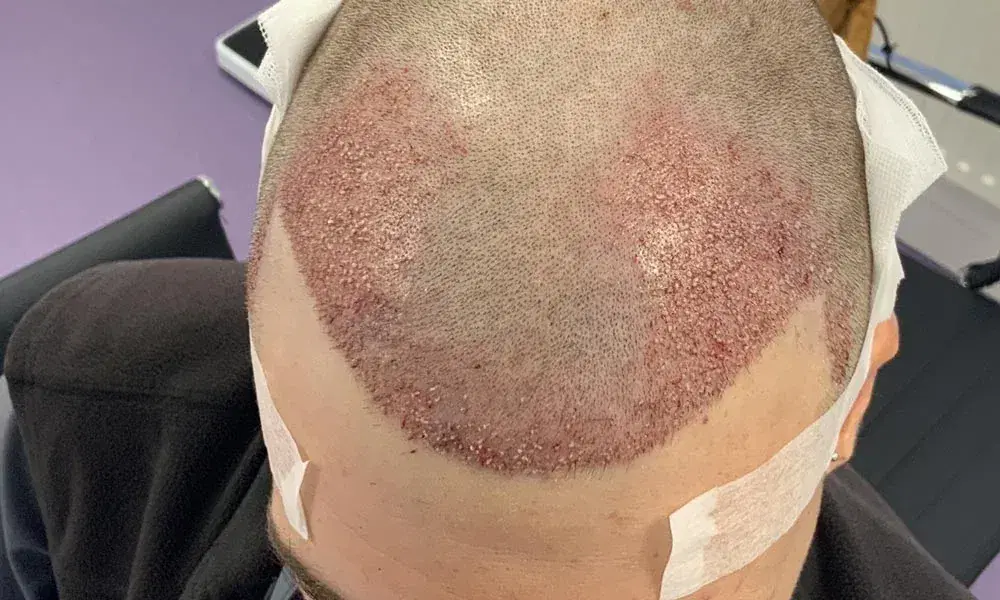
Preserved or implanted hair shafts visible immediately after surgery do not represent final growth.
Risks and Limitations
Potential temporary effects and complications include:
Bleeding.
Swelling.
Redness.
Crusting.
Temporary numbness.
Temporary shedding.
Folliculitis.
Infection.
Scarring.
Poor graft growth.
Low visual density.
Incorrect angle or direction.
An unnatural hairline, eyebrow or beard pattern.
Donor-area thinning.
Overharvesting.
Continued native-hair loss.
A mismatch between donor and facial-hair characteristics.
Need for additional procedures.
Dissatisfaction when the agreed design is not understood clearly.
These risks are related to the surgical procedure, treatment area, patient health and clinical execution. Being transgender or non-binary does not inherently create greater transplant risk.
Scar transplantation carries additional uncertainty because scar tissue may be stiff, thick or less vascular than unaffected skin. A test session or staged plan may sometimes be considered, but no method guarantees equal growth within scars.
How Long Do the Results Last?
Viable transplanted follicles may continue producing hair over the long term, but the visual result can change.
Factors include:
Progressive loss of surrounding native hair.
Genetic susceptibility.
Hormone exposure.
Ageing.
Donor characteristics.
Scalp or skin disease.
Grooming.
Later surgery.
Scar changes.
Donor follicles from the scalp generally retain important characteristics after transplantation. This means scalp hairs placed in the beard or eyebrows may continue behaving more like scalp hair and require regular trimming.
“Permanent” should not be used as an unconditional promise that density, styling or the surrounding hair will never change.
How Much Does a Transgender Hair Transplant Cost?
Cost depends on the actual procedure rather than the patient’s gender identity.
Relevant factors include:
Scalp, beard, eyebrow or combined treatment.
Recipient-area size.
Graft estimate.
Donor quality.
FUE, FUT or implantation workflow.
No-shave requirements.
Previous transplantation.
Scar tissue.
Revision complexity.
Possible staged treatment.
Tests and medication.
Postoperative products.
Follow-up.
International travel services.
A written quotation should state:
Which areas will be treated.
Estimated graft allocation.
Technique and shaving plan.
Who performs each stage.
Included medical tests.
Medication and aftercare.
Follow-up arrangements.
Travel, hotel or transfer inclusions where relevant.
Circumstances that may change the price.
A higher fee does not guarantee superior design, growth or care.
How to Choose a Gender-Affirming Hair Transplant Clinic
Clinic-selection checklist
Staff communicate respectfully.
The clinic asks for the patient’s chosen name and pronouns.
Design goals are discussed without stereotyping.
The relevant scalp or facial treatment experience can be demonstrated.
The cause of hair loss is assessed.
Hormone and medication decisions are referred to appropriate clinicians.
Previous and planned facial surgery is considered.
Donor capacity and future hair loss are explained.
The clinic identifies who performs every surgical stage.
Consent procedures cover photographs and privacy.
Comparable case images are genuine and standardised.
Risks, limitations and alternatives are discussed.
Complication and revision policies are available in writing.
International follow-up arrangements are clear.
Respectful branding alone does not establish clinical competence. Likewise, surgical experience does not excuse insensitive or non-consensual care. Patients should assess both.
Privacy and International Patient Considerations
Before travelling, ask how the clinic handles:
Preferred and legal names in separate contexts.
Pronouns in clinical records.
Passport and booking information.
Photograph storage.
Publication consent.
Communication through email or messaging.
Interpretation.
Accommodation privacy.
Medication transport.
Hormone supplies.
Follow-up after returning home.
Emergency contact.
Communication with the patient’s regular clinician.
Clinical photographs should never be published merely because a general consent form was signed. Consent should identify how images may be used and whether the patient’s transgender status may be disclosed.
WPATH’s current Standards of Care emphasise respect, individualised needs and access to appropriate healthcare for transgender and gender-diverse people.
Transgender Hair Transplant at Esthetic Hair
An individual assessment may consider:
Preferred scalp or facial-hair design.
Frontal, temporal, crown or facial treatment areas.
Hair-loss pattern.
Donor density and calibre.
Existing facial hair.
Previous transplantation.
Scalp or facial scars.
Current or planned hormone therapy.
Previous or planned facial surgery.
Shaving preferences.
Realistic graft requirements.
Long-term donor preservation.
Readers can submit clear photographs for preliminary planning, including frontal, side, top, crown and donor views. Beard, sideburn or eyebrow requests should include straight and profile facial images.
A photograph review cannot replace every aspect of an in-person examination. Final suitability may require scalp magnification, scar examination, donor measurement and review of medical or surgical records.
The treatment plan should be confirmed only after Esthetic Hair has verified which gender-affirming services, techniques, privacy procedures and clinical workflows it currently provides.
Frequently Asked Questions
What is a transgender hair transplant?
It is an individualised use of established hair-transplant methods to support a transgender, non-binary or gender-diverse patient’s preferred appearance. It may involve the scalp hairline, temples, crown, beard, moustache, sideburns, eyebrows or scars. It is not a separate extraction technology.
Can a hair transplant create a more feminine hairline?
It may reduce temporal recession, soften a frontal transition or add hair to selected areas. No hairline shape is universally feminine, and the design should reflect the patient’s facial proportions and preferences. A transplant adds follicles but does not physically advance the entire scalp like hairline-lowering surgery.
Can a hair transplant create a more masculine hairline?
It can help create or restore a more angular or individually selected outline when donor supply and anatomy permit. However, not every transgender man or non-binary patient wants the same shape. Design should not be inferred from gender identity.
Can transgender men receive beard transplants?
Yes, selected transgender men may be candidates for beard, moustache, chin, cheek, jawline or sideburn transplantation. Suitability depends on donor quality, existing facial hair, skin condition and the intended design. Transplanted scalp hair may differ from native beard hair and can require regular grooming.
Can testosterone cause scalp hair loss?
Testosterone may contribute to androgenetic scalp hair loss in genetically susceptible people. The pattern may involve the temples, frontal scalp or crown. Risk and progression vary, so not every person using testosterone develops significant loss.
Can feminising hormone therapy regrow a receding hairline?
It may slow or alter some androgen-related hair changes in selected patients, but it does not reliably recreate an established missing hairline. Results vary, and transgender-specific evidence remains limited. Medication decisions should be discussed with the clinician managing hormone therapy.
Do I need to stop hormone therapy before a hair transplant?
Do not stop or change hormone therapy without medical instructions. The answer depends on the medication, dose, route, medical history, clotting risks and surgical plan. The prescribing clinician and surgical team should coordinate when necessary.
Should I have a hair transplant before or after facial feminisation surgery?
The correct order depends on whether forehead contouring, hairline advancement, brow lifting or another procedure will change the hairline, scars or scalp tension. Where possible, the facial and hair-restoration teams should coordinate the sequence rather than applying one universal rule.
Can hair transplantation be combined with hairline-lowering surgery?
The procedures may sometimes be combined or staged. Hairline advancement moves scalp tissue, while transplantation places follicles into selected areas such as temporal recessions or scars. Scalp mobility, scar position, donor supply and the wider facial-surgery plan determine suitability.
Is FUE or DHI better for transgender patients?
Neither is universally better. FUE describes individual donor extraction, while DHI commonly describes an implanter-based placement workflow. Technique selection should consider donor quality, graft requirement, treatment area, scars, existing hair and shaving preference—not gender identity.
Can the procedure be performed without shaving?
Possibly. Options may include partial, concealed or donor-only trimming and selected unshaven techniques. The practical choice depends on graft numbers, treatment area, hair length and surgical access. “No shave” does not always mean that no hairs are shortened.
Can transplanted scalp hair be used for a beard?
Scalp donor hair is commonly used in facial-hair transplantation. It may retain scalp-like calibre, growth or grooming needs and may not perfectly match native beard texture. The clinician should assess colour, curl, diameter and donor availability before recommending treatment.
Can hair be transplanted into facial or scalp scars?
It may be possible in selected stable scars, but growth can be less predictable because scar thickness, stiffness and blood supply vary. Active disease or unsuitable scars may require another approach. Examination is necessary before estimating density or graft survival.
How many grafts will I need?
There is no standard number for a transgender hair transplant. The estimate depends on the treatment area, existing hair, donor density, hair calibre, scar tissue, desired coverage and future needs. A beard, eyebrow and frontal hairline also require different graft allocation strategies.
Are transgender hair-transplant results permanent?
Viable transplanted follicles may produce hair over the long term, but the surrounding native hair can continue changing. Hormones, genetic susceptibility, ageing, scalp disease and future procedures may affect the appearance. No responsible provider should guarantee an unchanged lifetime result.
How can I find a transgender-friendly hair transplant clinic?
Look for respectful communication, personalised design, appropriate experience, transparent staffing, careful donor planning, genuine consented cases and clear privacy procedures. Ask how the clinic coordinates hormone or facial-surgery considerations. LGBTQ-friendly branding alone does not prove medical competence.
Can non-binary people receive gender-affirming hair transplantation?
Yes. A non-binary person may pursue a feminising, masculinising, neutral, reconstructive or individually defined result. Treatment should be designed around the person’s preferences and clinical findings rather than forcing the design into a binary category.
Is a diagnosis of gender dysphoria required for hair transplantation?
A diagnosis should not be assumed to be universally required simply because a patient is transgender or non-binary. Requirements can vary according to jurisdiction, insurer, procedure and clinical setting. Medical suitability, informed consent and local rules should be clarified directly with the provider.
Final Assessment
Transgender hair transplantation is not one separate surgical method. It is a personalised application of hair-restoration techniques that may address the scalp hairline, temples, crown, beard, sideburns, eyebrows or scars.
The design should follow the patient’s individual goals rather than a fixed feminine or masculine template. Hormone therapy can influence scalp and facial hair, but it does not guarantee a particular pattern or eliminate the need for long-term planning.
Donor capacity, progressive hair loss, skin condition, previous procedures and future facial surgery must all be considered. Medication or hormone changes should only occur through coordination with the relevant clinicians.
Readers considering treatment can request a private assessment of their preferred design, donor area, hair-loss pattern, scars, previous procedures and future plans. An assessment should explain both the technically possible options and their limitations without assuming that surgery is necessary for anyone’s gender identity.
Source: https://pubmed.ncbi.nlm.nih.gov/37348980/