
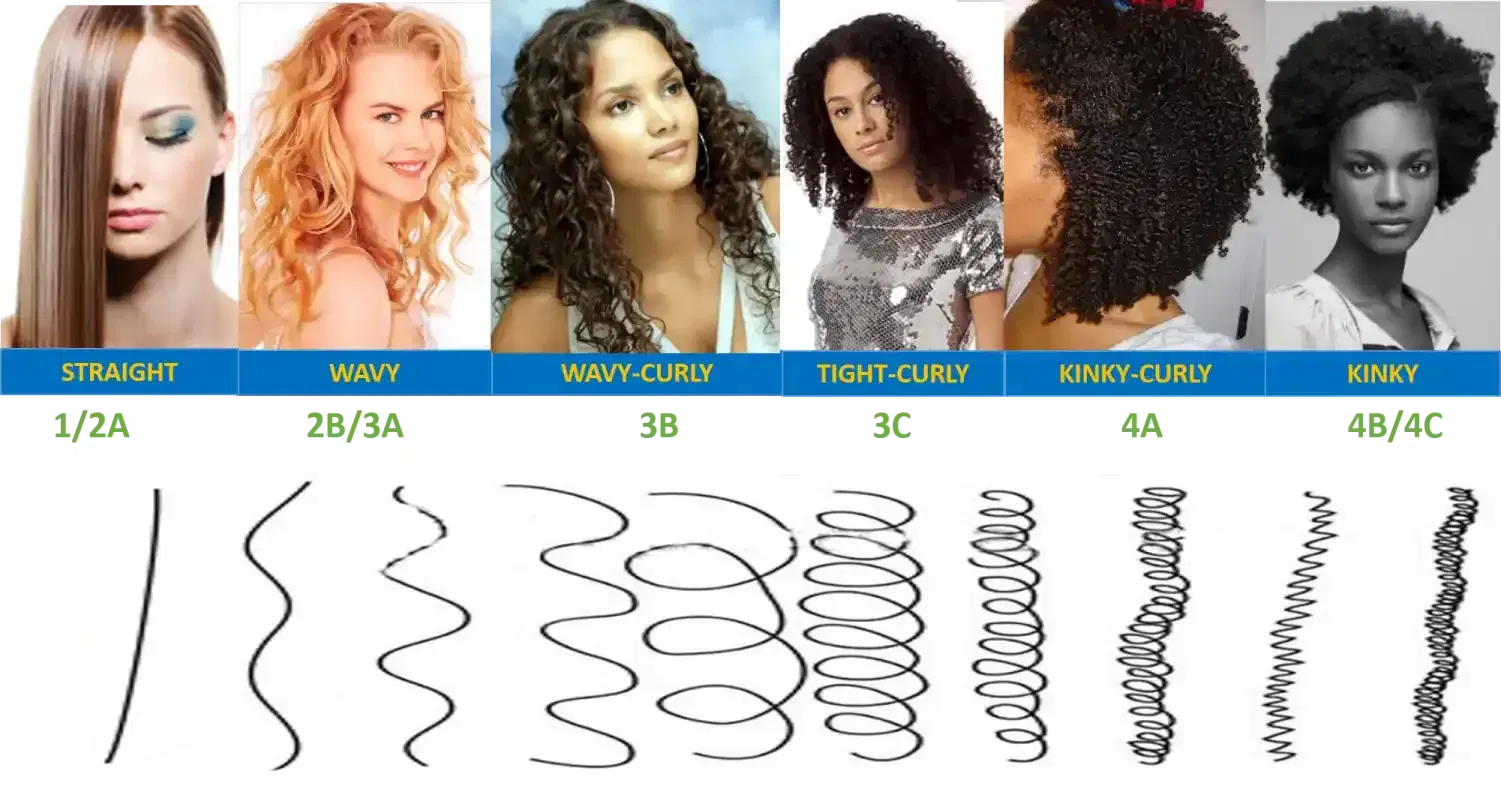
Type 3 curly hair is known for its visible spiral pattern. The curls may range from loose, wide loops to compact corkscrews, depending on the individual and the area of the head. Within this category, hair is commonly described as 3A, 3B, or 3C.
These labels can be useful when choosing products, styling methods, and haircuts, but they should not be treated as strict rules. Curl typing is a descriptive system rather than a medical or scientific diagnosis. Many people have more than one curl pattern, and the same hair can appear different depending on humidity, length, damage, product buildup, or styling technique.
Understanding Type 3 curly hair is less about fitting every strand into one category and more about recognising how the hair behaves. Curl size matters, but so do density, porosity, strand thickness, scalp condition, and the amount of moisture the hair retains.
What Is Type 3 Curly Hair?
Type 3 hair forms defined curls rather than loose waves or tightly angled coils. When allowed to dry without brushing or stretching, the strands usually create an S-shaped or spiral pattern.
One common characteristic of curly hair is that natural scalp oil does not travel down the strand as easily as it does on straighter hair. The bends and turns in the curl pattern can slow that movement. As a result, the lengths and ends may feel dry even when the scalp becomes oily.
Type 3 curly hair can also be affected by shrinkage. The hair may look much shorter when dry because the strands contract into spirals. The degree of shrinkage varies considerably. Loose curls may lose only a small amount of visible length, while tighter curls can appear significantly shorter after drying.
Frizz is another common concern, although frizz is not automatically a sign of unhealthy hair. It can develop when curls separate, when the cuticle is raised, or when the hair reacts to moisture in the air. Frizz may also increase after brushing dry curls, using too much heat, or handling the hair repeatedly while it dries.
What Is 3A Curly Hair?
Type 3A hair usually forms loose, wide spirals. The curl diameter may be similar to a large marker or piece of sidewalk chalk, although this comparison is only approximate.
The roots may appear relatively flat, especially when the hair is long or dense. The weight of the hair can stretch the curl near the scalp, while the mid-lengths and ends form more obvious loops.
Type 3A curls often have visible shine because their looser pattern may reflect light more evenly than tighter curls. However, the ends can still become dry or tangled, particularly when the hair is colour-treated, frequently heated, or exposed to sun and wind.
Heavy products can weigh down 3A hair and reduce volume. Thick butters, dense oils, and large amounts of styling cream may leave the curls elongated or greasy. Many people with this curl type prefer lightweight leave-in conditioners, mousses, foams, or fluid gels.
A simple 3A routine may involve gentle cleansing, a light conditioner, a small amount of leave-in product, and a gel or mousse applied to wet hair. Scrunching can encourage curl formation without forcing the hair into a shape it does not naturally hold.
What Is 3B Curly Hair?
Type 3B hair generally forms springy ringlets with a medium curl diameter. The curls are tighter than 3A curls and may resemble the width of a marker, finger, or small piece of chalk.
This curl type often has noticeable volume and can shrink more than 3A hair. The pattern may begin closer to the roots, although this depends on haircut, length, and density.
Type 3B hair may require a balance between moisture and hold. Products that are too light may not provide enough definition, while very heavy formulas can create buildup or reduce movement.
Cream-gel combinations often work well for this pattern. A curl cream can provide slip and softness, while a gel can help the curls retain their shape as they dry. The amount needed depends on strand thickness and density. Fine 3B hair may need less cream than coarse or very dense hair.
Tangling can be more noticeable with 3B curls because the spirals can wrap around one another. Detangling in sections, with conditioner or another product that provides slip, can reduce unnecessary pulling.
What Is 3C Curly Hair?
Type 3C hair forms tight, densely packed corkscrew curls. The curl diameter is often compared with a pencil or drinking straw. This pattern sits near the boundary between curly and coily hair, so some heads contain a mixture of 3C and Type 4 strands.
Shrinkage is usually more visible with 3C hair. A strand may appear much longer when stretched than it does in its natural dry state. This is normal and does not indicate poor growth.
Because the curls are compact and often densely arranged, 3C hair may feel full even when individual strands are fine. The scalp can also be harder to reach during washing and product application.
Moisture retention is often a priority for 3C curls. Richer conditioners, leave-in products, creams, and gels may help reduce friction and improve manageability. However, the heaviest product is not always the most suitable. Dense formulas can build up on the scalp or make fine strands feel coated.
Sectioning is particularly helpful when caring for 3C hair. Working in four or more sections can make cleansing, conditioning, detangling, and styling more controlled.
Can You Have More Than One Curl Type?
Most curl patterns are not completely uniform. Someone may have 3A curls around the face, 3B curls at the crown, and tighter sections near the back of the head. The underside may behave differently from the top because it receives less environmental exposure.
Different patterns do not necessarily mean that part of the hair is damaged. Genetics, follicle shape, strand thickness, and growth direction can create natural variation.
Damage can still alter curl shape. Repeated heat styling, chemical straightening, bleaching, and mechanical stress may loosen sections or make them less defined. The difference is often that damaged strands also feel rough, weak, or unusually difficult to style.
Rather than buying separate products for every small variation, it is usually more practical to adjust the amount of product or styling method in each area. A tighter section may need more water and conditioner, while a looser section may require less cream.
How Often Should Type 3 Curly Hair Be Washed?
There is no single washing schedule that suits every person with Type 3 curly hair. The right frequency depends on scalp oiliness, exercise, product use, climate, and personal comfort.
Some people wash every few days, while others prefer a weekly schedule. A scalp that feels itchy, oily, uncomfortable, or heavily coated may need cleansing sooner.
Curly hair does not always require a very harsh shampoo. A gentle cleanser can remove sweat, oil, and regular product residue without leaving the lengths excessively dry. However, gentle shampoo is not the same as avoiding proper cleansing.
Styling creams, oils, gels, dry shampoo, and mineral deposits can build up over time. An occasional clarifying wash may help when curls feel limp, sticky, dull, or difficult to wet. Clarifying too often may make the hair feel dry, so it should be adjusted to product use and scalp condition.
Shampoo should primarily be applied to the scalp. The lengths usually receive enough cleansing as the lather and water move through the hair during rinsing.
How Should Type 3 Hair Be Conditioned?
Conditioner improves slip, which can make curly hair easier to detangle. It also reduces friction between strands and can help the hair feel softer after washing.
Apply conditioner mainly to the mid-lengths and ends. People with dry roots or very dense curls may also use a small amount closer to the scalp, but heavy application can weigh down some curl types.
Detangle while the hair is wet and coated with conditioner. Fingers, a wide-tooth comb, or a flexible detangling brush may be used, depending on preference. Begin at the ends and gradually work upward rather than pulling from the roots.
Deep conditioning can be useful when hair feels unusually dry or has been exposed to heat, colour, sun, or swimming. It does not need to be part of every wash for everyone. Fine 3A hair, for example, may become overly soft or flat when treated with rich masks too frequently.
Porosity and Type 3 Curly Hair
Porosity refers to how easily hair absorbs and releases water. It often affects product choice more than curl type alone.
Lower-porosity hair may take longer to become fully wet and can develop surface buildup. Lightweight products applied to warm, very wet hair may spread more effectively.
Higher-porosity hair tends to absorb water quickly but may also lose moisture rapidly. It can occur naturally or as a result of chemical and heat damage. Layering a leave-in conditioner with a cream or gel may help the hair feel more manageable.
Home porosity tests, such as placing a loose hair in a glass of water, are not always reliable because oil, product residue, and surface tension can affect the result. Observing how the hair behaves during washing, drying, and styling is usually more useful.
How to Style 3A, 3B, and 3C Curls
Styling products generally work best when Type 3 hair is wet. Water helps curls group together, while styling products support the pattern as the hair dries.
For 3A curls, a light leave-in conditioner followed by mousse or gel may provide definition without reducing volume.
For 3B curls, a small amount of cream under a medium-hold gel can balance softness and structure.
For 3C curls, applying leave-in conditioner, cream, and gel in sections may improve coverage and reduce tangling. Some people need all three layers, while others get better results with fewer products.
Common application methods include scrunching, smoothing, finger coiling, brush styling, and praying hands. No method is universally correct. The best option is the one that produces manageable results without excessive pulling or time.
Once the hair is styled, avoid touching it repeatedly while it dries. Handling can separate curl groups and increase frizz.
Air-Drying and Diffusing
Air-drying avoids direct heat, but it can take several hours for dense Type 3 hair. Keeping the scalp wet for a long time may also feel uncomfortable.
A diffuser spreads airflow over a wider area and can reduce the disruption caused by a standard hair dryer nozzle. Use low or moderate heat and airflow rather than placing very hot air close to the hair.
Diffusing with the head upright may create a more elongated result. Tilting the head or gently placing sections into the diffuser bowl may increase volume. Moving the hair too much before it has started to set can create additional frizz.
A heat-protective product may be useful when diffusing regularly, although it does not make unlimited heat exposure harmless.
Protecting Curly Hair at Night
Friction against bedding can disturb curl definition and contribute to tangling. A satin or silk pillowcase, bonnet, or scarf may help reduce rubbing, although it will not prevent every knot.
Longer curls can be loosely gathered at the top of the head in a “pineapple” style. The tie should not be so tight that it places tension on the edges or leaves a strong dent.
Shorter 3C curls may be easier to protect with a bonnet or loose sections. In the morning, water or a lightweight refresh spray can help reshape flattened areas. Adding more product every day can cause buildup, so sometimes water and gentle finger styling are enough.
Haircuts for Type 3 Curly Hair
A well-planned haircut can influence shape, volume, and how evenly curls fall. Layers may remove bulk and allow curls to move more freely, but excessive layering can create unwanted width or thin-looking ends.
A stylist should consider shrinkage before deciding on length. Wet curly hair may appear considerably longer than it will after drying.
Some stylists cut curls dry so they can see how each section naturally sits. Others prefer a wet cut for precision and evenness. Both approaches can work when the stylist understands curly hair and communicates clearly about the intended shape.
Reference photographs are helpful, but results will still depend on density, curl pattern, length, and facial proportions.
Common Mistakes When Caring for Type 3 Hair
Brushing dry curls is one of the most common causes of lost definition and visible frizz. Unless the goal is a brushed-out style, detangling is generally easier on wet, conditioned hair.
Using too much oil can also create problems. Oil may reduce friction and add surface shine, but it does not provide water to dry hair. Applying repeated layers can leave curls coated without making them more hydrated.
Another mistake is changing several products at the same time. When the result improves or worsens, it becomes difficult to identify the cause. Introduce one change at a time and observe how the hair responds over several washes.
Tight hairstyles should also be used carefully. Repeated tension around the hairline can contribute to breakage and, in some cases, traction-related hair loss.
Final Thoughts
Type 3 curly hair includes a broad range of spiral patterns. Type 3A curls are generally loose and wide, 3B curls are springier and more compact, and 3C curls form tight corkscrews with more visible shrinkage.
Curl type can provide a starting point, but it does not tell the whole story. Porosity, density, strand thickness, scalp condition, damage history, and climate all affect how the hair behaves.
A practical routine usually begins with proper scalp cleansing, adequate conditioning, gentle detangling, and styling on wet hair. From there, products and techniques can be adjusted according to the individual. The aim is not to force every curl into a perfect category. It is to find a routine that keeps the hair comfortable, manageable, and suited to the way it naturally grows.