
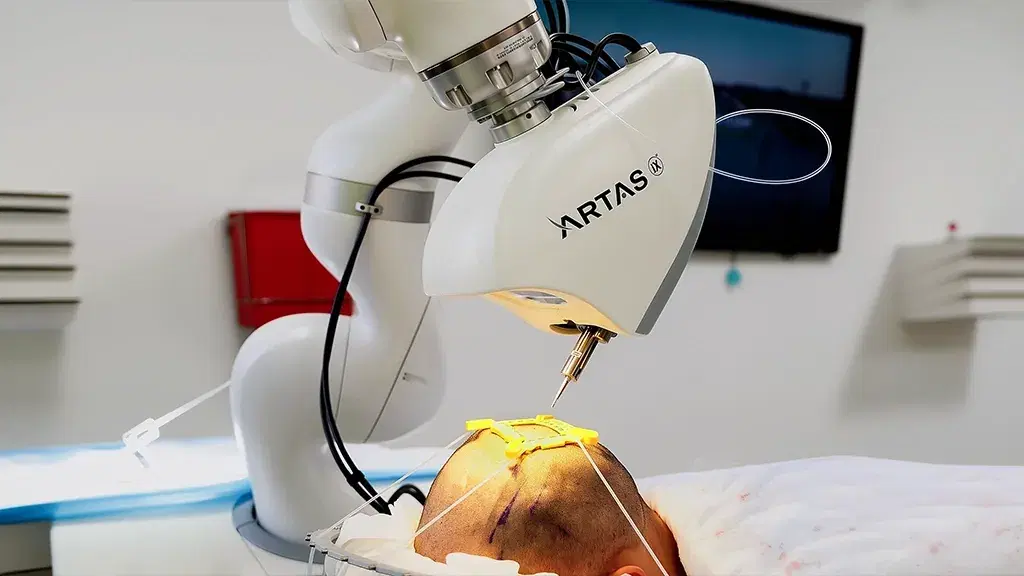
A robotic hair transplant is a physician-controlled FUE procedure using imaging, software, and a robotic arm to assist surgery. The system can identify follicular units, guide extraction, create recipient sites, and sometimes assist implantation. However, the robot does not independently diagnose hair loss, design the hairline, or manage long-term donor supply. Evidence shows comparable outcomes with manual FUE, not guaranteed superiority. Candidate suitability still depends on donor stability, hair characteristics, scalp anatomy, and surgical planning. Robotic treatment also creates small FUE scars and carries standard transplant risks.
What Does Robotic Hair Transplant Mean?
Robotic hair transplantation is robot-assisted follicular unit excision, usually performed with the ARTAS platform.
It does not create new hair or regenerate inactive follicles. Instead, it relocates existing follicles from a stable donor zone to thinning areas. Digital cameras map hair position, angle, spacing, and direction before the robotic arm acts. The physician selects settings and supervises every automated movement. Therefore, robotic transplantation remains surgery rather than a hands-free cosmetic treatment. The final appearance still depends on donor selection, hairline design, graft handling, and placement quality.
How Does a Robotic Hair Transplant Work?
Robotic hair transplantation works by combining scalp imaging, software planning, and automated follicular-unit targeting.
The exact workflow depends on the system and clinic configuration.
The team trims and anesthetizes the donor area before stabilizing the scalp.
Cameras identify visible follicular units and estimate their exit angles.
The physician sets punch depth, spacing, and harvesting boundaries.
The robotic arm scores selected grafts, while staff remove and inspect them.
Software can guide recipient-site creation using planned angle, depth, and density.
Some cleared configurations also assist implantation from a preloaded cartridge.
Clinicians still protect grafts, verify quality, and correct placement throughout surgery.
Which Hair Transplant Steps Still Require Human Control?
Human clinicians still control diagnosis, hairline design, donor strategy, graft handling, and safety decisions.
FDA documents describe ARTAS as a physician-controlled assistant, not an autonomous surgeon. A clinician defines treatment areas and operating parameters before robotic actions begin. Staff may remove scored grafts, sort them, store them, and load implantation cartridges. The team also monitors bleeding, anesthesia, positioning, hydration, and graft quality. After implantation, clinicians inspect follicles and adjust misplaced grafts when necessary. This division matters because artistry and long-term planning remain outside automated image recognition.
Who Is Suitable for Robotic Hair Transplantation?
Suitable candidates have stable donor hair, confirmed transplantable hair loss, and realistic long-term expectations.
However, device labeling adds a rarely discussed limitation. The 2018 FDA-cleared ARTAS indication specifies men with androgenetic alopecia and black or brown straight hair. That wording reflects the evaluated device indication, not a universal biological rule. Light hair may reduce image contrast, while strong curl can complicate follicle tracking. Some clinics modify preparation or choose manual extraction for unsupported characteristics. A medical examination must also exclude unstable alopecia, poor donor density, and active scalp disease. Eligibility should follow anatomy and diagnosis, not technology marketing.
Is the ARTAS Hair Transplant Robot FDA-Approved?
ARTAS received FDA 510(k) clearance, which is different from premarket approval.
The FDA classified the system as a Class II stereotaxic instrument. Clearance means the agency found substantial equivalence to a legally marketed predicate device. It does not mean FDA guarantees superior results or endorses a particular clinic. The 2018 clearance covered harvesting, recipient-site creation, and assisted implantation under physician control. Patients should therefore avoid treating “FDA-approved robot” as proof of surgical excellence. Provider training, patient selection, and documented outcomes remain entirely separate quality questions.
Is Robotic Hair Transplant Better Than Manual FUE?
Current evidence does not prove robotic hair transplantation consistently outperforms skilled manual FUE.
A 2024 split-scalp study compared ARTAS and manual FUE in 13 men. Robotic yield was 82.05%, versus 90.03% manually, without a significant difference. Robotically harvested grafts showed a significantly higher discard rate. Transection rates were similar, measuring 13.17% robotically and 13.96% manually. Patient satisfaction and regrowth showed no significant difference after twelve months. A separate 30-person FDA study found robotic implantation non-inferior at nine months. These small studies support comparability, but they cannot establish universal superiority. Operator skill and patient anatomy still influence both methods.
Does Robotic Hair Transplant Leave Scars or Cause Risks?
Robotic hair transplantation avoids a linear strip scar, but it does not provide scarless surgery.
It uses FUE punches, creating many small donor wounds.
Visible dot scarring can increase after oversized punches or aggressive harvesting.
Temporary swelling, crusting, itching, numbness, and shedding can follow treatment.
Folliculitis, infection, bleeding, necrosis, and poor growth occur less commonly.
Excessive extraction can permanently thin the donor region.
Poor planning can create unnatural hairlines or exhaust future donor reserves.
The robot may standardize movements, but it cannot eliminate biological or planning risks. Qualified medical oversight remains essential throughout the procedure.
How Long Do Robotic Hair Transplant Recovery and Results Take?
Recovery resembles standard FUE because robotic assistance does not change normal follicular healing.
Crusting and redness usually improve first, while transplanted shafts may shed later. New growth often becomes noticeable after several months and matures gradually. Final evaluation usually requires about twelve months, sometimes longer for crown work. Robotic accuracy cannot overcome limited donor supply or continuing androgenetic alopecia. Medical treatment may help protect existing hair when clinically appropriate. Choose a clinic by diagnosis quality, surgeon involvement, donor planning, and comparable results. Ask exactly which stages the robot performs and who completes every remaining stage.
References
FDA, ARTAS System 510(k) Summary:
https://www.accessdata.fda.gov/cdrh_docs/pdf17/K173358.pdfFDA, Premarket Notification 510(k):
https://www.fda.gov/medical-devices/premarket-submissions-selecting-and-preparing-correct-submission/premarket-notification-510kZhu Y, et al., Robotic Hair Restoration Versus Traditional FUE:
https://pmc.ncbi.nlm.nih.gov/articles/PMC11626372/Rose PT, Nusbaum B, Robotic Hair Restoration:
https://pubmed.ncbi.nlm.nih.gov/24267426/Hair Transplant Practice Guidelines:
https://pmc.ncbi.nlm.nih.gov/articles/PMC8611706/Deciding Surgical Candidacy in Pattern Hair Loss:
https://pmc.ncbi.nlm.nih.gov/articles/PMC8719975/Complications in Hair Transplantation:
https://pmc.ncbi.nlm.nih.gov/articles/PMC6371733/Hair Transplantation: State of the Art:
https://pubmed.ncbi.nlm.nih.gov/40354670/