
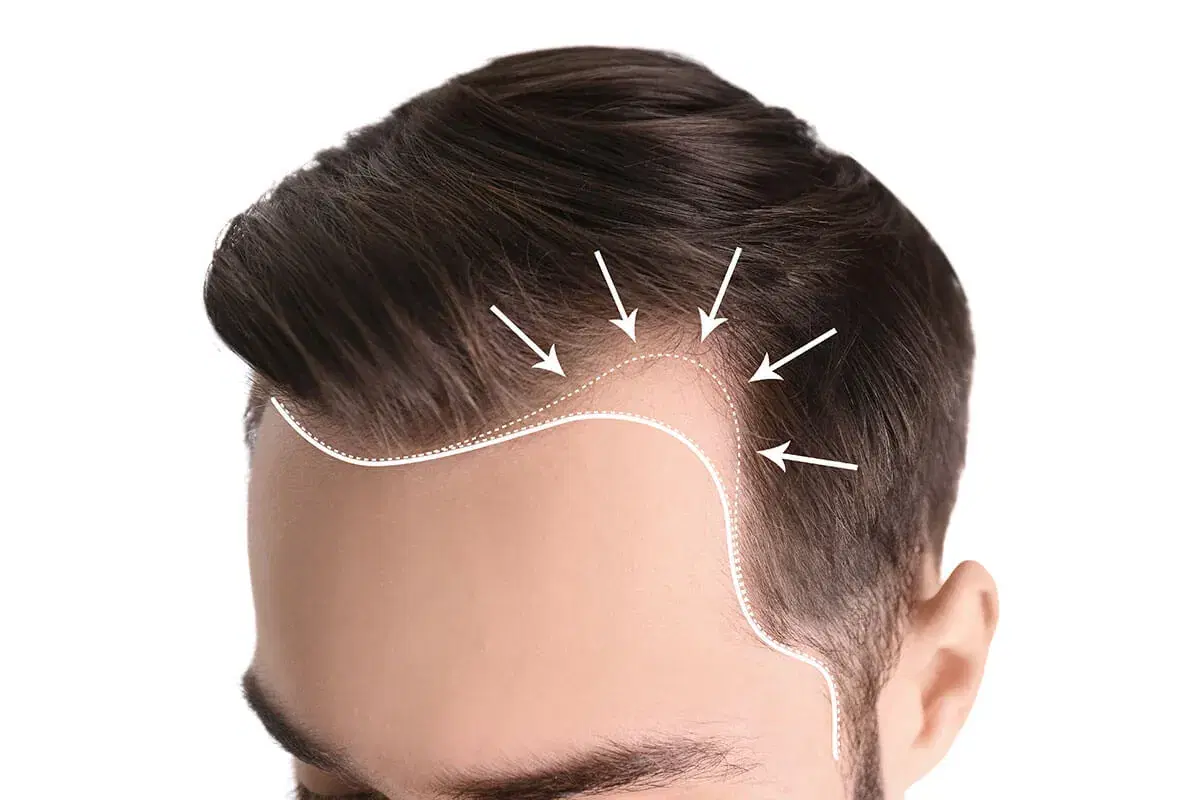
Is It Normal for One Side of the Hairline to Recede Faster?
Mild asymmetry between the two temples is common, and androgenetic hair loss does not have to progress at exactly the same speed on both sides. Human faces, skulls and natural hairlines are rarely perfectly symmetrical in the first place, so early recession can exaggerate a difference that was already present.
One temple may become visibly thinner months or even years before the opposite side develops similar changes. What matters more is the trend. A slightly higher temple that has looked unchanged for several years is different from a side where the hairline is steadily moving backward and the hairs along the edge are becoming finer.
What Causes Uneven Hairline Recession?
Several different mechanisms can make one side of the frontal hairline appear thinner or further back than the other. Genetic hair loss is one of the most common explanations, but it is not the only possibility.
Common causes include:
Asymmetrical androgenetic alopecia
A naturally uneven adult hairline
Greater miniaturization at one temple
Tight hairstyles pulling more strongly on one side
Repeated twisting or pulling of the same section
Hair breakage near one temple
Local scalp inflammation
Alopecia areata
Scarring forms of alopecia
Previous injury or surgery near the hairline
Differences in styling, parting or hair direction
Unequal lighting that makes one temple appear thinner
The pattern around the recession usually provides more useful information than the asymmetry by itself.
Can Male Pattern Baldness Be Asymmetrical?
Male pattern baldness can develop asymmetrically, especially when recession first becomes noticeable at the temples. Although androgenetic alopecia eventually tends to follow recognizable patterns, individual follicles do not all miniaturize at the same moment or at the same rate.
One frontal corner can therefore lose diameter and density faster than the other. The shorter, finer hairs produced by miniaturizing follicles also provide less coverage, making the affected side look substantially further back before the hairline has physically shifted by a large distance.
Over time, the opposite side may also recede, but there is no rule that both sides must become identical. Some men retain a visibly asymmetric hairline throughout the course of their hair loss.
Why Does One Temple Often Look Worse Than the Other?
One temple can look worse because temple density, hair direction and follicle sensitivity are not perfectly mirrored across the scalp. Even small anatomical differences can become obvious once early thinning begins.
Hair on one side may naturally sweep backward while the other side grows more forward, creating different levels of scalp exposure. A stronger cowlick or directional change can produce the same effect.
Lighting also matters more than many people realize. Photographs taken under overhead light can expose one temple depending on head position, while selfies can reverse or distort perceived symmetry. This is why repeat photographs should use the same lighting, camera distance and hair position before concluding that one side is deteriorating faster.
Is an Uneven Hairline the Same as a Receding Hairline?
An uneven hairline is not necessarily a receding hairline. Some people naturally have one temple higher than the other, and this asymmetry can remain stable throughout adulthood.
True recession involves change over time. The edge gradually moves backward, density decreases or hairs near the border become shorter and finer because of follicular miniaturization.
A mature adult hairline can also sit slightly higher than an adolescent hairline without continuing to recede significantly. The distinction becomes clearer when older photographs are compared over several years rather than several weeks.
If one temple has always been higher but its shape and density remain stable, natural asymmetry may explain the appearance better than active hair loss.
Can Sleeping on One Side Cause Hairline Recession?
Sleeping consistently on one side is unlikely to cause typical progressive temple recession by itself. Normal pillow contact does not usually create enough tension to produce the follicular miniaturization seen in androgenetic alopecia.
Friction can contribute to hair-shaft breakage in some situations, particularly when hair is fragile, chemically treated or repeatedly rubbed. Breakage, however, affects the visible shaft rather than moving the follicular hairline backward.
Persistent pressure would also be an unusual explanation for isolated temple recession without other scalp changes. If the hairs are becoming gradually finer at the root rather than simply snapping, genetic miniaturization or another follicular condition deserves greater consideration.
Can Hairstyles Make One Temple Recede Faster?
Repeated tension can make one temple thin faster when a hairstyle consistently pulls that side more strongly. This is known as traction alopecia and commonly affects the frontal and temporal margins.
Tight ponytails, braids, extensions, buns, head coverings attached under tension or repeatedly pulling the hair back can place chronic stress on the same follicles. Asymmetrical styling can therefore create asymmetrical loss.
Early traction alopecia may improve when the tension stops, particularly while follicles remain intact. Long-standing traction can eventually produce permanent loss if repeated injury leads to scarring.
Small broken hairs, tenderness and recession exactly where tension occurs make traction more suspicious than a smooth, genetically patterned temple recession.
Can Stress Cause Hair Loss on Only One Side?
Psychological or physical stress usually causes diffuse shedding rather than isolated recession of one temple. Telogen effluvium, for example, tends to increase shedding across the scalp after illness, major stress, surgery, rapid weight loss or another significant trigger.
Stress can still make an existing asymmetry more visible. If overall density decreases, a temple that was already genetically thinner may suddenly look much worse.
Stress-related shedding can also overlap with androgenetic alopecia. In that situation, diffuse shedding temporarily exposes an underlying pattern of miniaturization.
A distinctly one-sided area that continues expanding should therefore not automatically be attributed to stress, particularly when there are changes in the skin or sharply localized hair loss.
Could Scalp Inflammation Cause Uneven Recession?
Scalp inflammation can contribute to localized shedding when irritation or inflammatory disease is stronger in one region. Redness, itching, burning, scale, crusting or pustules make inflammation more relevant than uncomplicated genetic recession.
Seborrheic dermatitis and psoriasis usually affect broader areas, but their distribution does not always look perfectly symmetrical. Contact dermatitis can also be localized if a product repeatedly reaches one side of the hairline.
Folliculitis may create tender bumps or pustules around individual follicles. When inflammation is intense or persistent, temporary shedding can occur.
The more important issue is distinguishing ordinary inflammatory shedding from a scarring process, because inflammation that permanently destroys follicles requires earlier diagnosis and treatment.
Can Alopecia Areata Affect One Side of the Hairline?
Alopecia areata can produce localized hair loss and may involve one side of the frontal or temporal hairline. Its appearance, however, is often different from the gradual miniaturization typical of androgenetic alopecia.
Loss may develop relatively quickly and create a smooth patch rather than slowly moving the entire temple backward. Some people develop characteristic short or tapered hairs around active areas, although these are not always present.
Alopecia areata can also affect the eyebrows, beard or other scalp regions.
Sudden focal loss should therefore be assessed differently from slow temple recession. The distinction matters because treatments and expected progression differ substantially between autoimmune patch loss and genetic pattern hair loss.
Can a Scarring Alopecia Begin Asymmetrically?
Some scarring alopecias can begin unevenly and may initially affect one side more noticeably. Conditions involving inflammation around frontal follicles deserve particular attention because delayed treatment can allow permanent follicular destruction.
Warning signs are often found in the scalp itself rather than in the shape of the hairline. Burning, pain, persistent redness, perifollicular scale or smooth shiny areas where follicular openings are disappearing should not be treated as ordinary male pattern recession without assessment.
Certain scarring conditions can involve the frontal hairline and eyebrows, while others appear as irregular patches.
Early diagnosis matters because once a follicle has been replaced by scar tissue, medications cannot simply reactivate it in the same way as a miniaturized but living follicle.
How Can I Tell Whether the Hairline Is Actually Getting Worse?
The most reliable way to judge uneven recession is to compare the hairline over months using standardized photographs rather than checking it repeatedly in mirrors. Small changes in hairstyle, hair length or lighting can make one temple appear dramatically different from day to day.
Take photographs with dry hair in the same position, using similar light and camera distance. Front, left temple, right temple and top-down views are usually more informative than one frontal selfie.
Also pay attention to hair caliber. Progressive miniaturization often produces a mixture of thick terminal hairs and finer, shorter hairs along the advancing edge.
Changes over six to twelve months provide much stronger evidence of progression than differences noticed over several days.
What Warning Signs Need Medical Assessment?
One-sided recession deserves closer medical assessment when it behaves differently from ordinary gradual pattern hair loss or when the scalp itself changes.
Important warning signs include:
Rapidly expanding localized hair loss
A clearly defined bald patch
Persistent burning or scalp pain
Significant redness around follicles
Heavy scaling or crusting
Pustules or drainage
Smooth or shiny skin in the thinning area
Loss of visible follicular openings
Eyebrow or eyelash loss
Broken hairs concentrated in one area
Sudden shedding across the rest of the scalp
Recession associated with a new medication or systemic symptoms
Progressive loss despite removing obvious traction
These findings do not identify one specific diagnosis, but they make professional examination more useful than assuming the problem is simply genetic.
Can Minoxidil Correct an Uneven Receding Hairline?
Minoxidil may improve density in some people with androgenetic hair loss, but it cannot guarantee that two asymmetric temples will become perfectly equal. Its role is to support susceptible follicles and prolong productive hair growth rather than redraw the hairline.
Response also varies by region. Frontal and temporal recession can be harder to restore than areas where follicles are miniaturized but still produce stronger hairs.
Treatment needs consistency, and early shedding can occasionally occur as follicles move through the growth cycle. Any benefit generally requires continued use.
If one side is receding because of scarring, traction or another unrelated condition, treating it as ordinary androgenetic alopecia without establishing the cause may delay more appropriate management.
Can Finasteride Help Asymmetrical Hair Loss?
Finasteride can help slow androgenetic hair loss in appropriate male patients, including cases where recession is more advanced on one side. It works on the hormonal pathway involved in follicular miniaturization rather than specifically targeting the more recessed temple.
The aim is usually stabilization and preservation of existing hair. Some patients also experience thickening of miniaturized hairs, but complete reconstruction of a deeply recessed temple should not be assumed.
Because it is a prescription treatment with potential adverse effects and individual contraindications, its risks and benefits should be discussed with an appropriate clinician.
If the underlying problem is traction, alopecia areata or scarring alopecia, finasteride does not address the primary cause.
Will the Slower Side Eventually Catch Up?
The less affected side may recede later in androgenetic alopecia, but it does not necessarily catch up until both temples look identical. Hair loss progression remains individual and can stay asymmetric for years.
A person may begin with a naturally higher right temple and then develop genetic recession on both sides, preserving that difference even as the overall hairline moves backward.
Conversely, one side may progress rapidly for a period and then remain relatively stable while the other side changes.
Predicting exact symmetry is therefore difficult. The more useful question is whether miniaturization continues across the frontal scalp and whether the overall pattern is becoming more advanced.
What Should I Do If One Side Is Receding Faster?
The first step is to determine whether there is genuine progression rather than reacting to one photograph or temporary change in styling. Tracking the hairline consistently for several months can reveal whether one temple is truly moving backward.
Useful steps include:
Compare photographs from previous years
Take standardized monthly or quarterly photos
Avoid repeatedly pulling or tightly styling the affected temple
Look for redness, scale, broken hairs or tenderness
Review whether new products contact one side more than the other
Note any recent illness, rapid weight change or unusual shedding
Check whether close relatives developed a similar recession pattern
Avoid aggressive scalp manipulation
Seek assessment if the change is rapid or localized
Discuss evidence-based treatment when androgenetic alopecia is confirmed
The goal is to identify the pattern early without treating normal asymmetry as a disease.
When Should I See a Dermatologist?
A dermatologist is particularly useful when the cause of asymmetric recession is unclear, the change is accelerating or symptoms suggest something other than ordinary genetic hair loss. Examination under magnification can help distinguish follicular miniaturization from breakage, inflammatory change or loss of follicular openings.
A gradual, symptom-free difference between the temples often turns out to be natural asymmetry combined with androgenetic hair loss. In contrast, sudden patches, pain, burning, marked scaling or scar-like skin deserve earlier evaluation.
One side receding faster does not automatically indicate a more dangerous form of hair loss. It does, however, provide a reason to look at the pattern carefully rather than assuming both sides of the hairline must behave identically.