
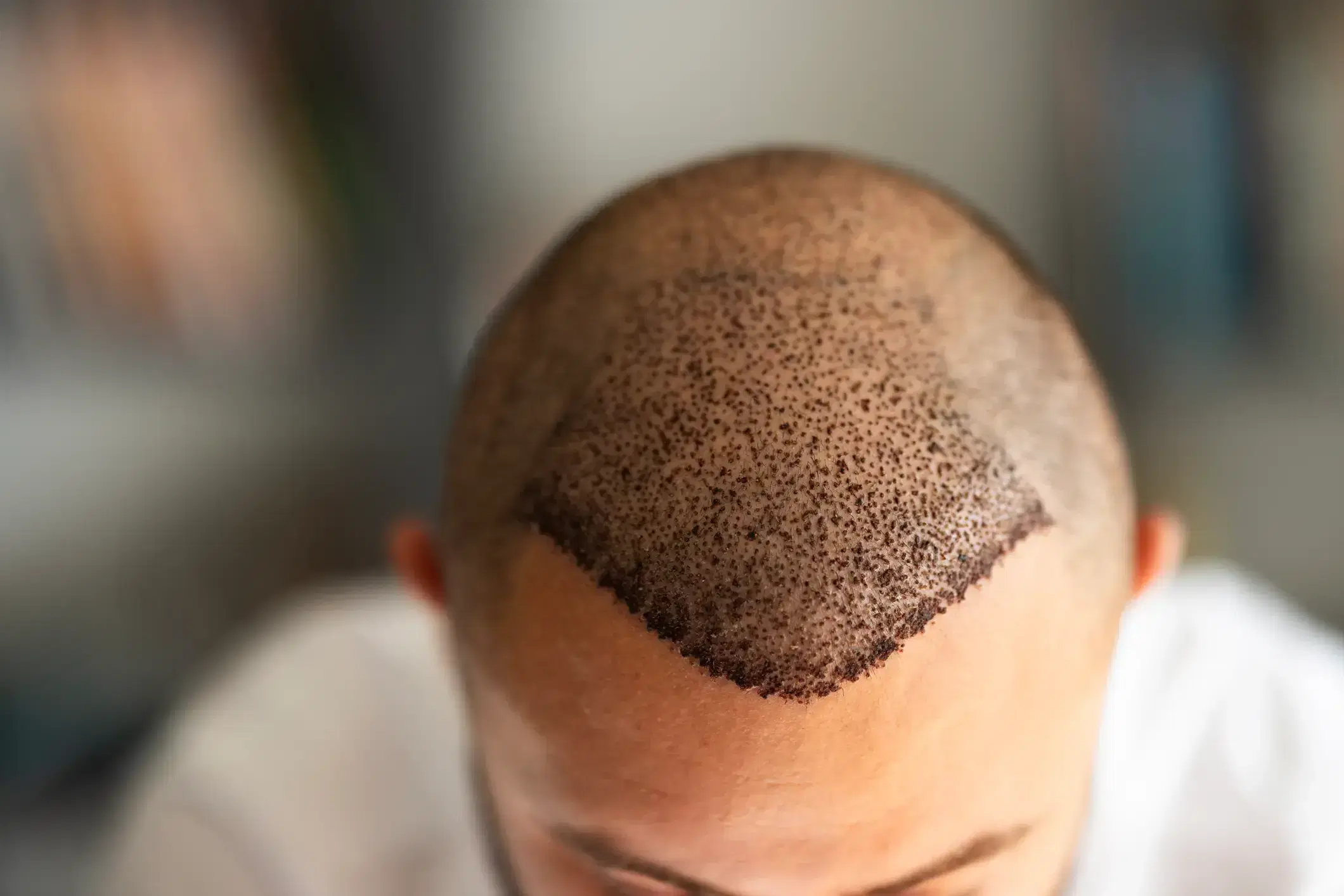
A hair transplant graft that has truly fallen out is usually difficult to confirm just by looking at a loose hair, scab or crust, because most material that comes away during healing does not contain the transplanted follicle. Actual graft dislodgement is most likely during the first few days after surgery and may be accompanied by fresh bleeding from the recipient site, especially after rubbing, scratching or trauma. By contrast, hairs attached to scabs commonly shed during the first one to two weeks while the follicular unit remains beneath the skin. Later shedding of transplanted hairs is also expected and does not mean the transplant has failed.
What Does a Hair Transplant Graft Actually Look Like?
A hair transplant graft is a small piece of tissue containing one or more hair follicles rather than simply the visible hair shaft. Depending on the graft, it may contain one, two, three or occasionally more hairs together with a small amount of surrounding tissue.
During transplantation, this follicular unit is placed into a recipient site in the scalp. The visible hair above the skin represents only part of the structure.
This distinction is important because patients frequently see a loose hair with dried blood, skin or crust attached and assume that the entire graft has come out.
In many cases, what they are seeing is only the hair shaft and healing debris.
What Happens If a Hair Transplant Graft Falls Out?
If a graft is truly dislodged before it becomes securely incorporated into the scalp, that particular follicular unit may no longer produce transplanted hair in that spot. The effect depends on how many grafts are lost.
Losing one isolated graft would usually have little visible effect on a procedure involving thousands of follicular units. Losing multiple grafts from the same area could have a greater impact on density.
True graft loss is primarily an early postoperative concern. Once healing progresses and the graft becomes securely held within the recipient site, ordinary washing and normal contact are much less likely to remove it.
Patients should not attempt to judge the final result from one suspicious scab or loose hair.
What Are the Signs That a Graft May Have Been Dislodged?
A graft may have been dislodged if there was recent trauma to the recipient area followed by fresh bleeding and visible tissue coming from the same site.
Possible warning signs include:
Fresh bleeding immediately after rubbing or scratching
A visible piece of tissue removed from a recently implanted area
Trauma during the first few postoperative days
A fingernail catching directly on a newly implanted graft
A recipient site that begins bleeding after a crust is forcibly removed
Several graft-like tissue fragments coming away after aggressive contact
A noticeable impact against the transplanted region
Bleeding that continues rather than stopping quickly
None of these signs alone can prove that a graft was lost. Photographs and clinical context are often more useful than examining the loose material yourself.
Does Bleeding Mean a Hair Transplant Graft Fell Out?
Fresh bleeding after direct trauma raises more concern for graft displacement than seeing a dry scab or loose hair without bleeding. Even so, bleeding does not automatically prove that an entire follicular unit has been removed.
Recipient sites contain small blood vessels, and healing skin can bleed if scratched or irritated.
The timing matters. Bleeding during the first few days after forceful contact is more concerning than a tiny spot of blood appearing after crust removal later in recovery.
If a transplanted area bleeds after being hit, scratched or rubbed, gentle pressure may be appropriate according to postoperative instructions, and the transplant team should be contacted if there is concern.
Repeatedly touching the site to investigate can cause more damage.
Is a Hair Attached to a Scab a Lost Graft?
A hair attached to a scab is usually not proof that the entire graft has fallen out. During healing, dried blood, plasma and skin debris form crusts around transplanted hairs.
As these crusts loosen, they may carry the visible hair shaft with them. The follicular structure responsible for future growth can remain beneath the skin.
This is especially common when crusts begin shedding naturally around the end of the first postoperative week and into the second week.
Patients often become alarmed because the hair appears attached to a small piece of tissue.
The appearance alone is unreliable. Pulling or dissecting the material to look for a root is not recommended.
Can a Graft Fall Out Without Bleeding?
A graft may theoretically be displaced without dramatic bleeding, particularly very early after implantation, but true early graft loss commonly causes at least some fresh blood because the recipient site has not fully healed.
The absence of bleeding therefore makes complete graft loss less likely, especially when only a hair shaft or dry crust has come away.
Later in recovery, shedding without bleeding is extremely common.
The visible transplanted hair can detach while the follicle remains inside the scalp and enters a temporary resting phase.
Patients should therefore avoid using bleeding as an absolute rule. It is one clue among several, including timing, trauma and what happened immediately before the material came loose.
When Are Hair Transplant Grafts Most Vulnerable?
Hair transplant grafts are most vulnerable during the first several days after implantation because the recipient sites are still healing and the grafts have not yet become firmly anchored.
During this period, direct rubbing, scratching, picking and impact carry the greatest risk.
The practical risk generally decreases as the first postoperative week progresses. By roughly seven to ten days, grafts are usually much more securely incorporated, although patients should continue following their own surgeon's washing and activity instructions.
The exact timeline can vary according to technique, recipient-site healing and individual recovery.
The safest approach is to treat the transplanted area very cautiously throughout the early postoperative period rather than testing whether the grafts feel secure.
When Do Hair Transplant Grafts Become Secure?
Transplanted grafts generally become increasingly secure over the first week and are much harder to accidentally dislodge after roughly seven to ten days. This does not mean all postoperative restrictions end immediately.
The surrounding scalp is still healing, and crusts, redness and sensitivity may remain.
By this stage, gentle washing according to postoperative instructions should not pull healthy grafts out simply because loose hairs appear in the hands.
Later shedding should also not be confused with graft loss.
A patient who reaches the second postoperative week without significant trauma usually does not need to worry that routine contact will suddenly remove large numbers of implanted follicles.
Can Washing Make Hair Transplant Grafts Fall Out?
Correct postoperative washing should not normally cause graft loss when performed according to the recommended timeline and technique. Early washing is usually deliberately gentle to avoid rubbing newly implanted areas.
The main risk comes from mechanical force rather than water itself.
Aggressive scrubbing, fingernail scratching or high-pressure water directed at very fresh recipient sites can create unnecessary trauma. Once crusts are ready to loosen, washing often helps them detach gradually.
Seeing hairs during this process is common and usually reflects hair-shaft shedding rather than the loss of follicular units.
Patients should follow the washing method provided by their transplant team rather than modifying it because of fear that every loose hair represents a failed graft.
Can Scratching or Rubbing Remove a Graft?
Scratching or strong rubbing can dislodge grafts during the earliest stage of recovery, particularly when fingernails catch on newly implanted recipient sites.
Itching is common after hair transplantation, so resisting the urge to scratch can be difficult.
Several strategies can reduce accidental injury:
Avoid using fingernails on the recipient area
Follow the recommended washing schedule
Use only postoperative products approved by the medical team
Avoid deliberately picking crusts
Sleep in the recommended position during early recovery
Keep tight hats or other friction sources away until permitted
Contact the transplant team if itching becomes unusually severe
Avoid checking grafts by repeatedly touching them
Persistent itching with marked redness, pain or discharge may require medical assessment rather than repeated scratching.
What Happens If You Accidentally Hit Your Head After a Hair Transplant?
An accidental impact does not automatically mean transplanted grafts have been lost, but the risk depends on how soon after surgery the impact occurred and how hard the recipient area was hit.
A mild touch several days into recovery is very different from striking the freshly transplanted hairline against a hard surface on the first night.
Fresh bleeding, obvious tissue displacement or a deep wound makes graft disruption more plausible.
If there is no bleeding and the scalp looks unchanged, significant graft loss is generally less likely.
Patients should take a clear photograph without repeatedly manipulating the area and contact the surgical team when an early postoperative impact appears significant.
Do Transplanted Hairs Falling Out Mean the Grafts Are Lost?
Transplanted hairs falling out usually do not mean the grafts have been lost. Shedding of the visible hair shafts is an expected part of recovery for many patients.
The follicular unit can remain alive beneath the skin even after the visible strand falls out.
This shedding commonly begins within the first few weeks after transplantation and may continue for several weeks. The scalp can temporarily look thinner than it did immediately after surgery.
That appearance often worries patients because the newly transplanted hairs seemed to be growing at first.
The important distinction is that the visible strand is temporary, while the transplanted follicle is intended to remain in the scalp and produce new hair later.
Why Do Transplanted Hairs Shed After Surgery?
Transplanted hairs commonly shed because surgery temporarily disrupts the normal hair-growth cycle. Many transplanted follicles enter a resting phase after being moved from the donor area into the recipient scalp.
The visible shafts may then detach while the follicles remain beneath the surface.
New growth usually develops gradually over the following months rather than immediately after shedding. Early regrowth can initially be fine, uneven or inconsistent.
This process is often described as postoperative shedding.
It should not be confused with the physical removal of a graft during the first days after surgery.
The two events occur through completely different mechanisms even though both can involve seeing a hair come away from the scalp.
What Is the Difference Between a Shed Hair and a Lost Graft?
A shed hair is primarily a visible hair shaft leaving the scalp, while a lost graft means the follicular tissue itself has been physically removed from its recipient site.
The differences are easier to understand when several clues are considered together.
A shed transplanted hair often:
Appears days or weeks after surgery
Comes away without significant fresh bleeding
May be attached to a dry crust
Looks like an individual hair or small group of hairs
Occurs during normal washing or crust shedding
Does not leave an obviously traumatic wound
A potentially displaced graft is more concerning when it appears immediately after early trauma and is accompanied by fresh bleeding.
Even then, visual diagnosis at home remains uncertain.
Can You See a Hair Follicle When a Transplanted Hair Falls Out?
The structure seen at the end of a fallen hair is not a reliable way to determine whether the transplanted follicle has been lost. Hairs can shed with material attached that looks like a bulb, sheath, sebum or dried tissue.
The true follicle responsible for future hair production sits within the skin and is more complex than the small structure patients commonly call the root.
This is why examining a shed hair under bright light does not provide a dependable answer.
Pulling at neighbouring hairs for comparison is even less useful and may cause irritation.
Timing, bleeding, trauma and the appearance of the recipient site provide more meaningful information than the shape of the end of a loose hair.
What Should You Do If You Think a Graft Fell Out?
If you think a graft has fallen out, avoid touching the area repeatedly and contact the transplant team if the event occurred during the early postoperative period.
Useful steps include:
Stop rubbing or inspecting the recipient site with your fingers
Do not try to push loose tissue back into the scalp
Take a clear photograph of the area
Photograph any suspicious tissue if it is easily visible
Note how many days have passed since surgery
Remember whether scratching, impact or washing caused the event
Check whether there was fresh bleeding
Follow instructions for controlling minor bleeding
Contact the transplant team if several grafts may have been affected
Seek urgent assessment for uncontrolled bleeding or significant injury
One questionable hair or crust usually does not justify panic or aggressive manipulation of the scalp.
Can a Lost Hair Transplant Graft Be Put Back In?
A patient should never attempt to reinsert a suspected lost graft at home. Successful transplantation depends on correct handling, tissue hydration, recipient-site placement and sterile technique.
A graft that has been outside the scalp may quickly become unsuitable for reimplantation, particularly if it has dried or been contaminated.
If obvious graft displacement occurs immediately after surgery, the surgical team can decide whether any intervention is appropriate.
Trying to push tissue back into the recipient site with fingers or household tools creates risks of infection, trauma and damage to neighbouring grafts.
The safest response is to leave the area alone and seek professional advice.
Will One Lost Graft Affect the Final Result?
Losing one isolated graft is unlikely to produce a noticeable cosmetic difference after a transplant involving hundreds or thousands of grafts. Hair-transplant density is created by the combined effect of many follicular units.
A cluster of lost grafts from one small area would be more relevant than a single suspected graft.
Even then, the true impact cannot be judged during the first days because redness, crusting and temporary shedding distort the appearance of the scalp.
Final density also depends on graft growth, hair calibre, hairs per graft and the distribution chosen during surgery.
Patients should therefore avoid evaluating transplant success based on one early healing event.
How Can You Protect Grafts During the First 10 Days?
Protecting grafts during the early healing period mainly involves avoiding friction, impact and unnecessary manipulation.
Helpful precautions include:
Follow the clinic's washing schedule carefully
Do not scratch transplanted areas with fingernails
Avoid picking or peeling crusts before instructed
Protect the scalp from accidental bumps
Sleep according to postoperative positioning advice
Avoid tight headwear until approved
Do not direct strong shower pressure onto fresh grafts
Avoid strenuous activity until permitted
Keep the recipient area clean as instructed
Do not apply unapproved oils, gels or topical products
Avoid constantly touching grafts to check whether they are secure
Contact the medical team after significant trauma
The goal is controlled healing, not keeping the scalp completely untouched for weeks.
When Should You Contact Your Hair Transplant Team?
You should contact your hair transplant team when there is significant early trauma, persistent fresh bleeding, suspected loss of multiple grafts or unusual signs of infection.
Increasing pain, spreading redness, marked swelling, pus, fever or worsening tenderness also deserve medical attention.
A single hair attached to a dry scab without bleeding is usually much less concerning, particularly after the first postoperative week.
Later shedding of transplanted hairs is also expected and should not be interpreted as graft loss.
When uncertainty remains, sending the surgical team a clear photograph is generally more useful than repeatedly touching or examining the area yourself. True graft loss is an early mechanical event, while most hairs that disappear during routine healing are simply part of the normal postoperative cycle.