
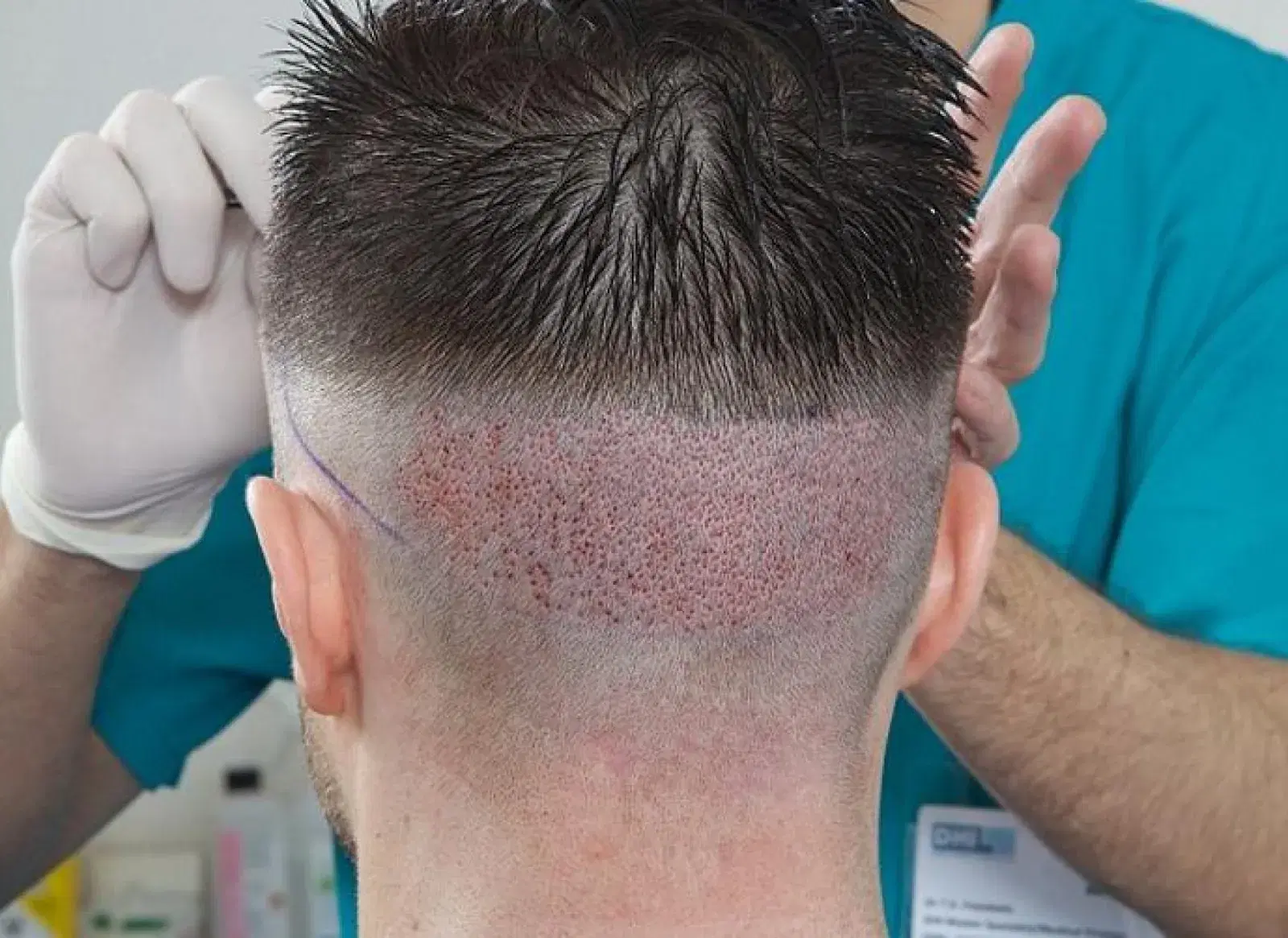
What Is the Donor Area in Hair Transplantation?
The donor area is the region where hair follicles are collected for transplantation, usually across the back and sides of the scalp. Hair from these locations often has greater resistance to the hormonal changes responsible for common pattern hair loss.
During a transplant, follicular units are removed from the donor region and relocated to thinning or bald areas. The procedure redistributes existing hair rather than creating new follicles.
The donor supply is therefore limited. Maintaining sufficient hair around the extraction sites is essential for preserving a natural appearance, particularly when the hair is worn short.
Why Is One Side of the Donor Area Thinner After Surgery?
Uneven donor density can develop when one side of the scalp undergoes more extensive extraction or experiences a different healing response.
Immediately after surgery, the difference may reflect hair length, redness or small extraction wounds. During the following weeks, temporary shedding of nearby hairs can create more noticeable gaps.
A separate possibility is that one side has lost a greater proportion of its original follicles through harvesting.
These causes can look similar in photographs, but they have different recovery patterns. Understanding whether follicles remain beneath the thinner area is the key to determining what improvement is possible.
Can Donor Hair Density Naturally Differ Between Sides?
Hair density is not necessarily identical on the left and right sides of the scalp before transplantation.
Small differences in the number of follicular units, hair shaft thickness and growth direction can influence how much skin is visible.
One side may naturally contain finer hair or a stronger change in growth direction, making it appear less dense after shaving.
These differences are easy to overlook when the hair is longer because overlapping strands provide additional coverage.
Surgery can make pre-existing asymmetry more noticeable, even when extraction is reasonably balanced. Comparing photographs taken before transplantation helps establish whether the difference existed previously.
Can Uneven Shaving Make One Side Look Thinner?
A short haircut can exaggerate differences in donor density because longer strands no longer overlap to conceal the scalp.
When one side is shaved slightly closer than the other, it may appear noticeably lighter or less populated. This effect becomes stronger when the hair has substantial contrast with the skin.
Hair growth direction also matters. Strands that naturally lie flat may cover more skin than hair growing outward at a different angle.
As the remaining hair lengthens, this visual difference often becomes less prominent.
However, improved coverage from longer hair does not necessarily indicate that the number of follicles has increased.
How Does FUE Extraction Affect Donor Area Symmetry?
Follicular Unit Extraction, or FUE, removes individual follicular units using small surgical punches.
Each extraction permanently reduces the number of follicles remaining at that particular donor site. The surrounding hairs provide coverage as the tiny wounds heal.
If extraction points are distributed evenly across suitable donor regions, the reduction in density may remain relatively inconspicuous.
When more grafts are taken from one side, however, the difference can become apparent after the hair grows.
What Are the Main Causes of Uneven Donor Hair?
One-sided donor thinning can result from temporary postoperative changes or a more permanent reduction in follicular density.
Uneven graft extraction: Removing a greater proportion of follicular units from one side leaves fewer hairs available to conceal the scalp after recovery.
Temporary shock loss: Surgical stress can cause unharvested follicles to shed their hairs, creating localized thinning that may improve over subsequent months.
Differences in natural density: Pre-existing variations in follicle numbers, hair thickness or growth direction may become more apparent after the donor region is shaved.
Scarring or inflammation: Extraction scars, folliculitis, infection and deeper tissue injury can produce irregular coverage, sometimes with permanent damage to additional follicles.
What Is Donor Area Shock Loss?
Donor area shock loss is temporary hair shedding that affects follicles remaining near the surgical harvesting sites. It is also known as donor-site effluvium.
The procedure can disturb the local environment around unharvested follicles, causing some hairs to shed even though their growth structures have not been removed.
This reaction may produce isolated patches or more widespread thinning.
The important distinction is that a follicle affected by temporary shedding can potentially resume hair production. By contrast, a completely extracted follicular unit is no longer present at its original location.
Shock loss therefore offers a possible explanation for thinning that develops after the initial surgical wounds have started healing.
Why Can Shock Loss Affect Only One Side?
Postoperative shedding does not always occur uniformly across the donor region.
Local differences in surgical trauma, extraction concentration and the inflammatory response may cause neighboring follicles on one side to experience greater disturbance.
Changes in the surrounding tissue environment can also influence how individual areas respond during recovery.
A localized patch may therefore appear even when the rest of the donor scalp continues growing normally.
However, unilateral thinning should not automatically be diagnosed as shock loss. Uneven extraction, infection and unrelated scalp conditions can produce a similar pattern.
The time at which the thinning appears and whether the follicles remain visible help clarify the cause.
When Does Donor Shock Loss Become Noticeable?
Donor-site shedding may become apparent approximately two to four weeks after hair transplantation.
During the first days, the donor area may look relatively even apart from the extraction points. Once the initial crusting clears, a new patch of thinning can appear unexpectedly.
This delayed change may reflect a temporary disruption of the growth cycle rather than new removal of follicles.
Published clinical observations have documented localized donor effluvium appearing within the first several weeks after FUE.
Nevertheless, timing alone cannot establish the cause. Permanent extraction-related gaps may already exist beneath the short hair, while temporary shedding develops around them.
How Long Does Uneven Donor Shock Loss Take to Recover?
Temporary donor shock loss often begins improving over several months, with visible recovery commonly developing within approximately three to six months.
The follicles must first resume active growth, and the new strands then need time to become long enough to cover the scalp.
As a result, shedding may stop before the thinner side looks noticeably fuller.
Some regions may recover more slowly, producing an uneven appearance during the process.
However, the expected recovery applies to follicles that remain intact. If one side was substantially overharvested or developed scarring, the missing density may not return through ordinary hair growth.
What Is Donor Overharvesting?
Donor overharvesting occurs when excessive numbers of follicular units are removed relative to the region's original density and its ability to maintain coverage.
The problem may affect the entire donor area or be concentrated on one side.
For example, if harvesting focuses heavily on an accessible section behind one ear, that area may become visibly thinner than the opposite side.
The appearance is sometimes described as moth-eaten because small, irregular gaps interrupt the surrounding hair.
Total graft count matters, but extraction distribution is equally important. Even a moderate number of grafts can cause noticeable depletion when taken from an excessively limited surface area.
Do Extracted Donor Follicles Grow Back?
A follicular unit completely removed during FUE does not normally regenerate at its original donor site.
That follicle has been transferred to the recipient area, leaving the donor region with fewer hair-producing structures.
This explains why overharvesting can create permanent thinning even when the scalp surface heals successfully.
However, adjacent follicles that remain in place may shed temporarily and later produce new hair.
The thinner side can therefore gain visible coverage as shock loss resolves without recovering the follicles that were surgically removed.
Distinguishing between these two processes is essential when evaluating asymmetry after transplantation.
Can FUE Scars Make One Side Look Patchy?
FUE creates numerous small circular wounds that heal with tiny scars.
These marks are often concealed by surrounding hair, but some become visible as pale dots when the scalp is shaved closely.
If extraction sites are more concentrated on one side, the accumulated scarring may make that region appear lighter or less densely covered.
Scar visibility also depends on skin pigmentation, the size of the extraction wounds and individual healing characteristics.
Longer hair can conceal some of the marks without changing the underlying scar tissue.
When the difference involves both scarring and permanent follicular depletion, hair regrowth alone may not fully restore visual symmetry.
Can FUT Cause Uneven Hair Density Around the Scar?
Follicular Unit Transplantation, or FUT, involves removing a strip of hair-bearing scalp and closing the wound.
This technique typically produces a linear scar rather than the scattered extraction marks associated with FUE.
Hair near the incision can shed temporarily because of surgical stress, and one section of the scar may heal differently from another.
Uneven tension or wider scar formation can make one side appear more exposed.
A localized thinning pattern after FUT therefore requires assessment of the incision itself, the surrounding follicles and the scar's final width.
The appearance should not automatically be attributed to the same extraction-related mechanisms seen with FUE.
Can Folliculitis or Infection Cause One-Sided Donor Thinning?
Folliculitis can develop when hair follicles become inflamed after transplantation, producing red bumps, pustules, tenderness or crusts.
Localized inflammation may make one donor section appear thinner, particularly when scratching or crust formation causes additional hair breakage.
Mild cases may resolve without permanent damage. However, deeper infection or substantial tissue injury can produce scarring and lasting hair loss.
Increasing pain, spreading redness or persistent discharge should not be treated as ordinary postoperative shedding.
The distinction is important because a scalp infection requires appropriate medical assessment, while uncomplicated shock loss generally follows a different course.
Can an Existing Hair Loss Condition Explain the Difference?
Not all donor thinning develops as a direct consequence of transplantation.
Some individuals have follicular miniaturization extending into the back or sides of the scalp. As the affected hairs become finer, one side may appear less dense.
Alopecia areata can also produce localized patches of hair loss and may occur independently of surgery.
Certain inflammatory scalp diseases can damage follicles and create irregular areas of thinning.
These conditions may become more noticeable after shaving, but their treatment differs from managing an overharvested donor area.
An accurate diagnosis should therefore consider both the surgical history and the possibility of an underlying scalp disorder.
How Can You Recognize Temporary Versus Permanent Donor Thinning?
The appearance, progression and condition of the scalp provide clues about whether the remaining follicles are likely to recover.
Timing of hair loss: Thinning that develops several weeks after surgery may be consistent with shock loss, while gaps present immediately after extensive extraction can suggest donor depletion.
Visible follicular openings: Areas containing surviving follicles may support regrowth, whereas smooth scarred patches with absent openings raise concern for permanent damage.
Changes over several months: Gradually improving density favors temporary shedding, while stable gaps after the expected recovery period may indicate lasting follicular loss.
Associated scalp changes: Persistent redness, painful bumps, unusual scarring or progressive expansion suggests that inflammation or another condition may be contributing.
Do Hair Length and Lighting Exaggerate Donor Asymmetry?
Hair length and lighting can make a modest density difference appear more dramatic than it actually is.
Overhead lighting highlights visible scalp, particularly when hair is cut very short or grows in a direction that leaves small gaps between strands.
The effect can differ considerably between the left and right sides because their growth patterns are not exact mirror images.
Photographs taken with different lighting, camera angles or hair lengths may therefore give misleading impressions of progression.
Comparing both sides under consistent conditions is more useful than relying on individual images.
However, visual factors should not be used to dismiss persistent thinning when the actual follicular density has decreased.
How Does Trichoscopy Help Diagnose Uneven Donor Density?
Trichoscopy uses magnification to examine hair shafts, follicular openings and scalp changes without requiring surgery.
It can help identify differences in follicular density, hair thickness and scarring between the left and right donor regions.
Surviving follicular openings may support the possibility of regrowth, while extensive scar tissue suggests permanent follicular loss.
The examination can also reveal signs of miniaturization, inflammation or a separate hair-loss disorder.
When the cause remains uncertain, photographs and repeated measurements can document changes over time.
Trichoscopy does not guarantee a particular recovery outcome, but it provides more useful anatomical information than judging donor density from ordinary photographs alone.
When Should Donor Area Density Be Reassessed?
Early donor assessment focuses on wound healing, redness, crusting and signs of infection.
Surface healing generally progresses substantially during the first one to two weeks, although hair density may remain difficult to judge while the scalp is closely shaved.
If shock loss develops, meaningful improvement may take several months.
A comparison around three to six months can help establish whether the thinner side is recovering, while later assessment may be needed when hair regrowth remains incomplete.
However, worsening pain, spreading inflammation or rapidly expanding bald patches should be evaluated without waiting for a routine recovery milestone.
The timeline for cosmetic improvement should never delay assessment of possible complications.
How Should You Care for an Uneven Donor Area?
Appropriate postoperative care protects healing tissues and surviving follicles, although it cannot replace follicular units already removed through harvesting.
Clean the scalp gently: Follow the recommended washing routine and avoid vigorous rubbing of healing extraction sites.
Avoid picking crusts: Removing scabs forcefully can irritate the skin, delay wound healing and increase the possibility of additional scarring.
Limit friction and harsh treatments: Tight headwear, aggressive shaving and strong chemical products may aggravate a sensitive donor region during early recovery.
Monitor changes consistently: Photograph both sides under similar lighting and seek assessment if gaps expand, become painful or fail to show expected improvement.
Can Minoxidil Help Hair Regrow on the Thinner Side?
Minoxidil may support hair growth in certain situations when functioning follicles remain within the thinner donor area.
However, evidence specifically demonstrating that it reliably accelerates donor-site shock loss recovery remains limited.
The medication cannot recreate follicular units removed during FUE or restore hair production inside established scar tissue.
Applying topical products to fresh wounds or inflamed skin can also increase irritation.
Before considering a hair-growth treatment, the cause of asymmetry should be established.
Temporary shedding, permanent donor depletion and an unrelated miniaturization disorder may require different approaches, even when they produce a similar appearance.
Can an Overharvested Donor Area Be Restored?
Permanent donor depletion is difficult to correct because surgically removed follicles cannot simply regenerate.
In selected cases, remaining scalp hair may be transplanted into visibly sparse donor regions. However, this approach consumes additional follicles and requires an adequate supply elsewhere.
Beard or body hair can sometimes provide supplementary grafts, although differences in texture and growth behavior may affect the appearance.
Extensive scarring can make corrective transplantation less predictable.
Restoration therefore requires realistic expectations about the hair that remains available.
Can Scalp Micropigmentation Improve Donor Area Symmetry?
Scalp micropigmentation is a cosmetic procedure that introduces small pigment deposits into the skin to resemble closely cut hair follicles.
It can reduce the visual contrast between a thinner donor section and the surrounding scalp.
The technique may be particularly useful when visible extraction scars or permanent gaps remain after healing.
However, micropigmentation does not produce new hair or increase actual follicular density.
The appearance depends on pigment placement, color matching and the length of the surrounding hair.
Treatment should be considered only after the scalp has healed sufficiently and the reason for asymmetry has been evaluated.
It offers camouflage rather than biological restoration.
Is Another Hair Transplant Safe After Uneven Donor Thinning?
A second transplant may remain possible when enough stable donor hair is available, but existing asymmetry requires careful evaluation before additional harvesting.
Removing more grafts from an already depleted side can make the imbalance more visible.
If the apparent thinning results from temporary shock loss, the donor area should first be allowed to recover sufficiently for its true density to be assessed.
Previous extraction distribution, hair thickness, remaining follicular density and any scarring also affect future options.
Another procedure should preserve the limited donor supply rather than sacrifice additional coverage to obtain a higher graft count.
When Does One-Sided Donor Hair Loss Require Medical Attention?
A thinner donor area deserves prompt assessment when the change is accompanied by symptoms suggesting infection, significant tissue injury or progressive hair loss.
Increasing pain, warmth, spreading redness, pus or fever may indicate infection.
Darkened skin, black crusting, open wounds that do not heal or rapidly worsening tenderness are particularly concerning because they can indicate deeper tissue damage.
Expanding bald patches with persistent inflammation also require evaluation, even when the initial transplant wounds have closed.
Cosmetic asymmetry without these symptoms is generally less urgent, but persistent thinning still deserves investigation when recovery fails to progress.
Early recognition may prevent avoidable damage to remaining follicles.
Will Both Sides of the Donor Area Look Even Again?
The two sides of the donor area may become more similar as the scalp heals, temporary shedding resolves and the remaining hair grows longer.
When the difference results mainly from uneven shaving or donor shock loss, visible coverage can improve considerably over the following months.
However, FUE permanently removes follicular units from their original locations. If significantly more grafts were extracted from one side, natural regrowth cannot replace those missing follicles.
Scarring and underlying hair-loss conditions can further limit recovery.
The most useful approach is to identify whether the asymmetry reflects temporary changes, permanent extraction-related depletion or a combination of both.
Long-term donor appearance depends on protecting the follicles that remain, recognizing complications early and avoiding additional harvesting that could make an existing imbalance more pronounced.