
Why Are Blood Tests Important Before a Hair Transplant?
Hair transplantation is generally performed under local anesthesia, but it remains a surgical procedure that involves extracting and implanting living follicles. During surgery, the scalp develops numerous small wounds, making normal blood circulation, clotting and tissue repair important considerations.
Blood testing provides information that may not be apparent during an ordinary physical examination. Someone can feel healthy while having anemia, poorly controlled diabetes or another condition that deserves attention before an elective procedure. Identifying these issues in advance creates an opportunity to address potential risks instead of discovering them during recovery.
However, blood tests represent only one part of the evaluation. Medical history, blood pressure, current medications, scalp examination and donor hair assessment are equally important. A normal laboratory report cannot guarantee that a transplant will be successful, and not every patient requires every available blood test.
What Blood Tests Are Done Before a Hair Transplant?
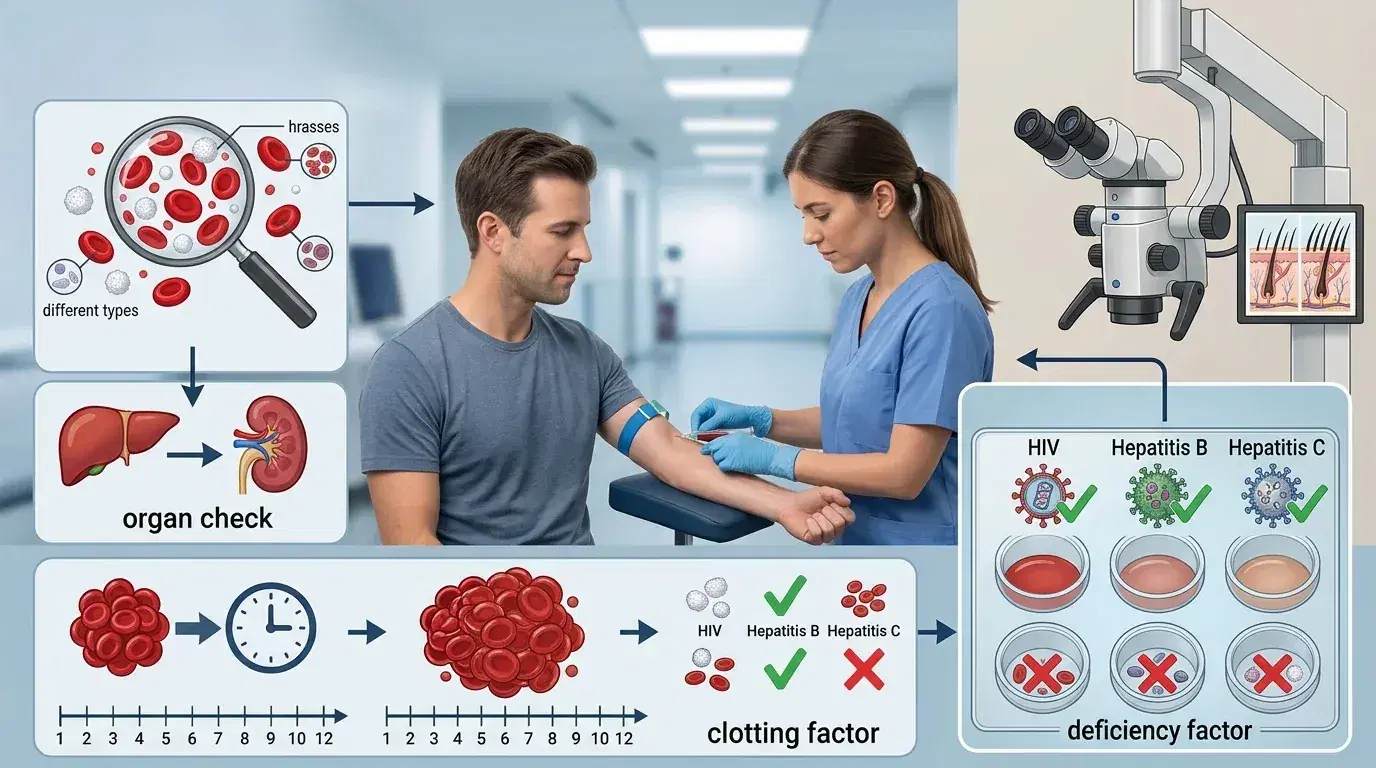
Preoperative hair transplant screening commonly focuses on blood count, clotting function, blood glucose and selected infectious diseases. Additional investigations may assess liver or kidney health, nutritional deficiencies and hormonal conditions when the patient's medical history suggests they could influence treatment.
Specialized hair transplantation protocols often include a relatively broad laboratory panel. General recommendations for low-risk elective surgery, however, support more selective testing in otherwise healthy people. The purpose of each investigation should therefore be clear rather than treating an extensive list of tests as automatically necessary.
A useful preoperative assessment distinguishes between tests that help manage surgical risks and those intended to investigate why hair loss developed in the first place. Both can be valuable, but they answer different medical questions.
Complete Blood Count: Checking Hemoglobin and Platelets
A complete blood count, commonly abbreviated as CBC, measures several components of the blood, including red blood cells, white blood cells and platelets. It is among the investigations frequently included in hair transplant preparation because it provides information relevant to general health and surgical recovery.
Hemoglobin is particularly important because it carries oxygen through the bloodstream. A low hemoglobin level may indicate anemia, which can be associated with fatigue, reduced exercise tolerance or an underlying nutritional or medical problem. Significant anemia deserves investigation before proceeding with elective surgery.
The white blood cell count can provide information about certain infections or blood disorders, although an abnormal result does not establish a diagnosis on its own. Platelet measurements are also useful because platelets contribute to normal clot formation after blood vessels are injured.
An abnormal CBC result does not automatically mean that transplantation is impossible. Its significance depends on the degree of the abnormality, associated symptoms and the reason it developed.
Blood Clotting Tests Before Hair Transplant Surgery
Hair transplantation involves many small incisions, making bleeding history an important part of the surgical assessment. Some preoperative protocols include coagulation tests to identify problems affecting the body's ability to form stable blood clots.
PT, INR and aPTT Tests
Prothrombin time, or PT, measures one part of the clotting process, while the international normalized ratio, or INR, provides a standardized way to interpret certain PT results. Activated partial thromboplastin time, abbreviated as aPTT, examines other parts of the clotting system.
These tests can be particularly relevant when a person has a known bleeding disorder, liver disease or uses certain anticoagulant medications. However, routine coagulation testing is not universally recommended for every healthy individual undergoing a low-risk operation.
Normal results also do not exclude every bleeding risk. Some medications affect platelet function, while certain newer anticoagulants cannot be reliably assessed using ordinary PT or aPTT measurements.
For this reason, a careful medication and bleeding history remains essential even when the laboratory results appear normal.
Blood Sugar and HbA1c Tests Before Hair Transplantation
Blood glucose testing helps assess the level of sugar circulating in the bloodstream, while hemoglobin A1c, or HbA1c, reflects average blood sugar levels over approximately the previous two to three months.
These measurements are especially relevant for patients with diabetes or suspected difficulties controlling blood glucose. Poorly controlled diabetes can increase the risk of postoperative infection and interfere with normal wound healing, which may complicate recovery from a procedure involving numerous small scalp incisions.
A patient with diabetes may need an up-to-date HbA1c result before surgery. The assessment can also help determine whether medication adjustments or additional monitoring will be necessary during a long surgical session.
However, routine HbA1c testing is not required for every person without diabetes. Testing should provide information that meaningfully supports the surgical decision rather than simply increase the number of investigations performed.
HIV and Hepatitis Screening Before a Hair Transplant
Some hair transplantation protocols include screening for HIV, hepatitis B and hepatitis C as part of the preoperative evaluation. These tests help identify blood-borne infections that may require additional medical assessment, appropriate precautions or treatment planning.
Hepatitis screening may involve tests such as hepatitis B surface antigen and hepatitis C antibodies, with further investigations used when an initial result requires confirmation. HIV testing also follows established diagnostic procedures, including confirmatory testing when necessary.
A positive screening result does not automatically establish a final diagnosis or mean that every surgical procedure is prohibited. The person's overall health, infection status and applicable medical considerations must be evaluated appropriately.
Testing should take place with suitable patient information, consent and confidentiality. Standard infection-control precautions remain necessary for every patient, regardless of whether blood-borne infection screening results are negative.
Liver and Kidney Function Tests
Liver and kidney function influence how the body processes medications and maintains its internal balance. Blood tests may therefore be appropriate when a patient has a known medical condition, relevant symptoms or takes medicines that require additional monitoring.
Liver-related investigations often include enzymes such as ALT and AST, while kidney assessment may involve creatinine, estimated glomerular filtration rate and electrolyte measurements. These results help identify abnormalities that could influence medication selection or the management of underlying disease.
A mildly abnormal liver enzyme result does not necessarily indicate a serious disorder, and a single measurement may require interpretation alongside previous results. Similarly, kidney function tests are most useful when the findings can influence treatment decisions.
These investigations should complement a medical history rather than replace it, particularly because blood tests do not reveal every potential problem with organ function.
Iron, Ferritin and Nutritional Deficiency Tests
Some blood tests before hair transplantation investigate the cause of hair loss rather than the immediate safety of surgery. Iron studies and ferritin measurements are especially relevant when someone experiences diffuse shedding, fatigue, restrictive eating or symptoms suggesting anemia.
Ferritin reflects stored iron, although its interpretation can be influenced by inflammation and other medical conditions. Low iron stores may contribute to hair shedding in some individuals, but taking iron supplements without confirming a deficiency does not guarantee improved hair growth.
Additional testing for vitamin B12, folate, vitamin D or zinc may be appropriate when diet, symptoms or medical history suggest a nutritional problem. Ordering every vitamin and mineral test routinely is not always useful.
The guide to vitamin and mineral deficiencies associated with hair loss explains why correcting an identified deficiency is more meaningful than taking high-dose hair supplements without a clear medical reason.
Are Thyroid and Hormone Tests Necessary Before a Hair Transplant?
Thyroid disorders can disrupt the normal hair growth cycle and cause widespread thinning that may resemble other forms of hair loss. When symptoms such as unexplained weight changes, fatigue, temperature sensitivity or diffuse shedding are present, thyroid testing can help clarify the underlying cause.
A thyroid-stimulating hormone test, commonly called TSH, is often used as the initial investigation. Additional hormone measurements may be requested when the result or clinical findings suggest a thyroid disorder.
Selected patients may also require tests related to androgen activity, especially when hair thinning occurs alongside irregular menstrual cycles, excessive facial hair growth or other signs of hormonal imbalance. However, routine testosterone testing is not necessary for every person with a receding hairline.
These investigations help distinguish hereditary pattern hair loss from conditions that require medical treatment. Transplantation may restore coverage, but it does not correct an untreated hormonal disorder responsible for continuing hair shedding.
Can Abnormal Blood Tests Delay a Hair Transplant?
An abnormal laboratory result may lead to additional evaluation before surgery, particularly when it suggests a condition that could affect bleeding, wound healing or overall health. However, not every result outside the laboratory reference range requires postponing the procedure.
Mild abnormalities sometimes have limited clinical significance, while more substantial findings may need repeat testing or treatment. For example, poorly controlled diabetes deserves attention because it can increase postoperative complications, whereas significant anemia may require investigation before an elective operation.
The underlying reason for the result matters as much as the number itself. A temporary change following a recent illness differs from a persistent abnormality associated with an established medical condition.
Delaying surgery when a meaningful health concern is identified can be a protective decision. Addressing the problem beforehand may support a safer recovery and prevent avoidable complications.
How Far in Advance Should Blood Tests Be Completed?
Completing preoperative testing before the scheduled surgery date allows time to review results and investigate unexpected findings. For straightforward assessments, testing may take place in the days or weeks preceding transplantation.
Patients with diabetes, anemia or another established medical condition may benefit from an earlier evaluation because improving disease control can take longer than obtaining a laboratory report. Leaving all investigations until the morning of surgery may create unnecessary difficulties when a result needs confirmation.
Some tests also have limited periods during which results remain clinically useful. A blood count obtained many months earlier may no longer reflect the patient's current condition, particularly after illness, medication changes or significant weight loss.
The main objective is to ensure that relevant results are available and reviewed before surgery rather than completing blood tests merely as an administrative formality.
How to Prepare for Blood Tests Before Hair Transplantation
Preparation depends on which investigations are being performed. A complete blood count generally does not require fasting, whereas certain glucose measurements may need a period without food before the sample is collected.
Patients should confirm the specific instructions for their requested tests instead of assuming that every blood sample requires an empty stomach. Unnecessary fasting may cause discomfort, particularly for people taking medication that affects blood sugar.
A complete list of prescription medicines, over-the-counter products and supplements should also be provided during preparation. Anticoagulants, antiplatelet medicines and certain herbal products may be relevant to surgical bleeding risk, but prescribed medication should never be stopped independently.
High-dose biotin deserves particular attention because it can interfere with some laboratory measurements, including certain thyroid tests. Informing the healthcare team about hair supplements helps prevent misleading results and unnecessary follow-up investigations.
Do Blood Tests Guarantee a Successful Hair Transplant?
Blood tests help identify certain medical risks, but they cannot predict exactly how many transplanted follicles will survive or how dense the final result will appear. Graft handling, recipient-site preparation, donor hair quality and postoperative protection all contribute to the outcome.
A person with normal laboratory results may still have an unsuitable donor area or a hair loss condition that requires further diagnosis. Conversely, someone with a manageable medical condition may remain a suitable candidate after appropriate evaluation and preparation.
This is why scalp examination and an accurate diagnosis should accompany laboratory screening. A detailed assessment considers whether the recipient area can support transplanted follicles and whether surrounding native hair is likely to continue thinning.
For additional preparation guidance, the Esthetic Hair frequently asked questions cover preoperative consultation, medication considerations and other practical steps involved in planning hair transplantation.
Frequently Asked Questions About Blood Tests Before a Hair Transplant
The following questions address common concerns about mandatory screening, fasting and the effect of abnormal laboratory findings on surgery.
Are blood tests mandatory before every hair transplant? Blood testing is commonly included in hair transplantation protocols, particularly for evaluating blood counts, glucose control, clotting concerns and selected infections. However, the need for individual investigations should reflect the medical history, applicable screening requirements and information needed to support a safe surgical decision rather than an assumption that every patient requires an identical laboratory panel.
Do you need to fast before hair transplant blood tests? Fasting may be necessary for certain glucose measurements, but many other investigations, including a complete blood count, generally do not require an empty stomach. The appropriate preparation depends on the specific tests requested, so patients should follow their laboratory instructions and avoid unnecessary fasting, especially when taking diabetes medication.
Can you have a hair transplant if your blood test results are abnormal? An abnormal result does not automatically prevent transplantation, although significant findings may require further investigation or treatment before elective surgery. The decision depends on the type of abnormality, its severity and whether it creates additional risks related to bleeding, anesthesia, infection or wound healing.