
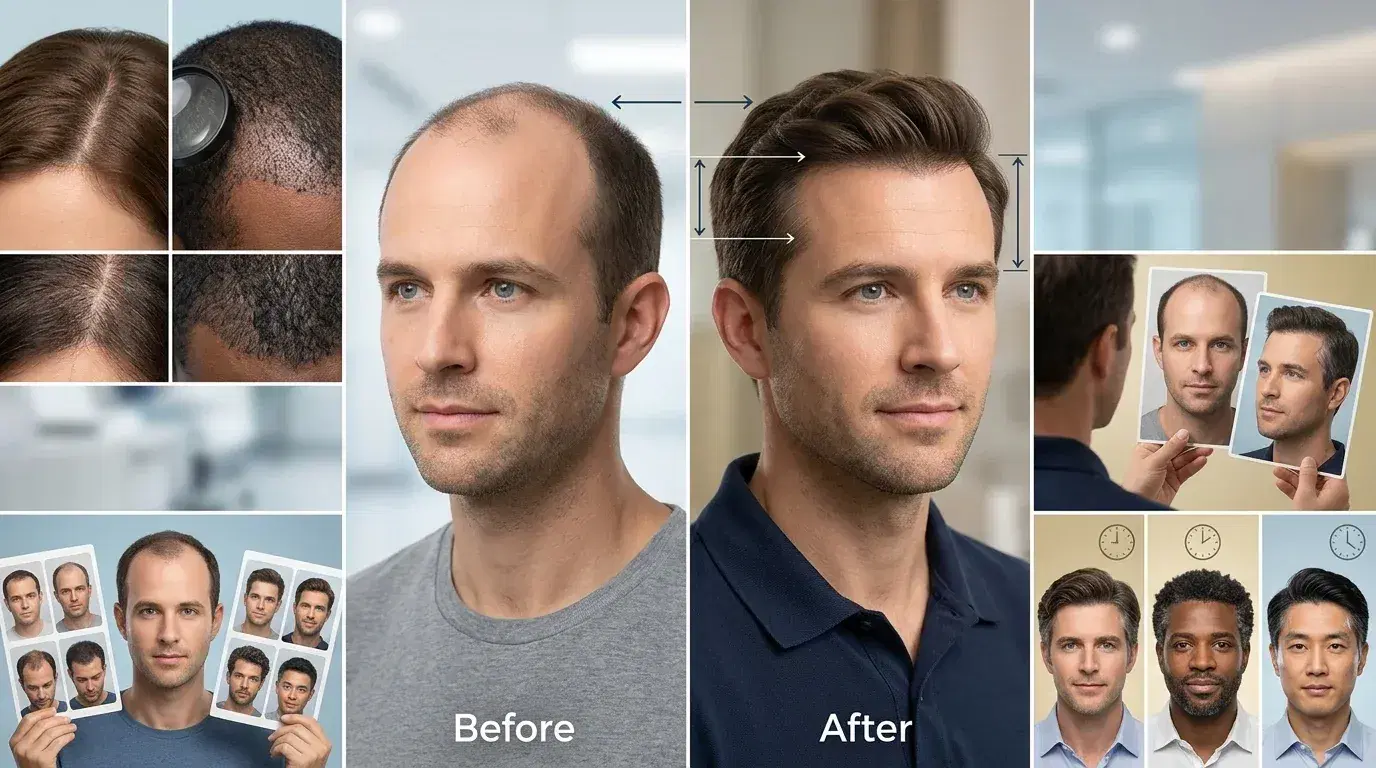
Hair transplant before and after photos can help you evaluate hairline design, density, donor-area appearance and the overall quality of a restoration. However, an accurate comparison requires more than noticing fuller hair, because lighting, camera angles, styling and the time between photographs can significantly influence how the results appear.
Why Hair Transplant Before and After Photos Matter
Before and after photographs provide a visual record of how hair transplantation changes the appearance of the scalp over time. They allow prospective patients to examine the relationship between the original hair loss pattern, the treatment area and the coverage achieved after surgery. When presented consistently, these images can help establish realistic expectations about what follicular transplantation may accomplish.
However, photographs do not reveal everything about a surgical result. A single frontal image may show a convincing hairline while providing little information about crown coverage or the condition of the donor area. Similarly, thick styling products and favorable lighting can create the impression of greater density without demonstrating how the hair looks under ordinary conditions.
The most useful approach is to examine an entire set of photographs rather than judge a procedure from one impressive transformation.
Compare Photos Taken Under Similar Conditions
A reliable comparison begins with photographs that use similar lighting, camera positions, distances and hairstyles. These details may seem minor, but they can dramatically change the amount of visible scalp and the apparent thickness of the hair.
Why Lighting Can Make Hair Look Thicker
Bright overhead lighting can reveal gaps between strands, especially when dark hair contrasts strongly with lighter scalp skin. Softer lighting may reduce this contrast, making the same hair appear denser without any actual change in follicular coverage.
A before photograph taken beneath harsh overhead lighting should not be compared directly with an after photograph captured using soft, flattering illumination. Even when both photographs are genuine, the difference in lighting can exaggerate the apparent improvement.
Consistent lighting provides a more useful indication of how the restoration has changed the hair rather than simply changing its presentation.
Camera Angles and Head Position
Camera angles also affect the apparent size and shape of thinning areas. Tilting the head forward can expose the crown, while raising the chin may make the frontal hairline appear lower and fuller.
Distance matters as well. A close-up photograph emphasizes individual strands and scalp visibility, whereas an image taken farther away may conceal irregularities in density or hairline design.
The strongest before and after comparisons reproduce the same head position and camera distance, allowing the viewer to examine the treated area without unnecessary visual distortion.
Check When the After Photos Were Taken
Hair transplantation produces gradual results, which makes the timing of postoperative photographs essential. An image taken immediately after surgery shows implanted hair shafts, not the mature growth that develops over the following months.
Many transplanted shafts shed during the first several weeks, and the recipient area may temporarily return to an appearance similar to its original condition. New hair commonly becomes visible around the third or fourth month, with more substantial coverage developing between six and nine months.
By approximately twelve months, much of the visible frontal result has developed, although additional maturation may continue afterward. Crown restoration can take longer, with some patients experiencing improvements over twelve to eighteen months.
A gallery that includes the time since surgery provides a clearer picture of the outcome. Comparing a six-month result with a twelve-month result without recognizing the difference can lead to unrealistic conclusions about density and growth.
Look Beyond the Frontal Hairline
The frontal hairline plays a major role in facial appearance, but it represents only one aspect of hair transplant quality. A convincing result should also be examined from above, from both sides and, where relevant, across the crown.
A front-facing photograph may show impressive coverage because the hair has been combed forward. The same result viewed from above may reveal areas where transplanted density remains limited or where existing native hair continues thinning.
Side photographs are particularly useful for assessing how the frontal hairline connects with the temples. They can reveal whether transplanted hairs follow natural growth directions or stand away from the scalp at noticeable angles.
When reviewing a case, seek several perspectives that demonstrate the complete relationship between the restored region and surrounding hair. A result that looks natural from different viewpoints provides stronger evidence than one photographed exclusively from its most flattering angle.
Pay Attention to Hair Length and Styling
Hair length can substantially influence perceived density. Longer strands overlap and cover more scalp, while short haircuts expose the spaces between individual follicular units.
This becomes particularly important when the before photograph shows very short hair and the after photograph features a longer, carefully styled hairstyle. Part of the visual improvement may come from the additional coverage provided by length rather than newly transplanted follicles alone.
Styling direction also changes the appearance of the result. Hair combed forward may conceal thinning behind the frontal border, while hair brushed backward can reveal the actual shape and density of the transplanted hairline.
Wet and dry hair should also be compared cautiously. Wet strands tend to group together, making the scalp more visible, whereas dry hair often creates greater volume. Photographs taken with similar hair lengths and styling conditions allow a fairer assessment.
How to Evaluate Hair Transplant Density in Photos
A successful hair transplant does not necessarily reproduce the original follicular density of a person who has never experienced hair loss. Instead, the objective is to create natural-looking coverage using a limited supply of healthy donor follicles.
Hair thickness, color, curl and the contrast between hair and scalp influence how dense the result appears. Thick or wavy strands may provide substantial visual coverage, while fine, straight hair can require a different distribution to achieve a similar appearance.
When examining after photographs, look at how well the transplanted region blends with surrounding hair. An abrupt difference between a dense frontal border and a sparse area immediately behind it may indicate uneven graft distribution or continuing native hair loss.
Photographs can demonstrate visual coverage, but they cannot establish an exact graft survival percentage. Measuring follicular density accurately requires more detailed examination than an ordinary marketing photograph provides.
What Makes a Transplanted Hairline Look Natural?
The frontal hairline deserves particular attention because its shape, height and density determine whether the restoration appears convincing. A natural hairline usually contains subtle irregularities rather than a perfectly straight boundary across the forehead.
The leading edge should also look relatively soft. Carefully selected single-hair grafts help create a gradual transition, while larger follicular units can provide greater fullness farther behind the frontal border.
Hair direction matters just as much as the outline. Transplanted strands should emerge at angles that complement the surrounding hair, particularly around the temples where growth patterns change noticeably.
An excessively low hairline may initially seem attractive in a photograph but become less appropriate as a person ages or experiences further thinning. For a closer examination of these design principles, the guide to natural-looking frontal hairlines after transplantation explains how graft selection, growth direction and balanced density contribute to realistic results.
Do Not Ignore the Donor Area
The donor area is often overlooked when people judge hair transplant transformations. However, the appearance of the back and sides of the scalp is an important part of the overall surgical result because these regions supply the follicles used during transplantation.
Follicular unit extraction removes individual grafts, leaving small healing sites that can produce tiny scars. When too many follicles are removed from a limited area, the remaining hair may develop visible thinning or an uneven appearance.
An attractive frontal hairline does not automatically demonstrate that donor hair was managed carefully. Photographs of the back and sides can help reveal whether the remaining hair provides even coverage, particularly when the patient wears a shorter haircut.
A complete case presentation should therefore include donor-area photographs alongside recipient-area results. Preserving donor resources matters for both immediate appearance and the possibility of future restoration.
Can Hair Transplant Before and After Photos Be Misleading?
Photographs can create misleading impressions without necessarily being digitally altered. Changes in lighting, hairstyle, hair length and camera position may produce a dramatic transformation that is difficult to reproduce under ordinary conditions.
Digital editing introduces another concern. Skin-smoothing filters, adjustments to shadows or selective changes around the hairline can reduce visible scalp and make coverage appear more uniform.
Hair fibers and concealing products may also affect the result. These products can temporarily reduce the contrast between hair and scalp, making a photographed area look denser than it would without cosmetic assistance.
Rather than assuming that every impressive photograph has been manipulated, examine whether the presentation allows a meaningful comparison. Consistent backgrounds, multiple viewing angles and clearly identified treatment dates make it easier to evaluate the result fairly.
Compare Patients With Similar Hair Loss Patterns
One of the most useful ways to interpret a gallery is to focus on patients whose starting conditions resemble your own. A person with mild frontal recession has different restoration requirements from someone with extensive hair loss affecting the entire upper scalp.
The donor supply, hair shaft thickness and recipient-area size all influence what can be achieved. Someone with thick, curly hair may obtain impressive coverage from a graft distribution that would look less dense in a person with fine, straight hair.
Age and future hair loss also matter. A younger patient with early recession may require a conservative hairline design that preserves donor follicles, while someone with established advanced thinning may prioritize broader coverage over maximum frontal density.
Comparing cases with similar characteristics provides more realistic expectations than focusing exclusively on the most dramatic results in a gallery.
Why Graft Numbers Do Not Tell the Whole Story
Hair transplant galleries sometimes display the number of grafts used during a procedure. This information is useful because it provides context about the extent of treatment, but a higher graft count does not automatically indicate a better result.
A graft may contain one or several hairs, meaning two procedures involving the same number of follicular units can transplant different total numbers of strands. Hair caliber and the size of the recipient area further influence how much coverage those grafts create.
Graft distribution is equally important. A procedure that concentrates follicles around the frontal hairline may produce stronger facial framing, while another that distributes them across a larger area may improve overall coverage without achieving the same apparent frontal density.
The most meaningful comparison considers the original hair loss pattern, available donor supply, treatment area and mature appearance together. Looking only at the graft count can conceal differences that are clearly visible in well-documented photographs.
How to Use a Hair Transplant Results Gallery Effectively
A well-organized gallery allows viewers to compare cases rather than simply browse attractive images. Ideally, each case should identify the treatment area, show the patient's starting condition and include photographs taken after enough time has passed for meaningful growth.
Review several cases rather than selecting one exceptional transformation. Consistency across patients can reveal whether natural hairline design, balanced coverage and donor preservation appear repeatedly in the documented results.
The hair transplant before and after gallery offers examples that can be examined for changes in frontal coverage, hairline proportions and overall appearance. When reviewing any gallery, prioritize cases with sufficient visual information to understand what changed between the photographs.
It is also useful to distinguish a photograph showing an excellent cosmetic outcome from evidence that the same outcome can be expected in every patient. Hair transplantation has biological and anatomical limits that a gallery cannot eliminate.
What Questions Should You Ask About a Photo Result?
Photographs become more informative when they are accompanied by details about the procedure and postoperative timeline. Knowing how many sessions were performed, how long after surgery the images were taken and which areas received grafts helps explain the visible improvement.
It is worth checking whether the after photographs show the result following a single procedure or several stages of transplantation. A substantial transformation completed over multiple operations should not be presented as evidence of what one session will necessarily achieve.
The role of existing hair should also be considered. Some patients have substantial native hair that contributes to the final coverage, while others depend more heavily on transplanted follicles.
These details help connect the visual result with the treatment actually performed. Without them, even a sharp, professionally photographed image provides only a partial account of the outcome.
How to Judge Long-Term Hair Transplant Results
A mature photograph demonstrates how transplanted hair looks at one point in time, but long-term success involves maintaining a natural relationship with the surrounding hair. Native follicles can continue thinning after transplantation, particularly when hereditary hair loss remains active.
This means an excellent result at twelve months does not guarantee that the hairstyle will remain unchanged many years later. The transplanted follicles may continue growing while untreated areas gradually lose density, potentially creating new gaps behind the original restoration.
Longer-term photographs can help reveal whether the hairline design remains balanced as the surrounding hair changes. They may also show how well the donor region has maintained its appearance following extraction.
When long-term images are unavailable, the original design can still be assessed for conservative placement, appropriate temple contours and reasonable graft use. These features matter because a natural result should remain convincing beyond its first successful photograph.